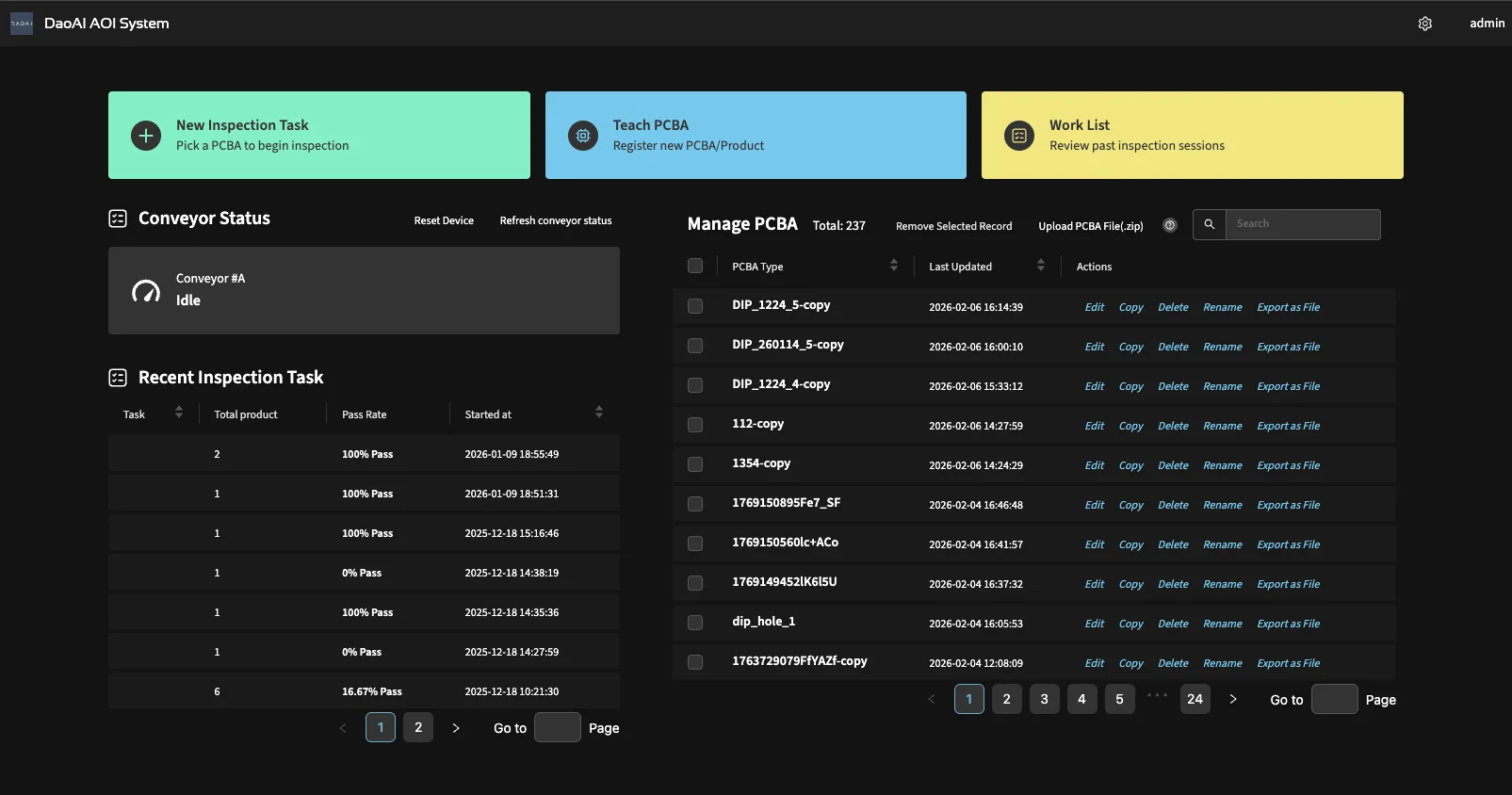
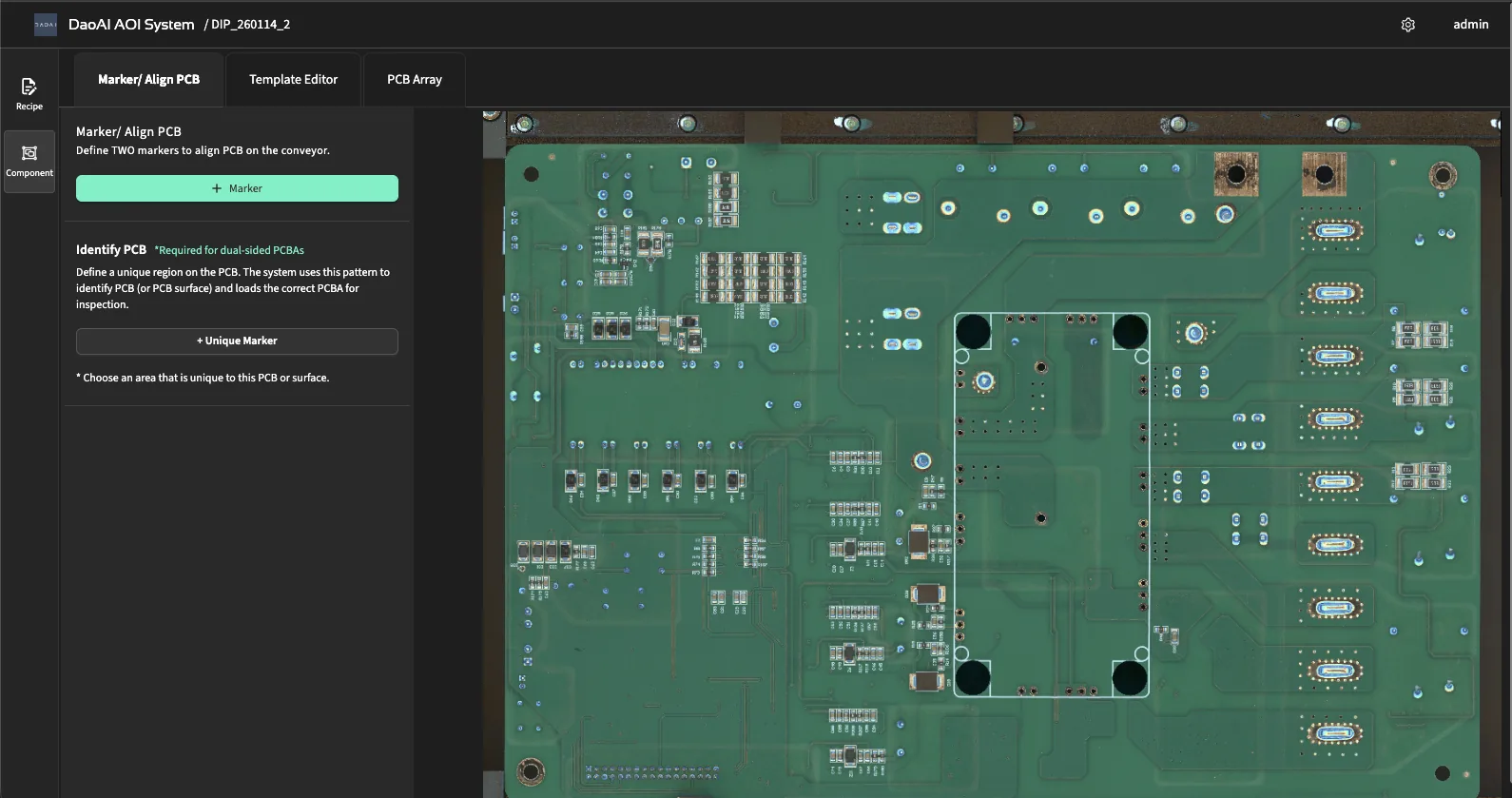
Scan one reference board
From one board of the current batch, AI learns component positions and appearance — no CAD, no defect library.

Inspection · ACI OS · SOFTWARE
ACI OS is the operating system for every ACI and next-generation AOI machine. It has two halves: visual recognition and cognitive judgement (the brain), and motion control of cameras and rails (the cerebellum). DaoAI ACI OS — built on a visual foundation model with feature cognition; model from one good sample. No CAD, no defect library, 100% on-premise, and embeddable in any 2D / 3D equipment. Next-generation term for this category: ACI, automated cognitive inspection.
SOVEREIGN AI VALUE
Yield curves, defect signatures, process parameters — this is a factory's core trade secret. Under IDC's framework, DaoAI's AI inspection brain starts with data sovereignty: flexible SDK / API / Docker deployment, with sample images and results never leaving your site or training any third-party model.
Good-sample templates and defect libraries are decades of production know-how — we help you use it, never help anyone else learn it.
Core inspection logic in DaoAI ACI runs on the line itself, independent of external networks or cloud availability.
Line feedback keeps sharpening detection on your line — the edge you gain is your own competitiveness, not a shared foundation.
From one board of the current batch, AI learns component positions and appearance — no CAD, no defect library.
Locates components, pins and polarity in seconds; handles rotation, flips and same-color parts — no hand-drawn ROIs.
Thresholds are derived from the board so operators can run it, and accuracy improves with every piece of feedback.
Understands a component's "identity" rather than comparing pixel and color similarity — just 1–20 good samples cover the same defect class, no negative-sample library needed.
Black parts on a black board, silver traces and silver parts — same-color scenes separate naturally in feature space.
Precise localization despite rotation, flips and surface contamination.
An inspector labels a false call once, the model updates, and the same error never recurs.
Tells acceptable process variation from real defects; false calls keep falling with feedback.
Continuously optimized for your products and defects, becoming a dedicated model that grows stronger the more you use it.
Flexible Deployment · DEPLOYMENT
Embed into your existing AOI / vision equipment and line software.
Standard interfaces connect to MES / host systems, with results flowing back in real time.
One-click private deployment — isolated environment, easy to operate and maintain.
Works out of the box with our 2D / 3D equipment.
Data stays 100% inside the factory — secure and compliant.
<12ms on-premise inference — no cloud needed, works offline.
FEATURE DEMOS
DETECTION EXAMPLES
DEFECT COVERAGE
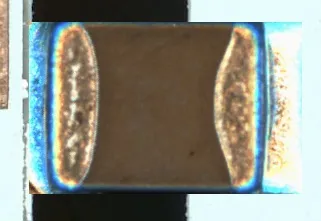
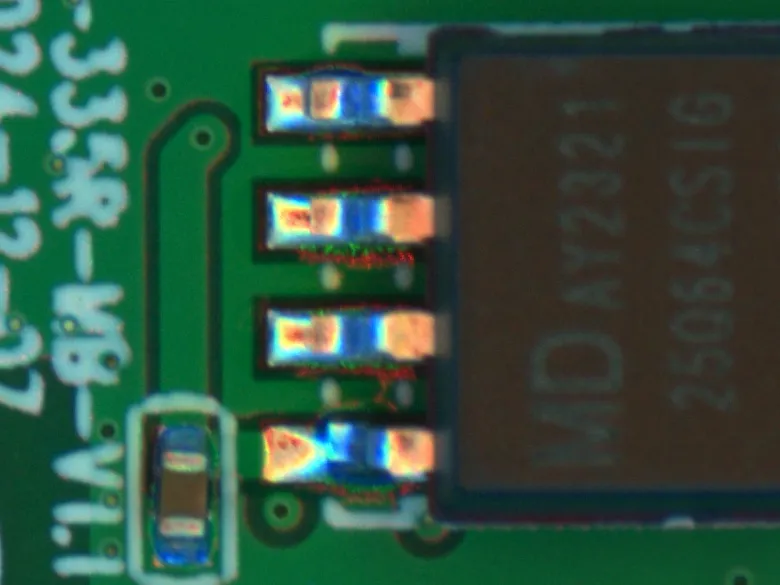
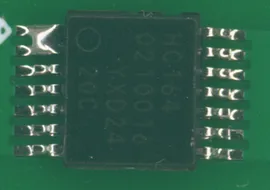
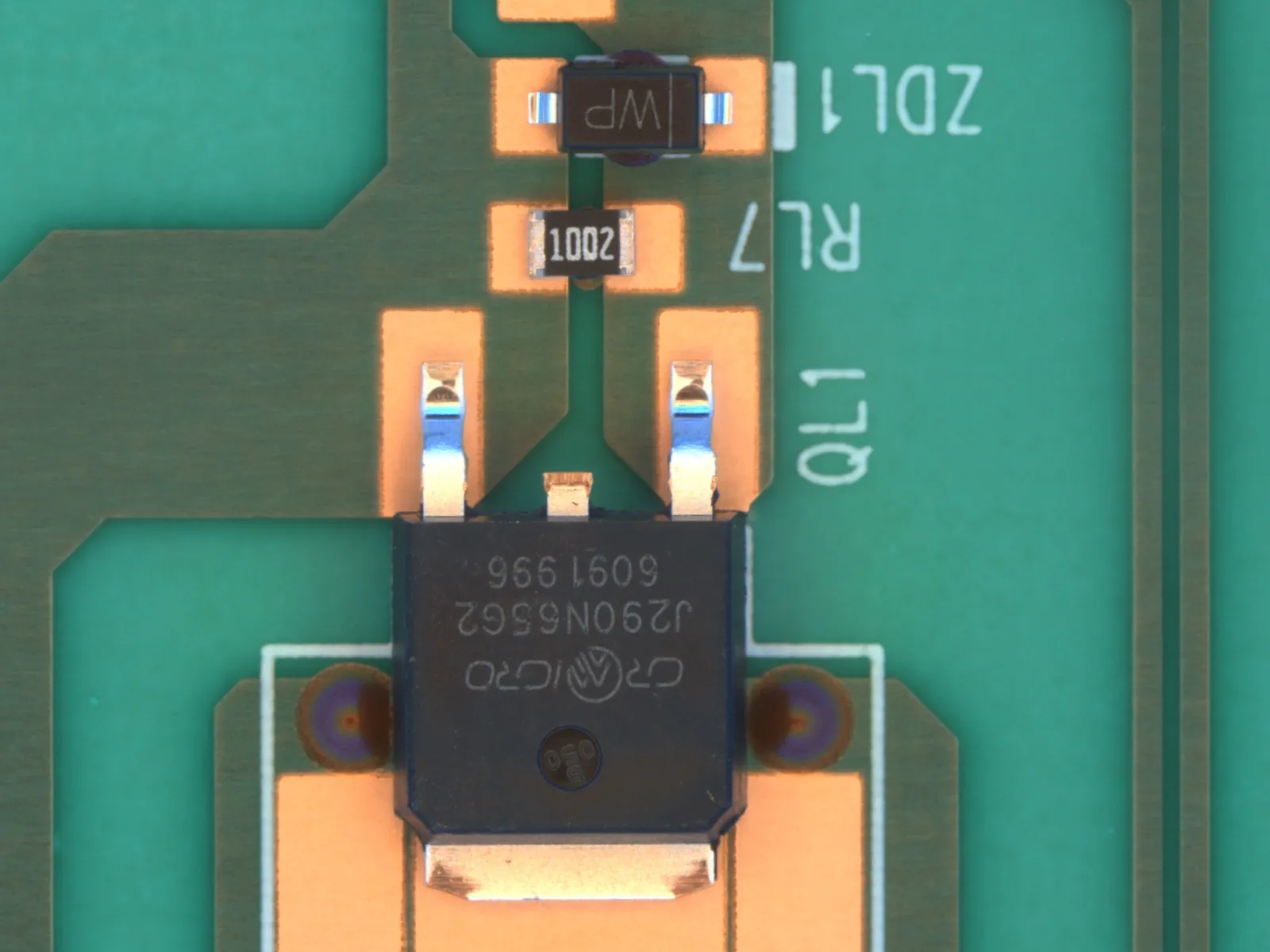

INSPECTION COVERAGE · 16 CAPABILITIES
In DaoAI ACI each inspection runs on an automatically generated inspection program. Select the applicable checks for each component package type.
| # | Capability | What it covers |
|---|---|---|
| 01 | Component Presence & Identification | Missing or incorrect components. |
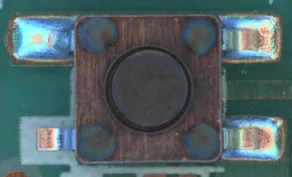
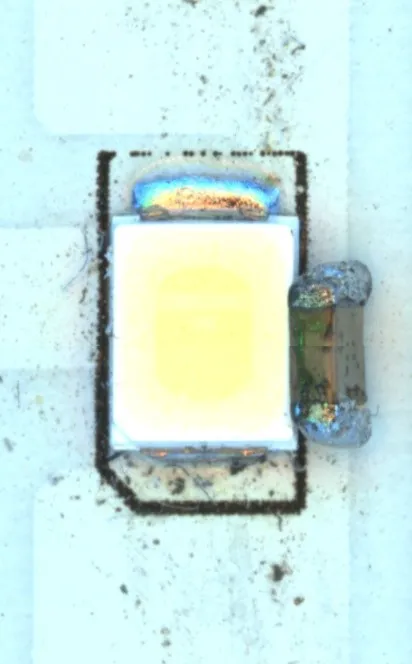
| 02 | Placement, Orientation & Polarity | X/Y offset, skew or rotation, incorrect polarity, tombstoning, billboarding, and upside-down placement. |
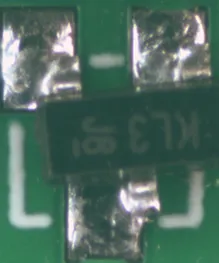
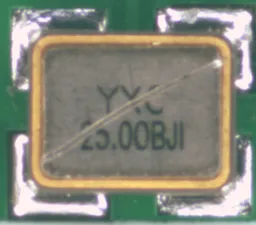
| 03 | Component Condition | Package or body damage, damaged chip terminations, burn marks, and discoloration. |
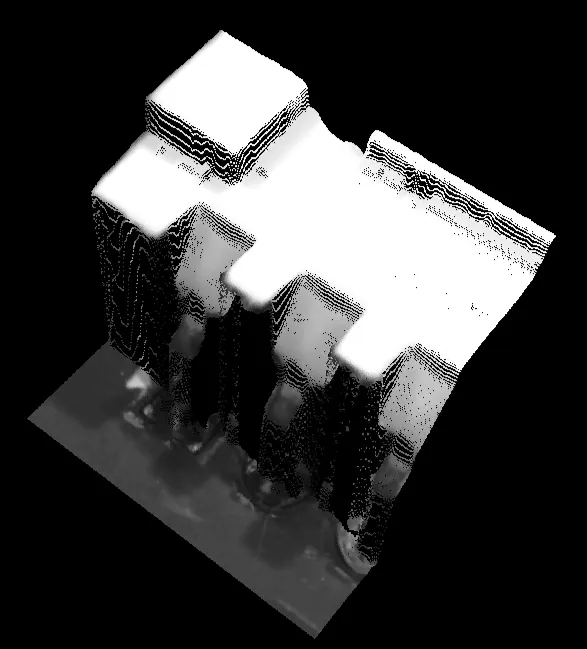
| 04 | Component Height & Coplanarity | Measures component height and detects lifted or tilted bodies and coplanarity defects using 3D AOI. |
| 05 | Solder Joint Quality | Insufficient solder, excess solder, and cold solder joints. |
| 06 | Open Solder Joints | Open or unsoldered connections, available in both 2D and 3D configurations. |
| 07 | Lead Condition | Lifted, bent, damaged, missing, or unsoldered component leads. |
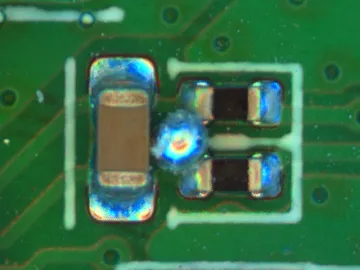
| 08 | Solder Bridging | Unintended solder connections between adjacent pads or leads. |
| 09 | Adhesive Contamination on Pads | Unwanted SMT adhesive (red glue) on solder pads. |
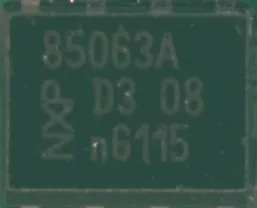
| 10 | OCR / OCV | Reads and verifies alphanumeric component markings, symbols, and laser-marked text. |
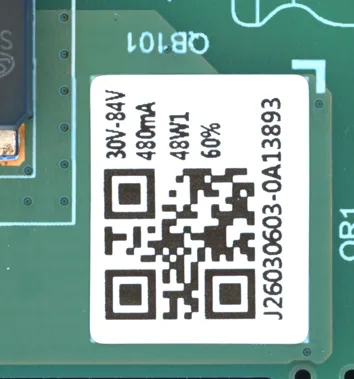
| 11 | Barcode & Serial Number Reading | Reads 1D barcodes, QR codes, and serial numbers for unit-level traceability. |
| 12 | Through-Hole Lead & Solder Joint Inspection | Pre-wave: lead/pin presence and insertion. Post-wave: missing, insufficient, or excess solder. |
| 13 | Through-Hole Solder Bridging | Solder bridges between adjacent through-hole pads. |
| 14 | Solder Balls & Particles | Solder balls or particles anywhere on the assembly, not only adjacent to a solder joint. |
| 15 | Foreign Object Debris (FOD) | Debris, wire clippings, dropped components, and other foreign material. |
| 16 | Surface Contamination | Unacceptable flux residue, stains, or other surface contamination. Coming soon. |
FULL CONTROL
The AI programs it. You stay in full control — four levels of control and twenty-one settings across six areas. Auto-programming and model updates preserve your manual settings; locked parameters stay at the values you choose.
Adjust AI-generated thresholds while reviewing measurements. Define the range available to AI updates, or disable AI updates for that check.
Set inspection rules per package type instead of editing components individually. Save them as presets for other products.
Draw a box around a component or feature that was not detected; the system learns its parameters from the golden board and adds it.
Train a custom model in DaoAI ACI on your own images for niche defects, then apply it to selected inspection regions.
PRODUCTION INTEGRATION · 11 CAPABILITIES
Line handling, quality analysis, data export, and support. Each capability is built into the DaoAI inspection software.
| Area | Capability | What it does |
|---|---|---|
| Line handling | Capture Path Optimization | The camera stops only where the board requires it. Fewer captures per board with every check enabled. |
| Line handling | Top/Bottom Side Program Selection | Program each side of a double-sided assembly separately, then run both in one inspection. The AI recognises which side is in front of the camera. |
| Line handling | Pass/Fail Board Routing | Failed boards are sorted according to the configured strategy, without operator intervention. |
| Quality analysis | Gage R&R (GR&R) | Repeatability and reproducibility study run in the software, on your boards, with the result exported directly. |
| Quality analysis | Process Capability (Cpk) | Process capability calculated from the inspection measurements the machine is already taking. |
| Quality analysis | First Pass Yield | Whole-board and sub-panel FPY. Per-position yield in a panel shows where a stencil or reflow problem sits. |
| Data & traceability | MES Export | CSV results, defect crop images, and the whole-board image per unit. Defect codes mapped to your MES vendor codes. |
| Data & traceability | Inspection History & Reports | Every inspection is stored with its images and verdict, so any board can be traced back. Reports and all analysis views export to Excel. |
| Operations & support | Repair Station | A dedicated screen for the repair operator: the defect call, its location on the board, and the image behind it. |
| Operations & support | Offline Programming | Program a product on a machine away from the line, export it, and import it on the production machine. |
| Operations & support | Remote Support | Remote assistance from our engineers when a problem needs a second look. |
| Criteria | Traditional rule-based AOI | Generic ACI | DaoAI Software |
|---|---|---|---|
| Inspection paradigm | Color / template matching | Generic classification network | Visual foundation model · feature cognition |
| Modeling data | Manual rules | Thousands of defect images | One good sample |
| Programming time | 3–5 hrs per board | Depends on AI engineer | Operator finishes in 5 min |
| Optimization | Fixed algorithm | Requires vendor retraining | Learns and updates from line feedback on the spot |
| Deploy | Locked to dedicated hardware | Often needs the cloud | SDK/API/Docker · 100% on-premise |
DaoAI's 5-minute automatic programming AI quality inspection brain is based on the feature recognition of the visual foundation model. It can build a model with just one good sample. No CAD or defect sample library is required. It's simple and efficient, and can be quickly put into use.
Compared with traditional rule-based AOI, DaoAI's quality inspection brain uses the feature recognition of the visual foundation model. It can complete programming in 5 minutes with one good sample, while the traditional method takes 3-5 hours per board. Also, our model can be continuously optimized and becomes more accurate over time.
Yes. DaoAI ACI supports various deployment methods such as SDK integration, REST API standard interface docking, one-click private deployment in Docker containers, and out-of-the-box use with local all-in-one machines. Data stays 100% in the factory, and edge inference is <12ms, available even offline.
The Q&A above was generated with AI assistance and is for reference only; official specifications and commitments are subject to direct consultation.
FEATURES
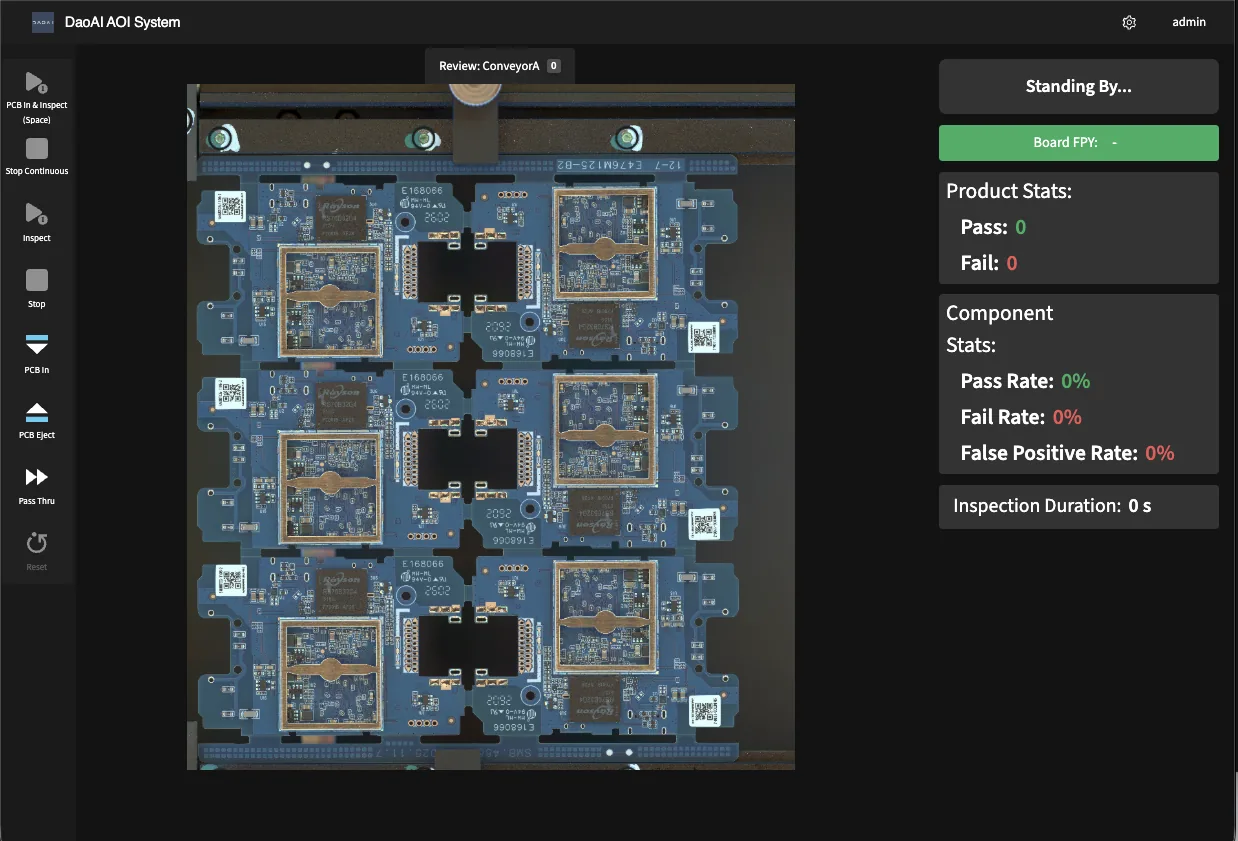
This software system is what the ACI cognitive inspection operating system looks like on the software side: one imaging and motion interface upward, adaptation to cameras, lights, motion axes and robot arms downward. That is why it embeds into the equipment you already have through SDK / API / Docker, and why a third-party machine can run it; and perception and control close the loop inside one system — the cognitive result decides what gets captured next.
一块良品样板,30 秒至 5 分钟写出检测程序。
报一次误报,模型学一次,越用越准。
你的缺陷、你的图像、你的模型,离线训练。
四个层级、六个区域共 21 项设置,手动设置永不被覆盖。
16 项检测能力,逐项说明覆盖什么。
画一块子板,自动找出整块拼板并逐位对齐。
OCR 读未知字符,OCV 核对已知字符。
元件之外:锡球、颗粒与异物。
炉前查插装,炉后查焊点,逐焊盘判定。
量具 R&R、Cpk、MES 导出、维修站等 11 项。
FULL DEMO
CONSOLE