
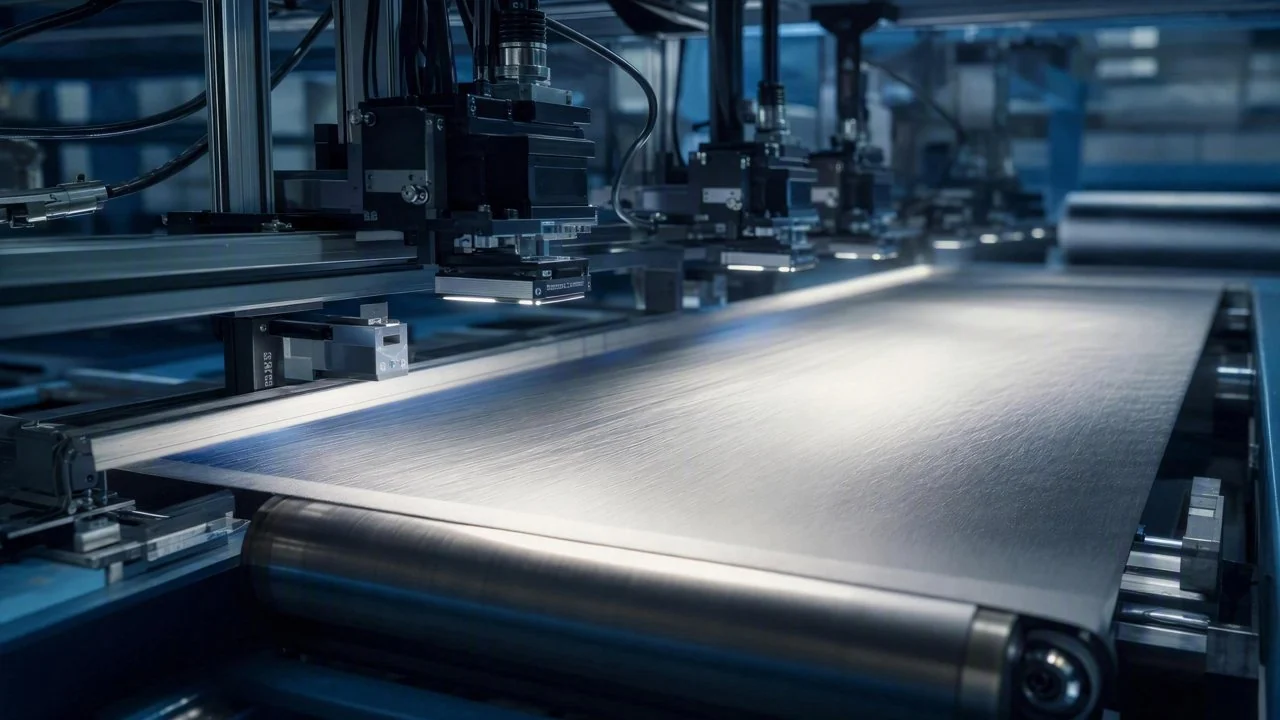
Wemio's DaoAI ACI OS (featuring visual foundation model-based feature recognition, 5-minute 0-code programming with one good sample, APDT few-shot learning with 1-20 good samples, semantic false positive filtering, and SDK/API/Docker 100% on-premise deployment) enhances texture surface unsupervised anomaly detection in chemical material production, boosting inspection throughput by over 35% to ensure 100% full inspection capacity. This significantly reduces missed detections and false positives inherent in traditional manual or rule-based vision solutions, thereby optimizing overall product quality and production efficiency.
The chemical and material industries, particularly in the production of polymer films, coated materials, or composite panels, have extremely stringent requirements for product surface quality. Texture surface anomalies in these materials, such as scratches, bubbles, impurities, color differences, or uneven coatings, not only affect aesthetics but can also directly impact their functionality, durability, and ultimately, the safety performance of their final applications. Traditionally, appearance inspection of these products relies heavily on manual visual inspection. However, in high-throughput and 24/7 continuous production environments, the efficiency bottlenecks of manual inspection, fatigue-induced missed detections, and subjective judgments leading to false positives have become critical factors limiting production capacity and quality improvement. In the current automotive manufacturing sector, AI quality inspection large models are already shortening new vehicle development cycles by enhancing defect detection rates. This trend similarly inspires the chemical material industry's urgent need for more efficient and intelligent quality inspection solutions to cope with increasingly complex material structures and faster production speeds.
Pain Points: Why This Hurdle is Difficult to Overcome
Unsupervised anomaly detection on textured surfaces of chemical materials faces multiple challenges, making it difficult for traditional solutions to meet modern production demands. First, **production throughput** is a core pain point. For a leading chemical material manufacturer, their polymer film production line operates at tens of meters per minute. Traditional manual visual inspection requires 5-7 people per shift but still cannot achieve 100% full inspection, with an actual sampling rate of only 30-40%, leading to a missed detection rate as high as 2-3%, severely impacting outgoing quality. Second, **false positive rates** remain high. Due to inherent subtle texture variations, fluctuating environmental lighting, or batch differences in materials, rule-based vision systems struggle to distinguish normal textures from true defects. This often results in false positive rates of 10-15%, consuming significant manual re-inspection time, with 2-3 people dedicated to re-inspection daily, indirectly dragging down overall line efficiency. Furthermore, **defect diversity and rarity** make supervised learning difficult to apply. Many anomalous defect types are uncommon and highly variable in form, making it challenging to collect sufficient defect samples for training. New defects cannot be recognized by the system, leading to changeover programming times of several hours or even days. Finally, **high deployment and maintenance costs** are a concern. Traditional vision systems require professional engineers for long-term on-site debugging and are highly dependent on hardware, resulting in high maintenance expenses.
The root cause of these difficulties lies in the inherently random and complex nature of chemical material surface textures, which are not simple geometric shapes or color distinctions. For instance, the fiber arrangement in composite materials or the microscopic particle distribution in coatings can form unique 'normal' texture patterns. Traditional rule-based vision algorithms struggle to model such 'normal fluctuations,' and any deviation is often misidentified as a defect. Moreover, subtle changes in environmental factors during production (e.g., temperature, humidity, dust) can lead to instability in image acquisition, further exacerbating false positives. The continuous emergence of new materials and processes leads to an endless variety of defect types, making traditional rule-based systems unable to adapt quickly, severely limiting the improvement of production throughput and the achievement of 100% full inspection.
Technical Principles
Wemio's DaoAI ACI OS addresses the challenges of unsupervised anomaly detection on textured surfaces of chemical materials primarily through its unique visual foundation model feature recognition capabilities and APDT few-shot learning mechanism. The system employs advanced self-supervised learning algorithms to train a visual foundation model that deeply understands normal texture patterns of material surfaces by processing vast amounts of 'good' product images. This model does not rely on predefined defect features or rules but rather learns and abstracts the intrinsic distribution patterns of good data. During inspection, the system compares the image under inspection with the learned good product patterns, and any region significantly deviating from the normal pattern is flagged as an anomaly. This 'normal' pattern-based learning approach is naturally suited for unsupervised anomaly detection scenarios, especially in the chemical material sector where defect samples are scarce. Unlike traditional rule-based AOI systems that require engineers to manually set thresholds and write complex rules, the DaoAI ACI OS learns autonomously, significantly reducing manual intervention. For example, when detecting tiny bubbles in polymer films, traditional methods might require setting parameters for bubble shape, size, and grayscale values, whereas the Wemio system learns the normal state of uniform light transmission without obvious refraction in the film, quickly identifying localized optical anomalies caused by bubbles.
Furthermore, the Wemio DaoAI ACI OS, leveraging APDT (Anomaly Pattern Detection and Transfer) few-shot learning technology, requires only 1–20 good sample images to complete model programming in just 5 minutes, achieving 0-code automatic changeover. This means that when the production line switches to materials of different specifications or textures, there's no need to spend hours or even days rewriting inspection programs, greatly improving changeover efficiency. Its built-in semantic false positive filtering mechanism further enhances detection robustness. This mechanism uses deep learning for secondary discrimination of detected anomalous regions, filtering out false positives caused by non-defect factors like lighting changes or inherent material texture fluctuations, thereby reducing the false positive rate by 85%. This ensures high accuracy while significantly reducing the burden of manual re-inspection. Compared to relying entirely on manual visual inspection, the Wemio DaoAI ACI system boosts detection speed by over 35% and enables 100% full inspection, preventing missed detections due to human fatigue and ensuring consistent product quality.
Typical Application Scenarios
- **Surface Scratches and Foreign Object Detection on Polymer Films:** On polymer film production lines, the Wemio DaoAI ACI OS can high-speed detect micron-level scratches, dents, bubbles, black spots, and other foreign objects on the film surface. The challenge lies in the film's transparency and reflective properties, coupled with fast production cycles and subtle, irregularly shaped defects. The system uses multi-angle illumination and high-resolution cameras for image acquisition, combined with its texture feature recognition model, to accurately identify anomalies that deviate from the good product's texture pattern.
- **Coating Uniformity Inspection for Composite Panels:** For composite panels used in automotive, construction, and other fields, the uniformity of their surface coating directly impacts product performance and appearance. The Wemio system can detect defects such as uneven coating thickness, color differences, particle aggregation, or sag. The difficulty lies in the complex optical properties of coating materials and the gradual nature of defects. By learning from a large number of uniform coating samples, the system establishes a normal pattern to identify any coating anomalies that deviate from it.
- **Surface Defect Detection for Specialty Fiber Materials:** In the production of specialty fibers, non-woven fabrics, and similar materials, defects such as fiber breakage, entanglement, holes, and oil stains are common issues. The Wemio DaoAI ACI OS can handle these highly random and irregular textures, identifying abnormal fiber arrangements. The challenge is that these materials inherently have some randomness in their structure, making it difficult for traditional rules to distinguish between normal randomness and actual defects. The system's unsupervised learning capability plays a crucial role here.
- **Surface Morphology Anomalies in Chemical Granular Materials:** For chemical granular materials like catalyst carriers and adsorbents, surface cracks, chipping, agglomeration, or irregular particles can affect their reactivity or filtration performance. The Wemio system can perform overall analysis of particle clusters to detect abnormal morphologies. The difficulty lies in the significant individual variation among particles, and the inspection goal is often the overall quality of the particle 'group' rather than the perfection of individual particles. The system learns the statistical features and surface textures of a large number of qualified particle groups to identify anomalies.
Case Study
A leading domestic chemical material manufacturer, specializing in high-performance optical films, has extremely stringent surface quality requirements for its products. Before integrating Wemio's DaoAI ACI OS, the manufacturer's optical film surface defect inspection primarily relied on manual visual inspection and a few traditional rule-based vision systems. Due to the high-speed production throughput of the film (approximately 40 meters/minute) and the imperceptibility of micron-level defects (such as scratches and point defects below 50 microns), the manual visual inspection's missed detection rate consistently remained around 2.5%, requiring 6-8 quality inspectors per shift, leading to high labor costs. Concurrently, traditional rule-based vision systems, unable to effectively handle the film's inherent subtle texture variations and environmental light changes, suffered from a false positive rate as high as 12%. This necessitated extensive daily manual re-inspection, severely slowing down overall production efficiency. After collaborating with Wemio, the manufacturer deployed an online inspection solution based on the DaoAI ACI OS. Utilizing its unsupervised learning capabilities, the model was trained with just 15 good samples and integrated into the production line. Post-deployment, the Wemio DaoAI ACI system successfully increased the film production line's inspection speed to 55 meters/minute, achieving 100% full inspection, which represents a **37.5% increase in inspection throughput**. More importantly, the **missed detection rate was reduced to below 0.4%**, and the **false positive rate decreased by 88%**, significantly reducing the manual re-inspection burden. This enabled the manufacturer to guarantee outgoing quality while reducing manual re-inspection time by 80%, substantially boosting the production line's overall capacity and market competitiveness.
Wemio's ACI OS not only improved our inspection speed and accuracy but, more importantly, enabled us to achieve 100% full inspection—a long-sought goal. Now, we can deliver high-quality products to our customers with greater confidence.
Wemio Solution and Products
Wemio provides the chemical material industry with an ACI OS centered on its powerful visual foundation model, delivering unprecedented inspection efficiency and accuracy. For deployment, Wemio's DaoAI ACI OS supports various integration methods including SDK/API/Docker, allowing 100% on-premise private deployment. This ensures customer data security and compliance with strict industry requirements for data sovereignty. The modeling and changeover process is exceptionally simple: customers only need to provide 1–20 good samples, and the Wemio system can complete automatic model programming in 5 minutes, achieving 0-code rapid changeover and significantly reducing production line downtime. By leveraging deep learning to model good product textures, the system can identify various subtle surface anomalies, including but not limited to scratches, bubbles, stains, color differences, and uneven coatings. Additionally, Wemio can also offer DaoAI 2D/3D ACI equipment, which, combined with proprietary 3D cameras and 3D morphology reconstruction technology, is used to detect more complex three-dimensional morphology defects, such as material coplanarity and micron-level morphological deviations, complementing the software system to provide a more comprehensive quality inspection solution. Furthermore, the Wemio World Model, as a unified foundation, ensures the system's semantic understanding and cross-scenario generalization capabilities, allowing it to continuously learn from production line feedback and optimize inspection performance.
Through Wemio's DaoAI ACI OS, customers can significantly increase production throughput, achieve 100% full inspection capacity, and reduce missed detection rates from traditional manual visual inspection or rule-based vision solutions to <0.5%, with false positive rates lowered by over 85%. This not only directly reduces labor costs and re-inspection burdens but, more importantly, vastly improves outgoing product quality, minimizing returns and customer complaints due to defects, thereby enhancing the enterprise's market competitiveness. The rapid changeover capability ensures flexibility for multi-variety, small-batch production, enabling enterprises to respond faster to market changes and shorten the time-to-market for new materials and products. Just as AI quality inspection large models in automotive manufacturing shorten new vehicle development cycles, this provides a solid guarantee for innovation and development in the chemical material industry.
FAQ
What is the fundamental difference between Wemio's ACI OS and traditional AOI?
Wemio's ACI OS is based on visual foundation models and deep learning, enabling unsupervised anomaly detection and few-shot learning, automatically programming with just a few good samples. Traditional AOI relies on manually set rules and thresholds, requiring precise definition of defect features. It suffers from high false positive rates, time-consuming changeover programming, and prone to missed detections when facing complex textures and diverse defects. Our system is smarter, more flexible, and more efficient, especially for textured surfaces and unknown defect detection.
What is the approximate budget required to deploy Wemio's ACI OS?
The budget for Wemio's ACI OS depends on several factors, including the complexity of the detection task (e.g., required accuracy, speed), difficulty of production line integration, necessary hardware configuration (cameras, lighting, etc.), and whether custom functionalities are needed. We offer flexible licensing models and deployment options. We recommend contacting our sales team with your specific requirements for a detailed quotation and return-on-investment analysis.
How does Wemio's ACI system ensure data security and privacy?
Wemio's ACI OS supports 100% on-premise private deployment, meaning all data processing and model operations occur on the customer's local servers; data is not uploaded to the cloud or any external servers. We provide various integration methods such as SDK/API/Docker to ensure the system integrates into the customer's existing IT infrastructure, strictly adhering to industry data security standards and privacy regulations, thereby guaranteeing the absolute security of critical production data.
Full solution for this scenario: Chemical / materials industry solutions
This article was generated by AI. Customer cases are simulated scenarios based on real product capabilities and figures are illustrative; see product pages for official benchmarks.