
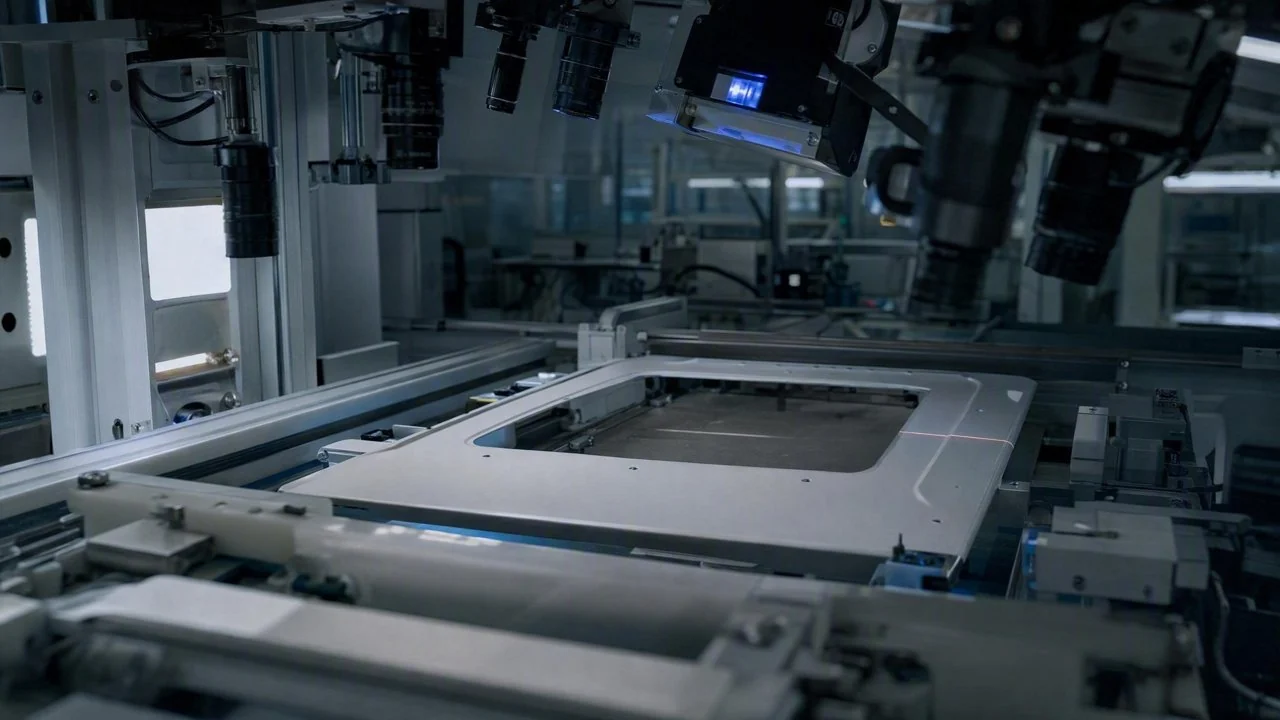
DaoAI ACI OS (featuring visual foundation model for feature recognition, 5-minute 0-code automatic programming with one good sample, APDT positive/few-shot learning with 1–20 good samples, semantic false positive filtering, and SDK/API/Docker 100% on-premise private deployment support) precisely identifies complex appearance defects such as micro-scratches, dents, and discoloration spots on home appliance panels. This system reduces the missed detection rate from a common 1.5% in traditional manual inspection and rule-based AOI solutions to <0.3%, significantly enhancing product outgoing quality and brand reputation.
In the home appliance manufacturing sector, particularly for large appliances like refrigerators, washing machines, and air conditioners, the appearance of panels is the most intuitive window for consumers to perceive product quality. These panels are not only large in size and surface area but also embody the brand's design aesthetics and craftsmanship. As consumer demands for product appearance increase and high-end home appliance designs become more complex, tiny defects such as micro-scratches, dents, discoloration spots, injection molding flaws, uneven spraying, and surface particles can significantly impact product qualification rates. Traditionally, such appearance inspections heavily relied on manual visual inspection or rule-based AOI equipment. However, high-intensity, repetitive manual inspection is prone to subjective judgment and fatigue, leading to fluctuating missed detection rates. While rule-based AOI improves efficiency, it struggles to adapt to the diversity and complexity of defects, incurring high model iteration costs and persistent false positives when faced with new materials or coatings, severely hindering production line rhythm and quality control efficiency. It is against this backdrop that DaoAI introduced its advanced ACI OS, focusing on addressing the core pain points in home appliance panel appearance inspection, especially excelling in detection rate and missed detection reduction.
Pain Points: Why This Hurdle Is Difficult to Overcome
Home appliance panel appearance inspection faces multiple challenges, making it difficult to effectively control missed detection and false positive rates. First, defects are diverse and minuscule, such as micro-scratches less than 0.1mm in diameter or dents only a few micrometers deep. Their visual characteristics are extremely subtle under different lighting conditions and background textures, making high-precision identification difficult for the human eye. Second, panel materials and surface treatment processes are increasingly complex, including brushed stainless steel, high-gloss plastics, and glass films. These materials themselves exhibit reflection, refraction, or texture, which can easily generate false defect signals during imaging. This leads to false positive rates exceeding 8% for traditional rule-based AOI, significantly increasing the workload of manual re-inspection. Third, fast production line cycles, especially for large home appliance panels, demand extremely short inspection time windows, requiring the system to complete full-frame image acquisition and analysis within hundreds of milliseconds. This puts immense pressure on image processing and algorithm inference.
The root cause of these difficulties is that traditional rule-based AOI relies on engineers manually setting thresholds and feature extraction rules, which are not robust to minor changes in lighting, angles, and defect morphology. Once the production line changes models or new materials are introduced, the rule library needs to be adjusted from scratch, which is time-consuming and labor-intensive. Manual visual inspection, on the other hand, is limited by the physiological limits and subjectivity of the human eye. In long-term, highly repetitive work, the missed detection rate generally hovers around 1.5%, and it is particularly difficult to guarantee stable detection for rare defects. Furthermore, the current pursuit of high-precision 3D stereo models in industrial digital twin construction highlights the limitations of 2D images in depth information. While 3D cameras can provide morphological data, the parsing of raw point cloud data and the extraction of defect features still require strong AI algorithm support to avoid merely staying at the model reconstruction level without effective application in defect detection. All these point to an urgent need for more intelligent and generalized visual inspection solutions.
Technical Principles
The reason why DaoAI ACI OS can achieve significant detection rate improvement and missed detection reduction in high-precision home appliance panel appearance inspection lies in its core visual foundation model and APDT few-shot learning technology. This system utilizes advanced deep learning architecture to autonomously learn and extract general visual features from vast industrial images, forming a deep semantic understanding of objects, textures, and defects, rather than simple pixel matching. This gives the DaoAI system powerful feature recognition capabilities, enabling effective identification even for minute, blurry, or morphologically diverse defects. For example, for subtle scratches on home appliance panels, the system can recognize their linear, unnatural texture interruption features, rather than just relying on brightness or contrast, thereby significantly reducing false positives.
Compared to traditional rule-based AOI and manual inspection, DaoAI ACI OS demonstrates overwhelming advantages. Traditional AOI requires engineers to spend days or even weeks writing and debugging complex rule sets, and these rules can become invalid with slight changes in lighting, product batches, or defect types, leading to high false positive rates or missed detections. Manual inspection is limited by human eye fatigue and subjectivity; for large-sized, highly reflective, and tiny-defect products like home appliance panels, the missed detection rate is difficult to control below 1%. In contrast, the DaoAI system, through APDT positive/few-shot learning, requires only 1–20 good sample images to complete model training and programming within 5 minutes, enabling rapid model changeover. Its semantic false positive filtering mechanism effectively distinguishes real defects from visual noise such as background textures and reflections, reducing the false positive rate by 85% and significantly decreasing the workload of manual re-inspection. Furthermore, DaoAI ACI OS supports SDK/API/Docker 100% on-premise private deployment, ensuring customer data security and integration into existing production lines.
Typical Application Scenarios
- **Injection Molded Part Surface Defect Detection:** For plastic injection molded parts of home appliance panels, such as refrigerator liners and washing machine control panels, DaoAI ACI OS can accurately detect defects like incomplete filling, bubbles, sink marks, black spots, and burrs. The challenge lies in the significant variation of these defects across different materials and colors, and some defects like sink marks may only be visible under specific lighting angles.
- **Metal Brushed Panel Scratch and Dent Detection:** For brushed stainless steel or aluminum alloy panels, the DaoAI system can effectively identify micro-level scratches, bumps, and dents. The difficulty lies in the brushed texture itself potentially being misidentified as a defect, and the high reflectivity of metal surfaces posing imaging challenges.
- **Glass or Acrylic Panel Discoloration and Contaminant Detection:** For glass or acrylic materials used in oven doors and induction cooker panels, the system can detect dust, oil stains, discoloration spots, and bubbles. The challenge involves the transparency of the material and the low contrast of tiny foreign objects.
- **Sprayed Surface Particle and Orange Peel Texture Detection:** For painted home appliance casings, DaoAI ACI OS can detect paint particles, orange peel texture, sagging, and missed sprays. The difficulty lies in uneven paint thickness or surface roughness variations potentially being misidentified, and the extremely high demand for uniform lighting.
- **Silk-screened Character and Pattern Defect Detection:** Detecting misalignment, blurriness, broken lines, or missing parts in functional symbols and brand logos silk-screened on home appliance panels. The challenge is the small size and low contrast of characters, and interference from complex backgrounds.
Case Study
A leading home appliance manufacturer's high-end refrigerator production line had long faced challenges in panel appearance inspection. This line utilized high-gloss stainless steel and composite material panels, with large product sizes and complex, minute defect types, such as subtle scratches within brushed textures, injection molding burrs at panel edges, and surface discoloration spots. Traditionally, the manufacturer employed a hybrid model of “manual visual inspection + rule-based AOI”: after initial inspection by rule-based AOI, a large number of suspected defects still required manual re-inspection. This necessitated 8-10 quality inspectors per production line, and manual re-inspection was time-consuming, averaging 30 seconds per panel, severely slowing down the production line rhythm. More critically, even experienced quality inspectors found it difficult to avoid fatigue during long hours of work, leading to a missed detection rate consistently around 1.2%, occasionally even higher for certain batches, ultimately impacting end-user experience and brand reputation.
To address this pain point, the manufacturer introduced the DaoAI ACI OS. During implementation, the DaoAI team first evaluated the client's existing 2D industrial cameras and line scan cameras, integrating them to feed high-resolution images directly into the DaoAI ACI OS for analysis. For the complex optical properties of refrigerator panels, we optimized the imaging solution and utilized the APDT few-shot learning function, training the core defect model with only 15 good sample images in 4 minutes. After the system went online, its powerful semantic false positive filtering capability significantly reduced interference from non-defect features. Following a one-month trial run and data validation, the DaoAI ACI OS successfully reduced the missed detection rate on this production line to <0.3% and simultaneously lowered the false positive rate by 80%, cutting manual re-inspection volume by 75%. This not only freed up 60% of quality inspection manpower but, more importantly, significantly enhanced the stability of outgoing product quality, effectively maintaining the brand's high-end image.
"The DaoAI ACI OS has allowed our panel inspection to achieve unprecedented precision and efficiency. Now, we can deliver high-quality products to the market with greater confidence."
DaoAI Solution and Products
DaoAI's core solution for home appliance panel appearance inspection is built upon the DaoAI ACI OS, leveraging its visual foundation model's feature recognition and APDT few-shot learning advantages. During actual deployment, we first evaluate the customer's existing inspection equipment. The DaoAI ACI OS supports integration with various mainstream 2D/3D industrial cameras, ensuring efficient image data acquisition. For the complex surface characteristics of home appliance panels, we combine DaoAI's self-developed 3D cameras and 3D morphology reconstruction technology (DaoAI 2D / 3D ACI equipment) to obtain more comprehensive depth and morphological information. This addresses the detection needs for hidden solder joints, coplanarity, or micron-level morphological defects, further improving detection accuracy and reducing missed detections.
In the modeling phase, the DaoAI ACI OS's “5-minute 0-code automatic programming with one good sample” mechanism significantly shortens the online deployment cycle for new products or defect types. Its APDT positive/few-shot learning capability requires only 1–20 good sample images to complete model training, greatly reducing data annotation costs and time. In operation, the system's semantic false positive filtering function accurately distinguishes non-defect features like product textures and environmental reflections from real defects, reducing the false positive rate by 80%. This avoids a large number of ineffective manual re-inspections, allowing valuable human resources to focus on scenarios truly requiring intervention. Furthermore, DaoAI ACI OS supports SDK/API/Docker 100% on-premise private deployment, ensuring that core customer production data remains on-site, meeting strict data security and privacy protection requirements. Through continuous learning from production line feedback (DaoAI World world model), the system continuously optimizes its performance, achieving a closed-loop iteration from production line to algorithm, ensuring long-term stable and efficient operation. Ultimately, through this series of technological combinations, DaoAI has achieved excellent performance in home appliance panel appearance inspection, with a detection rate of over 99.7% and a missed detection rate of <0.3%, while reducing model changeover time to within 5min, delivering tangible business value to customers.
FAQ
How does DaoAI ACI OS help reduce false positive rates in home appliance panel inspection?
DaoAI ACI OS, through its built-in visual foundation model and semantic false positive filtering mechanism, deeply understands image content, distinguishing real defects from non-defect features like product textures, light reflections, and environmental noise. This avoids false alarms caused by overly sensitive threshold settings in traditional rule-based AOI, significantly reducing the false positive rate, thereby cutting down manual re-inspection workload and time costs.
What are the main advantages of DaoAI ACI OS compared to traditional manual inspection and rule-based AOI?
DaoAI ACI OS offers significant improvements in accuracy, efficiency, and adaptability compared to traditional solutions. It can reduce the missed detection rate to <0.3%, far below the approximately 1.5% of manual inspection. Moreover, with APDT few-shot learning, it only requires 1–20 good sample images and 5 minutes to complete model changeover for new products, whereas traditional rule-based AOI requires days or even weeks of rule debugging. Its powerful generalization capability and semantic understanding can adapt to complex and varied defect types and material surfaces, which is unmatched by traditional solutions.
What is the estimated budget for deploying DaoAI ACI OS, and what factors influence the cost?
The deployment cost of DaoAI ACI OS is influenced by various factors, including the scale of the production line, the number of inspection points, the complexity of defect types to be detected, whether additional hardware like 3D cameras needs to be integrated, and the specific deployment model (e.g., cloud-based or 100% on-premise private). We offer flexible licensing models and can customize solutions based on client needs. We recommend contacting our sales team with detailed production line requirements for a precise quote and return on investment analysis, ensuring the solution aligns with your budget and business objectives.
Full solution for this scenario: Consumer / general industry solutions · Injection-Molded Part Appearance Inspection
This article was generated by AI. Customer cases are simulated scenarios based on real product capabilities and figures are illustrative; see product pages for official benchmarks.