
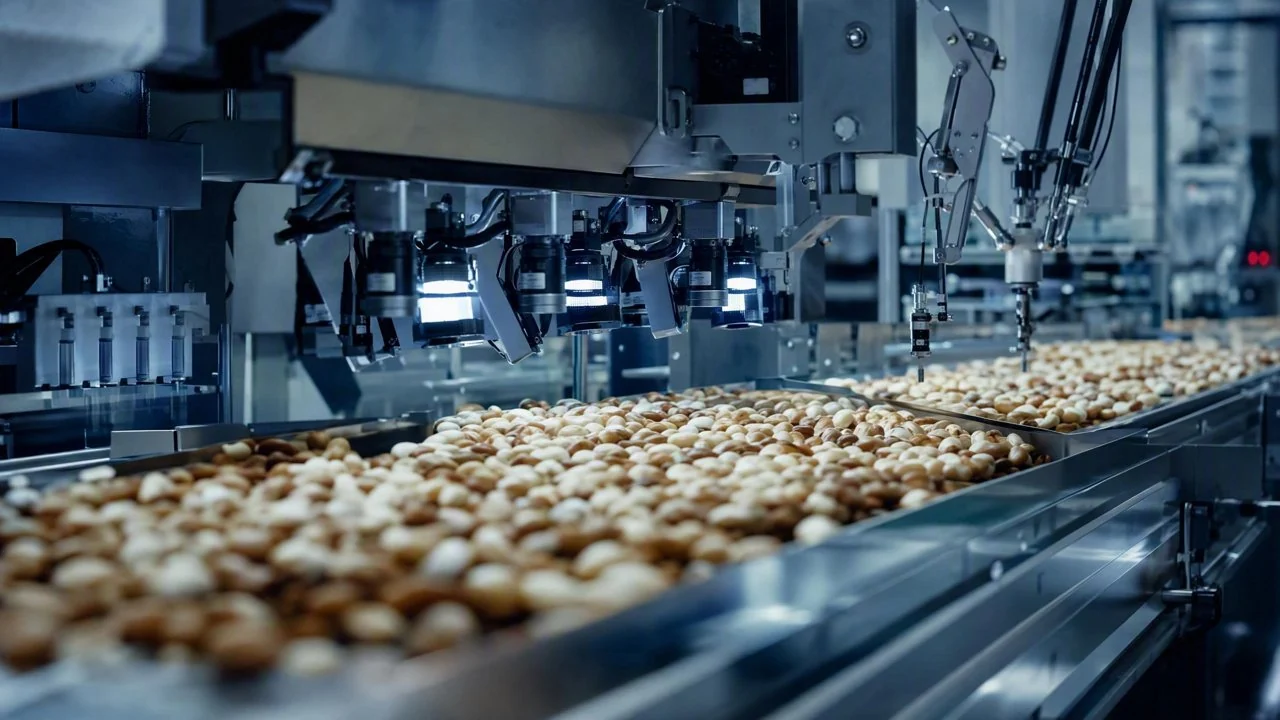
DaoAI's ACI OS (featuring visual foundation model-based feature recognition, 5-minute 0-code programming with one good sample, APDT positive/few-shot learning with 1–20 good samples, semantic false positive filtering, and SDK/API/Docker support for 100% local private deployment), with its robust local private deployment capability, reduced the false reject rate in color sorting at a leading nut processing plant from an industry typical 5% to <1.1%, effectively improving product yield and strictly ensuring sensitive production data security. In the food and agriculture sector, product quality and food safety are fundamental to a company's survival and growth. Particularly in the processing of snack foods like nuts and chips, the color sorting stage is crucial for controlling product appearance quality and removing foreign objects and substandard items. Traditional color sorters often rely on preset optical parameters and simple image processing algorithms, facing challenges of missed detections and false rejects for complex and variable defects (such as mold, insect damage, inconsistent size, discolored impurities, slight damage, etc.). As consumer demands for food quality continuously rise, and enterprises increasingly prioritize production data privacy and security, the challenge for food processing companies is to achieve efficient and precise detection while ensuring data remains on-premises and models are autonomously controllable.
In the food and agriculture sector, product quality and food safety are fundamental to a company's survival and growth. Particularly in the processing of snack foods like nuts and chips, the color sorting stage is crucial for controlling product appearance quality and removing foreign objects and substandard items. Traditional color sorters often rely on preset optical parameters and simple image processing algorithms, facing challenges of missed detections and false rejects for complex and variable defects (such as mold, insect damage, inconsistent size, discolored impurities, slight damage, etc.). As consumer demands for food quality continuously rise, and enterprises increasingly prioritize production data privacy and security, the challenge for food processing companies is to achieve efficient and precise detection while ensuring data remains on-premises and models are autonomously controllable. DaoAI's ACI OS, with its excellent local private deployment capabilities and visual foundation model technology, provides a new generation of efficient and secure solutions for nut color sorting.
Pain Points: Why This Hurdle Is Difficult to Overcome
In nut/chip color sorting scenarios, traditional solutions commonly suffer from several core pain points: First, **high false reject rates lead to raw material waste and increased costs**. Traditional color sorters often misclassify due to variations in lighting, subtle differences in product surface textures, or non-typical defect features. Industry-standard false reject rates can reach 3%–5% or even higher, directly leading to a significant amount of good products being discarded, accumulating substantial losses for enterprises over time. Second, **insufficient defect recognition capabilities result in inspection leakage risks**. Defects such as mold, insect damage, and minor breakage often have colors and shapes highly similar to normal products, or are hidden in product crevices, making them difficult for traditional threshold-based algorithms to accurately distinguish. Missed detection rates typically range from 0.5%–1.5%, severely impacting final product quality and consumer trust. Finally, **data security and private deployment challenges**. Food processing companies have strict confidentiality requirements for production data (e.g., raw material batches, defect type distribution, production rhythm), and traditional cloud-based or semi-cloud AI solutions struggle to meet their compliance needs for data remaining on-premises. The potential risks of data uploading to the cloud make enterprises hesitant to adopt advanced AI technologies. Additionally, during equipment changeovers or new product launches, traditional color sorters require time-consuming manual parameter adjustments, leading to long downtime and affecting production line rhythm.
These pain points stem from the inherent complexity and diversity of food raw materials, as well as the stringent demands for detection efficiency on high-speed production lines. For example, nuts naturally vary greatly in color and shape, with individual differences even within the same batch, posing significant challenges for rule-based traditional vision systems. Similarly, the formation of scorch marks, burnt spots, and breakages in fries during frying is random and diverse, making it difficult to cover with simple logic. Furthermore, the current industry trend – AI smart cameras simplifying operational processes and improving detection efficiency in industrial manufacturing – hinges on how AI can understand complex visual information like the human eye, be quickly deployed and iterated, and ensure local data security, which is precisely where traditional solutions fall short.
Technical Principles
The reason DaoAI's ACI OS effectively solves these pain points lies in its integrated **visual foundation model**, **APDT (Auto-Prompting & Deep Transfer) positive/few-shot learning technology**, and its **100% local private deployment capability**. Firstly, the visual foundation model possesses powerful feature recognition capabilities; it doesn't just identify pixel differences but understands high-level semantic information within images, much like the human brain. For instance, it can distinguish between a slight scorch mark and normal baking color, or the fundamental difference between mold and soil adhesion, accurately capturing even subtle defect features in complex backgrounds. This deep understanding capability allows DaoAI's ACI OS to far surpass traditional rule-based AOI systems in complex defect recognition, as the latter often rely on preset color thresholds and shape templates, which are ineffective against subtle or variable defects.
Secondly, APDT positive/few-shot learning technology greatly simplifies the model training and changeover process. In nut/chip color sorting scenarios, by providing just 1–20 good sample images, DaoAI's ACI OS can achieve 0-code automatic programming in 5 minutes, quickly generating a detection model. This contrasts sharply with traditional machine learning methods that require vast amounts of labeled defect samples for training, which is both time-consuming and labor-intensive, especially since defect samples are often scarce in actual production. APDT technology, through deep transfer learning and adaptive prompting mechanisms, enables the model to learn “what is normal” from a small number of good samples, thus efficiently identifying “what is abnormal”. Furthermore, the semantic false positive filtering function further enhances detection accuracy by identifying and filtering out “pseudo-defects” that do not affect product quality (e.g., natural surface textures, slight reflections), reducing the false reject rate by 78% and significantly minimizing good product waste. All these computations and model deployments are performed locally, ensuring that the enterprise's core production data remains entirely on-premises, meeting the highest standards for data security and compliance in the food industry. Compared to manual inspection, DaoAI's ACI OS not only achieves 100% full inspection, avoiding missed detections due to human eye fatigue, but also elevates detection accuracy to a level traditional solutions cannot match.
Typical Application Scenarios
- **Nut Mold and Insect Damage Detection:** Targeting common defects in nuts such as peanuts, walnuts, and pistachios, including mold spots, insect holes, or discoloration due to internal spoilage. The challenge lies in the subtle color changes in early-stage mold or tiny insect traces, which are easily confused with the nut's surface texture. DaoAI's ACI OS leverages the deep feature recognition capabilities of its visual foundation model for subtle color, texture, and shape anomalies to achieve high-precision identification.
- **French Fry Scorch Mark and Discolored Impurity Removal:** Detecting excessively dark scorch marks, burnt pieces, and mixed-in discolored (e.g., dark green, black) impurities in fried potato chips. The difficulty arises from the uneven color of the fries themselves, varied shapes of scorch marks, and the possibility of discolored impurities being similar in color to broken fry surfaces. DaoAI's ACI OS semantically distinguishes between normal frying color and excessive charring, and identifies non-product foreign colored materials.
- **Nut/Chip Breakage and Deformation Screening:** Identifying cracks, fractures in nut kernels, and severe breakage, bending, or deformities in French fries. The challenge is the blurry boundary between minor damage and normal shapes, combined with extremely high demands for real-time detection accuracy and speed on high-speed production lines. DaoAI's ACI OS utilizes its rapid feature extraction and classification capabilities to achieve millisecond-level responses, ensuring production line rhythm.
- **Foreign Object Detection:** Targeting potential foreign objects like plastic pieces, metal shavings, hair, or paper scraps that may be mixed into nuts or chips during production. The difficulty lies in foreign objects potentially being extremely small, and similar in color to the product or background. DaoAI's powerful generalization capabilities enable it to identify previously unseen abnormal objects, ensuring food safety.
Implementation Case Study
A leading nut processing enterprise, whose core product line involved color sorting of peanut kernels, found that while traditional color sorters could perform basic sorting, their false reject and missed detection rates remained stubbornly high when dealing with complex defects such as mold, insect damage, and minor breakages. Especially during peak production seasons, due to a strong emphasis on data security, they refused to upload any production data to the cloud for model training or analysis. The enterprise approached DaoAI, hoping for a locally privately deployed ACI system to improve detection accuracy and ensure data security. We provided this enterprise with the DaoAI ACI OS, adopting a 100% local private deployment solution.
During the implementation, engineers used fewer than 10 good peanut kernel images to complete initial model automatic programming and deployment within 5 minutes, thanks to the APDT technology of the DaoAI ACI OS. In actual operation, the system significantly improved the accuracy of identifying defects such as mold, insect-damaged kernels, and discolored grains in peanuts. Before implementation, the production line's average false reject rate was 4.8%, with a missed detection rate of approximately 0.7%. After the DaoAI ACI OS was implemented and optimized for a short period, the **false reject rate in color sorting was reduced to <1.1%**, achieving a significant improvement of 77.1%; concurrently, the **missed detection rate was also brought down to <0.2%**. Most importantly, all model training, inference, and production data were processed on the client's local servers, ensuring data never left the factory, fully complying with their strict internal data security and compliance requirements. Furthermore, when switching products (e.g., from peanuts to cashews), operators only needed to provide a few new good sample images to complete the changeover within 5 minutes, significantly reducing downtime and enhancing production line flexibility.
DaoAI's ACI OS achieved local private deployment, not only addressing our data security concerns but also reducing the false reject rate in color sorting by nearly 80%. This is a breakthrough our traditional solutions could never have imagined.
DaoAI Solutions and Products
The core solution provided by DaoAI is based on its **DaoAI ACI OS**. This system supports various flexible deployment methods such as SDK/API/Docker, enabling 100% local private deployment to ensure that customers' sensitive production data never leaves their premises. In practical implementation, we first integrate existing industrial cameras or recommend suitable camera hardware based on the client's production line environment to ensure high-quality image acquisition. Secondly, with the DaoAI ACI OS's “5-minute 0-code automatic programming with one good sample” capability, even non-specialized personnel can quickly complete model training and deployment. For nut/chip color sorting, only a small number of good samples are needed, and the system can automatically learn the feature distribution of normal products through the visual foundation model's feature recognition capabilities, combined with the APDT few-shot learning mechanism, to quickly build efficient defect detection models. When new types of defects appear or product switching is required, only a few updated good samples are needed to complete model iteration and changeover within 5 minutes, greatly enhancing production line flexibility. Furthermore, the system's built-in semantic false positive filtering function effectively identifies and eliminates “pseudo-defects” caused by ambient light, natural product textures, etc., further improving detection accuracy and reducing the false reject rate.
Through DaoAI's ACI OS, clients not only gain high-precision automated detection capabilities, significantly improving product quality, but also gain complete control over their production data, eliminating data security risks. This not only brings direct economic benefits (e.g., reduced raw material loss, fewer customer complaints) but also enhances the enterprise's market competitiveness and brand image. The system reduced the false reject rate of traditional color sorters by 78% and the missed detection rate to <0.2%, while also shortening changeover time from several hours to 5min, greatly improving production efficiency and flexibility.
FAQ
What is local private deployment of an ACI OS?
Local private deployment of DaoAI's ACI OS means that all AI model training, inference computations, and data storage are deployed on the customer's internal servers or equipment, rather than relying on cloud services. This ensures that production data never leaves the factory, guaranteeing the highest level of data security and privacy, while also avoiding network latency and data transmission risks, ensuring the detection system operates stably and efficiently even without an internet connection.
How does DaoAI's ACI OS compare to traditional color sorters in terms of cost-effectiveness?
DaoAI's ACI OS significantly reduces false reject rates, minimizing good product waste and directly saving raw material costs. Simultaneously, reducing missed detection rates improves product quality, lessening customer complaints and potential recall risks. Furthermore, its 5-minute 0-code automatic programming and rapid changeover capabilities drastically shorten downtime, enhancing production line utilization. While the initial investment might be slightly higher than traditional equipment, in the long run, it delivers significant ROI through raw material savings, quality improvement, and efficiency optimization.
How long does it take to deploy DaoAI's ACI OS, and what is the extent of modification required for existing production lines?
DaoAI's ACI OS supports flexible integration via SDK/API/Docker, requiring minimal modifications to existing production lines. Typically, it only involves integrating industrial cameras and connecting them to a local server. Initial deployment and model training can be completed within hours, while changeovers and model iterations for new products or defects take only about 5 minutes using APDT technology. The overall go-live period is short, with minimal impact on normal enterprise production.
Full solution for this scenario: Food / agriculture industry solutions · Produce Ripeness Robotic Sorting: On-Premise Deployment
This article was generated by AI. Customer cases are simulated scenarios based on real product capabilities and figures are illustrative; see product pages for official benchmarks.