
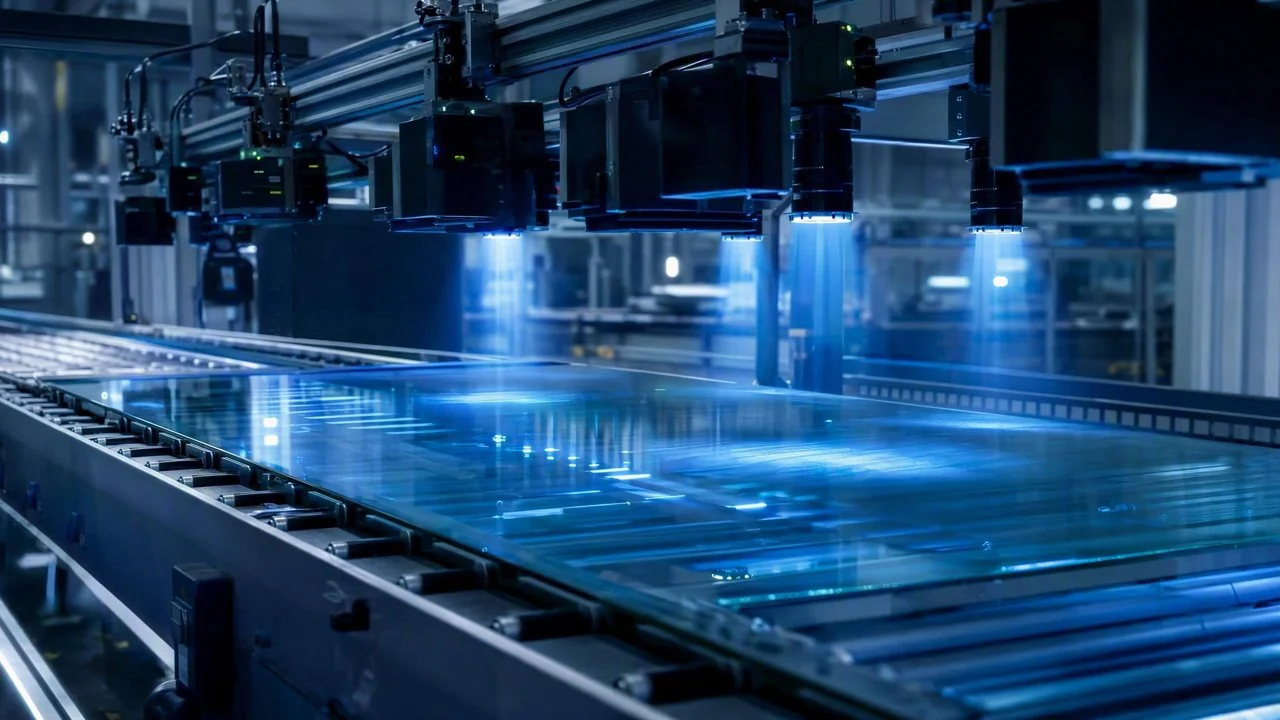
DaoAI AI AOI software system (featuring visual foundation model for feature cognition, 5-minute 0-code programming with one good sample, APDT few-shot learning with 1–20 good samples, semantic false positive filtering, and SDK/API/Docker 100% on-premise deployment) seamlessly integrates with high-speed production line cameras, boosting detection efficiency for microscopic surface defects in glass deep processing by +45% and reducing manual re-inspection rates by 80%, significantly enhancing compatibility between production line throughput and 100% full inspection capacity.
In the chemical and materials industry, especially in deep processing fields like flat glass, display panel glass, and specialty glass, products demand extremely high surface quality. Any tiny scratch, bubble, impurity, or chip can lead to product rejection. A leading specialty glass manufacturer, with extremely fast production line throughput capable of producing meters of glass ribbon per second, found traditional manual inspection or rule-based AOI systems inadequate for their stringent demands of 100% full inspection capacity and high throughput. DaoAI AI AOI software system, with its excellent defect recognition capability and efficient programming mode, is becoming a key technology to address this challenge. The system accurately identifies various microscopic defects on glass surfaces, ensures product quality, and does not slow down the production line, bringing significant production efficiency improvements to enterprises.
Pain Points: Why This Hurdle Is So Difficult to Overcome
Detecting glass surface defects on high-speed production lines presents multiple challenges for traditional solutions: Firstly, manual inspection, at high throughputs, suffers from persistently high false negative rates, especially for micron-level or low-contrast defects. Fatigue often causes significant fluctuations in detection rates, with average false negatives typically ranging from 3%–5%. Secondly, traditional rule-based AOI systems are complex to program. For materials like glass with varied surface textures and diverse defect types, rule writing is time-consuming and difficult to enumerate all variations, leading to false positive rates as high as 10%–15%, where a large number of good products are misidentified, increasing manual re-inspection workload by 50%. Thirdly, during product changeovers, traditional AOI systems require hours or even days for reprogramming, incurring high production line downtime costs. Finally, the complex glass production environment, with factors like light reflection and dust interference, easily affects imaging quality, further exacerbating detection difficulty. These factors collectively lead to unstable product quality, increased production costs, and a conflict between production line throughput and full inspection.
The difficulty stems from the 'hidden' and 'diverse' nature of glass defects, coupled with the 'real-time' requirements of high-speed production lines. Glass surface defects such as tiny bubbles, faint patterns, slight scratches, etc., often have indistinct features with low contrast against the background. Moreover, the complex optical properties of glass, involving reflection, refraction, and transmission, make defect imaging highly unstable. In high-speed production, short camera exposure times lead to low signal-to-noise ratios in images, further blurring defect features. Traditional rule-based algorithms struggle to adapt to such complex and variable environments, while manual inspection is limited by the physiological constraints and attention span of human vision. The DaoAI AI AOI software system is designed to address these challenges, utilizing advanced visual foundation models to extract and learn the essential features of defects from complex backgrounds, thereby achieving stable and efficient detection in high-speed, variable environments.
Technical Principles
The DaoAI AI AOI software system leverages the feature recognition capabilities of visual foundation models, which fundamentally differs from traditional approaches based on feature engineering or supervised deep learning models. Traditional methods require a large number of labeled defect samples for training, and the rarity and diversity of glass defects make sample acquisition exceptionally difficult. The DaoAI system, however, employs an APDT positive/few-shot learning mechanism, requiring only 1–20 good samples to quickly build a good product model. Its core lies in self-supervised and contrastive learning, enabling the model to understand 'what is normal' and thus identify any deviation from the normal state as an anomaly. This '5-minute 0-code automatic programming with one good sample' capability greatly simplifies model deployment and maintenance processes. When a potential defect is detected, the system utilizes a semantic false positive filtering module to perform a secondary judgment based on contextual information and the semantic morphology of the defect, effectively distinguishing true defects from background noise or artifacts, reducing the false positive rate by 80%.
Compared to traditional rule-based AOI systems, the DaoAI AI AOI software system offers overwhelming advantages. Rule-based AOI relies on engineers manually writing complex logic and thresholds, requiring fine-tuning for each defect type and every lighting condition. When dealing with the varied reflections and textures of glass surfaces, the rule library becomes exceptionally large and difficult to maintain, leading to high changeover costs. In contrast, the DaoAI system automatically learns defect features from data through deep learning, eliminating the need for manual rule writing and significantly reducing deployment time. Compared to traditional supervised learning models, the DaoAI system requires very few defect samples, addressing the pain point of scarce defect samples in the glass industry and achieving rapid iteration and high generalization capabilities. Furthermore, the DaoAI AI AOI software system supports SDK/API/Docker 100% on-premise private deployment, ensuring absolute data security and privacy for customers, meeting the high data compliance requirements of the chemical and materials industry.
Typical Application Scenarios
- **Surface Defect Detection in Flat Glass Production Lines**: On float glass or rolled glass production lines, the DaoAI AI AOI software system can real-time detect common surface defects such as scratches, bubbles, stones, pits, and haze. The challenge lies in dynamic capture and recognition of defects at high speeds, as well as stable imaging under complex lighting conditions.
- **Display Panel Glass Substrate Defect Detection**: In the front-end manufacturing of display panels, the surface quality of glass substrates is crucial. The system can detect micron-level particles, pits, scratches, and edge chips. The difficulty lies in the extremely small size of defects and the very high demands for detection accuracy and speed, as any flaw can affect display performance.
- **Quality Control for Specialty Glass (e.g., Automotive Glass, Pharmaceutical Glass)**: For stress patterns in automotive glass, bubbles in optical glass, foreign objects inside pharmaceutical glass, etc., the DaoAI AI AOI software system can perform high-precision detection. The challenge is the diversity of product forms, the complexity of defect types, and the fact that some defects are located inside the glass or on curved surfaces, making them difficult for traditional methods to effectively cover.
- **Secondary Defect Detection After Glass Deep Processing (Cutting, Edging, Drilling)**: After glass undergoes processes like cutting, edging, and drilling, new micro-cracks, chips, grinding marks, residues, etc., may appear. The system can accurately identify these processing-induced defects, ensuring the final quality of products before leaving the factory. The challenge lies in distinguishing processing marks from actual defects, and precise detection of edge areas.
Case Study
A global leading specialty glass manufacturer, at one of its major factories in China, specializes in the production of high-precision optical glass. This production line has extremely strict requirements for microscopic defects on the glass surface. However, constrained by high throughput, traditional rule-based AOI systems, when encountering tiny scratches and bubbles on new glass models, had a false positive rate exceeding 12%, leading to an additional 4 manual re-inspection personnel daily, severely impacting production line efficiency. At the same time, due to the limitations of the rule library, there was still a 0.8% risk of false negatives for certain rare but critical defects. To address these issues, the manufacturer introduced the DaoAI AI AOI software system for trial. During the initial deployment, the DaoAI engineering team completed system integration and model training in just 3 days. Through APDT few-shot learning, using only 15 good samples, the system was able to detect new products.
The DaoAI AI AOI software system successfully reduced the false positive rate by 80% and the false negative rate to <0.3% on the specialty glass production line, while shortening new product changeover programming time from several hours to 5 minutes, significantly enhancing the compatibility between production line throughput and 100% full inspection.
After the system went live, its effects were immediate. The false positive rate for microscopic scratches and bubbles was successfully reduced by 80% by the DaoAI AI AOI software system, dropping from over 12% to below 2.4%, greatly alleviating the pressure of manual re-inspection. Concurrently, the false negative rate for various microscopic defects was stably controlled at <0.3%, significantly lower than the customer's previous level of 0.8%, effectively improving product yield. More importantly, for new product changeovers, what previously required several hours of programming and debugging time can now be completed in just 5 minutes for model updates and parameter adjustments using the DaoAI AI AOI software system, drastically reducing downtime and ensuring production line throughput continuity. The customer expressed high satisfaction and plans to promote the application of the DaoAI AI AOI software system across more production lines.
DaoAI Solutions and Products
DaoAI's AI AOI software system solution for the glass industry, driven by its core visual foundation model and combined with AI smart cameras, has realized the intelligent upgrade of industrial defect detection. In the modeling phase, customers only need to provide 1–20 good samples, and the DaoAI AI AOI software system can automatically complete model training in 5 minutes through APDT positive/few-shot learning technology, without any code writing. This '0-code' programming mode greatly reduces technical barriers and deployment costs. During defect detection, the system can process image data collected by high-speed cameras in real-time, utilize the feature recognition capabilities of the visual foundation model for precise identification of microscopic defects on glass surfaces, and effectively reduce false alarms through the semantic false positive filtering module. For specific customer needs, DaoAI also offers DaoAI 2D / 3D AI AOI equipment, which can integrate self-developed 3D cameras for three-dimensional morphological reconstruction, further enhancing the detection capability for hidden defects or micron-level morphology. The system supports SDK/API/Docker 100% on-premise private deployment, ensuring data security and control, and can seamlessly integrate with existing MES/SCADA systems to achieve closed-loop data management. Furthermore, the DaoAI World Model, as a unified foundation, continuously learns from production line feedback, constantly improving the model's generalization ability and adaptability.
By deploying the DaoAI AI AOI software system, customers can achieve significant quantifiable results. Firstly, the false negative rate can be stably reduced to <0.3%, significantly improving outbound product quality. Secondly, the false positive rate is reduced by 80%, greatly reducing manual re-inspection workload and freeing up valuable human resources. Thirdly, new product changeover programming time is shortened to 5 minutes, greatly enhancing production line flexibility and efficiency, potentially saving millions in annual downtime losses. Fourthly, detection efficiency is increased by +45%, fully meeting the 100% full inspection demands of high-speed production lines and ensuring production line throughput. The DaoAI AI AOI software system not only solves the problem of glass surface defect detection but also brings tangible business value to the chemical and materials industry through technological innovation, helping enterprises maintain a leading position in fierce market competition.
FAQ
How does the DaoAI AI AOI software system help us improve production line throughput?
The DaoAI AI AOI software system significantly boosts production line throughput through its efficient APDT few-shot learning capability, enabling 5-minute 0-code automatic programming with just one good sample, drastically reducing changeover and debugging time for new products. Concurrently, the system boasts extremely high detection efficiency and a low false positive rate, minimizing manual re-inspection and rework, ensuring continuous high-speed operation of the production line, thereby directly enhancing overall production line throughput and 100% full inspection capacity.
What are the main advantages of the DaoAI AI AOI system compared to traditional AOI or manual inspection?
The primary advantage of the DaoAI AI AOI system lies in its feature cognition based on visual foundation models, capable of handling complex and diverse defects that traditional methods struggle with, especially in few-shot scenarios. It requires minimal defect samples, training models with just a few good samples, leading to rapid programming, low false positives, and minimal false negatives. Traditional AOI relies on complex rules, is time-consuming to program, and lacks generalization. Manual inspection is limited by human fatigue and speed, unable to meet high-speed full inspection demands.
What is the approximate deployment cost of the DaoAI AI AOI software system?
The deployment cost of the DaoAI AI AOI software system depends on your specific application scenario, detection requirements, necessary hardware configuration (e.g., number and type of cameras), and integration complexity. We offer flexible SDK/API/Docker deployment solutions, supporting 100% on-premise private deployment to ensure data security. A precise quote requires a customized assessment based on your detailed needs. We recommend scheduling a free consultation with our experts, who will provide you with a personalized solution and accurate cost estimate.
Full solution for this scenario: Chemical / materials industry solutions
This article was generated by AI. Customer cases are simulated scenarios based on real product capabilities and figures are illustrative; see product pages for official benchmarks.