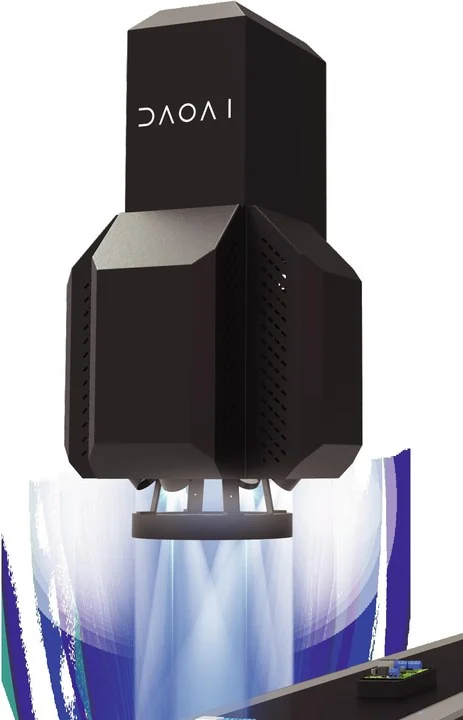
DaoAI AQ-060
Telecentric · 60 × 60mm · 2μmFour-way structured light with an RGBW ring light — no shadows, no blind spots. For PCB joints and placement.

HARDWARE · 3D INDUSTRIAL CAMERAS
Two lines, eleven models. Inspection cameras for micron-scale appearance and dimensional QC, down to 2μm repeatability on an 18MP sensor. Picking cameras for robot 3D guidance across a 500–3000mm working distance. Structured-light imaging throughout, IP65 housings, float thermal calibration over 0–40°C.
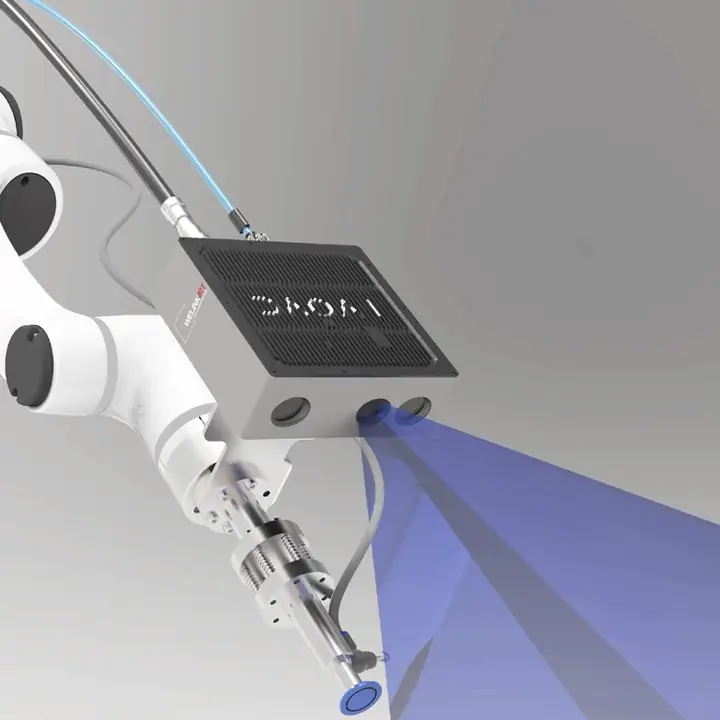
In-house 3D industrial cameras are the imaging layer of DaoAI's (微链道爱) physical-AI stack: structured-light imaging with 3D HDR for black and highly reflective parts, in an inspection family (AQ / AD / IN) and a picking family (BP). The boundary with third-party cameras is who defines the imaging parameters — camera and world model come from the same company, so imaging can be tuned for the model. The company does not make ToF cameras; it can read third-party ToF depth data.
Six inspection models, from a 60 × 60mm telecentric field at 2μm repeatability to a 477 × 435mm large-format field — one optical stack, one point-cloud pipeline.
Four-way structured light with an RGBW ring light — no shadows, no blind spots. For PCB joints and placement.
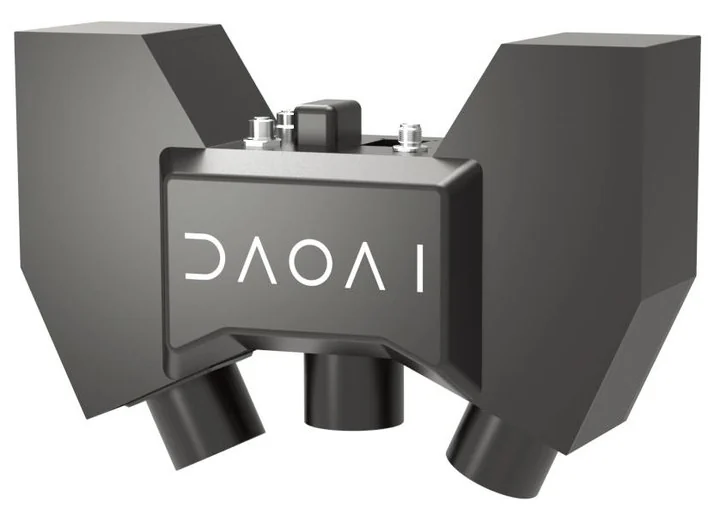
18MP with 3D HDR for small-component precision inspection, ±8mm range.
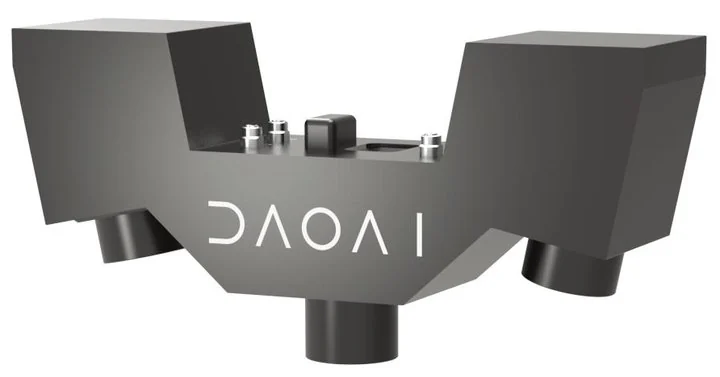
Large-format inline inspection with ±40mm range — a laptop-sized part in one shot.
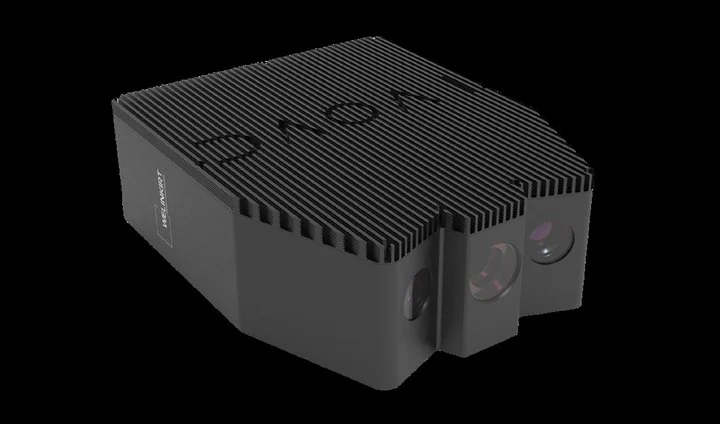
5MP snapshot inspection, 5μm Z repeatability, for consumer-electronics parts.
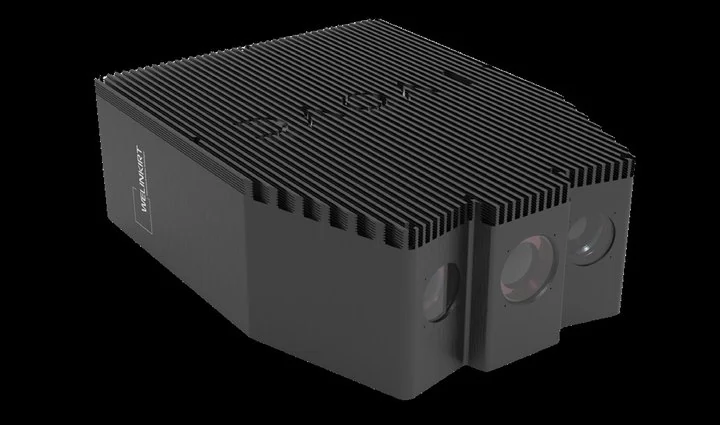
5MP snapshot inspection with a 132 × 106mm field of view.
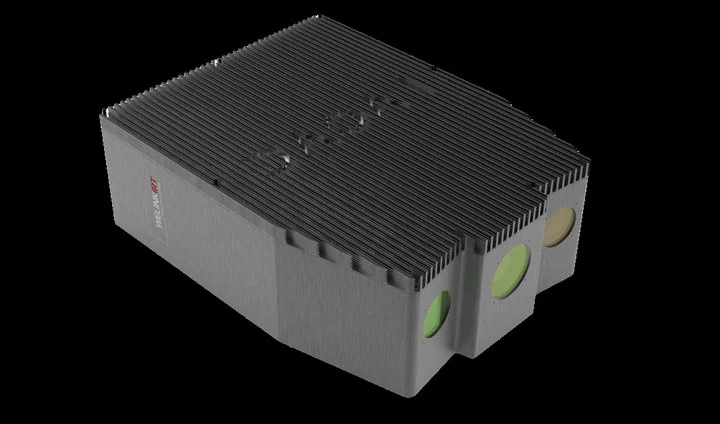
5MP snapshot inspection, 225 × 185mm field of view, up to 450mm.
| Specification | AQ-060 | AD-080 | AD-470 | IN-XS | IN-S | IN-M |
|---|---|---|---|---|---|---|
| Working distance (mm) | 32 | 186 | 510 | 100–140 | 150–270 | 270–450 |
| Field of view (mm) | 60 × 60 | 77 × 70 | 477 × 435 | 83 × 60 | 132 × 106 | 225 × 185 |
| Measuring range | ±5 mm | ±8 mm | ±40 mm | — | — | — |
| Image resolution | 18 MP · 4288 × 4288 | 18 MP · 4496 × 4096 | 18 MP · 4496 × 4096 | 5 MP | 5 MP | 5 MP |
| Repeatability | 2 μm | 4 μm | 40 μm | 5 μm | 8 μm | 15 μm |
| Calibration accuracy | — | — | — | 20 μm | 25 μm | 30 μm |
| Spatial resolution (mm) | — | — | — | 0.03 | 0.05 | 0.09 |
| 3D acquisition time (s) | 1 | — | — | 2 | 2 | 2 |
| Illumination / projection | 4-way structured light · RGBW ring · telecentric lens | Dual projector · white LED | Dual projector · white LED | Dual-cam · blue LED | Dual-cam · blue LED | Dual-cam · blue LED |
| Data interface | CoaXPress 2.0 (CXP-12×4) | 10 GigE | 10 GigE | Ethernet | Ethernet | Ethernet |
| Power | 24V DC 12A | 24V DC 10A | 24V DC 10A | — | — | — |
| Dimensions (mm) | — | — | — | 224 × 286 × 98 | 208 × 286 × 98 | 208 × 286 × 98 |
| Weight (kg) | — | — | — | 3.8 | 3.7 | 3.7 |
← swipe to see the full spec table →
Shared specs · 0–40°C operating range · passive cooling · IP65 industrial housing · 3D HDR captures dark and specular surfaces clearly in a single shot · contrast / outlier / cluster / Gaussian / hole-filling point-cloud filters · on-site calibration restores accuracy in under three minutes · IN series carries NVIDIA® Jetson Xavier™ NX.
PICKING CAMERAS
Five models covering 500–3000mm working distance — eye-in-hand on AMR arms, collaborative picking, and large-part palletising. Dual cameras with structured light.
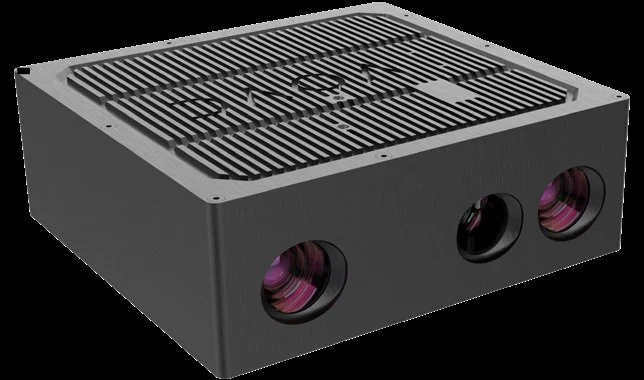
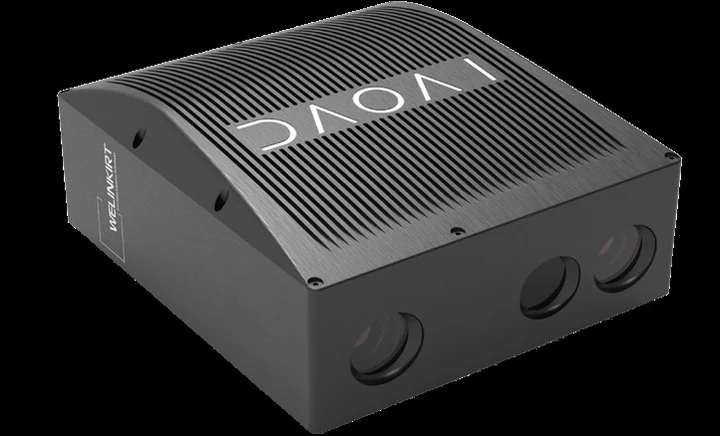
Lightweight body; blue-LED pattern projection resists ambient light. Built for AMR-mounted arms.
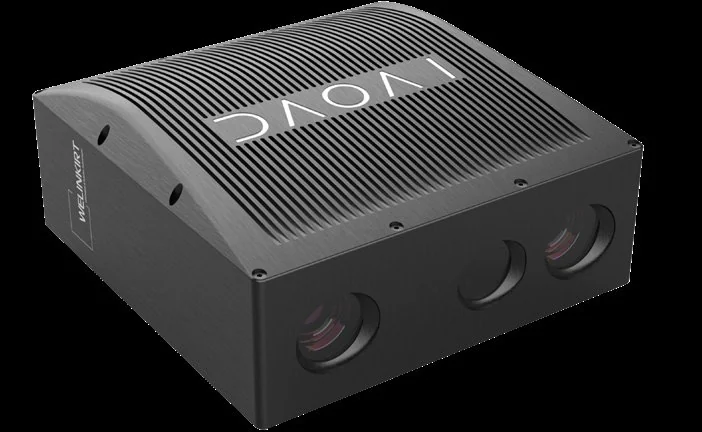
Same body as BP-AMR, on-board GPU cuts acquisition to 0.6–1.1 s.
2.3MP white-LED imaging keeps true colour; best repeatability in the range, arm-mountable.
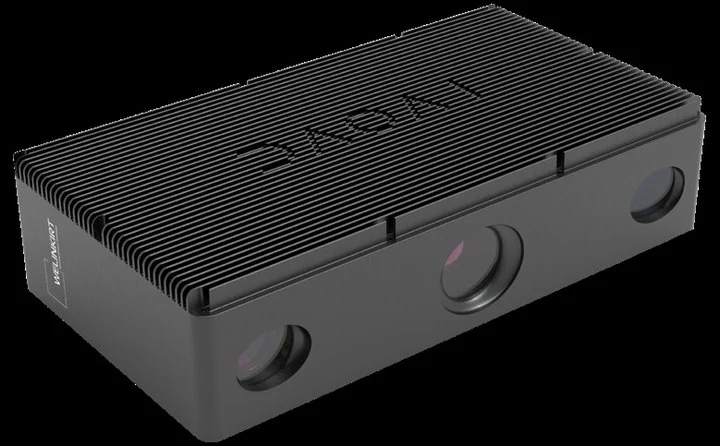
280mm baseline balances accuracy and reach for collaborative picking and machine tending.
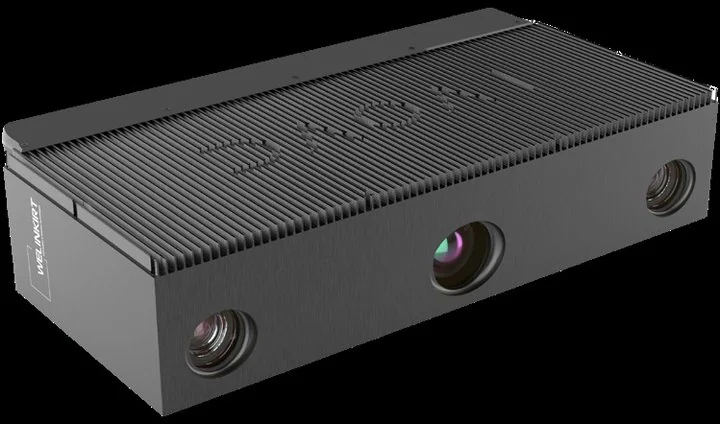
1725 × 971mm field of view for de-palletising and large-part loading.
| Specification | BP-AMR | BP-AMR-GPU | BP-S | BP-M | BP-L |
|---|---|---|---|---|---|
| Working / measuring distance (mm) | 500–1000 | 500–1000 | 500–1000 | 800–1800 | 1000–3000 |
| Optimal FOV (dia. × length, mm) | 617 × 394 | 617 × 394 | 665 × 394 | 897 × 560 | 1725 × 971 |
| Image resolution | 1.6 MP | 1.6 MP | 2.3 MP | 2.3 MP | 2.3 MP |
| Baseline (mm) | 120 | 120 | 130 | 280 | 360 |
| Calibration accuracy ¹ (mm) | 0.2 | 0.2 | 0.07 | 0.25 | 0.32 |
| Z repeatability ² (mm) | 0.1 | 0.1 | 0.04 | 0.08 | 0.14 |
| 3D acquisition time (s) | 0.8–1.3 | 0.6–1.1 | 0.8–1.3 | 0.8–1.3 | 0.8–1.3 |
| Camera configuration | Dual-cam · blue LED | Dual-cam · blue LED | Dual-cam · white LED | Dual-cam · white LED | Dual-cam · white LED |
| Dimensions (mm) | 180 × 182 × 70 | 180 × 212 × 87 | 200 × 212 × 93 | 360 × 208 × 93 | 440 × 254 × 107 |
| Weight (kg) | 1.5 | 2.1 | 2.3 | 5 | 5.2 |
← swipe to see the full spec table →
Shared specs · 0–40°C operating range · Ethernet · passive cooling · IP65 industrial housing · the dual-camera layout improves thermal stability; every unit passes a 58-hour thermal test and is float-calibrated across 0–40°C · on-board NVIDIA® Jetson TX2 NX captures a 3D point cloud in under a second · Camera Studio configuration software with C# / C++ APIs, running in three minutes.
¹ Calibration accuracy: mean measurement error on a calibration target within the optimal FOV and distance. ² Z repeatability: standard deviation of Z over 15 scans across 100 sample points in the full FOV at the optimal working distance.
TECHNOLOGY
An in-house 3D HDR algorithm captures dark and specular surfaces clearly in one exposure — no bracketing.
The AD series uses two projectors to even out illumination and remove point-cloud distortion at bright/dark boundaries.
AQ-060 surrounds the part with four Scheimpflug projectors and an RGBW ring light, cutting shadows and blind spots.
AQ-060 carries a high-precision telecentric lens, so parts are imaged at true size with minimal angle-induced error.
Contrast, outlier, cluster, Gaussian and hole-filling filters clean invalid points on dark, specular and complex parts.
A calibration target ships with every camera; accuracy can be restored on site in under three minutes.
Dual cameras improve thermal stability; every unit passes a 58-hour thermal test and is float-calibrated across 0–40°C.
Jetson TX2 NX on the picking series, Jetson Xavier NX on inspection; acquisition and reconstruction run in parallel.
POINT CLOUD · IN THE FIELD
Raw point-cloud output from our 3D cameras, unretouched. 3D HDR resolves dark and specular surfaces in a single exposure and the filter stack removes invalid points — the manual rates point-cloud correctness at >99%.
| Scenario | Recommended model | Why |
|---|---|---|
| PCB / solder joints · mid-size boards | AQ-060 | 60 × 60mm field at 2μm repeatability, one capture per second, fewer shots per board. |
| Small-component precision inspection | AD-080 | 77 × 70mm field, 4μm repeatability, ±8mm range. |
| Large-format inline inspection | AD-470 | 477 × 435mm field with ±40mm range — a laptop-sized part in one shot. |
| Consumer-electronics parts | IN-XS | 100–140mm working distance, 5μm Z repeatability. |
| Automotive parts | IN-M | 270–450mm working distance, 225 × 185mm field. |
| Eye-in-hand on AMR arms | BP-AMR / BP-AMR-GPU | Lightweight body, blue-light ambient rejection; the GPU variant captures in 0.6–1.1 s. |
| Short-range precision picking | BP-S | 0.04mm Z repeatability — the best in the range. |
| De-palletising and large parts | BP-L | Up to 3 m working distance, 1725 × 971mm field. |
← swipe to see the full spec table →
FAQ
Structured light throughout. On the inspection side, AQ-060 uses four Scheimpflug projectors with an RGBW ring light and a telecentric lens, while AD-080 / AD-470 use dual white-light projectors; the picking series pairs dual cameras with blue or white LEDs. We do not build ToF cameras — where a third-party ToF device is already on site, our software can ingest its depth data alongside our own.
On the inspection side: 2μm for AQ-060, 4μm for AD-080 and 40μm for AD-470; the IN series reaches 5μm (IN-XS), 8μm (IN-S) and 15μm (IN-M) Z repeatability. On the picking side BP-S leads at 0.04mm. Repeatability here is the standard deviation of Z over 15 scans across 100 sample points in the full field of view at the optimal working distance.
Yes. An in-house 3D HDR algorithm resolves dark and specular surfaces in a single exposure, so highlights do not blow out on dark parts and detail is not lost in the shadows of shiny ones. Contrast, outlier, cluster, Gaussian and hole-filling point-cloud filters remove the remaining invalid points.
Start from working distance and field of view: inspection runs from 32 to 510mm and 60 × 60 to 477 × 435mm; picking runs from 500 to 3000mm. Then narrow by accuracy: AQ-060 or AD-080 for micron-scale appearance and dimensional inspection, AD-470 for large formats, and BP-S / BP-M / BP-L for robot guidance by distance. The selection guide on this page lists a recommended model per scenario.
Every camera passes a 58-hour thermal test and is float-calibrated across 0–40°C; the dual-camera layout further reduces temperature-induced measurement error. If an on-site check shows accuracy has drifted, the calibration target shipped with the camera restores it in under three minutes.
These answers were drafted with AI assistance and are indicative only; final specifications and commitments follow the commercial agreement.