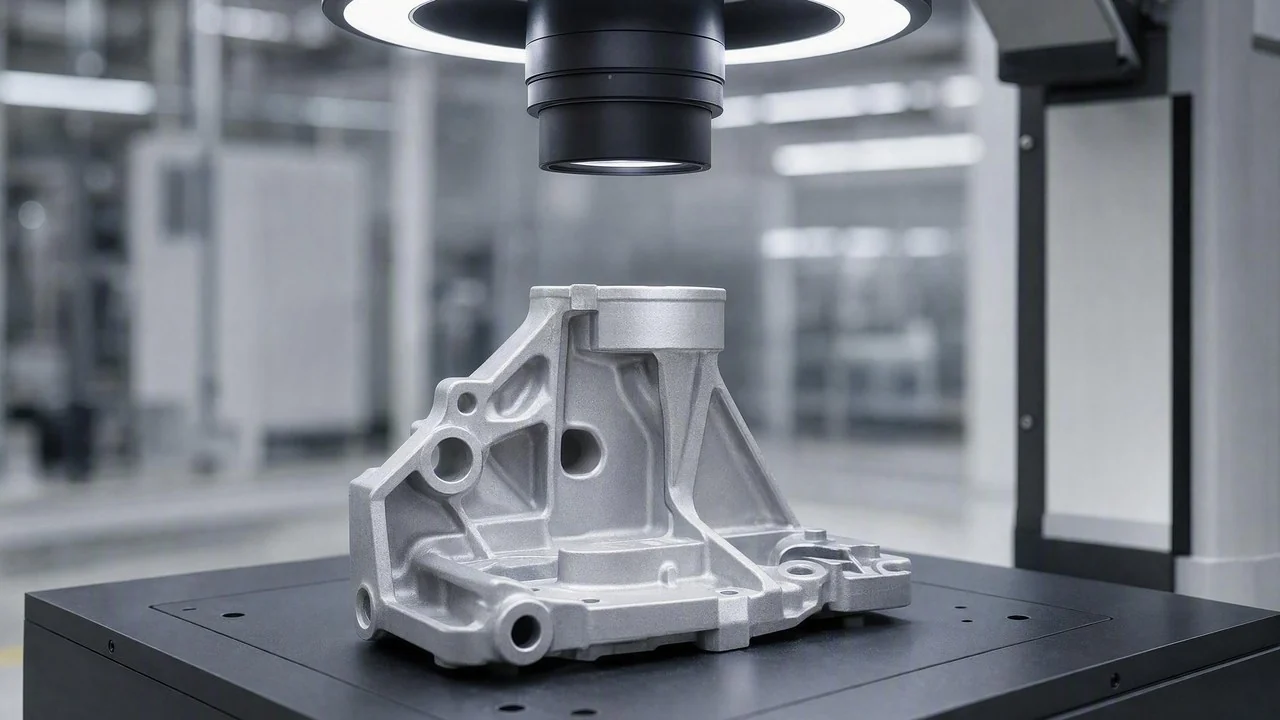
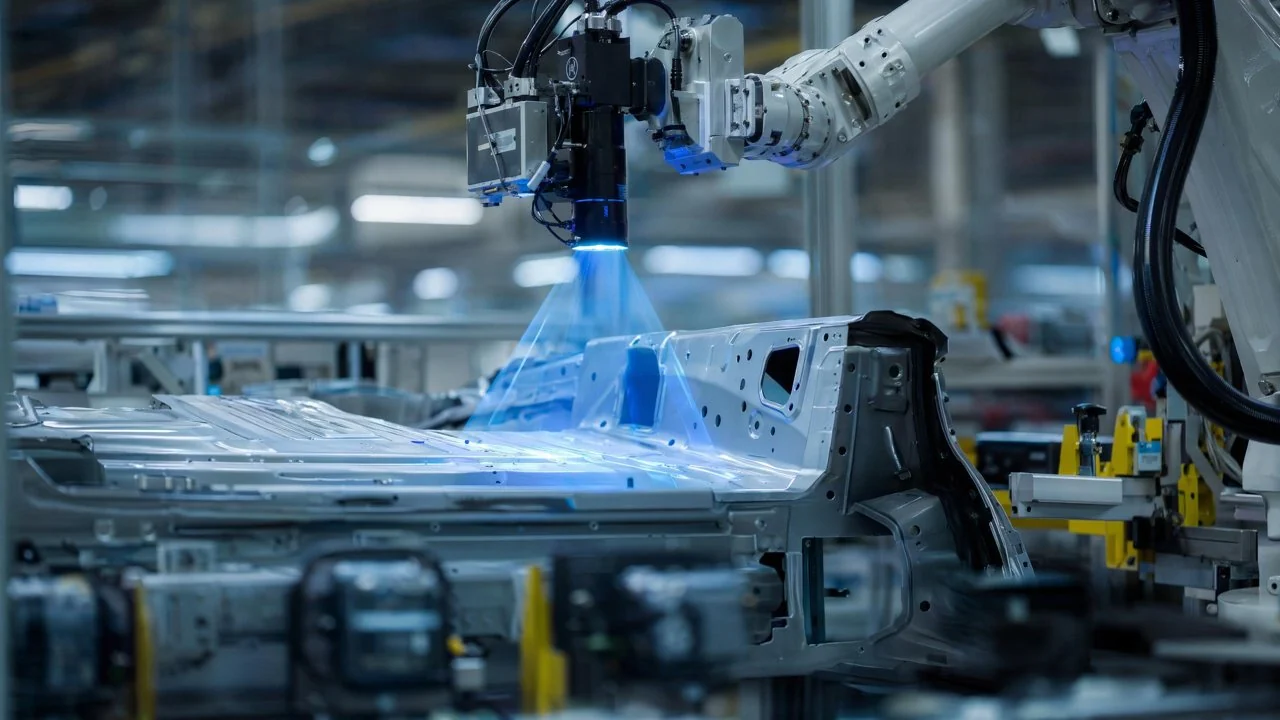
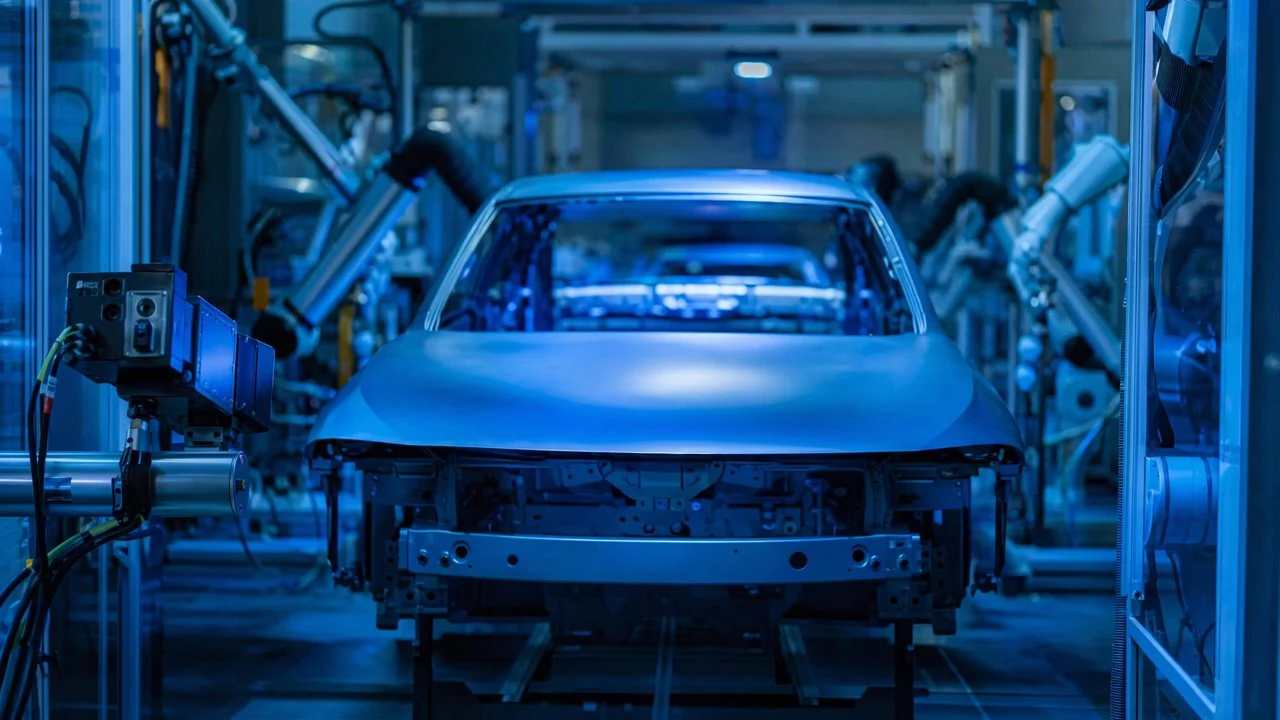
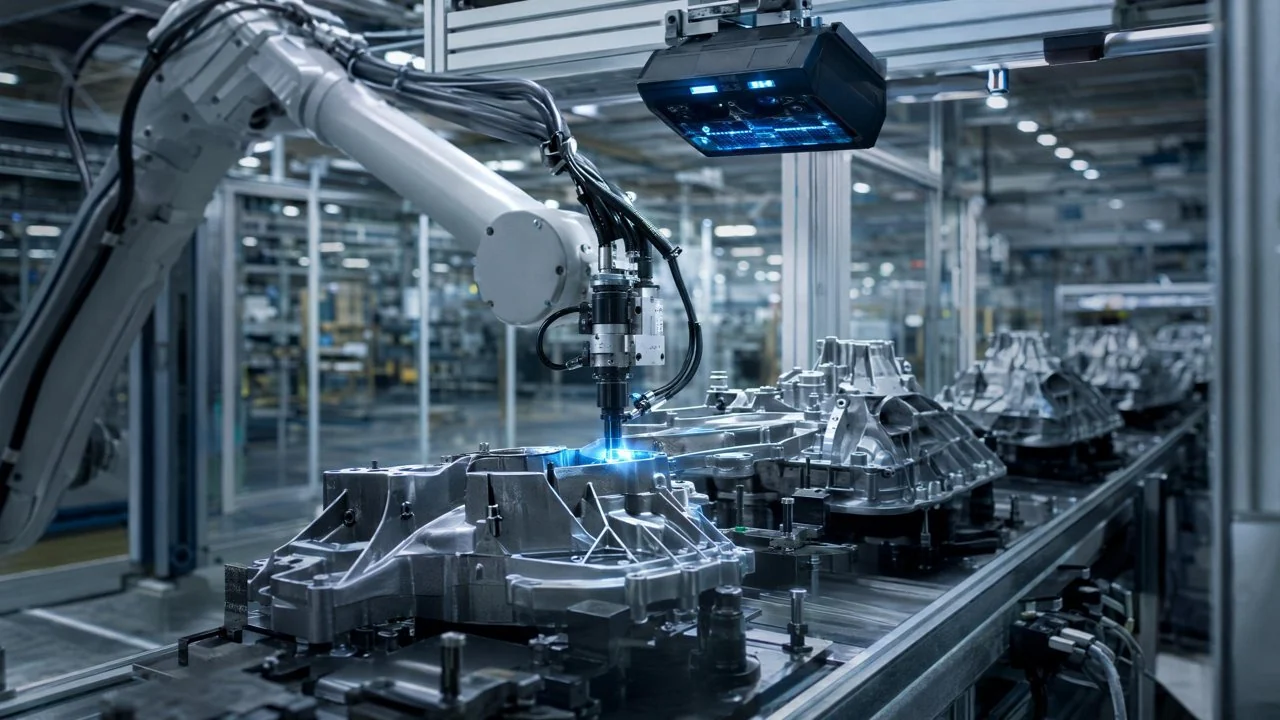
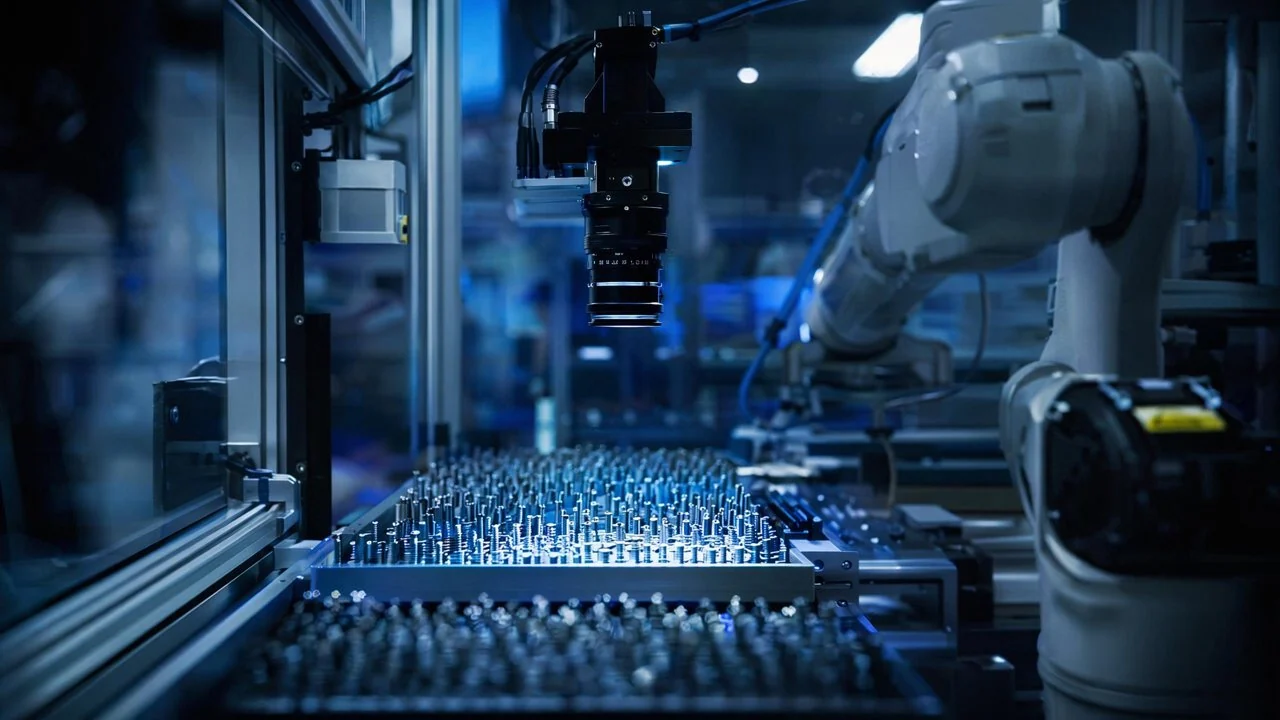
DaoAI's Automotive / parts: 100% Inline 100%, 0 Skips/misses, 99%+ Pick success. Automotive electronics and parts — inline full inspection of assembly and dimensions.
Vision work on an automotive line splits in two. One half is judgement: 0.3 mm scratches and dents on stamped panels, hundreds of body-in-white weld seams whose shape varies from part to part. The other half is motion: a glue path has to follow where the part actually is, and randomly stacked parts have to be picked out of a bin one by one. The first is hard because defect appearance varies faster than rules can be written. The second is hard because part position is not fixed, so a pre-programmed trajectory starves the bead, necks it, or misses the grip entirely.
These two halves are usually bought as two systems — AOI for inspection, robots for motion — with people or dedicated fixtures bridging the gap. More fixtures mean slower changeovers, and an escape that reaches the customer is costed per vehicle.
2. How the solution is put together
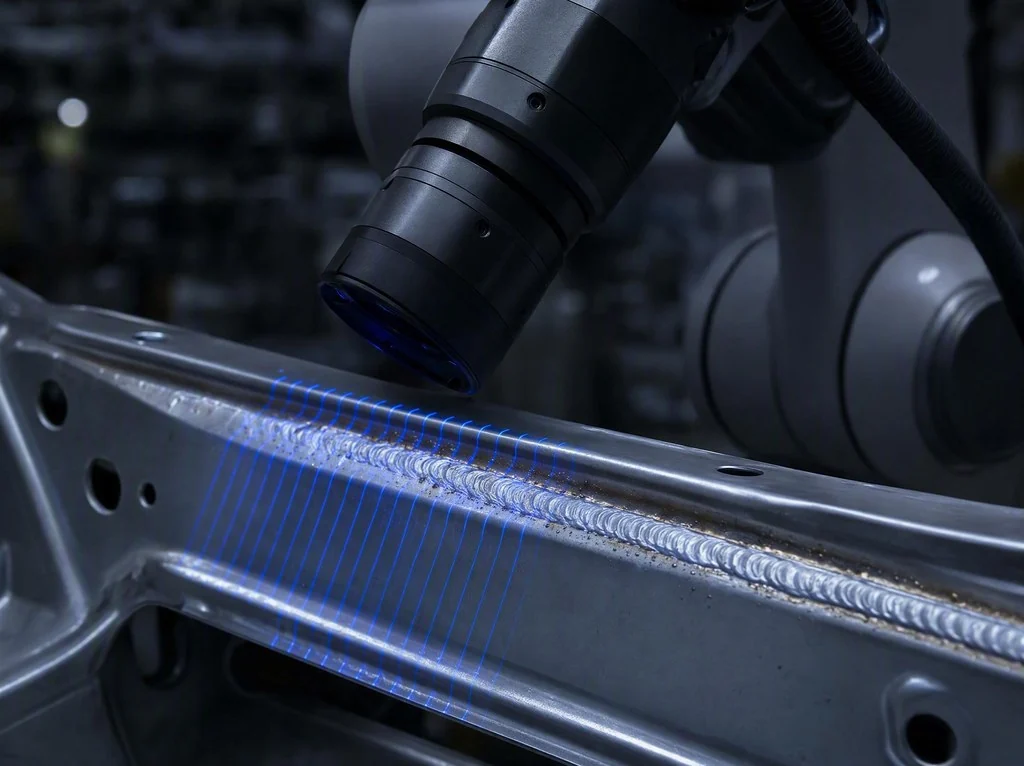
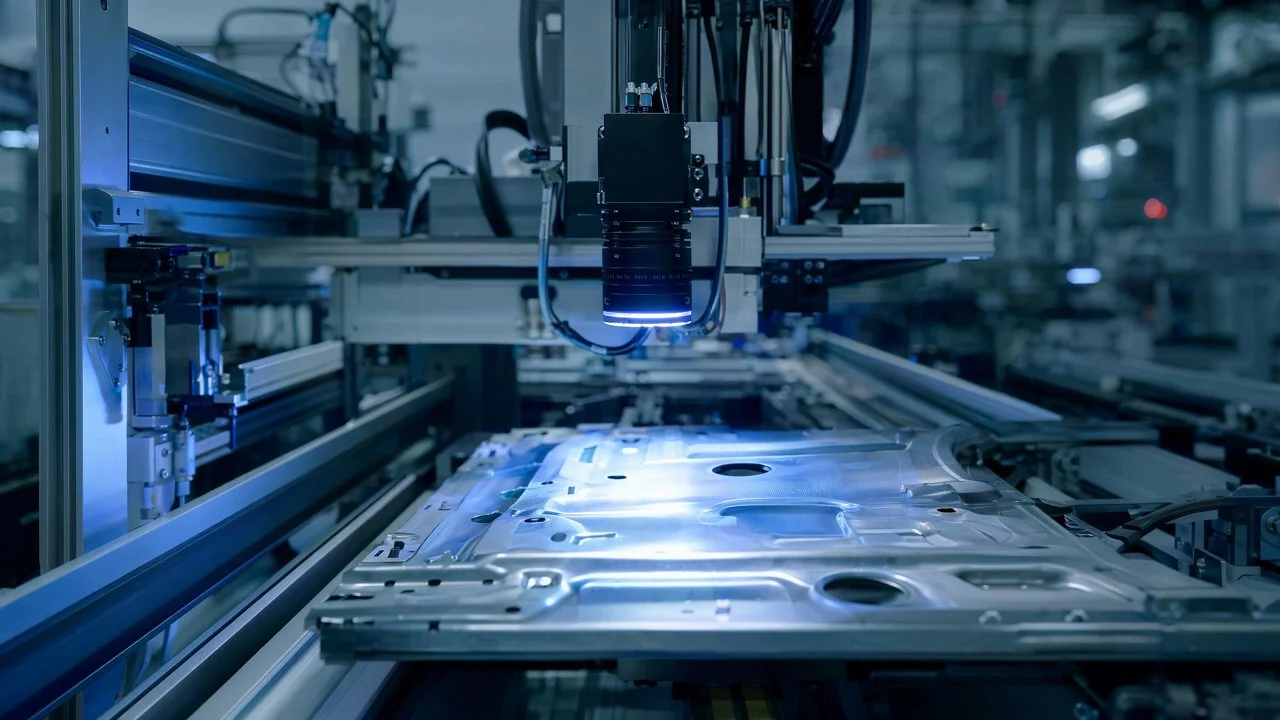
See: ACI judges surface and weld-seam defects — cracks, under-fill, scratches, dents — from a model rather than a rule per defect class.
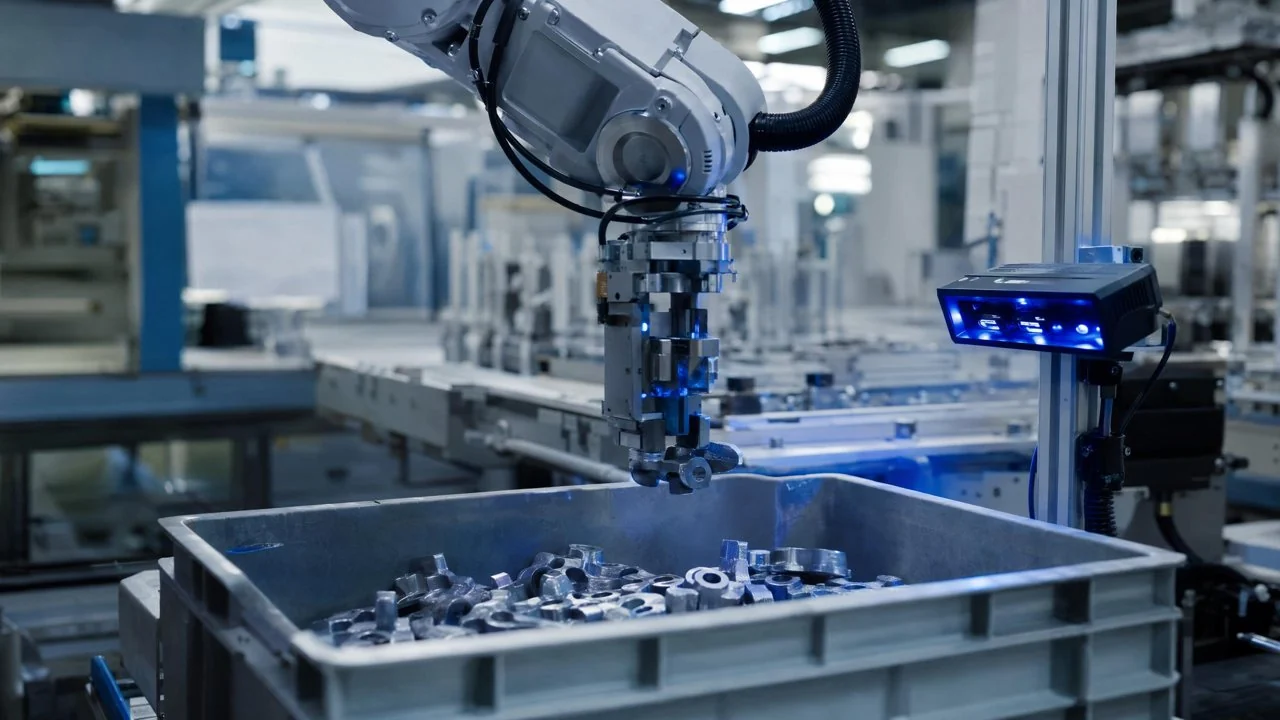
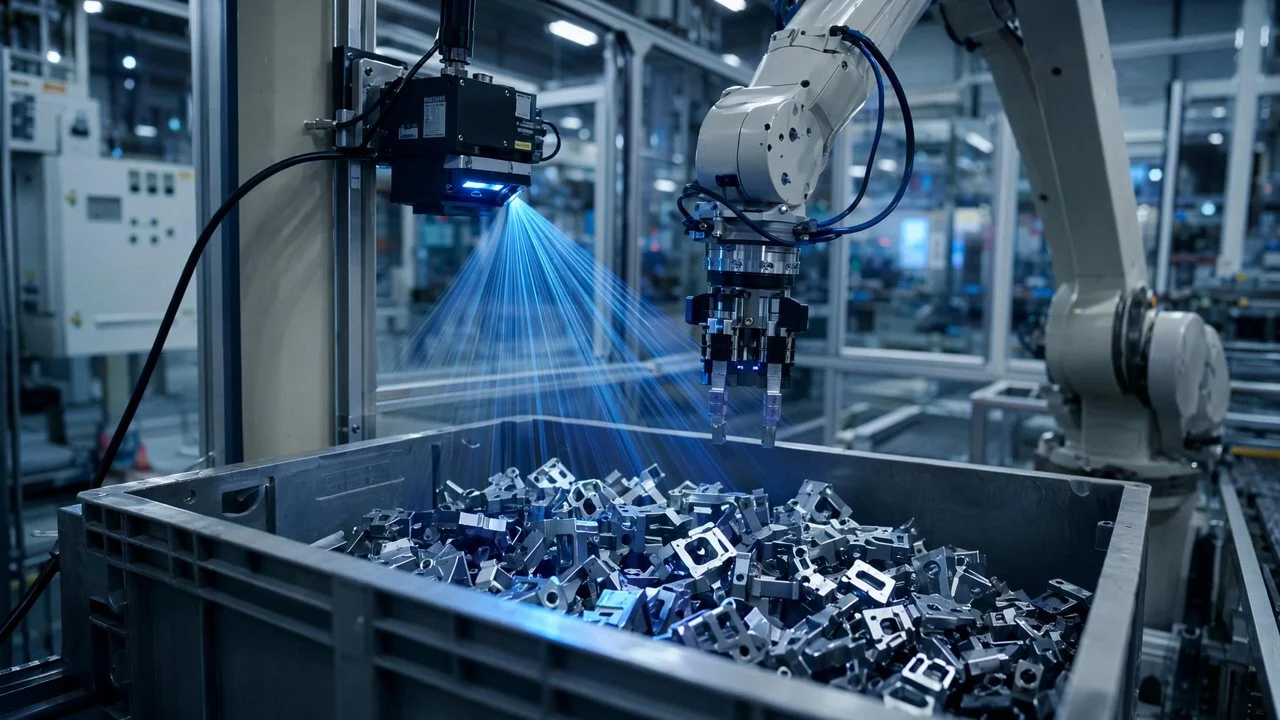
Grip: 3D robotic vision estimates 6D pose, including for parts with no fixed feature points and reflective surfaces, without dedicated fixtures.
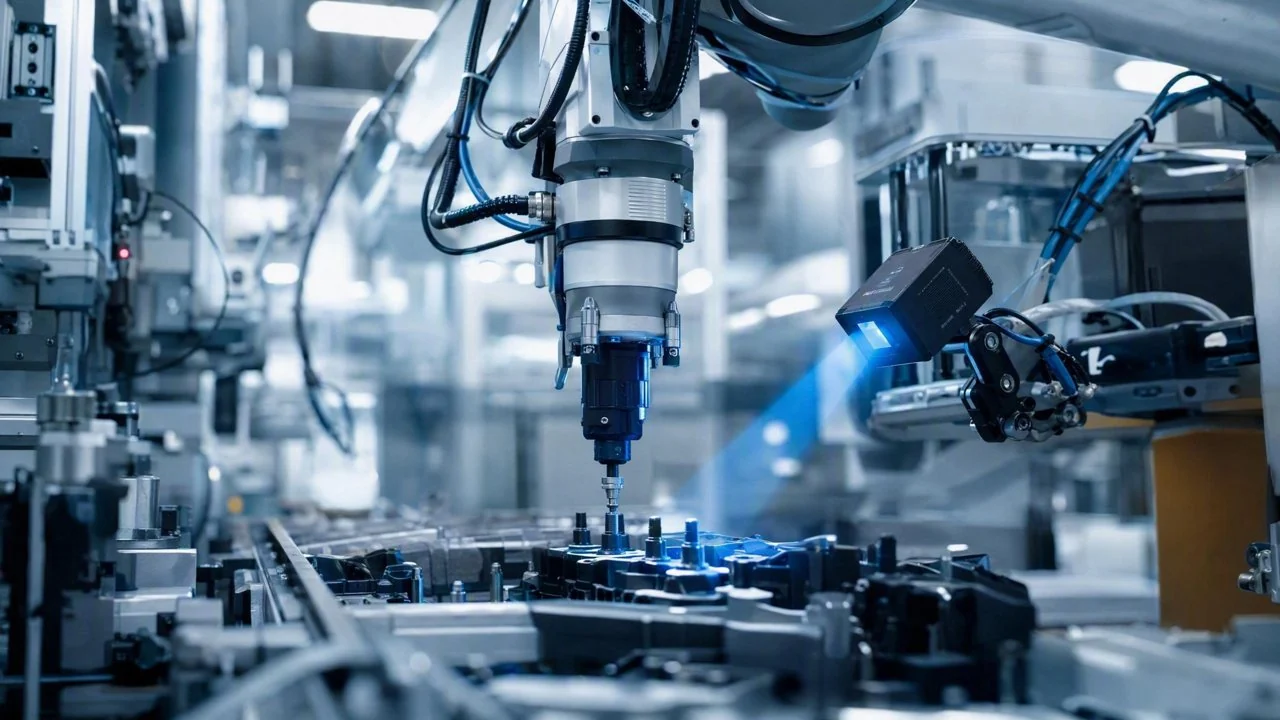
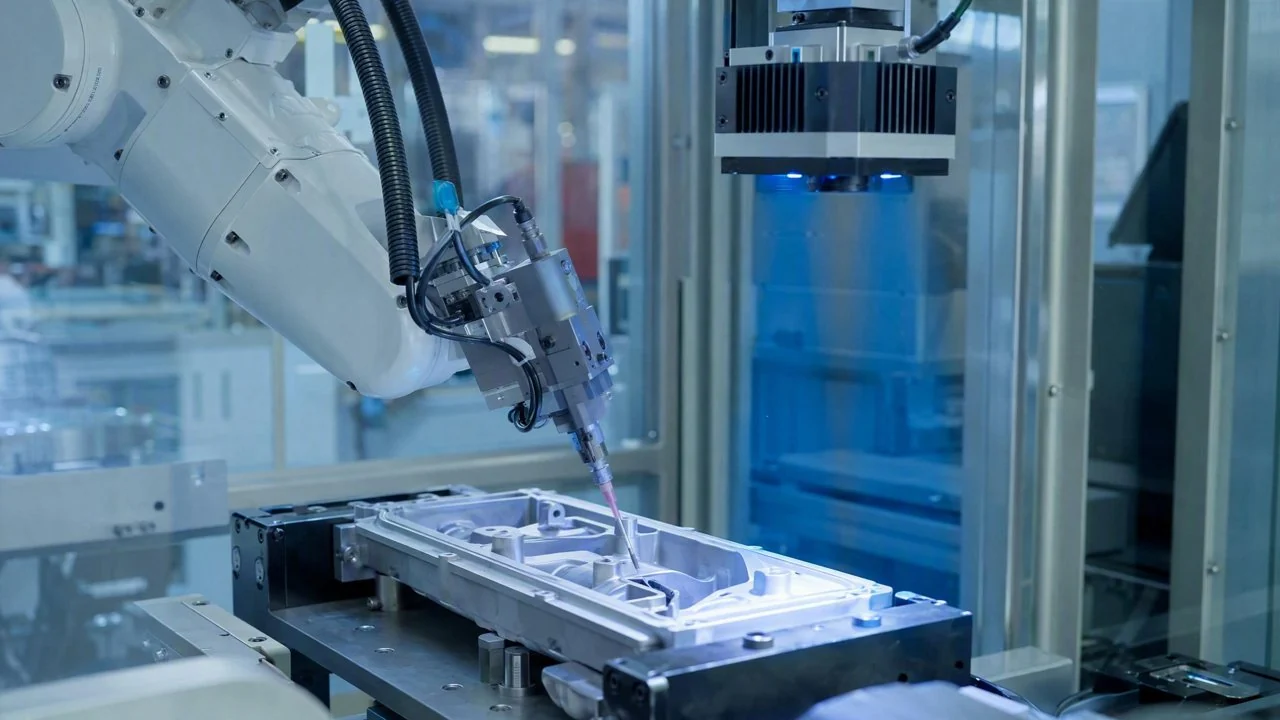
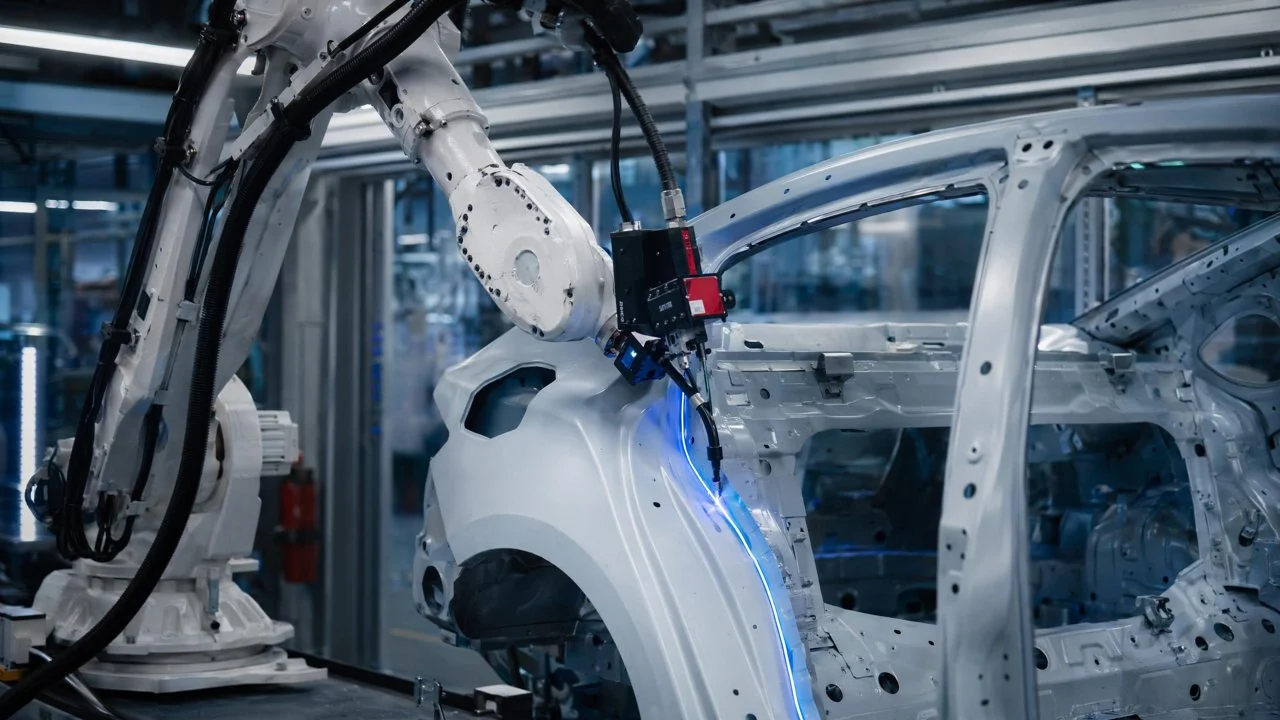
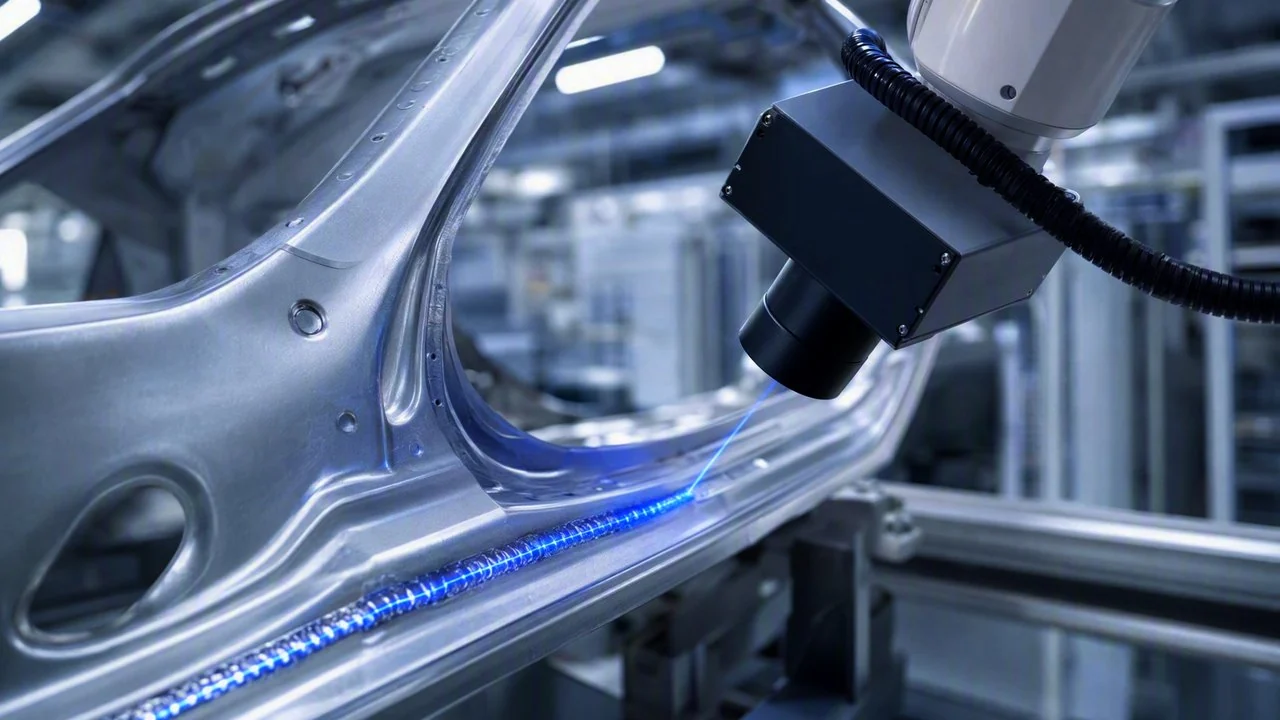
Move: trajectory work such as dispensing measures and corrects as it goes — the camera reports where the part actually is and the robot follows the measured path instead of a pre-programmed one.
Line integration: results and defect coordinates return to MES / SPC alongside tightening and welding process data. Production data stays inside the plant.
Running inspection and guidance on one DaoAI World vision foundation is what makes this practical in automotive: cameras, calibration, training and deployment live on one platform, so inspection stations and robot stations do not each need their own stack.
3. Choosing the configuration
Station
Recommended
What it addresses
Dispensing / sealing guidance
3D robotic vision with in-house 3D camera
Starved beads, necking and misplacement caused by part-position drift
Bin picking
3D robotic vision (6D pose)
Randomly stacked, reflective, feature-poor parts
Weld seam / stamped surface
ACI surface inspection
Consistent judgement of cracks, under-fill, scratches, dents
Assembly error-proofing
2D ACI plus platform templates
Missing and wrong parts, dimensional and positional deviation, checked inline
4. How deployment runs
DaoAI's deployment runs in four steps. ① Assessment — split the work station by station into inspection and guidance, and state cadence and tolerance up front. ② Configuration — choose cameras, systems and mounting (on-robot or fixed), with a quote and a delivery plan. ③ On-site deployment — hand-eye calibration and template setup; operators are up to speed in about 30 minutes. ④ Feedback — re-inspection and rework results flow back, and the model updates in minutes.
5. What to measure afterwards
For inspection stations: combined detection rate, false-call rate, smallest detectable feature. For guidance stations: positioning accuracy, pick success rate, cycle time per part. Across DaoAI's deployed automotive lines the typical picture is ±0.5 mm dispensing accuracy with 100% inline inspection and starved beads close to zero; 99%+ pick recognition at 4–8 seconds per pick; and 97% combined detection on weld seams and stamped surfaces with 0.2% false calls and 0.3 mm smallest detectable feature.
Figures are the typical range our solution reaches in anonymised industry scenarios. Actual values vary with part, station and cadence; on-site measurement governs.
From adhesive guidance and random bin picking to weld seams and stamped-surface defects — 3D robot vision plus ACI take on what conventional vision cannot.
Scene · in-line adhesive guidance
A tier-1 supplier · real-time adhesive-path correction
ChallengeDispensing robots run pre-programmed paths blind; once the part shifts you get skips, neck-down and misplacement.
Solution3D robot vision measures and corrects as it dispenses (brain-eye-body loop) with in-house 3D cameras and sub-millimetre hand-eye coordination.
100%Inline 100%
±0.5mmBead accuracy
0Skips/misses
Scene · random bin picking
A parts plant · feeding randomly stacked components
ChallengeA bin of randomly stacked, feature-less, reflective parts is simply beyond conventional vision.
Solution3D robot vision estimates 6D pose, locates without features, and guides picking through the brain-eye-body loop.
99%+Pick success
4–8sCycle/part
3DReflective bins
Scene · welds & stamped surfaces
A body-panel plant · weld and stamping inspection
ChallengeWeld shapes vary widely and stamped surfaces carry 0.3 mm scratches and dents; manual reading is inconsistent and customer escapes run high.
SolutionACI surface inspection plus the world model covers cracks, under-fill, scratches and dents across many classes.
97%Accuracy
0.2%Escapes
0.3mmMin defect
Cases are anonymised industry scenarios; the figures are typical ranges achievable with our solutions.
In-depth cases · IN-DEPTH
Automotive / Parts · in-depth cases
Each case breaks down the path to deployment in a real scenario — industry context, pain points, our solution and the results.
What inspection challenges can AI vision solve for automotive parts?
It covers stamped sheet-metal surface defects, weld-seam quality, sealant bead continuity, X-ray porosity in aluminum die-casting, and 6D pose for part picking. DaoAI handles metallic glare and complex curved surfaces.
Strong metallic glare causes misses in traditional vision, how is that solved?
DaoAI combines multi-angle lighting with feature-cognition deep models to suppress glare, reliably detecting scratches and dents on highly reflective, low-contrast surfaces.
Can weld and sealant inspection achieve 100 percent inline coverage?
Yes. DaoAI 2D / 3D ACI inspects weld formation and sealant continuity on every part within cycle time, replacing sampling and catching skips and broken beads in real time.
How does robotic vision improve loading and part sorting?
DaoAI robotic vision provides 6D pose and bin-picking, guiding robot arms to grasp randomly placed parts precisely for loading and unloading, raising automation throughput.