
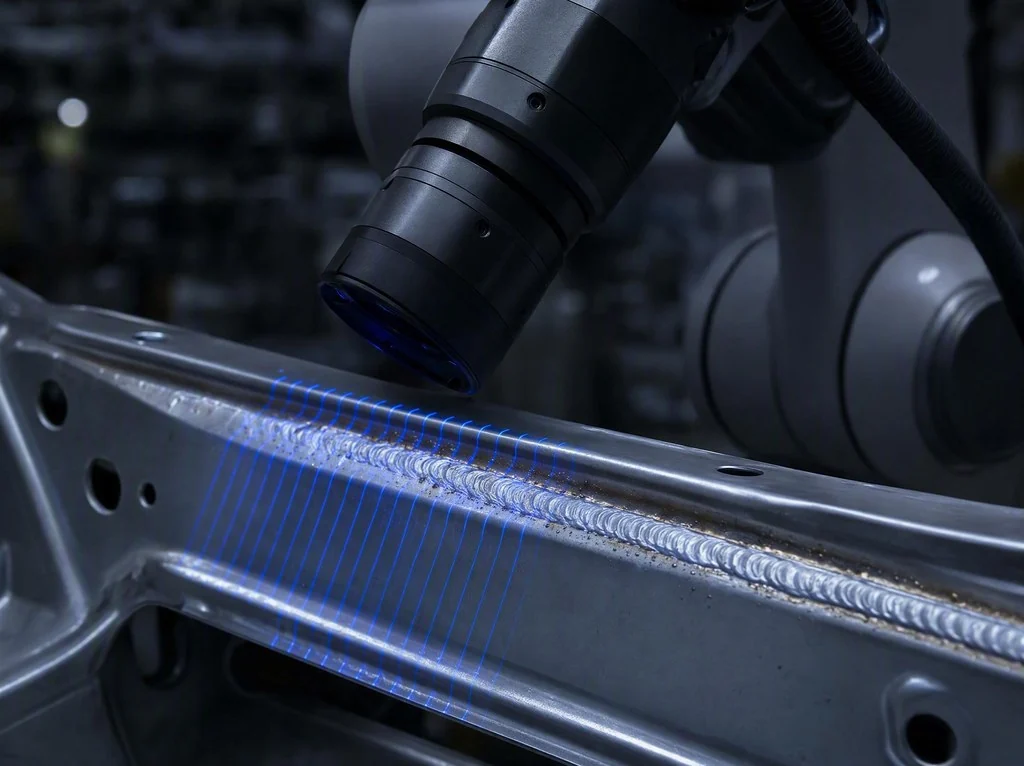
The quality of welds in white car bodies is directly related to the safety and reliability of the entire vehicle. In the current situation where traditional detection methods face many difficulties, WeLinkirt's deep-learning detection technology provides a new solution for the detection of welds in white car bodies.
Scenario: In the automotive manufacturing industry, the white car body serves as the basic framework of a vehicle, and its quality directly determines the structural strength and collision safety of the whole car. There are hundreds of welds distributed on the white car body. These welds are like the "lifelines" of the white car body, tightly connecting various body parts. However, the quality of welds is affected by multiple factors, such as welding technology, welding materials, and the external environment, which may lead to various weld defects. Therefore, accurate and efficient detection of welds is a crucial step in the automotive manufacturing process.
Pain Points: Why Is It Difficult?
In terms of defect morphology, the weld defects of white car bodies are complex and diverse. Cracks may appear in welds in different directions, lengths, and widths. Some cracks are so subtle that they are even difficult to detect with the naked eye. The situation of incomplete welding is manifested as insufficient filling in some areas of the weld, and its area and position also vary. Undercutting may be continuous or intermittent. The size, quantity, and distribution of pores are also ever-changing. Statistics show that in manual visual inspection, the missed detection rate due to complex defect morphology is as high as 15%.
Low contrast is also a prominent problem. The color and texture of the weld surface are similar to those of the surrounding base metal, making the contrast between defects and normal areas visually insignificant. Especially for some tiny defects, it is even more difficult to identify them under low-contrast conditions. This is like looking for a subtle difference in a sea of similar colors, posing great challenges to manual visual inspection. Relevant data show that the misjudgment rate due to low contrast reaches 12%.
It is difficult to unify the judgment criteria of different inspectors. Each inspector has their own work experience and judgment standards. Even when facing the same weld defect, different inspectors may have different judgment results. Moreover, during different work shifts, due to differences in the fatigue level and concentration of inspectors, this difference will be more obvious. It is estimated that the misdetection rate caused by inconsistent judgment criteria is about 10%. With the wide application of high-strength steel and galvanized sheets in the manufacturing of white car bodies, the reflection on the weld surface becomes stronger. Strong reflection will interfere with the inspector's line of sight, making it difficult for them to clearly observe the details of the weld, further increasing the difficulty of manual judgment and making it difficult to ensure the consistency of quality.
Technical Principle
WeLinkirt's DaoAI ACI (AI-AOI) surface defect detection system uses deep learning as its core technology. The technology collects a large number of weld samples to train the model repeatedly. These samples contain various types of weld defects, such as cracks, incomplete welds, undercutting, and pores. During the training process, the model learns the characteristic expressions of these typical defects, such as the line features of cracks and the area features of incomplete welds.
During actual detection, the system images each weld section by section. The imaging device uses a high-precision camera and an advanced optical system to clearly capture the details of the weld. Then, the system conducts reasoning and analysis on the imaging results, using the trained deep-learning model to automatically identify the category, location, and grade of the defect. Compared with traditional manual visual inspection methods, the deep-learning detection technology is not affected by subjective factors and can transform the subjective judgment that originally relied on experience into a unified and reproducible objective standard. At the same time, the system stores the results of each detection as traceable quality data, facilitating subsequent quality analysis and process improvement.
Typical Application Scenarios
- Crack detection: Cracks are one of the more serious defects in welds. The difficulty of crack detection lies in the subtlety and diversity of cracks. WeLinkirt's system can identify cracks in different directions, lengths, and widths through learning from a large number of crack samples. During the detection process, the system conducts high-precision feature extraction and analysis on the weld image, and even tiny cracks can be accurately detected. The difficulty lies in distinguishing cracks from the normal texture of the weld surface. The system improves the accuracy of crack recognition through continuous optimization of the deep-learning algorithm.
- Incomplete weld detection: Incomplete welds will affect the strength and sealing performance of the weld. During detection, the system conducts precise analysis on the filling area of the weld to determine whether the weld meets the specified filling standard. The difficulty lies in determining the boundary of the incomplete weld area. The system can accurately define the incomplete weld area and give the corresponding defect grade through image segmentation and feature matching technology.
- Undercutting detection: Undercutting will reduce the bearing capacity of the weld. WeLinkirt's system uses edge detection and image enhancement technology to highlight the characteristics of the undercutting area, thereby accurately identifying undercutting defects. The difficulty lies in distinguishing undercutting from the normal weld edge. The system learns the unique characteristics of undercutting through a large number of sample trainings, improving the accuracy of detection.
- Pore detection: The presence of pores will cause cavities inside the weld, affecting the quality of the weld. The system identifies the location and size of pores through gray-level analysis and morphological processing of the weld image. The difficulty lies in distinguishing pores from image noise. The system uses filtering and denoising algorithms to improve the detection accuracy of pores.
Implementation Case
A medium-sized body parts factory with an annual production of about 500,000 white car bodies mainly relied on manual visual inspection of weld appearance before. Before introducing WeLinkirt's DaoAI deep-learning vision detection system, the missed detection rate of welds in the factory was as high as 18%, and the misjudgment rate was 15%. The consistency of quality judgment between different shifts was poor. During the implementation process, WeLinkirt's technical team first conducted in-depth research on the factory's welding process and weld characteristics, and collected a large number of weld samples for model training. Then, the system was installed and debugged to ensure that it could be smoothly integrated with the factory's production line. After a period of trial operation and optimization, the system was officially launched.
Transform the experience in inspectors' minds into a unified, reproducible, and traceable standard in the model.
WeLinkirt's Solution and Product
WeLinkirt's DaoAI ACI surface defect detection system provides a comprehensive solution for the detection of welds in white car bodies. The system is centered around deep learning and can cover four types of typical weld defects, such as cracks, incomplete welds, undercutting, and pores. The system has unified judgment criteria, and the results remain consistent regardless of which shift the detection is carried out. At the same time, the system has a high degree of traceability. The detection results of each weld will be recorded in detail, facilitating subsequent cause-tracing analysis of processes and equipment. In addition, the system also has an automatic alarm function. When a serious defect is detected, it will issue an alarm in time to remind the operator to handle it.
Quantitative Results
After using the DaoAI system, the detection of weld defects in the factory has become more stable. The missed detection rate has dropped from the original 18% to 3%, a decrease of 83.3%. The misjudgment rate has been reduced from 15% to 2%, a decrease of 86.7%. The consistency of quality judgment has been significantly improved, and the difference in detection results between different shifts has been significantly reduced. At the same time, the defect data has also supported the continuous optimization of welding parameters. Through the analysis of defect data, the factory has adjusted parameters such as welding current and welding speed, further improving the quality of welds.
FAQ
Why not use manual visual inspection for weld detection in white car bodies?
The weld defects in white car bodies have complex morphologies and low contrast. It is difficult to unify the judgment criteria of different inspectors, resulting in both missed detections and misjudgments. The use of high-strength steel and galvanized sheets makes the weld surface more reflective, making manual judgment difficult and hard to ensure quality consistency. Statistics show that the missed detection rate due to complex morphologies is 15%, the misjudgment rate due to low contrast is 12%, and the misdetection rate due to inconsistent judgment criteria is 10%.
What are the advantages of DaoAI's weld detection system?
DaoAI is centered around deep learning and can cover four types of defects, such as cracks and incomplete welds. It has high accuracy and can significantly improve the detection rate of low-contrast defects. The judgment criteria are unified, and the results are consistent across different shifts. The data is traceable, transforming subjective judgment into objective standards and storing quality data for process improvement.
What effects did a body parts factory achieve after using the DaoAI system?
After using the DaoAI system, the detection of weld defects in the factory became more stable. The missed detection rate decreased from 18% to 3%, and the misjudgment rate decreased from 15% to 2%. The consistency of quality judgment was improved, and the difference in detection results between different shifts was reduced. The defect data also supported the continuous optimization of welding parameters, improving the quality of welds.
Full solution for this scenario: Automotive / parts industry solutions · Deep-Learning Inspection of Body-in-White Weld Seams
This article was generated by AI. Customer cases are simulated scenarios based on real product capabilities and figures are illustrative; see product pages for official benchmarks.