One general world model
A shared representation of physical reality: space, material, light, motion, causality. Four product lines run on the same foundation, the same self-training platform, the same compute scheduling layer.

OUR THESIS
Not "a large language model plus skills or agents." Language models are strong at composing symbols and knowledge. But manufacturing, robotics and surveillance ask a different question: how an object exists in three-dimensional space, how it moves, and why it moves that way — constraints that live in the physical world, not in a text corpus. Bolting tools onto a language model changes what it can call; it does not give it a representation of the physical world.
A shared representation of physical reality: space, material, light, motion, causality. Four product lines run on the same foundation, the same self-training platform, the same compute scheduling layer.
One small, fast model per scenario — inference at the edge, retrained from what that site actually sees. The small model owns precision and latency; the foundation keeps them all reading the same physical world.
Tool-calling answers "can it operate this." A world model answers "can it see what is there." A defect verdict, a grasp pose, a predicted trajectory are not retrieved — they are computed from 3D structure and physical law.
OUR APPROACH
At DaoAI, moving to a new scene does not mean retraining a bigger model. The base model takes a handful of good-part samples and amplifies them, under physical constraints, into enough training data. A 1–20 sample cold start, a model trained in 30 seconds, a vertical derived with zero lines of code — these follow from that approach, not from parameter count.
ONE FOUNDATION · DAOAI WORLD
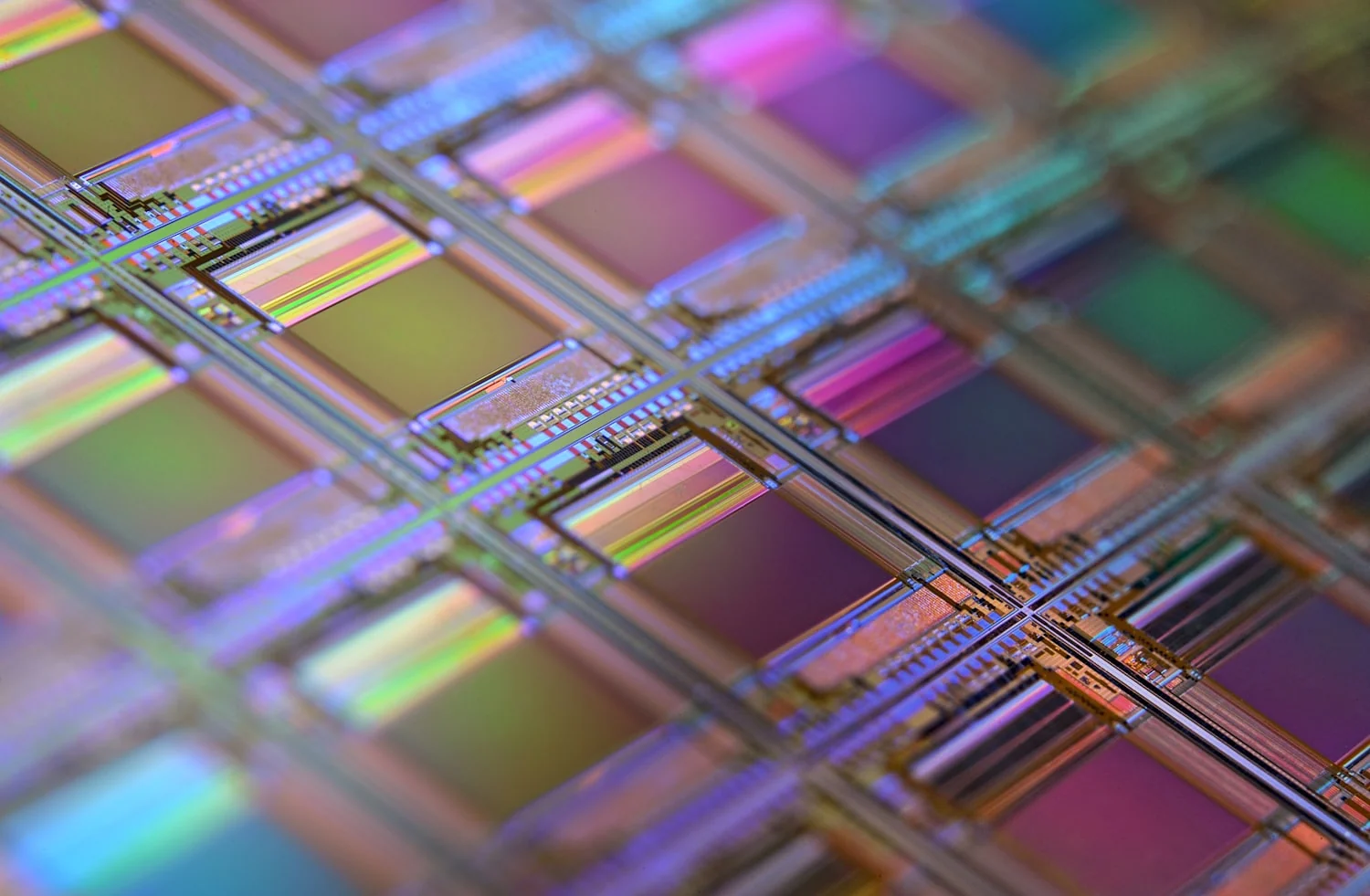
A conventional vision system solves one question at a time: is there a defect here, where is this point. DaoAI World holds space, material, light, motion and causality in a single model — which is why four product lines can share one foundation, and why the same system can move from line-side defect detection to quantitative analysis of electron-microscope images.
3D structure
Reconstructs a scene's geometry and scale from 2D pixels rather than template-matching on a plane. Our own 3D camera repeats to 4μm.
Reflective and black parts
DaoAI's 3D structured light plus HDR imaging — black, highly reflective and complex curved surfaces imaged cleanly in one shot, without powder spray or exposure stacking.
Changing conditions
The model recognises the object, not one particular pixel distribution, so shifting plant light or a new material batch doesn't mean starting over.
Pose and trajectory
Hand-eye calibration to ±0.05mm, recognition and locating in under a second, direct bin picking, no point-by-point teaching.
Why it moves that way
Infers how and why objects move by the laws of physics, turning "understanding" into something a robot can actually execute.
All four product lines share one foundation, one self-training platform and one compute-scheduling layer — from inspection and robot vision to SkyVision, and on to the generative side with Wemio.Explore DaoAI World
MANIFESTO · SOVEREIGN PHYSICAL AI
Chat, images, code — that's digital AI. Reading a defect, directing a robot, generating a world that obeys physics — that's physical AI. And physical AI lives on the line, inside the plant, where the data shouldn't take a single step outside.
DaoAI's answer is blunt: the whole system can run inside your own server room — data stays in the plant, the model trains itself, and the capability stays best-in-class. 100% on-premise · no public cloud required · flexible SDK / API / Docker integration.
WHY NOW
For government, transport and energy — critical information infrastructure — the revised Cybersecurity Law's localisation requirement is already a hard constraint. Sovereign AI has to hold three things at once: the data stays in your plant · you own the technology chain · you decide how it deploys. That is why we build the whole stack, from the sensor to the world model.
Line data stays inside your plant, meeting enterprise data-security and compliance needs.
3D structured light plus HDR imaging — black and reflective parts imaged cleanly in one shot, full stack in-house from sensor to world model.
Embeds into any equipment and your existing line systems — deployment shape and pace are yours to set.
THE CONSOLE
Review components, judge defects, compare against golden. Three real DaoAI World workflows. Click a tab.
 OK
OK
OK
OK
Good
A thumbnail grid to walk the batch. Selection is green-bordered, verdicts sit on the image — the operator only confirms or overrides.
Polarity, offset and missing-part checks all within tolerance.
 Bridge
Particle
Bridge
Bridge
Particle
Not good · review
Surface defects overlay the original image, coloured by class. Threshold sliders are adjustable on the line and take effect immediately — no retraining.
Two solder bridges and one foreign particle — rework recommended.
 R12 missing
C7 offset
R12 missing
C7 offset
Defective
Side by side: the current sample against the golden reference, with differences boxed automatically — this is what "model from one good sample" looks like in the UI.
R12 missing and C7 offset out of tolerance — defective.
Interface illustration — shown to explain the workflow and verdict logic. Values are demonstration samples, not any single customer's real batch data.
ONE FOUNDATION · FOUR PRODUCT LINES
Space, material, light, motion, causality — DaoAI World understands them together, which is why reading manufacturing · guiding robots · reading cities · generating content all run on the same foundation.
Manufacturing · Inspection
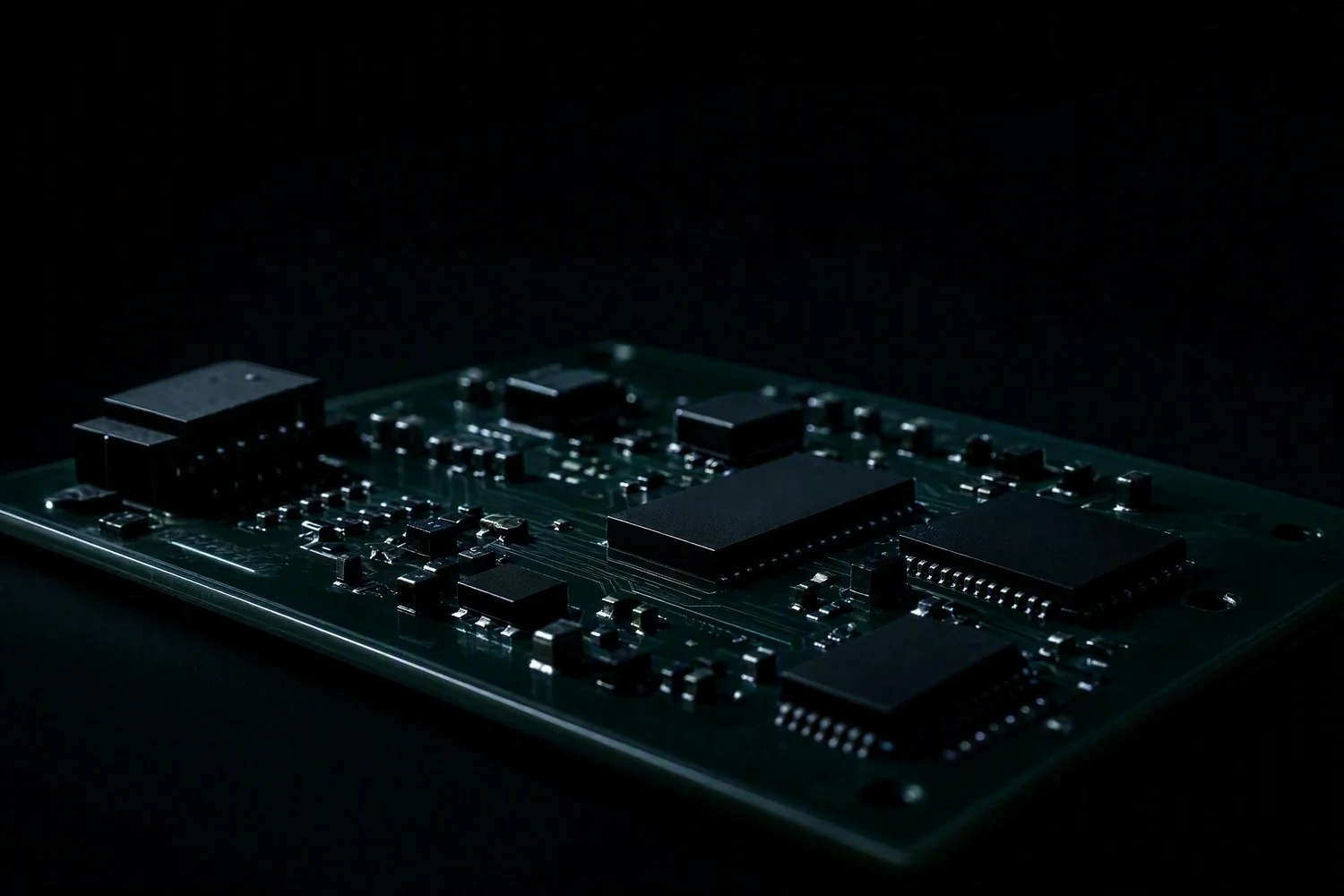
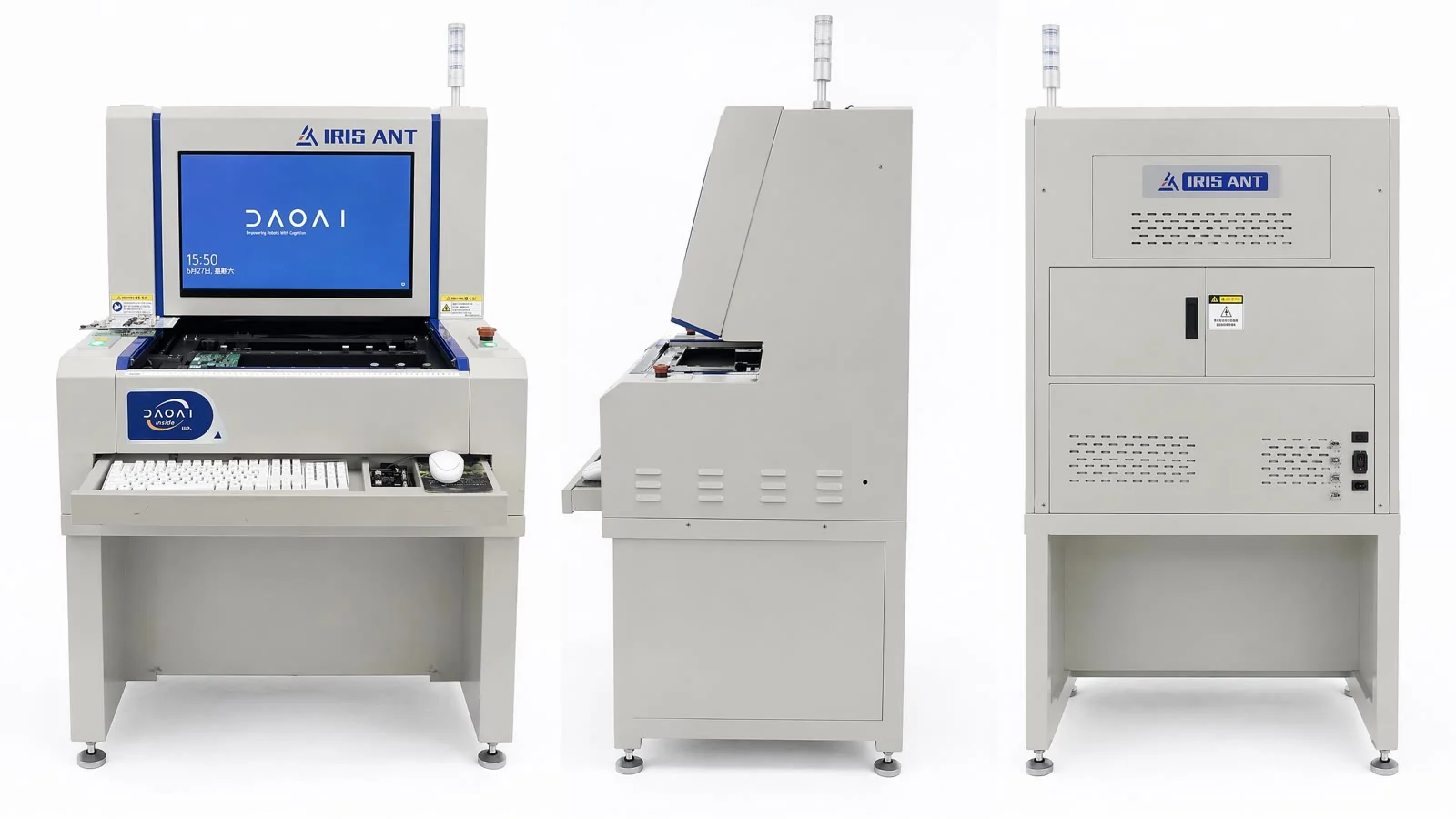
Traditional AOI runs on hand-written rules and thousands of defect samples, reprogrammed board by board. We use feature cognition from a visual foundation model: one good sample to start, then line feedback flows back and it keeps sharpening.
No CAD drawings, no pre-collected defect library
Auto-programs and goes live in about 5 minutes — operators run it themselves
PCBA / SMT / semiconductor / display / connector inspection
Smart mfg · Robotics
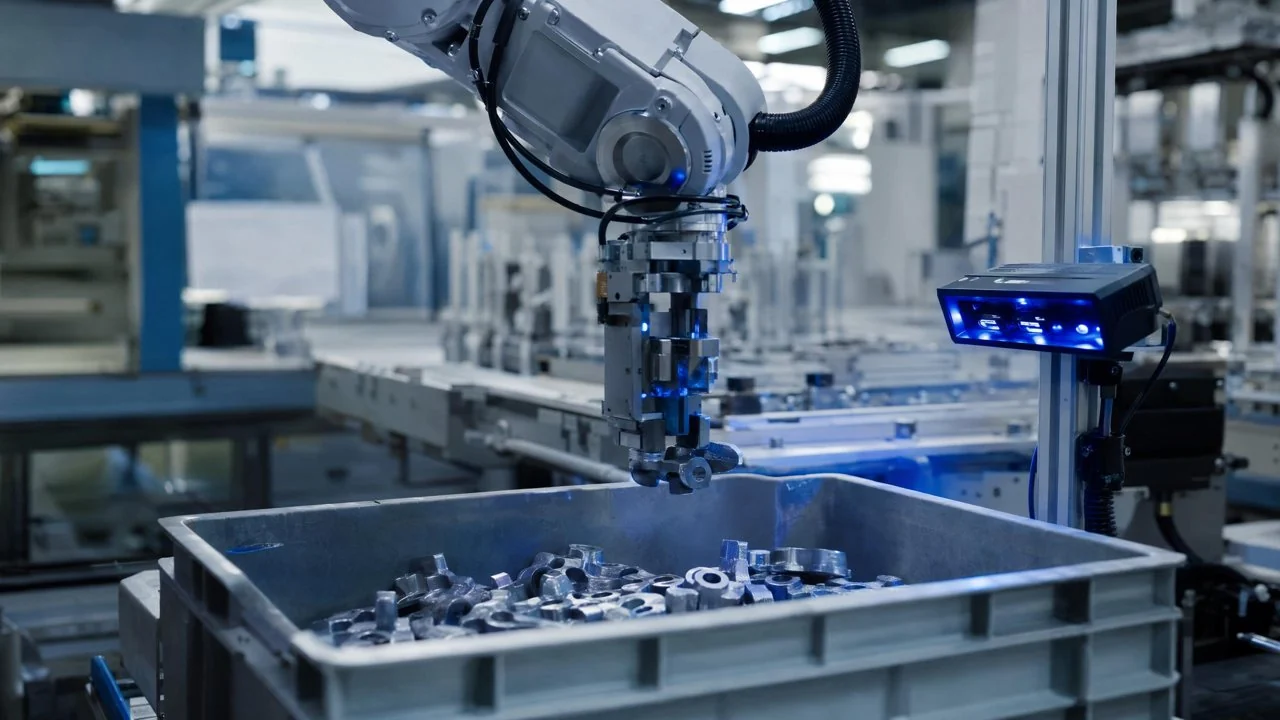
Eyes that understand space. 3D-vision-guided picking, machine tending and direct bin picking — it reads the scene, plans its own path, and holds sub-millimetre hand-eye coordination.
Stable on reflective metal, black parts and complex curved surfaces
Works with structured-light / ToF / stereo input, no point-by-point teaching
Works with major robot brands — inspection and guidance share one foundation
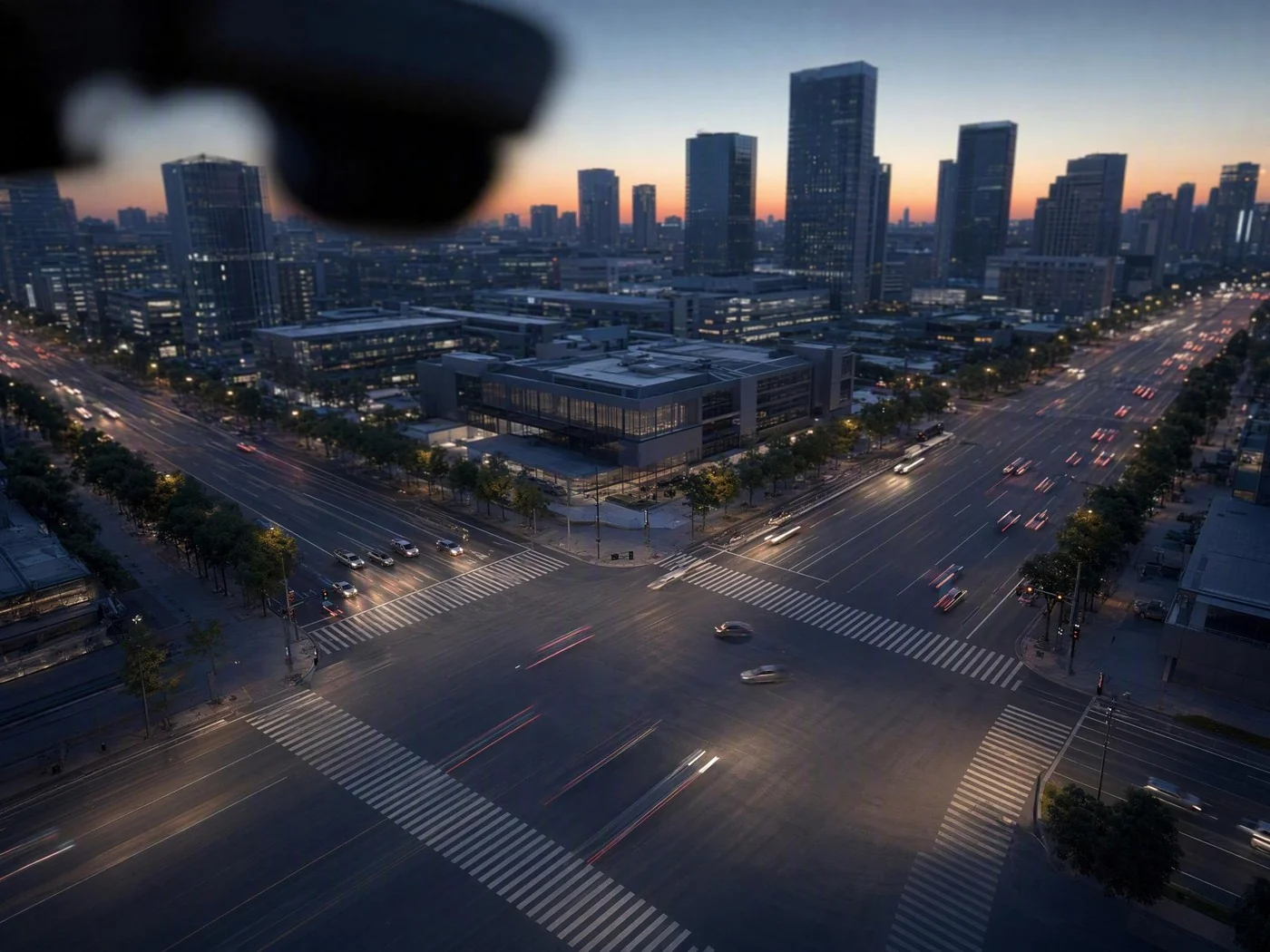
Cities · Surveillance
A no-code visual AI platform. A few on-site sample images, a few minutes of training, edge inference — the video stream never leaves your network, and it reuses the cameras you already have.
No code: your own staff label, train and deploy
Edge deployment — video never leaves the local network
Works with existing cameras and NVRs, low retrofit cost
Forward-looking · Content
A content platform for corporate marketing teams — company IP, brand films, founder IP, product explainers and company story dramas, all in one workspace. It is also the same foundation extended toward generative work: inspection is a discriminative vision task and video generation is a generative one — their model objectives and evaluation regimes could hardly differ more, so one foundation reaching both ends is our own test of the cross-task-family reuse claim. This line is in forward-looking R&D.
Characters and sets hold across shots — no restarting every take
Motion under physical constraints: no drift, no clipping
Script to final cut to multilingual release, one agent pipeline

NEXT FRONTIER
After language, AI's next door is understanding the 3D physical world. From 2025 to 2027 we work on one thing — machines that truly perceive space, reason about cause and effect, and interact with precision.
From 2D pixels to 3D modelling — reconstructing a scene's geometry, materials and structural relationships.
Infer how and why objects move, reasoning about cause and consequence by the laws of physics.
Turn understanding into action — guiding robots to micron-level interaction in the real world.
Illustrative visualisation — a live point cloud once a camera is connected.
CUSTOMERS
Multinational and tier-one manufacturers vet inspection suppliers hard; once you are in, it turns into multi-year repeat business and plant-to-plant replication. Every credential and case below is backed by a certificate or a signed contract.
Concentrated in 3D measurement error compensation, structured-light calibration, depth-order reasoning, surface-defect detection and robot end-effector position compensation.
Also certified as a National High-Tech Enterprise and a Zhongguancun High-Tech Enterprise, with first-unit and Beijing new-technology product certificates.
Selected for "industrial inspection agent built on a visual foundation model"; SkyVision was separately named one of 26 national industrial-AI scenarios.
Delivered for a leading international chemicals group: quantitative analysis of electron-microscope crystal images — three models trained from scratch in about two months, deployed inside the customer's own network.
FLAGSHIP CUSTOMERS · UNDER CONTRACT
ECOSYSTEM & PILOTS
PARTNERS
THE MOAT
Peers do algorithms or hardware; we build the whole stack ourselves — from sensor and 3D imaging to the world model. One flywheel feeds all four product lines.
Feedback from real lines and real scenes is not something money can buy.
Eight years on plant floors, line by line, is engineering experience that accumulates slowly.
Full-stack in-house — from sensor to world model, we own the whole chain.
Hundreds of millions of real industrial samples, all sharpening the same world model.
On top of those real samples, DaoAI World amplifies training data 2–10× under physical constraints — being able to generate physically valid samples is itself proof that the model understands physics.
32 granted patents (15 of them inventions) plus 96 software copyrights, every one verified against its certificate.
Co-author of two industry standards: humanoid-robot perception and motion control, and general technical requirements for industrial robot vision systems.
FEATURED
From the world model to the Series B — the path we took.

WAIC 2026 turned toward physical AI: when AI enters the physical world, the real engine is a world model that reads three-dimensional space.
Read more
Xinhua reports: WeLinkirt closed a Series B led by the Chongqing Industry Guidance Fund, built on its own DaoAI World model.
Read more
Xinhua's "AI Insight": 2026 is the starting point for physical AI at scale — it has a verifiable commercial loop and real hardware to land on.
Read moreFAQ
WeLinkirt (DaoAI) is a physical-AI company. Its DaoAI World foundation model powers four product lines — industrial ACI inspection, robotic vision, SkyVision intelligent surveillance and Wemio content creation — all focused on making AI work reliably in the real physical world.
Traditional AOI relies on hand-written rules or thousands of defect samples and per-board manual programming. DaoAI uses feature cognition from a visual foundation model: it models from a single good sample — no CAD, no defect-image library — and keeps learning from line feedback, getting sharper with use.
The software auto-programs and goes live in about 5 minutes from a single good sample — no CAD drawings and no pre-collected defect library — and line operators can run it themselves.
No cloud required. DaoAI supports 100% on-premise (private) deployment, keeping line data on site, with flexible SDK / API / Docker integration to meet enterprise data-security and compliance needs.
Four product lines — industrial ACI inspection (ACI OS plus 2D and 3D ACI systems), robotic vision, SkyVision intelligent surveillance, and Wemio content creation — all built on the unified DaoAI World foundation model.
Electronics / PCBA, semiconductor, automotive and parts, EV battery, pharma, food and agriculture, chemical, and consumer goods and general manufacturing.
GET IN TOUCH
Manufacturing, city governance or content — we'd like to talk. Bring one good sample and we can build the model on the spot.