
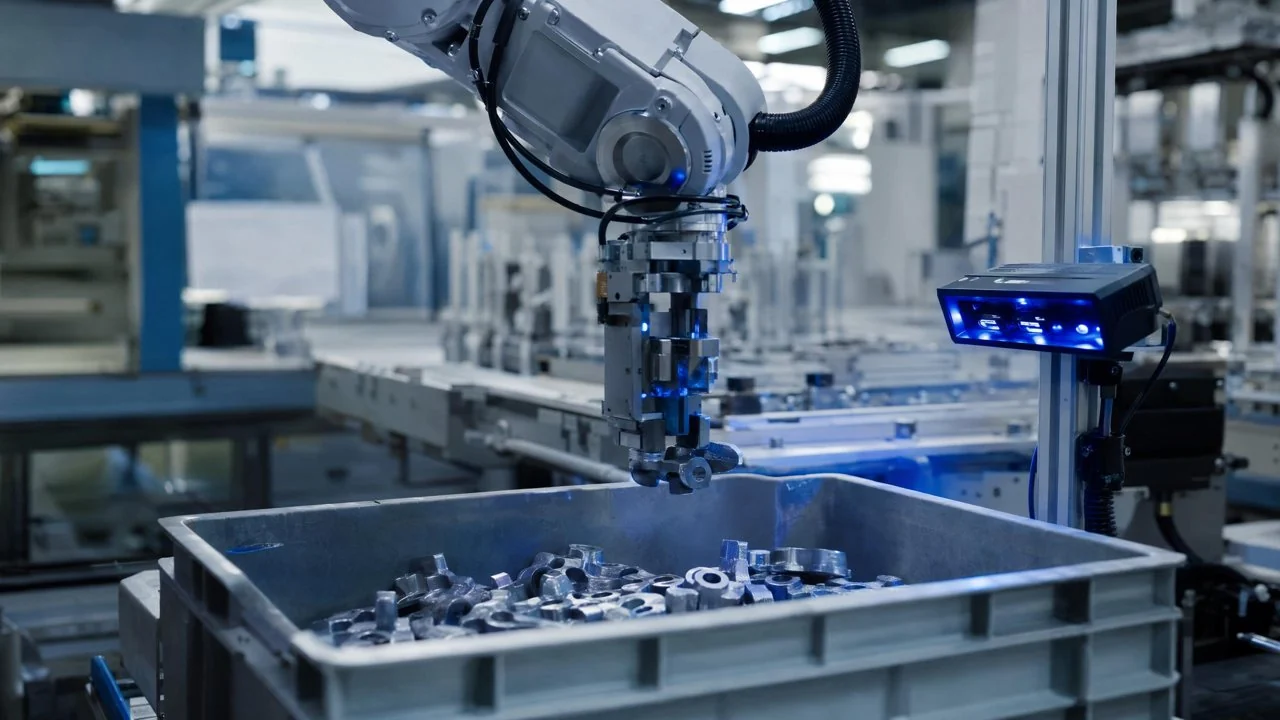
In the component manufacturing industry, the feeding process may seem simple, but in fact, it hides many challenges. Especially for parts that are randomly stacked and have smooth, featureless surfaces, traditional automation solutions often fail. DaoAI 3D vision technology from WeLinkirt provides an effective solution to this problem.
On the production lines of the component manufacturing industry, bin picking is a common and important process. Products such as metal structural parts produced by component factories are usually stored in bins in bulk form, waiting for the feeding operation. These parts are randomly stacked in the bins, with random spatial poses, some of them are mutually occluded, and many parts have smooth and reflective surfaces, lacking identifiable texture features. This complex scenario poses extremely high requirements for automated feeding, and traditional methods are difficult to meet the efficiency and accuracy requirements of production.
Pain Points: Why is it Difficult?
From the perspective of the parts' placement state, they are disordered in the bins, with random poses and layered occlusion. This makes it difficult for robots to directly locate the accurate position and pose of each part. Statistics show that in this situation, the picking success rate of traditional automation solutions may be as low as less than 50%. This means that the robot has a 50% probability of failing to pick the target part accurately, seriously affecting production efficiency.
Analyzing from the surface features of the parts, many metal structural parts have smooth and reflective surfaces, lacking obvious texture features. Traditional 2D vision technology mainly relies on the planar position and texture information of the parts for recognition. However, for these smooth and featureless parts, 2D vision can only provide the planar position and cannot judge the flipping and tilting of the parts. This leads to frequent slipping, box-hitting or empty-picking situations during the robot's picking process, and the automation solutions have been shelved many times. On some production lines, the error of manual observation of the part's pose may reach ±10°, which further aggravates the difficulty of picking.
From the perspective of the production cycle, the traditional feeding method has high labor intensity and unstable cycle. Manual bending to pick parts is not only inefficient, but also the long-term repetitive labor can easily lead to worker fatigue, and the production cycle fluctuates greatly, possibly between 10-20 seconds per piece, which cannot meet the needs of large-scale and high-efficiency production.
Technical Principle
DaoAI 3D vision technology from WeLinkirt uses a self-developed 3D camera, which can image a whole box of parts at once and generate high-density point clouds. The high-density point clouds contain rich three-dimensional information of the parts, providing a basis for subsequent accurate recognition and pose estimation.
At the algorithm level, the algorithm driven by the DaoAI World model plays a key role. This algorithm directly estimates the 6D pose of each part, that is, the three-dimensional position and three-dimensional attitude. Different from the traditional 2D vision method, it does not rely on the texture features of the parts, but recognizes based on the three-dimensional shape. Even under working conditions with no obvious feature points and strong reflection, it can stably recognize the pose of the parts through accurate analysis of the three-dimensional shape.
Based on the estimated 6D pose, the system plans the collision-free picking path and picking sequence. It will automatically avoid the bin wall and adjacent parts to protect the fixture and the workpiece. The robot picks parts layer by layer from the surface to the inside according to the planned path and sequence, realizing real random picking. Compared with traditional methods, this technology can locate parts more accurately and avoid picking failures caused by inaccurate pose judgment.
Typical Application Scenarios
- Picking reflective parts: For metal parts with smooth and reflective surfaces, traditional vision technology has difficulty in recognizing their features. DaoAI 3D vision can accurately estimate the 6D pose of the parts and achieve stable picking by generating high-density point clouds and analyzing the three-dimensional shape. The difficulty lies in overcoming the interference of reflection on imaging and accurately extracting the shape information of the parts.
- Picking occluded parts: When parts are mutually occluded in the bin, it is difficult for traditional methods to judge the pose of the occluded parts. DaoAI technology can identify some features of the occluded parts through the analysis of the overall point cloud, and then estimate their 6D pose and plan a reasonable picking path. The difficulty lies in accurately restoring the shape and position of the occluded part.
- Picking parts attached to the bin wall: When parts are attached to the bin wall, the judgment of their pose and position is relatively complex. The DaoAI system can accurately identify the relative position of the part and the bin wall and plan a collision-free picking path to ensure safe picking. The difficulty lies in considering the restrictions of the bin wall on the picking operation.
- Picking parts with complex poses: Some parts have very complex poses, such as large tilting and flipping angles. The 6D pose estimation algorithm of DaoAI can accurately capture these complex poses and provide precise picking guidance for the robot. The difficulty lies in accurately modeling and analyzing the complex poses.
Implementation Case
A medium-sized component factory, which mainly produces various metal structural parts, faced the problem of random bin picking in the production process. The factory had tried a variety of traditional automation solutions before, but all failed due to low picking success rate and unstable cycle, and could only rely on manual labor for feeding.
After introducing DaoAI 3D vision technology from WeLinkirt, the project team first conducted a detailed investigation and analysis of the factory's production environment and part characteristics, and customized the system according to the actual situation. After a period of debugging and optimization, the system was successfully launched.
Before the launch, the picking success rate of the factory was less than 60%, the production cycle fluctuated between 10-20 seconds per piece, and the manual labor intensity was high and the efficiency was low. After the launch, the picking success rate reached over 99%, the production cycle was stabilized at 4-8 seconds per piece, and the feeding process was unmanned.
WeLinkirt's Solution and Products
WeLinkirt's DaoAI 3D vision solution is mainly composed of a self-developed 3D camera and an algorithm driven by the DaoAI World model. The 3D camera can quickly and accurately generate high-density point clouds, providing rich data for subsequent processing. The DaoAI World algorithm uses these point cloud data to achieve precise estimation of the 6D pose of parts and collision-free path planning.
This solution has high flexibility and adaptability, and can be customized according to different production scenarios and part characteristics. Whether it is a reflective, occluded or complex-posed part, it can achieve efficient and accurate picking. At the same time, the system is simple and convenient to operate, easy to maintain and manage, and can save a large amount of manpower and material costs for enterprises.
Quantitative Results
By using DaoAI 3D vision technology from WeLinkirt, the enterprise has achieved significant results in many aspects. In terms of the picking success rate, it has increased from less than 60% to over 99%, greatly improving the stability and reliability of production. In terms of the production cycle, it has been shortened from 10-20 seconds per piece to 4-8 seconds per piece, and the production efficiency has been greatly improved. In addition, the feeding process has been unmanned, and the manual labor has been liberated from repetitive bending and picking, reducing the labor intensity and also reducing the errors and uncertainties caused by manual operation, improving the product quality.
FAQ
Why is bin picking a difficult problem on the production line?
The parts in the bin are randomly stacked and mutually occluded, and their surfaces are smooth and featureless. Traditional 2D vision cannot judge the flipping and tilting of the parts, and the robot is prone to slipping, hitting the bin or empty-picking during the picking process. This makes it difficult to implement automation solutions, and manual operation has high labor intensity and unstable cycle. Therefore, bin picking has become a difficult problem on the production line.
How does DaoAI 3D vision solve the bin picking problem?
DaoAI's self-developed 3D camera generates high-density point clouds, and the algorithm driven by the DaoAI World model estimates the 6D pose of the parts. The system plans the collision-free path and sequence based on this, realizing random picking. It can stably recognize parts even under working conditions with no obvious feature points and strong reflection, and the success rate is over 99%.
What are the effects of using DaoAI 3D vision for feeding?
After using this technology, the feeding step of this process becomes unmanned, and the downstream equipment will not stop due to empty-picking. The overall cycle is controllable. Manual labor is liberated from repetitive bending and picking, and the production efficiency and stability are improved. The picking success rate has increased from less than 60% to over 99%, and the cycle has been shortened from 10-20 seconds per piece to 4-8 seconds per piece.
Full solution for this scenario: the full inspection solution for Automotive / parts · Random Bin Picking: 6D Pose-Guided Grasping for Featureless Parts
This article was generated by AI. Customer cases are simulated scenarios based on real product capabilities and figures are illustrative; see product pages for official benchmarks.