
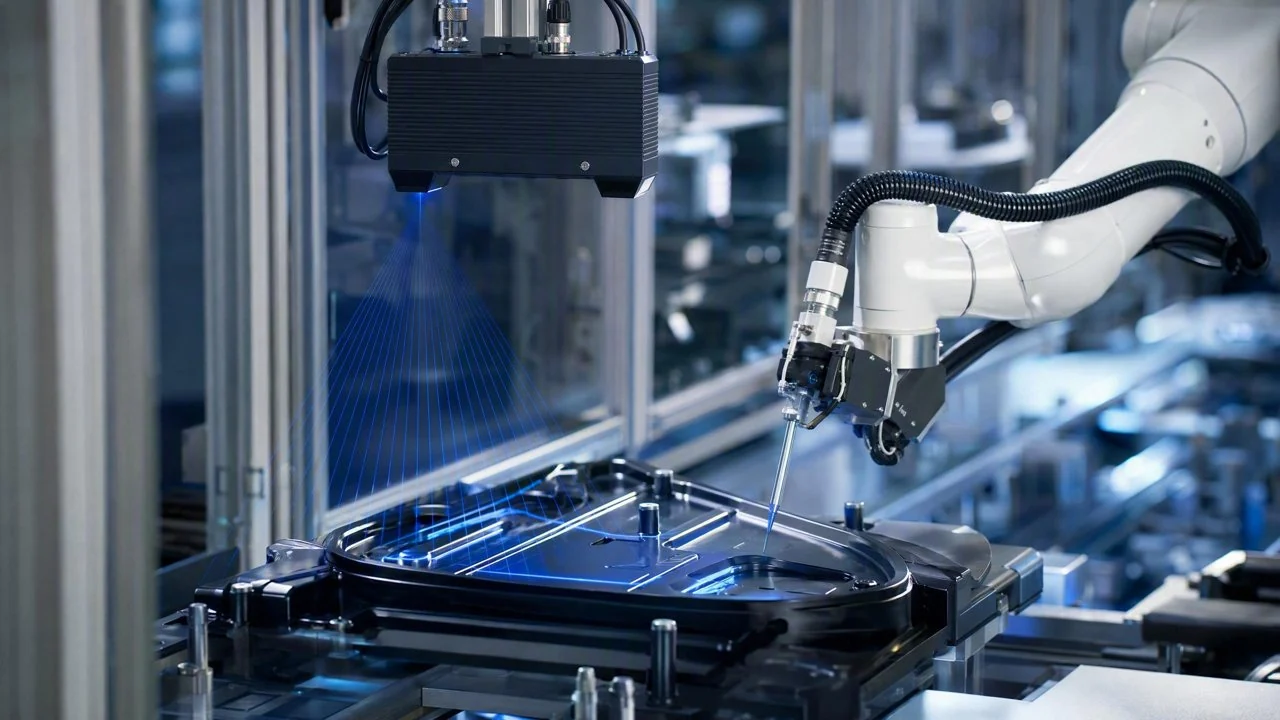
Glue application is the first line of defense for vehicle body sealing and NVH (Noise, Vibration, and Harshness). Its quality directly affects the waterproof, dustproof, and NVH performance of the whole vehicle. However, traditional glue detection methods have many drawbacks. A Tier-1 supplier has achieved a major breakthrough in glue detection by introducing the DaoAI 3D robot vision technology of WeLinkirt.
In the automotive manufacturing industry, glue sealing is a crucial process. It not only relates to the waterproof and dustproof performance of the vehicle body but also plays a key role in the NVH performance of the vehicle. Glue application is like an invisible armor for the vehicle body, silently protecting the comfortable environment inside the vehicle. For automotive parts suppliers, especially Tier-1 suppliers, who provide key parts to vehicle manufacturers, the quality of glue sealing directly affects the quality and reliability of the final product. In production processes such as door and lid sealing lines, the quality of glue application cannot be ignored. Once there are problems with glue application, it may lead to problems such as water leakage and abnormal noise during the use of the vehicle, causing great trouble to users and also affecting the brand image and market competitiveness of the enterprise.
Pain Points: Why Is It Difficult?
Traditional glue detection methods have obvious limitations. First of all, in terms of detection accuracy, relying on manual sampling inspection and visual confirmation at the end of the production cycle, it is difficult to ensure the accuracy of detection. Manual sampling inspection can only cover a part of the products, and there are a large number of blind spots in sampling. The glue width accuracy can only reach the millimeter level, while in actual production, even a small deviation in the glue width may have an impact on the sealing performance. For example, when the glue width deviation exceeds ±0.5mm, it may lead to poor sealing and water leakage problems. Secondly, in terms of detection efficiency, manual detection is slow and cannot meet the needs of large-scale production. Moreover, this post-detection method, once a problem is found, the products often have flowed into the final assembly process, resulting in extremely high rework costs. According to statistics, under the traditional detection method, the rework cost may increase several times. In addition, the slight position deviation of the incoming workpieces is also a difficult problem. The glue-applying robot with a fixed trajectory cannot adapt to this deviation and is prone to applying the glue in the wrong position, resulting in glue shape defects. The root cause of these problems lies in the lack of real-time and intelligent features in traditional detection methods, which are unable to effectively monitor and adjust the glue-applying process.
In addition, glue shape defects are often difficult to distinguish with the naked eye. Problems such as glue breaks, missed coating, and uneven glue width are not easily detected in the production process. Even during visual confirmation, there may be omissions due to subjective factors and visual errors. Moreover, traditional detection methods cannot accurately detect the continuity of the glue strip, and it is difficult to detect some small breakpoints and gaps, which lays hidden dangers for subsequent quality problems.
Technical Principle
WeLinkirt's DaoAI 3D robot vision technology uses advanced algorithms and hardware mechanisms. DaoAI deploys a self-developed 3D camera that moves with the glue-applying robot. This camera can perform point - by - point three-dimensional contour reconstruction of the glue strip. The principle is to emit specific light and use the reflection and scattering of the light on the surface of the glue strip to obtain three-dimensional information of the glue strip. Then, advanced algorithms are used to process this information and calculate parameters such as glue width, glue height, and continuity in real-time. The vision system, as the “eye”, transmits the detected deviation information back to the decision-making unit, which acts as the “brain”. The decision-making unit, based on this deviation information, performs complex algorithm operations to generate corresponding control instructions, and drives the robot, which acts as the “body”, to perform real-time correction in the next trajectory. This brain-eye-body closed-loop working mode achieves closed-loop control with sub-millimeter-level hand-eye coordination.
Compared with traditional methods, this technology has obvious advantages. Traditional methods rely on manual judgment and fixed trajectories, lacking real-time and accuracy. DaoAI 3D robot vision technology can detect glue shape defects in real-time and accurately, and correct them in time. The detection is completed simultaneously with the glue application without occupying additional production cycles, greatly improving production efficiency. At the same time, this technology can also record and analyze the quality data of the glue strip in real-time, providing a strong basis for subsequent process optimization.
Typical Application Scenarios
- Glue break detection: For glue break problems, the DaoAI 3D camera can accurately detect the continuity of the glue strip through point - by - point three-dimensional contour reconstruction. When a continuity breakpoint is detected, the system will immediately alarm and mark the coordinates. The difficulty lies in that some small breakpoints may be difficult to detect, and high-precision cameras and algorithms are required to ensure the accuracy of detection.
- Missed coating detection: Missed coating situations can be judged by comparing the actually detected glue strip contour with the preset standard contour. If the system detects that there is no glue strip in a certain area, it will immediately identify it as missed coating and issue an alarm. The difficulty lies in how to accurately distinguish the normal boundary of the glue strip from the missed coating area to avoid false judgments.
- Uneven glue width detection: DaoAI can calculate the glue width in real-time and compare it with the preset glue width standard. When the glue width exceeds the tolerance range of ±0.5mm, the system will automatically determine that the glue width exceeds the standard and record the relevant data. The difficulty lies in that there may be some irregular textures and fluctuations on the surface of the glue strip, and algorithms are required for filtering and processing to accurately measure the glue width.
- Glue overflow detection at the start and end: At the start and end positions of the glue strip, glue overflow is likely to occur. The DaoAI 3D camera can focus on these positions and judge whether there is glue overflow by analyzing the shape and size of the glue strip. The difficulty lies in that the shape of the glue strip at the start and end positions is relatively complex, and special algorithms are required for accurate detection.
Implementation Case
A Tier-1 automotive parts supplier has a certain-scale production workshop and multiple door and lid sealing lines. Before introducing the DaoAI 3D robot vision technology, the supplier's glue detection mainly relied on manual sampling inspection and visual confirmation, and there were a large number of quality problems. During the implementation process, the WeLinkirt team first conducted a detailed investigation and analysis of the supplier's production process, and carried out customized development and deployment of the system according to the actual situation. After a period of debugging and optimization, the system was officially put into operation. Before the implementation, problems such as glue breaks and missed coating occurred frequently in the production line, the downstream rework rate was relatively high, and water leakage complaints also occurred from time to time. After the implementation, the situation has been significantly improved. The detection rate of defects such as glue breaks and missed coating has increased from the original 70% to over 99%, the false alarm rate has decreased from 15% to below 3%, and the missed detection rate has decreased from 30% to below 1%.
“The DaoAI 3D robot vision technology has brought new changes to our glue detection. It not only improves product quality but also reduces production costs.” - A person in charge of a Tier-1 supplier
WeLinkirt's Solution and Product
WeLinkirt's DaoAI 3D robot vision solution is a complete glue sealing detection system. The system includes core components such as a self-developed 3D camera, a decision-making unit, and a robot control module. The 3D camera has the characteristics of high precision and high speed and can obtain three-dimensional information of the glue strip in real-time. The decision-making unit uses advanced algorithms to quickly process and analyze the detection data and generate accurate control instructions. The robot control module can drive the robot to perform real-time correction according to the instructions of the decision-making unit. In addition, the system also has data management and analysis functions, which can record and trace the glue quality data in real-time and provide strong support for the enterprise's quality management.
Quantitative results: By introducing the DaoAI 3D robot vision technology, the downstream rework related to the sealing glue in the production line has been significantly reduced, and the rework rate has decreased by more than 80%. Water leakage complaints are approaching zero, from several cases per month to almost zero. The quality data can be traced piece by piece, providing first-hand information for subsequent process optimization. At the same time, the detection efficiency has been greatly improved, the production cycle is not affected, and the production efficiency and economic benefits of the enterprise have been significantly improved.
FAQ
How does DaoAI help a Tier-1 supplier improve the glue sealing detection effect?
DaoAI deploys a self-developed 3D camera that moves with the glue-applying robot. It performs point - by - point three-dimensional contour reconstruction of the glue strip and calculates parameters such as glue width, glue height, and continuity in real-time. The vision system transmits the deviation information back to the decision-making unit, which drives the robot to perform real-time correction, achieving 100% online detection and thus improving the detection effect.
What were the problems with the original glue detection method of a Tier-1 supplier?
Previously, it relied on manual sampling inspection and visual confirmation. Problems such as glue breaks and missed coating could only be found after the fact. Once the products flowed into the final assembly, the rework cost and the risk of water leakage complaints increased significantly. The position deviation of the workpieces could also cause the glue-applying robot to apply the glue in the wrong position. Moreover, the accuracy of manual detection was limited, and there were a large number of sampling blind spots.
What are the effects after the DaoAI glue sealing detection system is put into operation?
The downstream rework related to the sealing glue in the production line has been significantly reduced, with the rework rate decreasing by more than 80%. Water leakage complaints are approaching zero. The quality data can be traced piece by piece, providing first-hand information for subsequent process optimization. At the same time, the production efficiency has been improved.
Full solution for this scenario: Automotive / parts industry solutions · 100% Inline 3D Inspection & Path Correction for Automotive Glue Dispensing
This article was generated by AI. Customer cases are simulated scenarios based on real product capabilities and figures are illustrative; see product pages for official benchmarks.