
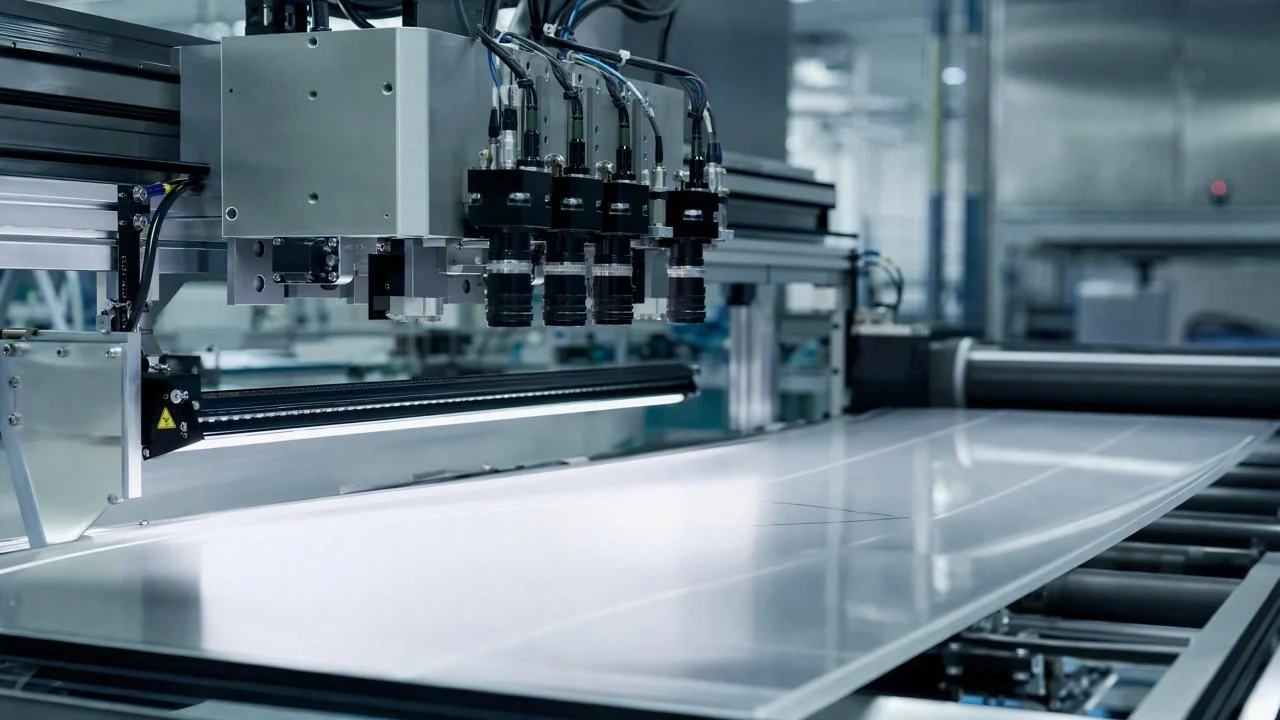
DaoAI AI AOI software system (featuring visual foundation model for feature recognition, 5-minute zero-code programming with one good sample, APDT positive/few-shot learning with 1–20 good samples, semantic false positive filtering, and SDK/API/Docker support for 100% on-premise private deployment) leveraged its industry-leading unsupervised learning and local private deployment capabilities to successfully achieve precise anomaly detection of micro-bubbles and scratches on complex textured surfaces for a leading chemical material manufacturer's specialty film production line. It reduced the traditional manual inspection's false negative rate from 1.2% to <0.3%, while ensuring 100% of core production data remained on-premises, perfectly meeting the client's dual demands for data security and efficient quality inspection.
In the chemical and materials industries, especially in fields like specialty films, composite materials, and functional coatings, product surfaces often exhibit complex and varied textured structures. These textures are an inherent part of the product's function or process characteristics, not defects themselves. However, against these textured backgrounds, tiny foreign objects, bubbles, scratches, indentations, or coating irregularities pose serious threats to product performance and final application. Traditional rule-based AOI systems struggle to differentiate between normal textures and true defects, leading to a high rate of false positives or missed detections. Manual visual inspection is inefficient and highly susceptible to subjective factors. More critically, for chemical material enterprises involved in new material R&D, customized production, or military-grade components, production data, process parameters, and defect samples are considered core trade secrets, strictly prohibiting data from leaving the factory or being uploaded to the cloud. Therefore, achieving high-precision, unsupervised anomaly detection on complex textured surfaces while ensuring data security has become a common and urgent challenge in the industry.
Pain Points: Why This Hurdle Is So Difficult to Overcome
Anomaly detection on textured surfaces in the chemical materials industry faces multiple challenges: First, **defects are rare and diverse**; many occur only once in millions of products and vary widely in form, making it difficult to collect sufficient defect samples for supervised training. Second, **complex textured backgrounds**—the material's natural texture, stretch marks, mold patterns, etc.—are visually highly similar to actual defects, leading to persistently high false positive rates for traditional rule-based AOI systems. A leading manufacturer in specialty film production reported that manual re-inspection due to texture interference accounted for as much as 85% of their total re-inspection volume, significantly slowing down production rhythm. Third, **data security compliance** is paramount, especially for classified materials or core technology products, where no production data (including image data) is ever allowed to leave the local network. This renders AI solutions relying on cloud training or third-party data centers unfeasible. Fourth, **high changeover and iteration costs**; minor adjustments to material formulations, thickness, or surface treatment processes can alter texture characteristics, requiring traditional AOI systems to spend hours or even days of downtime for rule rewriting or model retraining, impacting production flexibility.
The root cause of these difficulties lies in the challenges industrial AI faces in data acquisition and model generalization within visual quality inspection scenarios. Data for rare defects is hard to obtain, making it difficult for models to learn effectively; complex and variable textured backgrounds test the model's generalization ability, making it hard to maintain stable performance across different batches and process parameters. Simultaneously, data security and local deployment requirements further restrict the application of general cloud-based AI models, forcing enterprises to seek solutions that can operate efficiently in a local network environment and handle few-shot or even zero-shot learning.
Technical Principles
The DaoAI AI AOI software system addresses unsupervised anomaly detection on textured surfaces primarily through its **visual foundation model for feature recognition** and **APDT positive/few-shot learning** mechanism. The system first utilizes large-scale pre-trained visual foundation models to perform deep feature extraction and representation learning on textured images of chemical materials. These foundation models have learned vast amounts of general visual knowledge, enabling them to capture subtle structural and textural information in images, differentiating between normal and anomalous patterns.
Specifically, the DaoAI AI AOI software system builds a “digital twin” model of normal textures, learning and memorizing the distribution patterns of normal textures with as few as **1–20 good samples**. When new product images are input, the system calculates their deviation from the normal pattern and flags any parts exceeding a preset threshold as anomalies. This **unsupervised learning** characteristic perfectly solves the problem of unlabeled data for rare defects. Furthermore, its integrated **semantic false positive filtering** module can further learn and identify common normal texture variations (e.g., ripple marks, slight stretch marks), distinguishing them from true defects, significantly reducing false positive rates. Unlike traditional rule-based AOI that requires manual definition of numerous complex thresholds and geometric rules, the DaoAI AI AOI software system adaptively learns from data, avoiding tedious rule writing and maintenance, and offering stronger robustness to texture variations. Compared to manual visual inspection, the DaoAI AI AOI software system achieves 100% comprehensive and stable detection, eliminating missed detections and inconsistencies caused by human eye fatigue and subjective judgment. In a real production line scenario for a chemical material client, the DaoAI AI AOI software system reduced the false positive rate by 68% and decreased manual re-inspection time by 75%.
Typical Application Scenarios
- **Detection of Bubbles and Scratches on Specialty Film Surfaces:** In the production of optical films, battery separators, and other specialty films, minute bubbles, scratches, or indentations can severely impact product performance. The DaoAI AI AOI software system precisely identifies these micron-level defects against complex textured backgrounds, ensuring film uniformity and optical properties.
- **Interlaminar Delamination and Fiber Breakage in Composite Materials:** Carbon fiber composites, fiberglass, etc., may experience interlaminar delamination, fiber breakage, or resin rich areas during molding. These defects are difficult to detect within composite textures. The DaoAI AI AOI software system effectively detects structural anomalies by learning normal fiber arrangements and resin distributions.
- **Foreign Objects and Irregularities on Functional Coating Surfaces:** In the production of anti-corrosion coatings, insulating coatings, catalyst coatings, etc., particulate foreign matter, sags, orange peel texture, or uneven thickness on the coating surface are common defects. The DaoAI AI AOI software system identifies these anomalies that differ from the coating's own texture characteristics, ensuring coating functionality.
- **Surface Defects in Polymer Injection Molded Parts:** Polymer products such as plastic and rubber parts may exhibit sink marks, burrs, black spots, or flow marks after injection molding. These defects are hard to distinguish on mold textures or product structural textures. The DaoAI AI AOI software system accurately locates such defects.
Implementation Case Study
A leading domestic chemical materials manufacturer specializes in R&D and production of high-performance specialty films, with products widely used in new energy, semiconductors, and other advanced fields. Their production line is highly automated, but due to the complex microscopic textures on the film surface, and the rarity and varied forms of defects (e.g., micro-bubbles, scratches, surface contamination), traditional AOI systems generated excessively high false positive rates. This led to a large number of good products being misidentified, requiring extensive manual re-inspection. Crucially, the manufacturer had extremely strict requirements for production data security, prohibiting any data from leaving the factory. The DaoAI AI AOI software system, with its 100% local private deployment capability, perfectly matched the client's needs.
In the initial project phase, the DaoAI team visited the client's site. Without requiring any defect samples, they completed model training in 5 minutes by collecting just 15 images of good film samples, leveraging the APDT positive sample learning capability of the DaoAI AI AOI software system. During deployment, the DaoAI AI AOI software system was deployed as a Docker container on the client's local servers. All image data processing and model inference were completed within the local network, completely eliminating the risk of data leakage. After going live, the system real-time monitored the film production line, precisely identifying micron-level bubbles and scratches. Before deployment, the manual inspection's false negative rate was as high as 1.2%, and 3 quality inspectors spent 6 hours daily on re-inspection. After deployment, the DaoAI AI AOI software system consistently kept the false negative rate below <0.3% and reduced the manual re-inspection volume by 75%. Quality inspectors only needed to confirm a small number of high-confidence anomalies flagged by the system, significantly improving production efficiency and quality stability. The client highly recognized the excellent detection performance achieved by the DaoAI AI AOI software system while ensuring data security.
“The DaoAI AI AOI software system truly resolved our data security concerns, while making the detection of textured surface defects—our biggest headache—so efficient and precise. This is a critical step in our production line's intelligent upgrade.” – Quality Inspection Manager, Chemical Materials Manufacturer
DaoAI Solution and Products
The core solution provided by DaoAI for the chemical materials industry revolves around its flagship product, the **DaoAI AI AOI software system**. This system is built upon its unique **visual foundation model for feature recognition** capability, enabling it to deeply understand the essence of complex textures and differentiate between normal textures and true defects. Addressing the client's utmost concern for local private deployment, the DaoAI AI AOI software system offers various deployment options, including **SDK/API/Docker**, ensuring all data processing and model inference can be performed on the client's local servers, achieving **100% on-premise private deployment**. Data is never uploaded to the cloud, meeting the highest level of data security and compliance requirements. For modeling and changeover, the DaoAI AI AOI software system supports **5-minute zero-code automatic programming with one good sample**, greatly simplifying the model deployment process. Combined with **APDT positive/few-shot learning (1–20 good samples)**, it can quickly establish effective detection models even for rare defects, reducing changeover downtime from hours to minutes. Furthermore, the **semantic false positive filtering** function effectively reduces false positives caused by texture interference, alleviating the burden of manual re-inspection. Coupled with DaoAI 2D / 3D AI AOI equipment or the client's existing camera systems, the DaoAI AI AOI software system provides a complete closed-loop from data acquisition to intelligent analysis.
By deploying the DaoAI AI AOI software system, chemical materials enterprises can not only achieve precise unsupervised detection of textured surface defects, controlling the false negative rate to <0.3%, significantly improving product quality, but also reduce manual re-inspection volume by 75%, substantially saving labor costs and increasing production rhythm. More importantly, 100% local private deployment completely eliminates data security risks, providing robust protection for the enterprise's core technologies and trade secrets. This not only enhances production efficiency but also builds a stronger compliance barrier and core competitiveness for enterprises in the fierce market competition.
FAQ
What is on-premise private deployment for the AI AOI software system?
On-premise private deployment of the DaoAI AI AOI software system means all software modules, models, and data processing capabilities are deployed directly on the customer's local servers or edge devices. This ensures all production data, including images, inspection results, and model training data, are processed and stored within the customer's internal network environment. No data is ever uploaded to the cloud or any external server, guaranteeing the highest level of data security and privacy protection, and meeting stringent industry compliance requirements.
How does the AI AOI software system handle complex textured surface defects in chemical materials?
The DaoAI AI AOI software system addresses complex textured surface defects through its visual foundation model-based feature recognition and APDT positive sample learning mechanism. It first learns the inherent patterns of normal textures, then identifies any significant deviations from these normal patterns as anomalies. Combined with semantic false positive filtering, the system can distinguish between normal texture variations and true defects, significantly reducing false positive rates that traditional methods face with complex textured backgrounds, achieving precise unsupervised anomaly detection.
How long does it take to deploy the DaoAI AI AOI software system?
The DaoAI AI AOI software system supports various flexible deployment methods like SDK/API/Docker. For typical textured surface anomaly detection scenarios, once the customer provides the necessary hardware and network environment, the software system deployment and initial model training (requiring only a few good samples) can usually be completed within hours. Overall go-live to stable operation, depending on the complexity of the production line and integration needs, can be achieved within days to weeks, rapidly delivering value to the customer.
Full solution for this scenario: the full inspection solution for Chemical / materials · Unsupervised Anomaly Detection on Textured Surfaces
This article was generated by AI. Customer cases are simulated scenarios based on real product capabilities and figures are illustrative; see product pages for official benchmarks.