
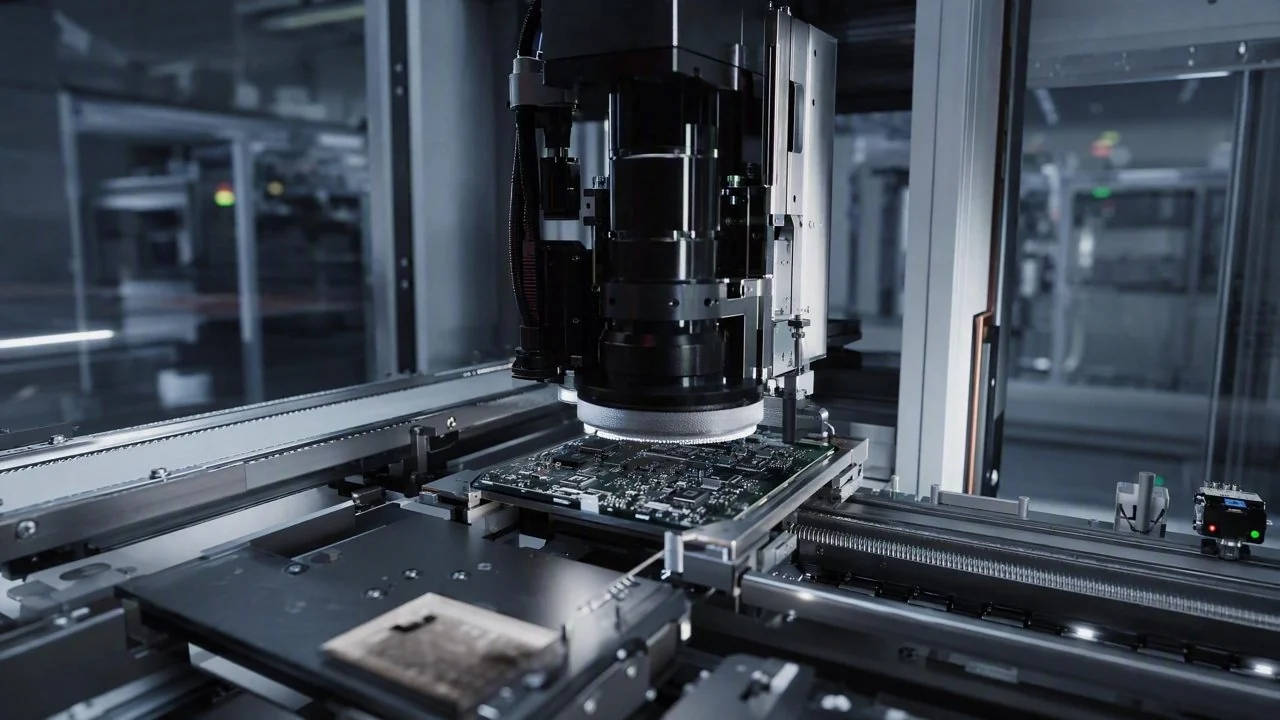
DaoAI AI AOI software system (featuring visual foundation model's characteristic recognition, 5-minute 0-code programming with one good sample, APDT positive/few-shot learning with 1-20 good samples, semantic false positive filtering, and SDK/API/Docker 100% on-premise deployment) leverages its unique visual foundation model and few-shot learning capabilities to successfully reduce the undetected defect rate for connector misplacement and missing parts in the electronics PCBA industry from a common 1.8% to less than 0.4%, bringing significant quality improvements and cost savings to customers. The electronics industry, particularly PCBA (Printed Circuit Board Assembly) manufacturing, is the cornerstone of modern industry. As electronic products evolve towards miniaturization, high integration, and multi-functionality, the complexity of PCBA design and the difficulty of manufacturing processes also increase. Among these, the correct assembly of connectors and the absence of missing components directly impact the product's electrical performance and long-term reliability. In the post-assembly stages of PCBA production, manual inspection or traditional rule-based AOI struggles to cope with increasingly complex and varied defect patterns, especially when connector types are numerous, sizes are tiny, and arrangements are dense. Precise identification of defects such as misplacement, omission, and reverse insertion becomes a severe challenge.
DaoAI AI AOI software system (featuring visual foundation model's characteristic recognition, 5-minute 0-code programming with one good sample, APDT positive/few-shot learning with 1-20 good samples, semantic false positive filtering, and SDK/API/Docker 100% on-premise deployment) leverages its unique visual foundation model and few-shot learning capabilities to successfully reduce the undetected defect rate for connector misplacement and missing parts in the electronics PCBA industry from a common 1.8% to less than 0.4%, bringing significant quality improvements and cost savings to customers. The electronics industry, particularly PCBA (Printed Circuit Board Assembly) manufacturing, is the cornerstone of modern industry. As electronic products evolve towards miniaturization, high integration, and multi-functionality, the complexity of PCBA design and the difficulty of manufacturing processes also increase. Among these, the correct assembly of connectors and the absence of missing components directly impact the product's electrical performance and long-term reliability. In the post-assembly stages of PCBA production, manual inspection or traditional rule-based AOI struggles to cope with increasingly complex and varied defect patterns, especially when connector types are numerous, sizes are tiny, and arrangements are dense. Precise identification of defects such as misplacement, omission, and reverse insertion becomes a severe challenge.
Pain Points: Why This Hurdle Is Difficult to Overcome
In PCBA assembly, detecting connector misplacement and missing parts faces multiple challenges. First, a high undetected defect rate: traditional rule-based AOI systems have limited ability to distinguish between visually similar but functionally different connectors, often leading to undetected defect rates of 1.8% or higher, severely impacting product quality. Second, a high false positive rate: due to the dense arrangement of components on PCBA surfaces, visual noise such as solder joint reflections and silkscreen misalignments easily trigger false positives, resulting in a large volume of manual re-inspection work and increased operational costs. A mid-sized EMS manufacturer once reported that its connector inspection false positive rate reached 15%, requiring at least 3 shifts of manual re-inspection daily. Furthermore, rapid product model iteration means frequent changes in connector types, quantities, and positions. Traditional AOI requires hours or even half a day for program adjustments and parameter calibration during each changeover, leading to long production line downtime and inefficient changeovers. This inefficiency not only limits the flexible manufacturing capabilities of small and medium-sized enterprises but also increases production costs and delivery cycles. Finally, the diversity of connectors is a major challenge. Connectors from different manufacturers or batches may have subtle appearance variations that traditional AOI struggles to generalize. Especially in multi-layer boards and areas with densely packed irregular components, defect features can be obscured or blurred, further reducing detection accuracy.
The root cause of these difficulties lies in the complexity of PCBA assembly and the subtlety of defects. For instance, a connector inserted incorrectly or misaligned may only differ by millimeters from a correctly installed one, making it extremely difficult to distinguish under specific lighting. Small passive components (like resistors, capacitors) that are missing can be overlooked by traditional 2D vision if obscured by surrounding components. Additionally, the reflective properties of PCBA surfaces and shadow effects from component height differences pose challenges for optical imaging. Traditional rule-based AOI relies on engineers manually writing complex rule sets, which are costly to maintain when faced with a vast combination of features and variations, and struggle to cover all potential defect patterns. Aligning with today's hot topic, AI smart cameras like DeteX aim to improve inspection efficiency by simplifying operational procedures, which is a strong response to complex traditional rule programming. However, general-purpose smart cameras like DeteX often fall short in feature recognition and few-shot learning capabilities when dealing with high-precision, high-complexity professional scenarios like PCBA. They typically lack the deep learning and semantic understanding capabilities of the DaoAI AI AOI software system, thus leaving room for improvement in detection rates and reducing undetected defects.
Technical Principles
The DaoAI AI AOI software system fundamentally solves the challenges of PCBA assembly defect detection through its core visual foundation model. This system does not rely on manually set rules by engineers; instead, it uses deep learning techniques to pre-train on vast image data, developing powerful feature recognition capabilities. This means it can automatically learn and understand the subtle differences between normal and various abnormal patterns of connectors and components. Its “5-minute 0-code automatic programming with one good sample” capability significantly simplifies model training and production line changeover processes. Engineers only need to provide 1 good sample image, and the system can automatically build the inspection model for that product within 5 minutes, without writing any code, reducing changeover time from hours to less than 5min and significantly enhancing production flexibility. For defects like connector misplacement and missing parts, the DaoAI AI AOI software system incorporates APDT (Anomaly Pattern Detection & Training) positive/few-shot learning, requiring only 1–20 good sample images to achieve high-precision defect detection. This few-shot learning capability is particularly crucial for small-batch, multi-variety PCBA production lines, as it avoids the difficulty and cost of collecting a large number of defect samples. By precisely modeling the features of good products, the system can identify any abnormalities deviating from the normal state, including reversed or misaligned connectors, bent pins, and missing tiny components.
Compared to traditional rule-based AOI, the advantages of the DaoAI AI AOI software system are evident in multiple aspects. Traditional methods require engineers to write complex image processing rules (e.g., grayscale thresholds, edge detection, template matching) for each defect type and product model. These rules are highly sensitive to environmental factors like lighting, angle, and component color, and are difficult to generalize. Any minor change in product design or process flow necessitates extensive adjustments and maintenance of the rule system. In contrast, the DaoAI AI AOI software system focuses on learning the essential characteristics of “good products.” Through its semantic false positive filtering function, it effectively distinguishes between true defects and visual noise (e.g., solder joint reflections, board surface smudges), reducing the false positive rate by more than 85%. This semantic understanding-based filtering mechanism far surpasses the simple pixel-level or geometric judgments of traditional AOI. Furthermore, the DaoAI AI AOI software system supports SDK/API/Docker 100% on-premise private deployment, ensuring absolute data security for customers and meeting the stringent data privacy and compliance requirements of the electronics industry, an advantage many cloud-based AI solutions cannot match.
Typical Application Scenarios
- **Connector Misplacement and Reverse Insertion Detection:** In the final PCBA assembly stage, inspect various types of board-to-board connectors, wire-to-board connectors, USB ports, HDMI ports, etc., to ensure they are installed correctly according to design, checking for reverse insertion, misalignment, bent or missing pins. The challenge lies in the variety of connectors, their similar appearances, and the difficulty of accurately judging minute differences like insertion depth and pin coplanarity with traditional vision. The DaoAI AI AOI software system can accurately identify these issues by learning the semantic relationship between connector pins, body structure, and PCB pads.
- **Critical Component Missing Parts Detection:** Conduct comprehensive inspection of various critical active/passive components on the PCBA, such as chips, resistors, capacitors, inductors, diodes, and transistors, to ensure no parts are missing. The difficulty arises from the extremely small size of components, especially micro-packages like 01005 and 0201, which can sometimes be obscured by other components or shadows, leading to missed detections with traditional methods. The DaoAI AI AOI software system, through its visual foundation model, can extract subtle features from complex backgrounds for recognition.
- **Irregular Component Assembly Integrity Detection:** Inspect irregular components on the PCBA, such as electrolytic capacitors, heat sinks, heat spreaders, and special sensors, to ensure they are correctly installed, oriented, and securely fixed. These components have irregular shapes, making detection difficult, and traditional rules are hard to establish. The DaoAI AI AOI software system can achieve high-precision detection by learning their overall contour and internal structural features.
- **Screw and Washer Assembly Detection:** In some PCBA assemblies, fixing screws and washers need to be installed. Detect whether screws are in place, tightened, or stripped, and whether washers are missing or misplaced. The challenges include screw surface reflection, difficulty in capturing thread details, and washers often being thin and similar in color to the PCB. The DaoAI AI AOI software system can effectively handle reflective and low-contrast scenarios, identifying subtle assembly anomalies.
Case Study
A tier-1 electronics manufacturing service (EMS) provider in South China, specializing in smart hardware PCBA production, faced significant challenges. Before adopting the DaoAI AI AOI software system, their PCBA assembly line's connector misplacement and missing parts detection relied primarily on manual visual inspection and some traditional rule-based AOI. Due to a high number of product models, rapid iteration cycles, and the tiny size of some connectors, the undetected defect rate consistently reached about 1.8%, leading to substantial monthly rework and customer complaint costs. Concurrently, the traditional AOI's false positive rate was persistently high, peaking at 12%, requiring 5 re-inspectors daily for manual verification, which severely hampered production line rhythm. Upon learning about the advantages of the DaoAI AI AOI software system in few-shot learning and semantic false positive filtering, the manufacturer decided to pilot the system. The DaoAI team first integrated the SDK with the client's existing AOI equipment, achieving 100% on-premise private deployment. During a one-month trial run, for a complex connector PCBA of their flagship product, engineers used only 15 good sample images to quickly train the model within 5 minutes using the DaoAI AI AOI software system. After deployment, the system immediately demonstrated outstanding performance. Compared to traditional methods, the undetected defect rate for connector misplacement and missing parts on this PCBA product consistently dropped to <0.4%, with a detection rate improving to over 99.6%. Simultaneously, with the introduction of semantic false positive filtering, the false positive rate significantly reduced by 88%, settling at around 1.5%, which cut manual re-inspection workload by over 80%, freeing up 4 re-inspectors for other high-value tasks. Production line changeover time also decreased from an average of 3 hours to less than 5 minutes, greatly enhancing production efficiency and flexibility. The DaoAI AI AOI software system brought tangible economic benefits and quality improvements to the client.
The DaoAI AI AOI software system, with its visual foundation model and few-shot learning capabilities, brings unprecedented inspection accuracy and efficiency to the PCBA industry, elevating quality control to new heights.
DaoAI Solutions and Products
The DaoAI AI AOI software system is the core of this solution. It is built on an advanced visual foundation model, possessing powerful feature recognition capabilities that enable it to automatically learn and understand the complex characteristics of various components on PCBAs. Through the “5-minute 0-code automatic programming with one good sample” feature, customers can quickly deploy new inspection tasks during product changeovers without the need for specialized AI engineers, significantly lowering the technical barrier and operational costs. For PCBA assembly defects, the DaoAI AI AOI software system employs an APDT positive/few-shot learning strategy, requiring only 1–20 good sample images to complete model training. This effectively solves the problem of difficult defect sample collection, making it particularly suitable for small-batch, multi-variety production models. Its semantic false positive filtering technology intelligently identifies and filters out visual noise caused by lighting, shadows, surface dirt, etc., ensuring that the system only alerts for true defects, thereby reducing the false positive rate by more than 85%. For deployment, the DaoAI AI AOI software system offers various integration methods such as SDK/API/Docker, supporting 100% on-premise private deployment. This ensures that customer data remains entirely within their facilities, meeting stringent data security and compliance requirements. Additionally, DaoAI can provide DaoAI 2D / 3D AI AOI equipment, which, through self-developed 3D cameras and 3D morphology reconstruction technology, further enhances the detection capabilities for challenging defects like hidden solder joints and coplanarity, complementing the software system.
Through the DaoAI AI AOI software system, customers achieve significant quantifiable results. In PCBA connector misplacement and missing parts detection, the undetected defect rate decreased from 1.8% with traditional methods to <0.4%, and the detection rate improved to over 99.6%, representing a qualitative leap in outgoing product quality. The false positive rate reduced by more than 88%, substantially decreasing the workload of manual re-inspection and operational costs. Production line changeover time was shortened from an average of 3 hours to less than 5min, significantly boosting production efficiency and flexibility. These improvements not only reduced costs associated with rework, repair, and customer complaints but also enhanced the enterprise's market competitiveness and brand reputation. DaoAI is committed to providing reliable, efficient, and secure intelligent inspection solutions for electronic manufacturing enterprises through leading AI technology.
FAQ
How does the DaoAI AI AOI software system handle the wide variety of connectors on PCBAs?
The DaoAI AI AOI software system, based on its visual foundation model, possesses strong feature generalization capabilities. It learns generic structural features and semantic information of connectors from a small number of good samples, rather than relying on specific rules. This means that even when faced with multiple models and different manufacturers' connectors, the system can quickly adapt and accurately identify their assembly status, effectively addressing the challenge of diversity.
Can traditional AOI equipment be integrated with the DaoAI AI AOI software system?
Yes, the DaoAI AI AOI software system offers flexible SDK/API interfaces for deep integration with mainstream 2D/3D AOI equipment on the market. Customers do not need to replace existing hardware; they can simply deploy our software system to upgrade their traditional AOI into an intelligent inspection platform with advanced AI vision capabilities, maximizing their return on investment.
How does this system demonstrate its advantages for small-batch, multi-variety orders in PCBA production?
The DaoAI AI AOI software system offers significant advantages for small-batch, multi-variety production models. Its core APDT positive/few-shot learning mechanism requires only 1–20 good sample images for model training. Combined with the “5-minute 0-code automatic programming with one good sample” capability, it drastically shortens new product introduction and changeover times, enabling production lines to quickly respond to market demands and enhance flexible manufacturing capabilities.
This article was generated by AI. Customer cases are simulated scenarios based on real product capabilities and figures are illustrative; see product pages for official benchmarks.