
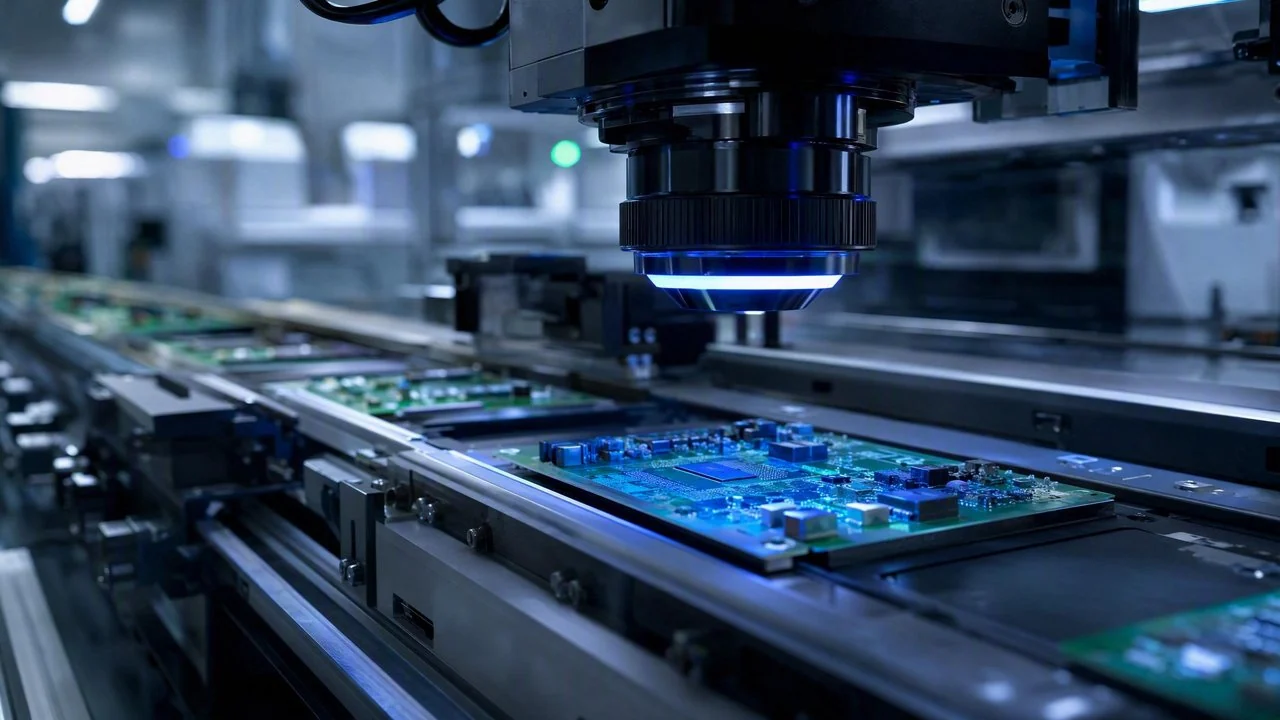
In the electronics manufacturing sector, particularly on PCBA production lines, component polarity reversal is a common defect leading to product malfunction and even scrap. Traditional inspection methods, whether relying on rule-based AOI equipment or extensive manual visual inspection, face challenges of low efficiency, high false alarm rates, and escalating labor costs. The DaoAI AI AOI software system emerges in this context, offering a precise, efficient, and significantly labor-cost-reducing intelligent inspection solution for the PCBA industry through its advanced visual foundation models and few-shot learning capabilities.
In the field of electronics manufacturing, particularly on PCBA production lines, component polarity reversal is a common defect leading to product malfunction and even scrap. Traditional inspection methods, whether relying on rule-based AOI equipment or extensive manual visual inspection, face challenges of low efficiency, high false alarm rates, and escalating labor costs. The DaoAI AI AOI software system, with its visual foundation model for feature recognition, 5-minute 0-code automatic programming with a single good sample, APDT positive/few-shot learning, semantic false alarm filtering, and 100% local private deployment via SDK/API/Docker, successfully addresses the core issues in PCBA component polarity reversal detection. It significantly reduces manual re-inspection hours, thereby optimizing overall labor costs. In a real-world application at a leading PCBA manufacturer, the system reduced the polarity reversal false alarm rate from 15% to <3.5%.
Pain Points: Why This Is a Tough Challenge
The difficulty of PCBA component polarity reversal detection manifests in several dimensions: Firstly, a high false alarm rate. Traditional rule-based AOI systems struggle to adapt to component diversity, lighting variations, and printing deviations, leading to a large number of false alarms, which can reach 10-20% during peak periods. Secondly, significant manual re-inspection costs. Each shift requires multiple skilled workers to re-verify every AOI alarm, consuming vast amounts of time. For example, a mid-sized factory might incur hundreds of thousands of yuan monthly in labor costs for polarity reversal re-inspection. Thirdly, model generalization challenges. New components are constantly emerging, requiring frequent updates to traditional AOI rule libraries. Each changeover or new product introduction means lengthy rule adjustments and validation cycles, severely impacting production rhythm and time-to-market. Finally, in the current industrial AI landscape, data annotation challenges make acquiring vast numbers of defect samples for deep learning model training both time-consuming and expensive, especially for rare defects.
The root causes of these dilemmas include: miniaturization and diversity of component markings (e.g., polarity marks on some diodes or capacitors might be tiny dots, thin lines, or subtle notches, easily confused under different lighting and angles); highly reflective PCBA surfaces, shadows, and complex component geometries further complicate imaging and recognition; simultaneously, high-speed production line demands mean extremely short inspection windows, making manual visual inspection prone to fatigue-induced omissions or misjudgments under pressure. Traditional AOI software's static rule sets cannot effectively handle these dynamic visual information changes, while pure deep learning models are limited by the cost and scarcity of data annotation, making it difficult to quickly adapt to new scenarios and defects.
Technical Principles
The DaoAI AI AOI software system fundamentally solves the challenges of PCBA component polarity reversal detection through its core visual foundation model. This system does not rely on predefined geometric rules or pixel thresholds but rather uses deep learning and feature recognition capabilities to understand component 'intent' and 'context' like a human expert. Its core technical principles are: First, the adoption of pre-trained visual foundation models. These models learn general visual feature representations from vast image datasets, giving them powerful generalization capabilities to identify polarity features of various component types and packages, even under uneven lighting or complex backgrounds. Second, the integration of APDT (Adaptive Positive/Few-shot Learning) technology. With only 1–20 good samples, the system can complete new product or component detection model programming within 5 minutes. This significantly shortens changeover times and addresses the issue of scarce defect samples. Compared to traditional rule-based AOI, which requires engineers to write hundreds or even thousands of rules, or pure deep learning, which needs thousands of defect samples, the DaoAI AI AOI system reduces model training complexity and cost by orders of magnitude.
Furthermore, the semantic false alarm filtering mechanism embedded in the DaoAI AI AOI software system further enhances detection accuracy. This mechanism understands the 'semantics' of defects rather than just pixel differences. For example, it can distinguish between 'false polarity dots' caused by light reflection and actual polarity markings, thereby significantly reducing false alarms. This semantic-based understanding allows the system to make smarter, more accurate judgments when facing various interference factors on the production floor. Compared to traditional methods, rule-based AOI often generates numerous false alarms due to its rigid threshold settings, while manual visual inspection is limited by human eye fatigue and subjective judgment, making both efficiency and consistency difficult to guarantee. The DaoAI AI AOI system, by combining the generalization capabilities of visual foundation models and the rapid adaptability of few-shot learning, achieves a dual improvement in detection accuracy and efficiency, with particularly significant effects in reducing manual re-inspection hours.
Typical Application Scenarios
- **IC/Chip Polarity Detection:** For pin 1 identification dots, notches, or silkscreen orientation on integrated circuit chips, the DaoAI AI AOI software system can accurately identify their direction and position, preventing chip burnout or functional anomalies due to reversed polarity. The challenge lies in chip surface reflection, tiny markings, and diverse package forms.
- **Electrolytic/Tantalum Capacitor Polarity Detection:** Polarity markings on electrolytic and tantalum capacitors are typically stripes or '+' signs; reverse installation can lead to explosion or short circuits. The DaoAI AI AOI system can reliably distinguish these markings, maintaining high detection rates even on capacitors of different colors and sizes. The challenge lies in varying marking standards from different manufacturers and low contrast between component colors and the PCB background.
- **Diode/LED Polarity Detection:** The polarity (cathode ring or positive/negative markings) of diodes and LEDs is critical. The DaoAI AI AOI software system can effectively detect these tiny markings, ensuring correct current direction. Challenges include transparent LED packaging potentially causing blurry visual effects, and significant differences in polarity markings across various diode package forms.
- **Connector Orientation Detection:** Some multi-pin connectors are directional; reverse installation can lead to connection failure or physical damage. The DaoAI AI AOI system can identify keyways, notches, or special shapes on connectors to ensure correct installation. The challenge lies in the wide variety of connectors and common visual obstructions in confined installation spaces.
Implementation Case Study
A Tier-1 PCBA manufacturer in South China, primarily supplying high-reliability products for automotive electronics and industrial control, heavily relied on manual visual inspection and traditional rule-based AOI for component polarity reversal detection on its PCBA production lines before adopting the DaoAI AI AOI software system. Due to numerous product models and complex component types, the false alarm rate of traditional AOI remained high, averaging 15%. This necessitated 8 skilled workers for round-the-clock re-inspection, resulting in high labor costs and increasing risks of missed defects due to human eye fatigue. When introducing new products, traditional AOI programming and debugging often took 2-3 days, severely slowing down the time-to-market.
The DaoAI AI AOI software system reduced our component polarity reversal false alarm rate by 78%, and new product changeover time from days to 5 minutes, significantly optimizing labor costs.
After implementing the DaoAI AI AOI software system, the manufacturer first configured a new production line's polarity reversal detection model using just 1-5 good samples, completing the process in only 5 minutes. Post-deployment, the false alarm rate quickly dropped from 15% to <3.5%, significantly outperforming traditional AOI and average manual inspection levels. This reduced the number of workers required for re-inspection from 8 to 2, saving substantial monthly labor costs. More importantly, while maintaining a detection rate of over 99.7%, production rhythm was ensured, and new product introduction cycles were drastically shortened. The DaoAI AI AOI system also ensured data security and compliance through 100% local private deployment.
DaoAI Solutions and Products
The core solution provided by DaoAI for the PCBA industry is the intelligent inspection solution centered around the DaoAI AI AOI software system. This system, leveraging its powerful visual foundation model, can achieve precise recognition of polarity markings on various electronic components, maintaining high robustness even in the face of complex lighting conditions and diverse component geometries. In terms of modeling and changeover, the DaoAI AI AOI software system supports “5-minute 0-code automatic programming with a single good sample.” This means engineers do not need to write complex rules or perform extensive data annotation; they can quickly train high-performance detection models with just a few good samples, reducing changeover downtime from hours to 5min. The APDT positive/few-shot learning capability of the DaoAI AI AOI software system is particularly suitable for scenarios with scarce defect samples, significantly lowering the threshold and cost of model training. Furthermore, the system's semantic false alarm filtering function effectively distinguishes true defects from environmental interference, reducing the false alarm rate by 78%, further minimizing manual re-inspection workload and labor costs.
For deployment and integration, the DaoAI AI AOI software system offers various flexible deployment options such as SDK/API/Docker, supporting 100% local private deployment to ensure data remains on-site, meeting strict client requirements for data security and compliance. This enables clients to smoothly integrate the system into existing AOI equipment or production lines for rapid deployment. In addition to the DaoAI AI AOI software system, DaoAI also provides DaoAI 2D/3D AI AOI equipment, which integrates self-developed 3D cameras and 3D morphology reconstruction technology. This equipment can be used to detect more complex three-dimensional defects such as hidden solder joints and coplanarity, further enhancing the comprehensiveness and accuracy of inspection. Through these product combinations, DaoAI is committed to helping clients achieve intelligent upgrades of their production lines, significantly improving quality management levels, and substantially optimizing labor costs.
FAQ
How does the DaoAI AI AOI software system help reduce manual inspection costs?
The DaoAI AI AOI software system significantly reduces the number of defects requiring manual re-inspection through its high accuracy and low false alarm rate, automating most repetitive and intensive inspection tasks. The system supports few-shot learning and rapid changeover, reducing engineering programming and debugging time, thereby substantially lowering overall labor and training costs.
Does this system require a large number of defect samples to train models?
No, it does not. The DaoAI AI AOI software system utilizes APDT positive/few-shot learning technology, requiring only 1–20 good samples to quickly train high-performance detection models. This effectively addresses the reliance of traditional deep learning models on vast defect datasets, especially suitable for rare defect detection scenarios.
What deployment options does the DaoAI AI AOI software system support? How is data security ensured?
The system supports various flexible deployment methods such as SDK/API/Docker and can achieve 100% local private deployment. This means all data will be processed and stored on the client's local servers, ensuring data never leaves the factory and strictly meeting clients' stringent requirements for data security, privacy, and compliance.
Full solution for this scenario: Electronics / PCBA industry solutions · Component Polarity False-Alarm Reduction
This article was generated by AI. Customer cases are simulated scenarios based on real product capabilities and figures are illustrative; see product pages for official benchmarks.