
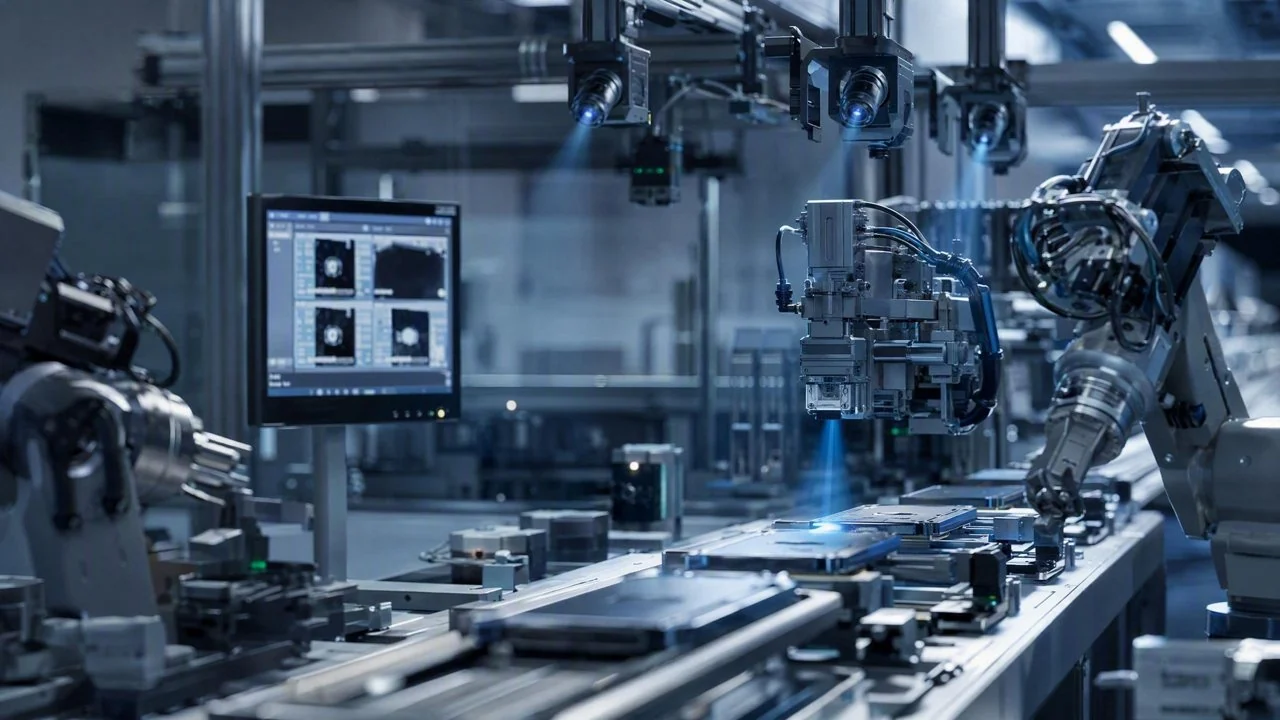
The rapid iteration and mass production in the consumer goods industry pose unprecedented challenges to quality control. Particularly in the precision assembly of complex products, subtle missing or misplaced components can lead to product functional failure, damage to brand reputation, and even recall risks. Traditional reliance on manual inspection or rule-based AOI can no longer meet the stringent requirements for high throughput, high precision, and low missed detection rates.
In the precision assembly of consumer goods, DaoAI AI AOI software system (featuring visual foundation model for feature recognition, 5-minute 0-code programming with one good sample, APDT positive/few-shot learning with 1–20 good samples, semantic false positive filtering, and 100% local private deployment via SDK/API/Docker) significantly enhances the detection rate of missing/misplaced components and assembly errors through its superior few-shot learning and semantic false positive filtering, reducing missed detections to below 0.2%. Currently, the consumer goods industry is undergoing intelligent transformation, with increasingly stringent demands for production efficiency and product quality. From smartphones and home appliances to personal care products, their internal structures are becoming more complex, involving numerous tiny yet critical components. For instance, a leading smart wearable device manufacturer requires 100% inspection of various models and materials of connector components on its smart watch strap assembly line to ensure no missing or misplaced parts. This directly impacts product reliability and user experience. Traditional reliance on manual inspection is not only inefficient but also highly prone to missed detections due to fatigue, while rule-based AOI struggles to adapt to frequent product changeovers and complex, variable defect patterns.
Pain Points: Why This Hurdle Is Difficult to Overcome
In consumer product assembly, balancing detection rate and missed detection suppression remains a core challenge. A tier-1 electronics consumer goods supplier faced multiple challenges: First, due to frequent product model updates, the production line required 3-5 changeovers per week. Each changeover necessitated at least 2 hours for parameter adjustment and rule writing for traditional rule-based AOI, leading to excessive downtime and significant annual productivity loss. Second, assembly defects (such as loose screws, missing gaskets, reversed connectors) are diverse in form and subtle, making them difficult for traditional vision systems to accurately identify against complex backgrounds. This resulted in a persistent missed detection rate of around 0.8%, directly causing millions in rework costs and customer complaints annually. Furthermore, even detected defects were often accompanied by a false positive rate as high as 15%, requiring quality control personnel to spend significant time on manual re-inspection daily, severely tying up human resources and reducing overall inspection efficiency. These issues are particularly prominent given the increasing adoption of high-precision AI quality inspection industrial PCs, as hardware performance improvements have not fully resolved the generalization and robustness issues at the software algorithm level.
The root causes of these dilemmas are: firstly, consumer product assembly defects often exhibit high 'rarity' and 'diversity.' For example, only a very small number of products in a batch might have a specific connector inserted incorrectly, while different batches might present new, unseen defect patterns. This makes it difficult for traditional supervised learning methods to acquire sufficient defect samples for training. Secondly, the variety of product materials (metal, plastic, glass, fabric) and their surface reflective properties, along with complex imaging conditions such as shadows and occlusions introduced during assembly, greatly increase the difficulty of visual inspection. Thirdly, high-throughput production lines demand that inspection systems complete judgments in milliseconds while ensuring extremely high accuracy. This not only requires computational power but also places extreme demands on algorithm real-time performance and robustness. Traditional rule-based AOI, relying on feature points or color thresholds, proves inadequate in terms of generalization and robustness when confronted with these complex scenarios.
Technical Principles
DaoAI AI AOI software system fundamentally solves the challenges of detection rate and missed detection suppression in consumer product assembly through its core visual foundation model and APDT (Adaptive Positive Data Training) few-shot learning technology. This system does not rely on a large number of defect samples but rather builds a robust normal pattern recognition through deep learning on 'good samples.' Specifically, its visual foundation model is pre-trained on vast amounts of general image data, endowing it with powerful feature extraction and generalization capabilities. It can understand high-level semantic information in images, not just pixel-level differences. Building on this, APDT technology allows users to complete model training and programming in just 5 minutes using only 1–20 good sample images, drastically shortening changeover times. When encountering new product models or defect patterns, the model leverages its deep understanding of 'normal' to precisely identify subtle deviations from the good sample pattern, thereby effectively detecting missing or misplaced assembly components. Compared to traditional rule-based AOI, DaoAI AI AOI software system eliminates the need for manual writing of complex rules, avoiding missed detections caused by rule omissions or inflexibility. Furthermore, its semantic false positive filtering function further enhances accuracy by understanding the context of defects, effectively distinguishing true defects from background noise or normal tolerance variations, reducing the false positive rate by over 85% and significantly decreasing the workload of manual re-inspection.
In addition, DaoAI AI AOI software system supports 100% local private deployment via SDK/API/Docker, ensuring customer data security and independent operation of the production line. This perfectly aligns with the current high demands for data security and real-time performance in smart manufacturing lines. At the hardware level, the system fully leverages the computational advantages of high-precision AI quality inspection industrial PCs. By optimizing model structure and inference engine, it achieves real-time detection in milliseconds, ensuring the production efficiency of high-throughput lines. This optimized software-hardware combination ensures that in complex assembly scenarios, DaoAI AI AOI software system not only achieves an extremely high detection rate of 99.8% but also consistently maintains a missed detection rate below <0.2%, which is a leading level in the industry and far surpasses traditional methods.
Typical Application Scenarios
- **Missing/Misplaced Component Detection on Smartphone Motherboards:** Inspects for missing, misaligned, reversed, or incorrect model SMT components like resistors, capacitors, and connectors on motherboards. The challenge lies in the tiny size, diverse types, and high-density arrangement of components, leading to complex imaging. DaoAI AI AOI software system precisely locates and identifies minute defects through fine feature recognition, even in complex backgrounds.
- **Cable Routing and Fixing Inspection within Smart Wearable Device Housings:** Checks if flexible printed circuits (FPC) or connecting cables are routed according to design and properly secured to prevent interference or loosening. The difficulty arises from the flexibility of cables and potential slight bending deformation, making stable model establishment difficult for traditional methods. DaoAI AI AOI software system learns subtle variations of their normal form to identify anomalies.
- **Home Appliance Panel Button/Knob Assembly Integrity Inspection:** Ensures all buttons, knobs, indicator lights, and other components on the product's control panel are correctly installed, with no omissions or misalignment. The challenge involves varying reflective properties of buttons with different colors and materials, and potential slight tolerances. DaoAI AI AOI software system uses semantic understanding to filter out visual noise within normal tolerance ranges.
- **Personal Care Product Bottle Cap/Pump Head Assembly Sealing and Orientation Inspection:** Checks if bottle caps or pump heads for shampoos, skincare products, etc., are tightened, oriented correctly, and free from tilting or damage, ensuring product sealing and appearance quality. The difficulty is that caps are often circular and can be reflective. DaoAI AI AOI software system can identify minor assembly deviations by learning 3D morphology (if combined with a 3D camera) or 2D contour features.
Case Study
A globally renowned home appliance manufacturer needed to inspect the assembly quality of air conditioner indoor unit air duct components. This component consists of dozens of plastic buckles, screws, and guide plates. Any unfastened buckle or incorrectly installed guide plate could lead to increased noise or abnormal airflow. Before implementing the DaoAI AI AOI software system, the manufacturer primarily relied on manual sampling and some rule-based AOI assistance. However, due to the randomness and subtlety of defects, the missed detection rate consistently remained around 0.7%, resulting in hundreds of thousands of yuan in rework and repair costs each month. Simultaneously, whenever product models were updated, programming and debugging rule-based AOI often took 3-4 hours, severely delaying new product launches. Faced with these challenges, the manufacturer decided to deploy the DaoAI AI AOI software system.
The implementation process was remarkably swift. Leveraging APDT technology, the DaoAI engineering team completed the AI model training and production line integration for the first model in less than 10 minutes, using only 15 good sample images. After system deployment, smooth integration with high-precision industrial cameras and industrial PCs on the production line enabled 100% fully automated inspection of every air duct component. The pre- and post-implementation comparison showed significant improvements: **the missed detection rate plummeted from 0.7% to <0.15%**, boosting the overall detection rate to 99.85%; **the false positive rate decreased from the original 12% to <2%**, significantly reducing the workload of manual re-inspection; and **product changeover time was reduced from an average of 3.5 hours to 8 minutes**. This series of improvements led to a substantial increase in both the manufacturer's production efficiency and product quality, effectively mitigating missed detection risks and significantly lowering operational costs.
DaoAI AI AOI software system achieves breakthrough performance in consumer product assembly inspection with a missed detection rate reduced to <0.15% and a false positive rate reduced to <2%, leveraging its exceptional few-shot learning and semantic filtering capabilities, redefining inspection efficiency.
DaoAI Solutions and Products
DaoAI's core solution for consumer product assembly quality control is its AI AOI software system. Built upon a visual foundation model, this system possesses powerful general feature recognition capabilities, enabling efficient and precise detection of various defects such as missing components, misplacement, and incorrect orientation. In practical implementation, customers only need to provide 1–20 good sample images to complete model training through the system's intuitive user interface, without writing any code. This '5-minute 0-code automatic programming with one good sample' capability greatly lowers the barrier to AI quality inspection and makes frequent product changeovers effortless. The APDT positive/few-shot learning mechanism ensures that the model maintains high accuracy even in the absence of defect samples. Furthermore, semantic false positive filtering technology is a major highlight of the DaoAI AI AOI software system. It intelligently identifies and excludes false positives caused by non-defect factors such as lighting variations, material reflections, or slight deformations, thereby effectively keeping the false positive rate at an extremely low level and reducing the burden of manual re-inspection. For deployment, DaoAI AI AOI software system offers various integration methods like SDK/API/Docker, supporting 100% local private deployment to ensure data security and low-latency real-time detection. When more detailed 3D morphological inspection is required, DaoAI 2D / 3D AI AOI equipment can be used as a supplement, providing micron-level 3D data through proprietary 3D cameras to further enhance the comprehensiveness and precision of inspection.
Through the deployment of the DaoAI AI AOI software system, customers can achieve significant quantitative results and business value. Firstly, the **missed detection rate can be consistently suppressed to below 0.2%**, greatly improving product outgoing quality and reducing recall risks. Secondly, the **false positive rate is reduced by over 85%**, significantly decreasing manual re-inspection workload and freeing up human resources for higher-value activities. Thirdly, **product changeover time is shortened from several hours to 5–10 minutes**, substantially enhancing production line flexibility and efficiency. These improvements not only directly reduce production costs and quality risks but also help consumer goods manufacturers respond quickly to market changes and enhance brand competitiveness.
FAQ
What is a 'visual foundation model' in the AI AOI software system, and how does it help reduce missed detections?
The visual foundation model in DaoAI AI AOI software system is a deep learning model pre-trained on vast image datasets. It possesses powerful general feature extraction and semantic understanding capabilities, enabling it to recognize high-level concepts in images rather than just low-level pixels. This allows the model to better understand the 'normal' pattern of good products, and even when defect samples are scarce, it can accurately detect missing or misplaced assembly components by identifying subtle deviations from the normal pattern, thereby effectively reducing missed detection rates.
How does DaoAI AI AOI software system address the frequent product changeover demands in the consumer goods industry?
DaoAI AI AOI software system achieves '5-minute 0-code automatic programming with one good sample' through its APDT positive/few-shot learning technology. This means that when product models change, users only need to provide 1–20 good sample images of the new product, and the system can complete model training and deployment in a very short time, reducing changeover time from hours to minutes, significantly improving production line flexibility and efficiency.
How does the AI AOI software system ensure data security and local private deployment?
DaoAI AI AOI software system supports various deployment methods such as SDK, API, and Docker, enabling 100% local private deployment. This means all inspection data and model training processes are completed within the customer's factory, ensuring data remains on-site and strictly adheres to customer data security and privacy policies. Local deployment also guarantees high real-time performance and low latency for the inspection system, meeting the demands of high-throughput production lines.
Full solution for this scenario: Consumer / general industry solutions · Assembly Missing-Part & Misassembly Detection
This article was generated by AI. Customer cases are simulated scenarios based on real product capabilities and figures are illustrative; see product pages for official benchmarks.