
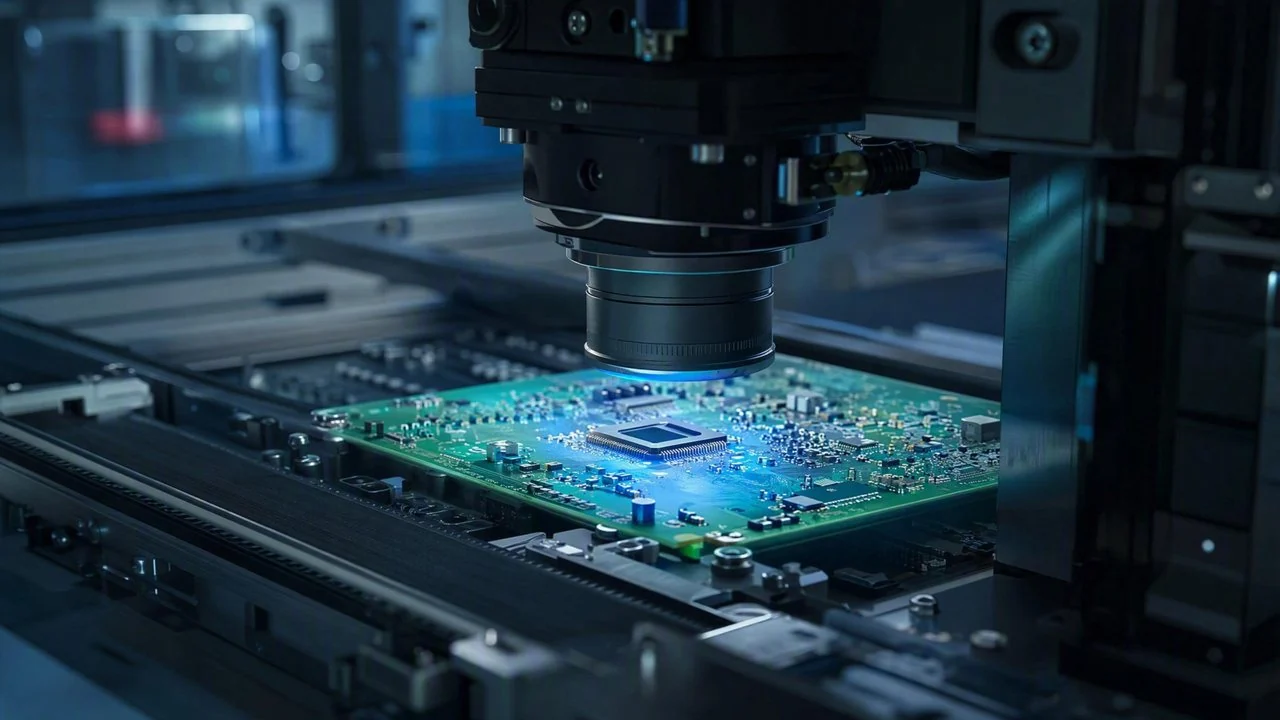
DaoAI ACI OS (featuring visual foundation model for feature recognition, 5-minute 0-code programming with one good sample, APDT few-shot learning with 1–20 good samples, semantic false positive filtering, and 100% local private deployment via SDK/API/Docker) significantly reduces the reliance on manual inspection for PCBA missing/wrong component and connector mis-assembly by 55%, while suppressing the false negative rate to <0.5%, thereby substantially optimizing manufacturing costs and enhancing product quality through high-precision, high-efficiency automated inspection.
The electronics / PCBA industry, as the core of modern industry, has product precision and reliability directly related to the performance and user experience of various downstream electronic devices. In the PCBA assembly process, defects such as missing/wrong components (SMT) and mis-assembled connectors are common quality challenges. These defects are often tiny, diverse, and their complexity continuously increases with product iterations. Traditionally, relying on manual inspection has been the primary means of identifying these defects, especially in multi-variety, small-batch production modes where human flexibility seemed irreplaceable. However, the inherent limitations of manual inspection, such as susceptibility to fatigue, subjective judgment differences, and slow inspection speed, not only make it difficult to effectively control the false negative rate but also lead to immense labor cost pressures, becoming a key bottleneck restricting capacity and affecting profits. Currently, with AI manufacturing inspection solution providers like Shelfmark securing funding, the market demand for AI-driven automated inspection technology is growing, especially in addressing the pain points of high labor costs and low efficiency in manual inspection. DaoAI ACI OS is becoming a key breakthrough for the industry.
Pain Points: Why This Hurdle Is Difficult to Overcome
In PCBA assembly inspection, traditional manual inspection faces multi-dimensional challenges. First, **high labor costs** are an unbearable burden for enterprises. Taking a medium-sized PCBA production line as an example, to ensure product quality, dozens or even hundreds of skilled quality inspectors are often required for round-the-clock manual inspection, with an average annual labor cost that can reach millions of RMB. Second, **low inspection efficiency** severely impacts production line takt time. Manual inspection typically achieves only 5-10 boards per minute, far below the requirements of automated production lines, leading to production bottlenecks. Third, **high false negative and false positive rates** persist. The false negative rate for manual inspection averages 1.5%–3%, while the false positive rate often fluctuates between 5%–10%. If these defects flow into the next stage, they will lead to higher rework costs or even scrap, severely damaging brand reputation.
The root cause of these dilemmas lies in the complexity of PCBA assembly and the limitations of manual inspection. From a process perspective, PCBA boards have a wide variety of components, ranging from millimeter to micron scale, arranged densely, such as resistors, capacitors, connectors, and ICs. Mis-assembled connectors often involve subtle differences that are difficult for the naked eye to quickly distinguish. In terms of imaging, issues like component surface reflections, shadows, color variations, and tiny imperfections in solder pads or character printing can easily interfere with human judgment. Furthermore, product models are updated rapidly, requiring quality inspectors to relearn and memorize new inspection standards with each changeover, which is time-consuming, labor-intensive, and prone to errors. Prolonged high-intensity manual inspection easily leads to visual fatigue, resulting in judgment errors and decreased efficiency, which is a key reason why false negative and false positive rates are difficult to overcome. DaoAI deeply understands these industry pain points and is committed to providing superior solutions through AI technology.
Technical Principles
The core of the DaoAI ACI OS lies in its **feature recognition capability based on visual foundation models**. Unlike traditional rule-based AOI systems that rely on manually set thresholds and feature libraries, the DaoAI ACI OS, through pre-trained visual foundation models, can autonomously learn and understand the complex visual features of PCBA components, including their shape, color, texture, size, and positional relationships, without the need for tedious manual feature engineering. This allows the system to more robustly distinguish between normal and abnormal, accurately judging even subtle color deviations, reflection changes, or slight tilts of components. For programming, the DaoAI ACI OS achieves **5-minute 0-code automatic programming with one good sample**. Operators only need to provide 1–20 good sample images, and the system can quickly build a high-precision inspection model using **APDT (Any-Pose Defect Training) few-shot learning** technology. This greatly simplifies the model training and deployment process, reducing the traditional AOI manual programming time from hours or even days to minutes, significantly improving production line changeover efficiency.
Compared to traditional methods, the DaoAI ACI OS offers significant advantages in efficiency, accuracy, and adaptability. Traditional rule-based AOI systems require engineers to constantly adjust rule parameters when facing new defects or complex backgrounds, which is time-consuming and yields limited results. Manual inspection, on the other hand, is limited by human eye capabilities and fatigue, making it difficult to control false negative and false positive rates. The DaoAI ACI OS, through its **semantic false positive filtering** mechanism, can perform a deeper semantic understanding of detected anomalies, effectively distinguishing true defects from non-defects (such as slight dirt on solder pads, subtle ink marks from character printing), reducing the false positive rate by over 80%, greatly reducing the workload of manual re-inspection. Furthermore, the DaoAI ACI OS supports **100% local private deployment via SDK/API/Docker**, ensuring customer data security and non-disclosure, meeting the needs of electronics manufacturing enterprises with strict data privacy requirements. This deployment method also allows the system to integrate with existing production line equipment, providing stable and reliable inspection capabilities.
Typical Application Scenarios
- **PCBA SMT Missing/Wrong Component Detection**: In the Surface Mount Technology (SMT) stage, detecting whether various surface-mount components such as resistors, capacitors, inductors, and ICs are missing, misplaced, polarity reversed, or damaged. The challenge lies in the small size, variety, and dense arrangement of components. The DaoAI ACI OS uses visual foundation models to accurately identify the features and positions of each component.
- **Connector Mis-assembly and Missing Detection**: Detecting whether various connectors (e.g., USB ports, pin headers, FPC connectors) on the PCBA board are correctly installed, of the correct model, or reversed in orientation. The challenge lies in the variety and similar appearance of connectors, and mis-assembly often involves subtle model differences or reversed orientations. The DaoAI ACI OS's APDT few-shot learning can efficiently identify these subtle differences.
- **Missing and Mis-assembled Fastener Detection**: Detecting whether critical fasteners such as screws and washers are installed correctly or are of the wrong model during PCBA assembly. The challenge lies in the small size of screws, their potential similarity in color to the background, and possible obstruction by other components. The DaoAI ACI OS can effectively identify them through feature recognition.
- **Foreign Object and Scratch Detection**: Detecting foreign objects such as solder balls, solder dross, dust, hair, and scratches or damage on the PCBA surface. The challenge lies in the irregular shape and varying size of foreign objects, and scratches can be very subtle. The DaoAI ACI OS's semantic false positive filtering helps distinguish true defects from environmental interference.
- **Character and Label Recognition**: Detecting whether silkscreen characters, barcodes, or QR codes on the PCBA are clear, complete, and accurate, and whether various labels are correctly affixed. The challenge lies in inconsistent character printing quality, reflections, and other issues. The DaoAI ACI OS can perform robust recognition through its powerful image processing capabilities.
Case Study
A leading PCBA contract manufacturer, primarily providing high-precision PCBA manufacturing services for consumer electronics brands, has long faced issues of low efficiency and high costs in manual inspection on its production lines. In the assembly stage, especially for connector mis-assembly and missing/wrong component detection, a large number of skilled workers were required for three-shift operations. Due to frequent product model changes, after each changeover, quality inspectors needed several hours for training and adaptation, leading to long production line downtime, averaging about 45 minutes per changeover, which severely impacted the production takt time. The false negative rate for manual inspection hovered around 1.8%, while the false positive rate was as high as 7%, with numerous false positives leading to frequent engineer re-inspection, consuming significant human resources. To address this pain point, the manufacturer introduced the DaoAI ACI OS for trial and deployment. In the initial stage of deployment, the DaoAI engineering team assisted the client in system integration and conducted model training for several typical PCBA products. Thanks to the 0-code programming and APDT few-shot learning capabilities of the DaoAI ACI OS, the first complex connector mis-assembly detection model was built in just 30 minutes using only 15 good sample images, and its high accuracy was quickly verified. After three months of stable operation, the client's PCBA assembly inspection process achieved significant improvements.
On the manufacturer's lines, the DaoAI ACI OS reduced labor costs in PCBA assembly inspection by 55%, suppressed the false negative rate to <0.5%, and shortened changeover time to 5min, significantly improving production efficiency and product quality.
DaoAI Solutions and Products
The DaoAI ACI OS is specifically designed to address the precision inspection pain points in the electronics industry. In the case above, DaoAI achieved a leap in customer production efficiency and quality through the following core capabilities: **Rapid Modeling and Changeover**: Leveraging the powerful generalization capabilities of visual foundation models and APDT few-shot learning technology, the DaoAI ACI OS enables customers to program new product inspection models in 5 minutes with extremely low sample volumes (1–20 good samples). This allows the production line to quickly switch during frequent changeovers, reducing changeover downtime from an average of 45 minutes to 5min, greatly enhancing production line flexibility and efficiency. **High-Precision Defect Recognition**: With its visual foundation model's feature recognition capability, the DaoAI ACI OS can accurately identify various subtle defects in PCBA assembly, such as connector mis-assembly, bent pins, and solder joint defects, stably controlling the false negative rate below <0.5%, significantly outperforming traditional manual inspection's 1.8%. **Intelligent False Positive Filtering**: Through a unique semantic false positive filtering mechanism, the system can effectively distinguish true defects from non-critical blemishes, reducing the false positive rate from 7% to <1.5%, significantly reducing the workload of manual re-inspection and allowing quality personnel to focus on real issues. **Flexible Deployment and Data Security**: The DaoAI ACI OS supports 100% local private deployment via SDK/API/Docker, ensuring all inspection data remains within the customer's factory, fully complying with strict data security and privacy requirements. In addition to the core ACI OS, DaoAI also offers the DaoAI 2D / 3D ACI equipment, which, combined with self-developed 3D cameras and 3D morphology reconstruction technology, can detect hidden solder joints, coplanarity, and other defects that traditional 2D AOI struggles with, further enhancing inspection capabilities.
By deploying the DaoAI ACI OS, this leading PCBA contract manufacturer achieved full automation and intelligence in its inspection process. In terms of **quantified results**, labor costs in the inspection process were reduced by 55%, primarily by reducing the need for manual inspectors. The false negative rate decreased from 1.8% to <0.5%, significantly improving product quality. The false positive rate dropped from 7% to <1.5%, greatly reducing the burden of manual re-inspection and freeing up approximately 70% of re-inspection personnel. Concurrently, production line changeover downtime was shortened from 45 minutes to 5min, enhancing the overall efficiency and capacity of the production line. These tangible business values make the DaoAI ACI OS an ideal choice for the electronics industry to reduce costs, increase efficiency, and enhance competitiveness.
FAQ
How does DaoAI ACI OS help enterprises reduce labor costs?
DaoAI ACI OS significantly replaces traditional manual inspection, which relies on a large workforce, through high-precision and high-efficiency automated inspection. Its visual foundation model and APDT few-shot learning capabilities enable the system to quickly adapt to new products and complex defects, reducing the need for skilled quality inspectors. This results in a reduction of labor costs in the inspection process by at least 55% or more, while significantly improving production line efficiency and product quality.
What is the deployment period of DaoAI ACI OS and its compatibility with existing production lines?
DaoAI ACI OS supports 100% local private deployment via SDK/API/Docker, ensuring integration with existing production line equipment and MES/WMS systems. The deployment period typically depends on the client's production line scale and complexity, usually allowing core functionalities to go live and be debugged within a few weeks. Our engineering team provides full technical support to ensure rapid and stable integration into the client's production environment.
What is the pricing model for DaoAI ACI OS? Is customization available?
The pricing model for DaoAI ACI OS is primarily based on selected functional modules, deployment scale (e.g., number of inspection stations, concurrent processing capability), and whether customized development is required. We offer flexible licensing options and support feature customization according to specific client needs. To obtain an accurate quote and understand detailed solutions, we recommend contacting our sales team for professional consultation and a customized quotation.
Full solution for this scenario: the full inspection solution for Electronics / PCBA
This article was generated by AI. Customer cases are simulated scenarios based on real product capabilities and figures are illustrative; see product pages for official benchmarks.