
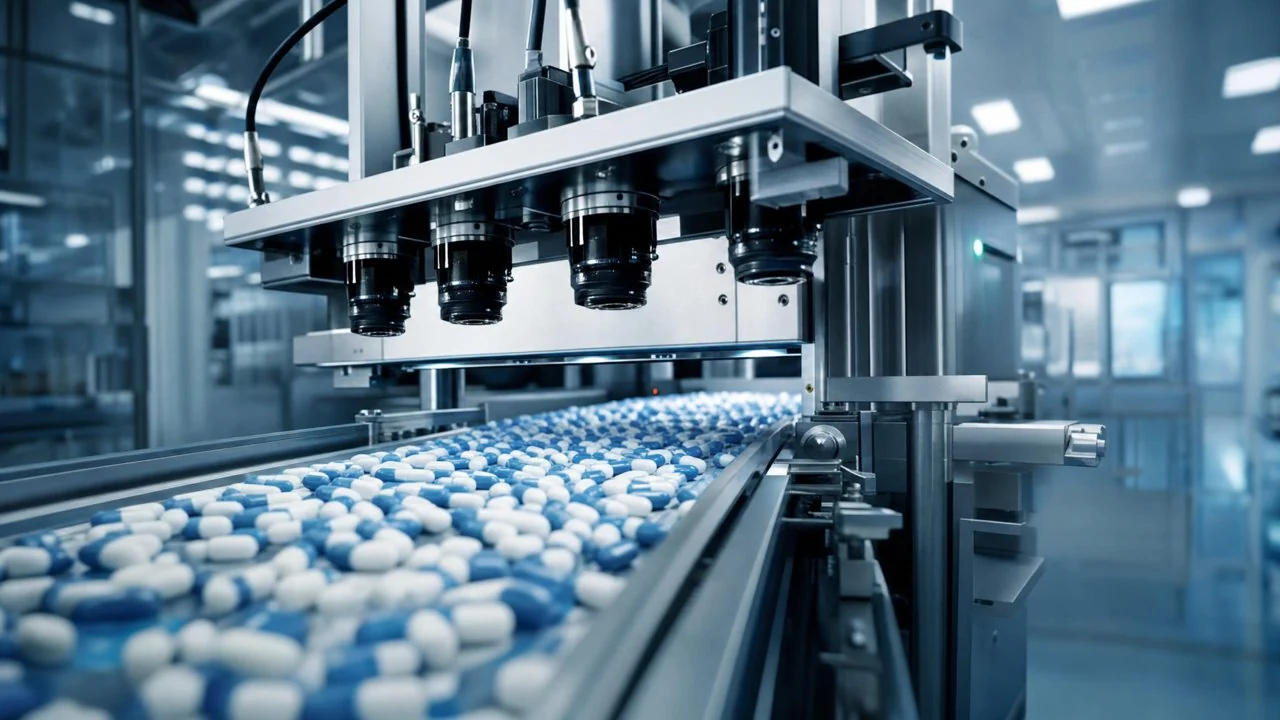
DaoAI ACI OS (featuring visual foundation model for feature recognition, 0-code automatic programming with one good sample in 5 minutes, APDT positive/few-shot learning with 1–20 good samples, semantic false positive filtering, and SDK/API/Docker support for 100% local private deployment) drastically cuts new product programming time for capsule appearance defect detection in high-mix low-volume pharmaceutical manufacturing from hours in traditional solutions to under 5 minutes, while maintaining a stable false negative rate of <0.4%, significantly boosting production line flexibility and inspection accuracy.
The pharmaceutical industry demands extremely stringent product quality, especially for oral solid dosage forms like capsules, where appearance defects directly impact drug safety and brand reputation. In actual production, capsule manufacturing processes are complex, from filling and sealing to polishing and sorting, any step can introduce various appearance defects such as scratches, color differences, deformation, breakage, or foreign objects. With personalized medicine and evolving market demands, pharmaceutical companies increasingly face high-mix, low-volume production models, posing significant challenges to the rapid adaptability of traditional inspection solutions. Traditional capsule appearance inspection primarily relies on manual visual inspection or rule-based machine vision systems, but these methods are inefficient and costly when dealing with complex, varied defect types and frequent changeovers.
Pain Points: Why This Hurdle Is Hard to Overcome
In the pharmaceutical industry's capsule production lines, high-mix, low-volume manufacturing presents multiple inspection challenges: First, traditional rule-based vision systems require significant time for programming and debugging when encountering new capsule products or subtle defects, leading to new product changeover downtime of 2-4 hours, severely impacting production rhythm and efficiency. Second, capsule defects are diverse (e.g., surface scratches, dents, color spots, air bubbles, discoloration, size anomalies), and many are visually very subtle, making consistent and stable identification difficult for the human eye. This results in high false negative rates for manual inspection, averaging 1-3%, and even higher with increased fatigue during long shifts. Simultaneously, traditional rule-based AOI systems are sensitive to environmental factors like lighting, background, and product placement, leading to high false positive rates, requiring extensive manual re-inspection, typically 4-6 hours per day for false positive verification, which increases labor costs. Furthermore, the pharmaceutical industry has extremely high compliance requirements, and any quality issue in a product batch can lead to recall risks and significant financial losses.
The root cause of these difficulties lies in the inherent complexity of capsule products: their surfaces are often smooth and reflective, making defect features inconspicuous; subtle process variations between different batches or production lines can lead to diverse defect morphologies; and high-mix, low-volume production necessitates frequent line changeovers, each requiring re-configuration and re-training of the inspection system. Traditional feature engineering-based machine vision requires manual definition of numerous rules and thresholds. When encountering new defects or new products, it necessitates re-writing code or adjusting parameters, which is time-consuming and labor-intensive, and often fails to cover all potential complex defect patterns. This leaves pharmaceutical companies facing significant technological bottlenecks and operational pressures in their pursuit of 'zero defect' levels.
Technical Principles
DaoAI ACI OS fundamentally solves the limitations of traditional inspection solutions through its core visual foundation model and APDT (Any-Positive-Defect-Training) positive/few-shot learning technology. This system no longer relies on manually defined rules but instead uses deep learning models to autonomously learn the visual features of good products and defects. For capsule inspection, DaoAI ACI OS only requires 1-20 good samples to complete model training and programming within 5 minutes, enabling rapid changeover. Its semantic false positive filtering function, by deeply understanding the semantic meaning of defect regions, effectively distinguishes true defects from background noise or normal textures, reducing false positive rates by 85% and significantly lessening the burden of manual re-inspection. This feature recognition capability, based on visual foundation models, allows the system to generalize and identify various subtle, irregular capsule defects, even those not present in the training set. Compared to traditional rule-based AOI, DaoAI ACI OS boasts stronger robustness and adaptability, effectively handling complex and variable production environments and defect characteristics.
Compared to traditional manual visual inspection and rule-based AOI, the advantage of DaoAI ACI OS lies in its 'learning' capability rather than 'programming' capability. Manual inspection is limited by human physiological constraints and fatigue, making stable, high-precision, 24/7 inspection difficult. While rule-based AOI can automate, its 'black box' nature means that when facing new defects or subtle variations, experts must spend significant time adjusting rules, and false positive rates are typically high. DaoAI ACI OS, through deep learning, learns normal patterns from a small number of good samples and identifies anomalies that deviate from these normal patterns using anomaly detection algorithms. This method not only significantly improves the defect detection rate to over 99.6% but also greatly reduces sensitivity to environmental factors like lighting and product posture, making system deployment and maintenance simpler. Furthermore, DaoAI supports SDK/API/Docker for 100% local private deployment, ensuring customer data security and meeting the stringent compliance requirements of the pharmaceutical industry.
Typical Application Scenarios
- **Capsule Surface Scratches and Dents Detection:** Capsules are prone to subtle scratches and dents during production and transport. DaoAI ACI OS uses high-resolution imaging combined with deep learning to identify these micron-level surface morphological changes, preventing potential quality issues that are hard to detect with the naked eye.
- **Capsule Color Difference and Discoloration Particle Detection:** The color consistency of medicinal capsules is a crucial indicator; discolored particles or localized color differences may indicate uneven raw material mixing or contamination. DaoAI ACI OS accurately captures subtle color variations, ensuring color uniformity across product batches.
- **Capsule Size and Shape Anomaly Detection:** Capsule length, diameter, ovality, and other size parameters must strictly conform to standards. The system can precisely measure and identify oversized or deformed capsules, rejecting non-conforming products.
- **Capsule Breakage and Sealing Defect Detection:** The integrity of capsules and the quality of their seals directly affect drug stability. DaoAI ACI OS can detect cracks, holes, and inadequate seals in capsules, ensuring drug efficacy and safety.
- **Capsule Surface Foreign Objects and Contamination Detection:** Microscopic fibers, dust, or other foreign objects introduced from the production environment pose a threat to drug quality. DaoAI ACI OS effectively identifies and rejects capsules with foreign objects through its powerful feature recognition capabilities.
Case Study
A leading domestic pharmaceutical enterprise, with its capsule production lines involving dozens of different specifications and colors of capsule products, frequently required line changeovers to adapt to market demands. Before adopting DaoAI ACI OS, the company primarily relied on manual visual inspection and an outdated rule-based AOI system. Each time a new product was introduced or a specification was adjusted, the rule-based AOI system required senior engineers to spend 3-4 hours on parameter tuning and rule programming, leading to extended line downtime and severely impacting production efficiency. The manual inspection team daily invested significant labor in re-inspection, and during peak periods, the false negative rate once reached 1.5%, while the false positive rate was around 15%, leading to numerous good products being misidentified and increasing rework costs. After deploying DaoAI ACI OS, by integrating its SDK into existing inspection equipment, the company achieved automated, high-precision inspection of capsule appearance defects. Post-deployment, new product changeover programming time was drastically reduced from the original 3-4 hours to an average of under 5 minutes, with line downtime significantly decreased by 95%. Concurrently, the capsule false negative rate was stably controlled below <0.4%, and the false positive rate was reduced to approximately 2%, cutting manual re-inspection workload by 80%. This not only substantially improved production efficiency and product quality but also significantly reduced labor costs and compliance risks.
"DaoAI ACI OS truly realized our pursuit of 'flexible manufacturing.' 5-minute changeover means our high-mix, low-volume production is no longer a bottleneck."
DaoAI Solutions and Products
DaoAI's core solution for the pharmaceutical industry is intelligent visual inspection based on the DaoAI ACI OS. This system, through advanced visual foundation models, enables the model to understand and recognize complex features in images like human experts, achieving precise judgment of various capsule defects. For deployment, customers can choose SDK, API, or Docker methods according to their needs, enabling 100% local private deployment to ensure data security and system control. During the modeling and changeover process, DaoAI ACI OS requires only 1-20 good product images for APDT positive/few-shot learning, greatly simplifying the complexity and time cost of model training. Its "0-code automatic programming" feature allows production line operators to quickly complete new product model configuration and deployment without professional programming knowledge. Furthermore, DaoAI also offers the DaoAI World foundation model as a unified base, enabling semantic understanding, cross-scenario generalization, and continuous learning from production line feedback to further optimize inspection performance. For more complex 3D morphological defects or robotic gripping requirements, it can be combined with DaoAI 2D / 3D ACI equipment or DaoAI Robot Vision product lines to form a more comprehensive solution.
Through DaoAI ACI OS, pharmaceutical enterprises can achieve a comprehensive upgrade of capsule appearance defect detection, significantly enhancing the intelligence level and market competitiveness of their production lines. Quantified results include: new product changeover programming time reduced from hours to under 5 minutes, improving production flexibility; false negative rate stably controlled below <0.4%, meeting the industry's high standard of 'zero defects'; false positive rate reduced by 85%, significantly lessening manual re-inspection workload; and support for 100% local private deployment, ensuring data security and compliance. These improvements not only reduce operating costs but also guarantee drug quality and patient safety, bringing tangible business value to enterprises.
FAQ
How does DaoAI ACI OS achieve 0-code rapid changeover for capsule inspection?
DaoAI ACI OS leverages the powerful feature recognition capabilities of visual foundation models through APDT positive/few-shot learning technology. For new capsule products, only 1-20 good sample images are needed. The system automatically learns and generates an inspection model within 5 minutes, requiring no manual coding or complex parameter configuration, thereby enabling rapid changeover and significantly reducing production line downtime.
What is the typical deployment cost and ROI period for the ACI OS?
The deployment cost of an ACI OS is influenced by various factors, including production line scale, required inspection precision, integration complexity, and local deployment needs. DaoAI offers flexible deployment options like SDK/API/Docker, allowing customers to integrate with existing hardware to maximize current investments. The ROI period is typically within 6-18 months, primarily achieved by reducing false negative rates, minimizing manual re-inspection labor from false positives, shortening changeover downtime, and improving overall production efficiency and product quality. Specific quotes and ROI analysis require a customized assessment based on your actual needs. Please contact us for a detailed proposal.
What unique advantages does DaoAI ACI offer in capsule defect detection compared to traditional machine vision or manual inspection?
DaoAI ACI OS offers significant advantages over traditional solutions: it can identify subtle and irregular defects with a detection rate of over 99.6%, far exceeding the stability of manual inspection and the generalization capability of traditional rule-based AOI. Its semantic false positive filtering reduces false positive rates by 85%, significantly cutting down manual re-inspection. Crucially, its 0-code rapid changeover capability addresses the pain points of high-mix, low-volume production, reducing changeover time from hours to under 5 minutes, greatly enhancing production flexibility and efficiency.
Full solution for this scenario: the full inspection solution for Pharma / drug
This article was generated by AI. Customer cases are simulated scenarios based on real product capabilities and figures are illustrative; see product pages for official benchmarks.