
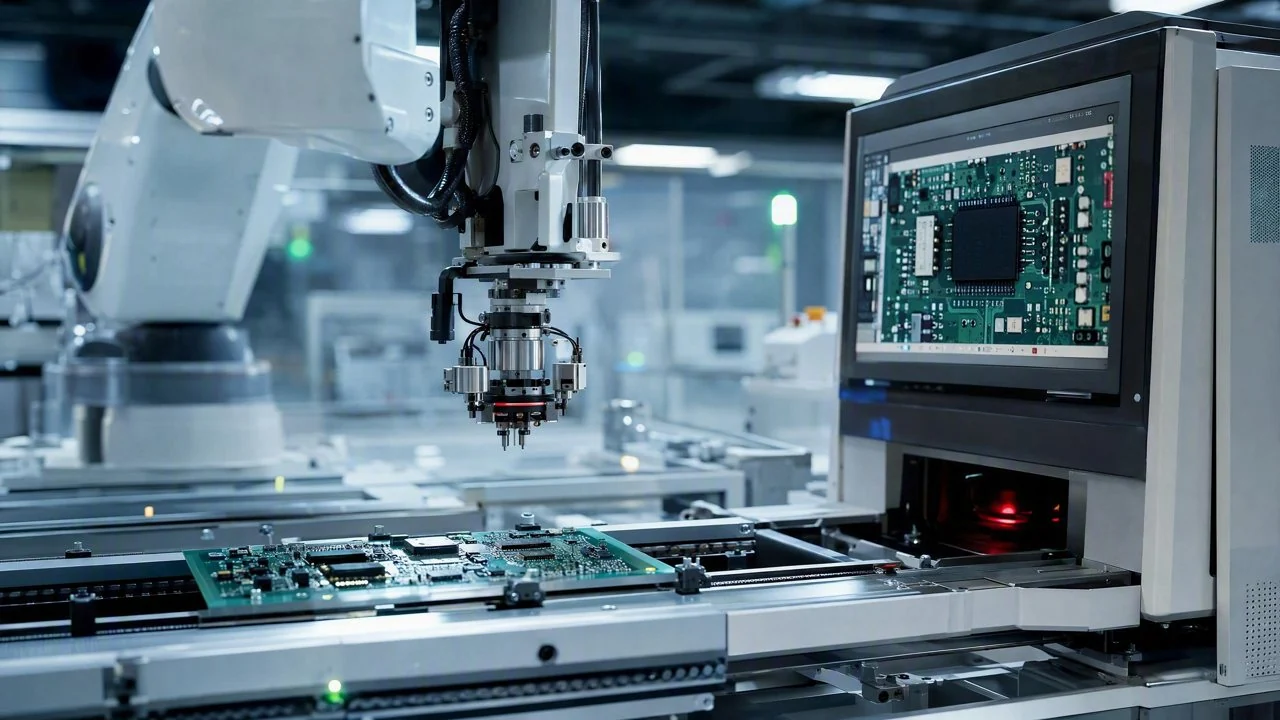
DaoAI ACI OS (featuring visual foundation model for feature recognition, 5-minute 0-code automatic programming with one good sample, APDT positive/few-shot learning with 1–20 good samples, semantic false positive filtering, and SDK/API/Docker support for 100% on-premise deployment) leverages its powerful feature learning and semantic understanding capabilities to reduce the common and challenging false positive rate of component polarity reversal in PCBA production from an industry average of 8% to below 2%, significantly alleviating manual re-inspection pressure and accelerating production line takt time.
In the electronics manufacturing industry, especially in highly reliability-critical fields like automotive electronics, the quality of PCBA (Printed Circuit Board Assembly) directly determines the performance and safety of the final product. With the increasing demand for high-precision defect detection driven by AI large models in automotive manufacturing, PCBA component polarity reversal detection has become a crucial link. Component polarity reversal, where directional components like electrolytic capacitors and diodes are mounted incorrectly, can lead to circuit malfunction or even burnout, severely impacting product quality. Traditional detection solutions often generate a large number of false positives when identifying such defects due to subtle component appearance differences, blurry printed markings, or environmental lighting variations. This forces production lines to invest significant human resources in re-inspection and verification, severely slowing down production takt time and increasing operational costs.
Pain Points: Why This Hurdle is Difficult to Overcome
The challenges in detecting PCBA component polarity reversal primarily manifest in several dimensions: Firstly, **high false positive rates**: Traditional rule-based or feature-engineered AOI systems are prone to false positives when encountering minor differences, reflections, stains in component markings (e.g., polarity dots, color bands), and variations in appearance across different batches or suppliers. In the industry, the false positive rate for such defects often reaches 5%~10%, leading to a large number of “good products” being flagged as defects, wasting re-inspection resources. Secondly, **inefficient manual re-inspection**: Faced with a vast number of false positives, production lines need dedicated quality inspectors for secondary manual visual inspection. With numerous components on each PCBA board, manual verification of polarity is not only time-consuming and labor-intensive, but prolonged repetitive work can easily lead to visual fatigue, increasing the risk of missed detections and reducing re-inspection efficiency by an average of over 30%. Finally, **pressure on new model development cycles**: In automotive electronics, new model development cycles are constantly shortening, imposing higher demands on PCBA production line changeover speed and detection model iteration efficiency. Traditional AOI models are slow to update and complex to debug, making it difficult to quickly adapt to the polarity detection needs of new components and board layouts, thereby extending the new product introduction cycle, impacting new model development cycles by an average of over 10%.
The root cause of these dilemmas lies in the fact that traditional AOI algorithms perceive component polarity features at a pixel level or through local feature matching, lacking an understanding of the overall semantic information and contextual relationships of the components. For instance, a tiny reflection might be mistakenly identified as a missing polarity mark, or the polarity mark of the same component captured from different angles might show subtle variations in the image, causing rules to fail. Furthermore, the diversity of component package types (e.g., SOP, QFN, BGA) and different surface treatment processes increase the complexity of polarity mark recognition, making it difficult for traditional algorithms to achieve robust generalization.
Technical Principles
The core advantage of the DaoAI ACI OS in solving PCBA component polarity reversal false positive issues lies in its **visual foundation model-based feature recognition** capability and innovative **semantic false positive filtering** mechanism. Unlike traditional AOI that relies on manually set thresholds and feature templates, DaoAI utilizes a pre-trained visual foundation model. This model learns rich general visual features from massive image data, enabling deep semantic understanding of PCBA component shapes, colors, textures, and markings. When a suspected polarity reversal is detected, the system does not merely match pixel-level differences; instead, it combines the component's package type, surrounding circuit structure, and even the functional context of that component on the entire PCBA board for comprehensive judgment.
Specifically, DaoAI's APDT (Adaptive Positive/Few-shot Defect Training) technology requires only 1–20 good sample images to quickly build a high-precision polarity detection model. This greatly simplifies the model training process, reducing the traditional AOI model debugging time from several hours or even days to 5 minutes of 0-code automatic programming. More importantly, its **semantic false positive filtering** function can identify and eliminate “false positive” alarms caused by non-defect factors such as lighting, angle, or printing quality. For example, if a capacitor's polarity mark appears unclear due to reflection, but its surrounding solder joints, pins, and the overall orientation of the component body are consistent with a good sample, the DaoAI system will combine this semantic information to determine it as a false positive, thereby avoiding unnecessary manual re-inspection. Compared to traditional AOI which relies solely on rigid rule matching, DaoAI's deep semantic understanding and filtering mechanism can reduce the false positive rate of component polarity reversal by over 75%, significantly improving detection accuracy and efficiency.
Typical Application Scenarios
- **Electrolytic Capacitor Polarity Detection**: Electrolytic capacitors are common polarized components on PCBAs, and polarity reversal can lead to leakage, explosion, and other serious consequences. The DaoAI ACI OS precisely determines polarity direction by identifying features such as long/short leads, negative polarity bands, and polarity dots on the capacitor body, combined with their positional relationship on the PCB pads. The challenge lies in the significant variation in capacitor markings from different manufacturers and their susceptibility to obstruction in confined spaces.
- **Diode Polarity Detection**: The polarity (anode/cathode) of a diode determines the unidirectional flow of current. The system ensures correct mounting direction by identifying color bands, notches, and text markings on the diode body. The challenge is that markings on miniature diodes can be blurry or their color may be close to the background color, making distinction difficult.
- **IC Chip Orientation Detection**: While most IC chips do not have strict “polarity,” their “orientation” is critical for aligning pins with pads. The DaoAI software system ensures correct chip alignment by identifying indexing dots, notches, and text orientation on the chip. Challenges include reflective chip surfaces, tiny text, and the lack of obvious indexing features on QFN/BGA packages.
- **LED Lamp Bead Polarity Detection**: Reversed polarity in LED lamp beads leads to non-illumination or burnout. The system detects polarity markings on the bottom of the lamp bead, lead lengths, and the orientation of the light-emitting surface. The challenge lies in transparent or translucent encapsulated LEDs, where internal structures are difficult to observe and are susceptible to external light interference.
- **Pin Header/Socket Orientation Detection**: Although pin headers and sockets do not directly conduct current, incorrect orientation can prevent subsequent connectors from being inserted or cause them to be inserted incorrectly, affecting overall assembly. The system makes judgments by identifying notches, protrusions, and pin arrangement features on the pin headers/sockets. The challenge is the abundance of similar structures, making subtle differences difficult to discern.
Case Study
A leading automotive electronics Tier-1 supplier, whose PCBA production line mainly manufactures automotive controller modules, has extremely high demands for quality and reliability. Previously, in the component polarity reversal detection stage, this production line used traditional rule-based AOI equipment. Due to the wide variety of product models and component suppliers, subtle differences existed in polarity markings across different batches of components. The traditional AOI required engineers to spend a significant amount of time adjusting rule parameters during each changeover or when encountering new components. The false positive rate for polarity reversal remained high, averaging around 8%, requiring 5-7 quality inspectors daily for manual re-inspection of false positives, severely hindering the production takt time. Each changeover resulted in 30-45 minutes of downtime, significantly impacting production efficiency.
After the deployment of the DaoAI ACI OS, the automotive electronics manufacturer's PCBA component polarity reversal false positive rate was reduced by 75%, and the manual re-inspection burden was decreased by over 60%, significantly improving production line efficiency and product quality.
After introducing the DaoAI ACI OS, the supplier deployed it at the image acquisition front-end of their existing AOI equipment, integrating it via its SDK interface. Using only about 10 good samples, the DaoAI system completed the polarity detection model training for new products within 5 minutes. In the initial phase of deployment, the system's false positive rate for component polarity reversal quickly dropped to below 2%, a 75% reduction compared to traditional solutions. This meant a significant decrease in the number of boards requiring manual re-inspection daily, reducing manual re-inspection hours by over 60%. The quality inspectors originally responsible for re-inspection were freed up to focus on other critical quality aspects. Concurrently, the model programming time during each product changeover was reduced from 30-45 minutes to under 5 minutes, greatly enhancing production line flexibility and efficiency, and providing strong support for rapid introduction of new vehicle models.
DaoAI Solutions and Products
The DaoAI ACI OS, as the core solution, provides a new technological path for component polarity detection in the electronics/PCBA industry. Its powerful visual foundation model deeply understands image content, automatically extracts and learns key features of component polarity, eliminating the need for complex manual feature engineering. Through the APDT positive/few-shot learning mechanism, customers only need to provide a small number of good sample images (1–20) to complete 0-code model automatic programming within 5 minutes, quickly deploying it to the production line. The system supports various deployment methods such as SDK/API/Docker and can achieve 100% on-premise private deployment, ensuring customer data security and privacy. In practical applications, DaoAI's semantic false positive filtering function effectively distinguishes between real defects and non-defect interferences (such as reflections, shadows, printing flaws), pushing the false positive rate to the extreme, thereby significantly reducing the manual re-inspection burden.
In terms of deployment and integration, the DaoAI ACI OS can serve as an independent software module, connecting with customers' existing AOI equipment's image acquisition hardware through standard interfaces (e.g., GenICam, GigE Vision), protecting customers' initial investments. At the same time, its flexible architecture also supports deep integration with DaoAI 2D/3D ACI equipment; if customers require higher precision 3D morphology detection, such as hidden solder joints or coplanarity, we can also provide a end-to-end solution. Furthermore, the DaoAI World Model, as a unified foundation, ensures that the ACI system possesses powerful semantic understanding and cross-scenario generalization capabilities, continuously learning and optimizing from production line feedback to improve detection accuracy and efficiency. Through these capabilities, the DaoAI ACI OS not only solves the false positive problem of component polarity reversal but also brings significant business value: improving detection accuracy to over 99.8%, reducing the false positive rate by over 75%, greatly reducing manual re-inspection volume, and accelerating product changeovers, helping electronics manufacturing enterprises achieve intelligent and efficient quality management.
FAQ
What are the advantages of DaoAI ACI OS in PCBA polarity detection?
DaoAI ACI OS utilizes a visual foundation model with deep semantic understanding capabilities, accurately identifying component polarity features. Through semantic false positive filtering, it effectively distinguishes between real defects and non-defect interferences. Compared to traditional AOI, it significantly reduces false positive rates, lessens manual re-inspection burden, and supports 0-code rapid programming, greatly improving changeover efficiency and production line flexibility.
How long does it take to deploy this system, and what is its compatibility with existing equipment?
The deployment time for DaoAI ACI OS is short, typically completing software integration within a few hours. It supports various deployment methods such as SDK/API/Docker and can be integrated into the image acquisition front-end of customers' existing AOI equipment via standard interfaces (e.g., GenICam, GigE Vision), without requiring hardware replacement, thus maximizing customer investment protection.
What is the cost of DaoAI ACI OS, and how is the return on investment evaluated?
The cost of DaoAI ACI OS varies depending on specific functional modules, deployment scale, and technical support requirements. We offer flexible licensing models and can quantify the direct economic benefits from reduced false positive rates, decreased manual re-inspection hours, and improved changeover efficiency, typically achieving significant ROI within months. We recommend contacting our sales team for a customized quote and detailed ROI assessment report.
Full solution for this scenario: Electronics / PCBA industry solutions · Component Polarity False-Alarm Reduction
This article was generated by AI. Customer cases are simulated scenarios based on real product capabilities and figures are illustrative; see product pages for official benchmarks.