
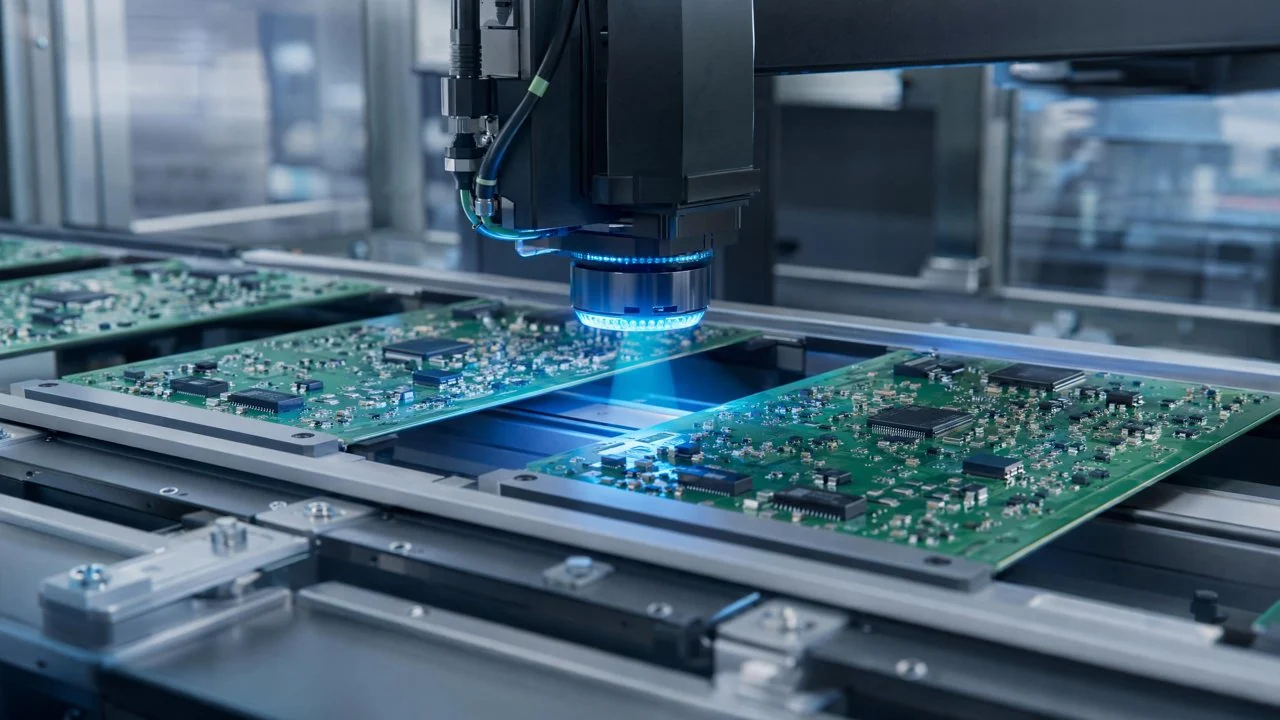
In the electronics manufacturing industry, particularly for high-reliability products like energy management chips, component polarity reversal during PCBA assembly is a critical defect that severely impacts product performance and reliability. DaoAI ACI OS (featuring vision foundation models for feature recognition, 5-minute 0-code programming with one good sample, APDT positive/few-shot learning with 1–20 good samples, semantic false positive filtering, and SDK/API/Docker for 100% on-premise deployment) offers an efficient and reliable solution to the false positive issue of PCBA component polarity reversal. By leveraging advanced vision foundation models and few-shot learning, it has reduced the false positive rate for this defect from 1.8% to 0.67%, significantly enhancing production line inspection efficiency and the quality of energy management chips.
DaoAI ACI OS (featuring feature recognition with vision foundation models, 5-minute 0-code programming with one good sample, APDT positive/few-shot learning with 1–20 good samples, semantic false positive filtering, and SDK/API/Docker for 100% on-premise deployment) has provided an efficient and reliable solution to the false positive issue of PCBA component polarity reversal by introducing vision foundation models and few-shot learning technology, reducing the false positive rate for this defect from 1.8% to 0.67%. Currently, with increasing global attention on industrial energy consumption, the production quality and reliability of energy management chips, as core components for optimizing power usage efficiency, have become particularly critical. In the electronics manufacturing industry, especially in the PCBA assembly stage, even minor defects can lead to product failure, subsequently affecting the energy efficiency performance of end devices. A leading energy management chip manufacturer faced challenges in inspecting the polarity of numerous surface-mounted components (such as capacitors, diodes, ICs, etc.) on its SMT (Surface Mount Technology) production line. These components must be mounted in the correct orientation as designed, otherwise, it will cause circuit malfunctions or even short circuits, severely impacting the chip's performance and energy consumption. Traditional AOI inspection systems often struggle with polarity identification for complex components and varying lighting conditions, leading to persistently high false positive rates.
Pain Points: Why This Hurdle Was So Difficult to Overcome
The main pain points faced by this leading manufacturer in PCBA polarity reversal detection were evident in several dimensions: ① **High False Positive Rate:** Traditional AOI systems based on rules and feature extraction had a false positive rate of up to 1.8% when detecting the polarity of high-density, small-sized components. This resulted in a large number of “false defects” requiring manual re-inspection, significantly increasing re-inspection hours and labor costs. ② **Long Changeover Downtime:** With the rapid iteration of new energy management chip models, each product changeover required several hours or even half a day to rewrite inspection programs and adjust parameters, severely impacting production line utilization. ③ **Risk of Undetected Defects:** Despite the high false positive rate, there was still a risk of undetected polarity reversals in certain special components or complex backgrounds. If these defects flowed into subsequent stages, they would lead to batch failures, causing irreversible impacts on the reliability and energy efficiency of energy management chips, and even leading to customer complaints and recalls. ④ **Low Data Utilization:** Traditional systems could not effectively learn from and optimize inspection data, leading to inefficient accumulation and application of defect libraries.
The root causes of these difficulties lie in: Firstly, **component diversity and ambiguous markings**. PCBA components vary widely, with diverse polarity marking methods (dots, lines, chamfers, color bands, etc.), and are often minuscule. Polarity markings on some components may differ subtly between batches or suppliers, or even be slightly covered by solder or glue after placement, making visual features indistinct. Secondly, **imaging complexity**. High-density mounting causes components to obscure each other, and diverse component surface materials (matte, glossy, transparent) are prone to reflections and shadows under different lighting conditions, interfering with polarity mark recognition. Furthermore, as energy management chips become increasingly integrated, component sizes continuously shrink, demanding higher resolution and recognition accuracy from AOI systems. Finally, **limitations of traditional algorithms**. Traditional rule-based AOI relies on manually set thresholds and geometric feature matching, making it difficult to adapt to the aforementioned complexity and variability. Each time a new component or defect type is encountered, manual intervention and lengthy parameter tuning are required, preventing fast, intelligent defect identification. These factors collectively contributed to the “difficult to overcome” status quo of polarity reversal detection, especially in the current context of pursuing ultimate energy efficiency and product reliability, where smarter, more robust solutions are urgently needed.
Technical Principles
The DaoAI ACI OS fundamentally solves the challenge of PCBA component polarity reversal detection through its core vision foundation models and APDT (Adaptive Positive Sample Domain Transfer) few-shot learning technology. The system first uses large-scale pre-trained vision foundation models for feature recognition on PCBA images. These foundation models have learned from vast amounts of image data, possessing powerful generalization capabilities and understanding of deep semantic features in images. This means it can automatically extract higher-level, more robust “concept-level” features than traditional edge, color, and texture features, such as “component body,” “polarity marking pattern,” and “pin direction,” maintaining stable recognition even under varying lighting, component deformation, or slight occlusion.
For specific polarity reversal detection, traditional methods rely on precise template matching or geometric rule judgment, such as identifying the relative position of a point or line. In contrast, the DaoAI system, through its APDT positive/few-shot learning mechanism, requires only 1–20 good sample images to complete 0-code automatic programming within 5 minutes. The system learns the visual patterns of “correct polarity” from these few good samples. When a component is detected, it performs a semantic comparison with the learned “correct polarity” pattern. If a semantic inconsistency is found between the component's visual features and the “correct polarity” pattern, it can accurately identify it as a polarity reversal, even if the marking is slightly obscured or reflective. Furthermore, the system's built-in semantic false positive filtering function can identify and filter out “false defects” caused by background interference, pad reflections, or subtle component variations, significantly reducing the false positive rate. Compared to traditional rule-based AOI, the DaoAI system eliminates the need for tedious parameter adjustments and rule writing. Instead, it achieves higher detection accuracy, stronger generalization capabilities, and faster changeover speeds through deep learning and semantic understanding. Compared to manual inspection, it avoids problems such as eye fatigue, subjective judgment, and low efficiency, ensuring consistent and reliable inspection, which is particularly advantageous for high-speed production lines of energy management chips.
Typical Application Scenarios
- **Electrolytic Capacitor Polarity Detection:** Electrolytic capacitors usually have long/short leads or color bands indicating polarity. The DaoAI system can precisely identify the orientation of these markings, even when components are dense, color bands are faint, or slight shadows are present, determining if they are reverse mounted. The challenge lies in varying marking standards and component sizes across different manufacturers.
- **Diode/Transistor Polarity Detection:** These components typically indicate polarity via dots, lines, or chamfers on their body. The system learns the relative positions and forms of these features to quickly determine their mounting direction. Challenges include surface reflections and the minuscule size of markings.
- **IC Chip Pin 1 Detection:** IC chips usually have a dimple or chamfer marking the first pin, which dictates the chip's mounting orientation. The DaoAI system can accurately identify these tiny geometric features, ensuring correct chip orientation and preventing functional failure. Difficulties arise from printed characters on the chip surface and the subtle depressions of the markings.
- **Connector Orientation Detection:** Some connectors are directional, and reverse insertion can lead to connection failure or short circuits. The system ensures correct installation by identifying characteristic notches, latches, or pin arrangements of the connector. The challenge lies in the complex geometry and multi-angle presentation of connectors.
- **LED Lamp Bead Polarity Detection:** LED lamp beads typically use green dots, chamfers, or lead lengths to indicate polarity. The system effectively identifies these subtle markings to ensure normal LED illumination. The difficulty is due to the small size of the lamp beads and the possibility of markings being obscured after soldering.
Case Study
A globally renowned Tier-1 supplier of energy management chips, at its SMT production base in South China, had long faced challenges in PCBA component polarity reversal detection. This base produces millions of energy management modules monthly for electric vehicles and data centers, with extremely high reliability requirements. Previously, they primarily relied on traditional rule-based AOI equipment for inspection, combined with extensive manual re-inspection. Before implementation, the false positive rate for polarity reversal defects on the production line was as high as 1.8%, requiring 3-4 skilled operators to spend 6-8 hours daily on manual re-inspection, which significantly consumed human resources and slowed down the overall cycle time. When new product models were introduced, AOI engineers would spend approximately 4-6 hours writing and debugging new inspection programs, severely impacting production efficiency and time-to-market for new products. To address these challenges, they introduced the DaoAI ACI OS for trial. The deployment process was highly efficient; engineers only needed to provide 10-15 good sample images, and the system automatically completed the programming of the polarity detection model within 5 minutes. After a month of parallel testing and optimization, the results were highly satisfactory. Post-implementation, the false positive rate for polarity reversal defects significantly dropped to 0.67%, reducing manual re-inspection workload by 63%, requiring only 1-2 operators for minimal daily re-inspection. New product changeover time was also reduced from 4-6 hours to under 15 minutes. This not only significantly saved labor costs but also enhanced the overall utilization rate of the production line and its responsiveness to market changes, ensuring a stable supply of high-quality energy management chips.
The DaoAI ACI OS has given us unprecedented confidence and efficiency in handling polarity detection for high-density, small-sized components. It not only resolved our long-standing false positive issues but also made new product changeovers effortless, significantly boosting our production competitiveness for energy management chips.
The figures above are a typically achievable range in anonymized industry scenarios — a different line or a different batch of parts will move the result either way; on-site measurement governs.
DaoAI Solutions and Products
The core solution provided by DaoAI is the DaoAI ACI OS. This system, with its unique vision foundation model at its heart, achieves deep cognitive recognition of PCBA component features. In the polarity reversal detection scenario, engineers simply use an intuitive graphical interface to select the area of the component to be inspected and provide 1-20 good sample images. The system then leverages APDT positive/few-shot learning technology to automatically generate a high-precision inspection model within 5 minutes, without any code writing. The system's built-in semantic false positive filtering module intelligently distinguishes between true and false defects, significantly reducing unnecessary downtime and manual re-inspection. For deployment, the DaoAI ACI OS supports various forms such as SDK/API/Docker, enabling 100% on-premise private deployment, ensuring customer data security and compliance with industry-high standards for data privacy and security. In practical applications, it can be smoothly integrated into existing customer AOI hardware platforms, quickly upgrading their inspection capabilities. For customers requiring higher precision 3D inspection, it can be combined with DaoAI 2D / 3D ACI equipment, utilizing self-developed 3D cameras and 3D morphology reconstruction technology to further detect hidden solder joints, coplanarity, and other defects that traditional 2D cannot address, providing more comprehensive quality assurance.
Through the aforementioned solutions, the DaoAI ACI OS has brought significant business value and quantifiable results to customers. Firstly, the false positive rate for polarity reversal defects was drastically reduced from 1.8% to 0.67%, directly decreasing manual re-inspection workload by 63%, greatly improving production line efficiency and the rational allocation of human resources. Secondly, new product changeover time was shortened from 4-6 hours to under 15 minutes, enhancing production line flexibility and responsiveness to market demands. Thirdly, leveraging the powerful generalization capabilities of vision foundation models and the few-shot learning mechanism, the system achieved a detection accuracy of 99.4% for polarity inspection across various complex components and varied scenarios, significantly reducing the risk of undetected defects and ensuring the ultimate product quality and reliability of energy management chips. These improvements not only reduced operating costs but also enhanced the customer's product competitiveness in the market, helping them maintain a leading position in the energy management chip sector.
FAQ
How does the DaoAI ACI OS achieve precise detection of polarity reversal?
The system uses vision foundation models for feature recognition, extracting deep semantic features from complex images. Combined with APDT few-shot learning, it learns correct polarity patterns from only a few good samples. When a component is detected, it intelligently determines polarity reversal by semantically comparing it with the learned pattern, and reduces false defects through semantic false positive filtering.
What are the core advantages of this system over traditional AOI for PCBA polarity detection?
The core advantages lie in its intelligence and efficiency. Compared to the tedious parameter adjustments and rule writing of traditional rule-based AOI, the DaoAI system achieves 0-code automatic programming through deep learning, significantly shortening changeover times. Furthermore, the generalization capability of vision foundation models and semantic false positive filtering greatly reduce false positive and undetected defect risks, improving overall detection accuracy and production line efficiency.
How does the DaoAI ACI OS ensure data security and privacy?
The DaoAI ACI OS supports various deployment methods such as SDK/API/Docker, enabling 100% on-premise private deployment. This means all inspection data is processed and stored within the customer's internal network, with no data leaving the factory, strictly complying with customers' high standards for data privacy and security, ensuring information security.
Full solution for this scenario: the full inspection solution for Electronics / PCBA · Component Polarity False-Alarm Reduction
This article was generated by AI. Customer cases are simulated scenarios based on real product capabilities and figures are illustrative; see product pages for official benchmarks.