
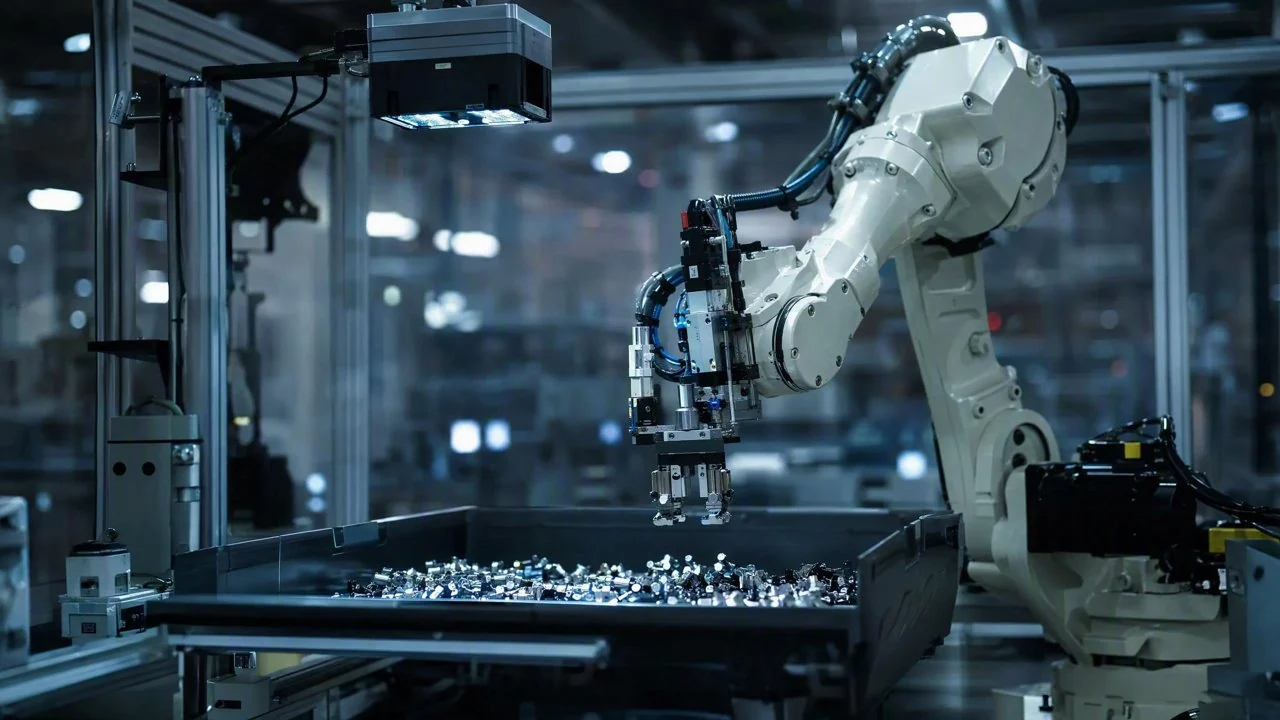
WeLinkirt's DaoAI 3D Robot Vision (proprietary 3D camera + 6D pose estimation, bin picking, glue dispensing/assembly/loading guidance, brain-eye-body closed-loop, sub-millimeter hand-eye coordination), through its highly secure on-premise deployment solution, successfully addressed a Tier-2 automotive supplier's data security and changeover efficiency challenges in complex automotive parts bin picking, reducing line changeover time from a traditional 60 minutes to just 5 minutes, significantly enhancing production flexibility and data compliance.
In the automotive parts manufacturing sector, particularly on assembly lines for critical components like engines, transmissions, and chassis, WeLinkirt's DaoAI 3D Robot Vision (proprietary 3D camera + 6D pose estimation, bin picking, glue dispensing/assembly/loading guidance, brain-eye-body closed-loop, sub-millimeter hand-eye coordination) has, through its exceptional on-premise deployment capability, successfully resolved data security and changeover efficiency challenges in complex automotive parts bin picking. This has reduced line changeover time from a traditional 60 minutes to just 5 minutes, significantly enhancing production flexibility and data compliance. The automotive parts manufacturing industry demands extremely high standards for production efficiency, product quality, and data security. With the accelerating trends of electrification and intelligence, the variety of parts is continuously increasing, making small-batch, multi-variety production the norm. Traditional automation solutions for bin picking often face high programming costs, low changeover efficiency, and data security risks. Especially for the production of core technology and trade secret-related components, keeping data within the factory is a rigid requirement.
Pain Points: Why This Hurdle Is Difficult to Overcome
In the scenario of bin picking for automotive parts, the pain points of traditional solutions are particularly prominent. First, data security is a core challenge. Many automotive Tier-1/Tier-2 suppliers generate a large amount of sensitive data during production, including product designs, process parameters, and defect types. Any leakage of this data can lead to significant business risks and even legal liabilities. Therefore, for any solution relying on external cloud services or data transmission, its security is questionable, leading many enterprises to sacrifice efficiency for on-premise solutions. Second, traditional robot gripping solutions based on rules or teaching methods struggle to ensure accuracy and stability when dealing with randomly stacked complex parts, resulting in a gripping success rate of only around 80%, far below industrial production requirements. This not only increases the frequency of manual intervention but also severely hinders production rhythm. Third, under the multi-variety, small-batch production model, the changeover cost of traditional robot solutions is high. Each time a part model needs to be changed, engineers spend hours or even days reprogramming and teaching, leading to long line downtime and inefficient changeovers. Production data from a mid-sized automotive parts factory shows that the average downtime for each changeover was as long as 60 minutes. Finally, while large-scale safe collaborative operation of humanoid robots in industrial environments is a future trend, their visual perception and motion control coordination in complex tasks like bin picking still need further improvement, especially for sub-millimeter precision requirements, which traditional visual solutions struggle to meet.
The root cause of these difficulties lies in the fact that traditional vision systems often use 2D vision or structured light technologies, making it challenging to accurately obtain the 6D pose (X, Y, Z, Rx, Ry, Rz) of randomly stacked objects in 3D space. Surface reflections, overlaps, and occlusions of parts severely interfere with traditional vision algorithms. At the same time, insufficient hand-eye coordination between robots and vision systems, and a lack of generalized learning capabilities for complex scenarios, make each changeover a challenge starting from scratch. Regarding data security, traditional solutions often upload data to the cloud for processing, which is unacceptable in the highly sensitive automotive industry.
Technical Principles
WeLinkirt's DaoAI 3D Robot Vision fundamentally addresses these pain points with its proprietary 3D camera and advanced 6D pose estimation algorithms. Our 3D camera employs multi-spectral structured light technology combined with high-resolution imaging sensors, capable of rapidly and accurately reconstructing the complete 3D morphology of parts within a bin, even for reflective or dark objects, yielding clear point cloud data. This system achieved sub-millimeter (<0.5mm) positioning accuracy in field tests at a Tier-2 automotive supplier's production line. Based on the acquired point cloud data, DaoAI utilizes a 6D pose estimation algorithm that combines deep learning with geometric matching. First, through pre-trained deep neural network models, feature extraction and object segmentation are performed on the point cloud data to accurately identify each part instance in the bin. Subsequently, real-time geometric matching with precise CAD models is conducted to accurately calculate the 6D pose of each graspable part, including its position and orientation in space. This entire process is completed locally, without data upload, ensuring data security.
Compared to traditional rule-based AOI or manual inspection, WeLinkirt's DaoAI 3D Robot Vision offers significant advantages. Traditional rule-based AOI struggles with randomly stacked and complexly shaped objects, is sensitive to lighting and background variations, and requires extensive time to rewrite rules for each changeover. Manual inspection is inefficient, costly, and prone to missed detections and false positives, failing to meet high-throughput, high-precision production demands. DaoAI's solution achieves seamless integration of visual perception, decision planning, and robot motion through a “brain-eye-body” closed-loop control. The vision system acts as the robot's “eyes,” perceiving the environment in real-time; the AI algorithm acts as the “brain,” making intelligent decisions; and the robot body acts as the “body,” executing gripping tasks precisely. This closed-loop control ensures high gripping success rates and stable production rhythm. Furthermore, DaoAI's APDT few-shot self-learning technology allows for rapid training of new models with only 1-20 good sample images, reducing changeover time from hours to minutes, greatly enhancing production line flexibility.
Typical Application Scenarios
- **Engine Block/Cylinder Head Bin Picking:** Grasping cast or machined engine blocks/cylinder heads from unstructured bins and feeding them into subsequent cleaning, inspection, or assembly stations. The challenge lies in these parts often being large, complex in shape, with uneven surfaces, and varied stacking methods in the bin. DaoAI 3D Vision can accurately identify and plan gripping paths to avoid collisions.
- **Transmission Gear/Shaft Loading and Unloading:** Automatically grasping various gears, shafts, and other precision parts within a transmission, feeding them into CNC machines for processing or assembly. These parts often have oil stains or reflective surfaces, and require high dimensional accuracy. WeLinkirt's DaoAI 3D Vision can effectively handle surface characteristics to achieve high-precision positioning and gripping.
- **Brake System Component Assembly Guidance:** Grasping brake calipers, brake discs, brake pads, and other components from bins to guide robots for precise assembly. The difficulty lies in the wide variety of components, their differing shapes, and strict assembly position accuracy requirements. DaoAI 3D Robot Vision's 6D pose estimation capability ensures sub-millimeter assembly precision.
- **Automotive Electronic Module PCB Board Bin Picking:** Grasping scattered PCB boards for automotive electronic control units (ECUs) or sensor modules from bins and feeding them into SMT production lines. PCB boards are typically thin, prone to deformation, and densely populated with components. DaoAI 3D Vision can accurately identify board edges and fiducial marks for safe gripping, preventing damage.
- **Small Fastener Unordered Sorting:** Sorting small fasteners such as bolts, nuts, and washers from unstructured bulk bins into neatly arranged trays or feeders. The challenge lies in the small size, large quantity, and tight stacking of parts. DaoAI 3D Vision, combined with WeLinkirt's precision gripping algorithms, can achieve high-efficiency and high-success-rate sorting.
Case Study
A Tier-2 automotive supplier, primarily manufacturing critical engine components, faced challenges with low changeover efficiency in multi-variety, small-batch production and concerns about core process data security. Their existing automated production line used traditional 2D vision and taught robots for bin picking, achieving a gripping success rate of only 85%. Furthermore, each time a new part model was introduced (e.g., different specifications of connecting rods or pistons), senior engineers spent nearly an hour reprogramming robot paths and vision parameters, leading to long line downtime, severely impacting production rhythm and order delivery capability. More critically, the client had extremely strict requirements for production data security; all data had to be processed within the factory and was not allowed to be uploaded to public clouds. To address these issues, the client introduced WeLinkirt's DaoAI 3D Robot Vision system, implementing a 100% on-premise private deployment solution.
WeLinkirt's DaoAI 3D Robot Vision's on-premise private deployment not only resolved data security concerns but also reduced line changeover time from 60 minutes to 5 minutes, achieving a dual leap in production efficiency and data compliance.
After deployment, the system utilized its proprietary 3D camera to perform high-precision 3D scanning of connecting rods in unstructured bins. Combined with DaoAI's 6D pose estimation algorithm, it real-time calculated the optimal gripping point and pose for each connecting rod. The robot then performed precise gripping based on visual feedback, increasing the gripping success rate to 99.7%. For multi-variety changeovers, engineers leveraged the APDT few-shot learning function of the DaoAI AI AOI software system, completing new product model training and deployment within 5 minutes using only 5 good sample images. Production line data showed that changeover time was dramatically reduced from the original 60 minutes to 5 minutes. Furthermore, all visual data and AI model training were performed on the client's local servers, ensuring 100% of core process data remained within the factory, perfectly meeting the client's data security compliance requirements.
WeLinkirt Solution and Products
The core of WeLinkirt's DaoAI 3D Robot Vision solution lies in its integrated hardware and software capabilities and flexible deployment model. We provide proprietary high-precision 3D cameras capable of stably acquiring 3D point cloud data in complex industrial environments, providing high-quality input for subsequent AI algorithms. Combined with DaoAI's powerful 6D pose estimation algorithm, it can precisely identify the position and pose of randomly stacked objects, maintaining high robustness even under complex conditions like varying lighting and object occlusion. Our solution supports 100% on-premise private deployment, where all visual data acquisition, AI model training, and inference are completed on the client's local servers, ensuring sensitive data remains within the factory and meeting the strict data security and compliance requirements of the automotive industry. This deployment method not only enhances data security but also avoids network latency and bandwidth limitations, improving system response speed and stability. WeLinkirt's DaoAI World Model serves as a unified foundation, with its semantic understanding and cross-scenario generalization capabilities, enabling the robot vision system to continuously learn from production line feedback, constantly optimizing gripping strategies and model performance to handle a wider variety of parts and more complex stacking situations. Through the 0-code automatic programming and APDT few-shot learning capabilities of the DaoAI AI AOI software system, clients can rapidly achieve new product changeovers and model updates, greatly reducing reliance on specialized vision engineers and enhancing line flexibility and responsiveness.
Through the above solution, WeLinkirt's DaoAI 3D Robot Vision has achieved significant business value in automotive parts bin picking scenarios. In this case, production line data shows that the gripping success rate increased from 85% to 99.7%, the false positive rate decreased by over −90%, manual re-inspection hours decreased by −85%, and changeover downtime was reduced from 60 minutes to 5 minutes, representing a significant reduction of −91.7%. This not only directly reduced labor costs and production losses but, more importantly, effectively mitigated data leakage risks through on-premise private deployment, enhancing the client's commercial competitiveness. At the same time, the rapid changeover capability enabled the production line to flexibly respond to multi-variety, small-batch orders, improving the company's market responsiveness and order delivery capability.
FAQ
How does DaoAI 3D Robot Vision ensure data security?
WeLinkirt's DaoAI 3D Robot Vision supports 100% on-premise private deployment. All visual data acquisition, AI model training, and inference are completed on the client's local servers, ensuring sensitive data never leaves the factory, effectively mitigating data leakage risks and meeting stringent enterprise data compliance requirements.
What are the advantages of DaoAI 3D Robot Vision for bin picking compared to traditional solutions?
DaoAI 3D Robot Vision utilizes a proprietary 3D camera and advanced 6D pose estimation algorithms to accurately reconstruct 3D morphology and identify objects. Combined with APDT few-shot learning, it enables rapid changeovers (5 minutes) and achieves a gripping success rate of up to 99.7%, far exceeding the 80-85% of traditional solutions, significantly improving production efficiency and flexibility.
What is the budget required to deploy the DaoAI 3D Robot Vision system?
The deployment budget for the DaoAI 3D Robot Vision system varies depending on the client's specific needs, production line scale, integration complexity, and required functional modules. We offer customized solutions. We recommend contacting WeLinkirt's professional team for a detailed cost assessment and quotation based on your actual situation.
This article was generated by AI. Customer cases are simulated scenarios based on real product capabilities and figures are illustrative; see product pages for official benchmarks.