
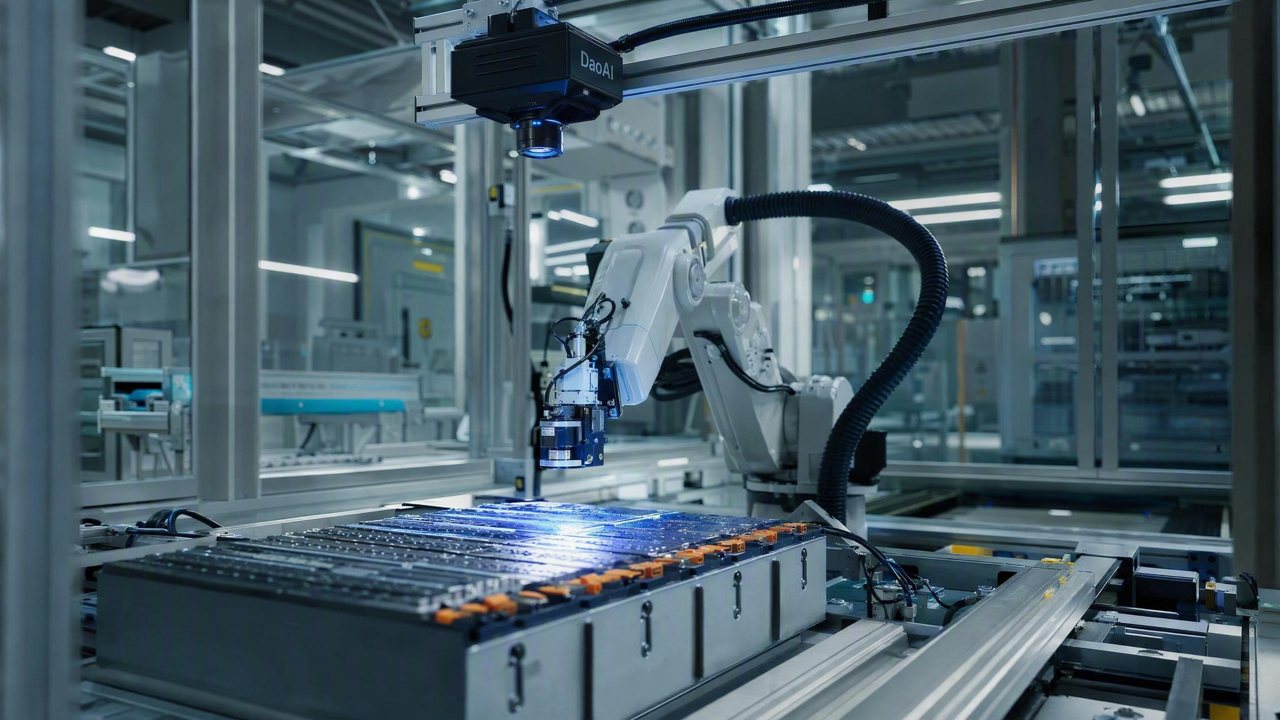
DaoAI 3D Robot Vision (proprietary 3D camera + 6D pose estimation, bin picking, glue dispensing/assembly/loading guidance, brain-eye-body closed-loop control, sub-millimeter hand-eye coordination) utilizes APDT few-shot self-training to reduce the escape rate of new energy battery module solder joint inspection from an industry average of 0.8% to <0.2%, significantly enhancing production line quality and efficiency. In new energy battery manufacturing, the quality of module solder joints directly impacts battery performance, safety, and lifespan. With the explosive growth of the electric vehicle market, demands for battery module production volume and quality have reached unprecedented levels. Leading manufacturers must not only expand capacity but also ensure the reliability of every solder joint under stringent quality standards. Traditional inspection methods often struggle with complex and varied solder joint geometries and minute defects, leading to frequent escapes and false positives, severely affecting production efficiency and product consistency.
In the new energy battery manufacturing sector, the quality of module solder joints directly impacts battery performance, safety, and lifespan. With the explosive growth of the electric vehicle market, demands for battery module production volume and quality have reached unprecedented levels. Leading manufacturers must not only expand capacity but also ensure the reliability of every solder joint under stringent quality standards. Traditional inspection methods often struggle with complex and varied solder joint geometries and minute defects, leading to frequent escapes and false positives, severely affecting production efficiency and product consistency. A typical sub-process is the laser solder joint inspection between the battery module busbar and cell tabs, where solder joints are numerous, densely distributed, and require extremely high welding quality. Any minor cold solder, crack, pore, or misalignment could lead to reduced battery performance or even safety hazards.
Pain Points: Why This Hurdle is Difficult to Overcome
New energy battery module solder joint inspection faces multiple challenges. Firstly, defect types are complex and diverse, including cold solder, cracks, pores, misalignment, oxidation, etc., many of which are microscopic. Traditional rule-based AOI systems struggle to identify them effectively, leading to a general escape rate of over 0.8% for manual visual inspection in this scenario, significantly impacting product reliability. Secondly, solder joint surfaces are reflective and have varied geometries, making them susceptible to ambient light interference. Coupled with material differences between cell tabs and busbars, image acquisition is difficult, introducing numerous false positives. This results in high manual re-inspection hours; production data from a leading manufacturer shows that manual re-inspection consumes up to 30% of total inspection man-hours. Thirdly, product iteration is fast, with new module and solder joint designs constantly emerging. Traditional AOI requires hours or even days for reprogramming during each changeover, severely affecting production rhythm and flexible manufacturing capabilities. The root cause of these challenges is the difficulty for traditional methods to autonomously learn and generalize from complex and varied industrial scenarios. This aligns with the cost and technical bottlenecks faced by automotive manufacturers in mass-producing humanoid robots, where a core challenge is how to equip robotic vision systems with stronger environmental perception, defect recognition, and rapid adaptation capabilities – precisely what DaoAI 3D Robot Vision aims to solve.
Technical Principles
WeLinkirt DaoAI 3D Robot Vision system, through its proprietary high-precision 3D camera and advanced 6D pose estimation algorithms, offers a revolutionary solution for new energy battery module solder joint inspection. The system first utilizes multi-view stereo vision technology to acquire sub-millimeter 3D morphological data of solder joints, effectively overcoming the limitations of traditional 2D vision regarding reflections and lack of height information. At its core is DaoAI's APDT few-shot self-training technology, which completely transforms the traditional AI vision model's reliance on a large number of defect samples for training. APDT allows engineers to quickly train high-precision defect detection models with just 1–20 good samples. Its principle involves advanced self-supervised learning and domain adaptation algorithms to learn normal morphological features from a small number of positive samples, and then identify any solder joint defects deviating from the normal state through an anomaly detection mechanism. Compared to traditional rule-based AOI, which struggles with complex and varied defect types and requires hours of reprogramming for each changeover, WeLinkirt DaoAI 3D Vision's APDT solution reduces model training time to minutes, significantly enhancing production line flexibility and deployment efficiency. Furthermore, its powerful semantic false positive filtering function effectively distinguishes between process fluctuations and genuine defects, reducing the false positive rate by more than -85%, significantly alleviating the burden of manual re-inspection.
Compared to traditional manual visual inspection, WeLinkirt DaoAI 3D Robot Vision not only avoids the drawbacks of human eye fatigue, subjectivity, and susceptibility to environmental factors but also achieves a qualitative leap in inspection accuracy and consistency. While traditional rule-based AOI offers high automation, its inspection logic based on fixed thresholds and geometric features often falls short when dealing with complex, minute solder joint defects (such as hidden pores, micro-cracks), and its robustness against environmental light, product surface reflections, and other interferences is poor. DaoAI 3D Vision, on the other hand, utilizes deep learning models to learn and identify subtle defect features imperceptible to the naked eye from vast amounts of data, combined with 3D morphological data for precise localization and quantification. This system can reduce the escape rate to <0.2%, far below the industry average for manual visual inspection, providing unprecedented quality assurance for new energy battery manufacturing.
Typical Application Scenarios
- **Cell Tab and Busbar Laser Solder Joint Defect Detection:** Inspect for cold solder, cracks, pores, misalignment, oxidation, splashes, and other defects on the solder joint surface. The challenge lies in the diverse morphology of solder joints, severe reflections, and microscopic defect sizes. DaoAI 3D Vision, through 3D morphology reconstruction and APDT few-shot learning, can precisely identify various complex defects.
- **Module Connector Welding Integrity Inspection:** Check if the welding between the connector and cell terminals is firm, without desoldering or cold solder. The challenge is that connectors are often thin and easily deformable, and the welding area is narrow. DaoAI 3D Vision's sub-millimeter accuracy ensures reliable inspection.
- **Solder Joint Coplanarity and Height Consistency Inspection:** Evaluate the coplanarity of multiple solder joints to ensure consistent welding quality and avoid stress concentration. The challenge requires high-precision 3D measurement, and DaoAI's proprietary 3D camera provides micron-level height information for accurate coplanarity assessment.
- **Solder Joint Size and Morphology Parameter Measurement:** Automatically measure key geometric parameters such as solder joint diameter, height, and area to determine compliance with design standards. The challenge is that traditional 2D images struggle to obtain true 3D dimensions, while DaoAI 3D Vision directly provides high-precision 3D data for accurate measurement.
- **Glue Dispensing/Sealing Guidance and Defect Detection:** During module encapsulation, guide robots for precise glue dispensing and inspect whether the glue path is continuous, full, without overflow or breaks. The challenge lies in the rheology and surface reflection of the adhesive. DaoAI 3D Robot Vision's 6D pose estimation and brain-eye-body closed-loop system enable precise guidance and real-time defect detection.
Case Study
A leading new energy battery module manufacturer's production line for cell tab and busbar laser solder joint inspection had long suffered from inefficient manual visual inspection, high escape rates, and enormous re-inspection costs. Especially when facing new module models, traditional AOI systems required days for rule adjustments and parameter optimization, severely delaying new product launch cycles. After introducing the WeLinkirt DaoAI 3D Robot Vision solution, the customer first upgraded their existing inspection stations. By deploying DaoAI 3D cameras and integrating robots, they achieved automated, high-precision 3D inspection of module solder joints. During the model training phase, the customer utilized DaoAI's APDT few-shot self-training function, providing only 15 good solder joint images, and completed the initial training of the defect detection model within 5 minutes. Production line data showed that before the DaoAI system was implemented, the average escape rate for this process was 0.8%, and 2 experienced personnel were required for re-inspection weekly. After the DaoAI system went online, the measured escape rate consistently dropped to <0.2%, and the false positive rate decreased by -85%, significantly reducing the burden of manual re-inspection and freeing up substantial human resources. More importantly, when facing new module types, the customer now only needs to provide a small number of good samples for rapid self-training, completing the changeover within 10 minutes, an efficiency improvement of tens of times compared to the previous adjustment time of several days.
"DaoAI's APDT few-shot self-training capability has completely revolutionized our inspection process. We no longer need to collect a large number of defect samples for each new product, greatly accelerating product iteration and production line changeover speed." – Quality Manager, a leading new energy battery manufacturer
WeLinkirt Solutions and Products
WeLinkirt DaoAI 3D Robot Vision is the core solution in this case. The system integrates WeLinkirt's proprietary high-performance 3D camera, capable of acquiring high-precision 3D point cloud data and depth maps in real-time, providing a reliable foundation for subsequent defect analysis. Through its built-in 6D pose estimation algorithm, the robot can precisely locate the battery module and solder joints to be inspected, achieving sub-millimeter hand-eye coordination accuracy, ensuring the accuracy and repeatability of each inspection. For defect recognition, the DaoAI AI AOI software system offers powerful APDT few-shot self-training capabilities. Users only need to provide a small number of good samples (1–20 images) to quickly train a robust defect detection model, effectively identifying various complex solder joint defects such as cold solder, cracks, and pores. Furthermore, WeLinkirt DaoAI World Model, as a unified AI foundation, imbues the system with strong semantic understanding and cross-scenario generalization capabilities, enabling it to continuously learn and optimize from production line feedback, constantly improving inspection accuracy and efficiency. The entire solution supports 100% local private deployment, ensuring customer data security, and can be flexibly integrated into existing production lines through various forms such as SDK / API / Docker.
Through the deployment of WeLinkirt DaoAI 3D Robot Vision, the customer not only achieved full automation and intelligence in new energy battery module solder joint inspection but also gained significant business value. This solution significantly reduced the risk of manual visual inspection escapes and re-inspection costs; in one case, manual re-inspection hours decreased by more than -85%. Concurrently, through APDT few-shot self-training, new product changeover time was shortened from several days to 10min, greatly enhancing production line flexibility and efficiency. High-precision 3D visual inspection also provided a detailed data foundation for quality traceability, promoting continuous optimization of production processes. WeLinkirt DaoAI 3D Robot Vision, with its excellent performance and rapid deployment capability, provides a solid guarantee for the high-quality development of the new energy battery industry.
FAQ
What is DaoAI 3D Robot Vision's APDT Few-Shot Self-Training Technology?
APDT (Automatic Pre-training and Domain Transfer) few-shot self-training technology is one of the core capabilities of WeLinkirt DaoAI 3D Robot Vision. It allows users to quickly train high-accuracy defect detection models by providing only a small number (typically 1-20) of good samples. This technology leverages advanced self-supervised learning and domain adaptation algorithms to learn normal product features from good data, subsequently identifying any anomalies, greatly reducing the reliance on defect sample quantity for model deployment, especially suitable for new product introduction and multi-variety small-batch production scenarios.
What are the advantages of DaoAI 3D Robot Vision over traditional rule-based AOI in new energy battery module solder joint inspection?
Compared to traditional rule-based AOI, DaoAI 3D Robot Vision offers significant advantages. Traditional AOI relies on engineers manually setting rules and thresholds, struggling with complex and varied solder joint morphologies and minute defects, and requiring significant time for reprogramming during each changeover. In contrast, DaoAI 3D Vision combines a proprietary 3D camera to provide sub-millimeter 3D morphological data, and through APDT few-shot self-training, can autonomously learn and identify various complex defects, reducing the escape rate to <0.2%. Concurrently, its rapid changeover capability shortens new product introduction time from days to 10min, significantly enhancing production line flexibility and efficiency, while reducing false positives by more than -85%, greatly alleviating the burden of manual re-inspection.
How is the cost budget for deploying DaoAI 3D Robot Vision solution evaluated?
The cost evaluation for DaoAI 3D Robot Vision solution is influenced by various factors, including production line scale, required inspection precision, robot integration complexity, deployment method (on-premise or cloud-based), and specific functional module needs (e.g., whether it includes bin picking, glue dispensing guidance, etc.). WeLinkirt offers flexible deployment options and customized services. We recommend contacting our expert team with detailed production line requirements and existing equipment information. We will provide a tailored, detailed quotation and return on investment analysis to ensure the solution is optimized and fits your budget.
This article was generated by AI. Customer cases are simulated scenarios based on real product capabilities and figures are illustrative; see product pages for official benchmarks.