
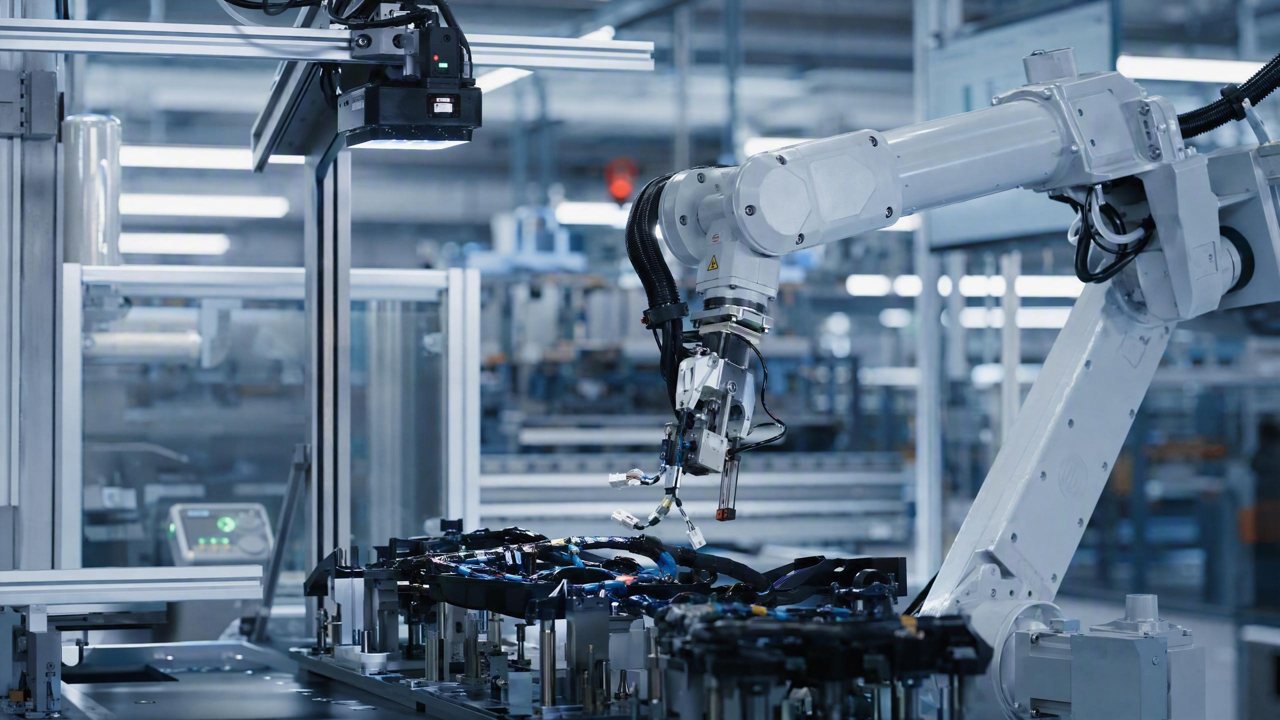
WeLinkirt DaoAI 3D Robot Vision (proprietary 3D camera + 6D pose estimation, bin picking, glue dispensing/assembly/loading/unloading guidance, brain-eye-body closed-loop, sub-millimeter hand-eye coordination), through high-precision 3D morphology reconstruction and intelligent defect recognition, elevates the detection rate of assembly errors and omissions in automotive harness assembly to over 99.7%, effectively reducing missed detections to below 0.3%, significantly enhancing assembly quality and production line efficiency. In the automotive/parts industry, total assembly is a critical process determining product performance and safety, especially for harness assemblies. Their complexity, diversity, and hidden nature pose significant challenges for traditional inspection solutions. A mid-sized automotive harness assembly manufacturer, for example, has production lines involving hundreds of different harness assembly models, each containing dozens or even hundreds of tiny components like connectors, clips, and zip ties. Misplacement, omission, or improper installation of these components can lead to functional failure, vehicle malfunctions, or even safety incidents.
WeLinkirt DaoAI 3D Robot Vision (proprietary 3D camera + 6D pose estimation, bin picking, glue dispensing/assembly/loading/unloading guidance, brain-eye-body closed-loop, sub-millimeter hand-eye coordination), through high-precision 3D morphology reconstruction and intelligent defect recognition, elevates the detection rate of assembly errors and omissions in automotive harness assembly to over 99.7%, effectively reducing missed detections to below 0.3%, significantly enhancing assembly quality and production line efficiency. In the automotive/parts industry, total assembly is a critical process determining product performance and safety, especially for harness assemblies. Their complexity, diversity, and hidden nature pose significant challenges for traditional inspection solutions. A mid-sized automotive harness assembly manufacturer, for example, has production lines involving hundreds of different harness assembly models, each containing dozens or even hundreds of tiny components like connectors, clips, and zip ties. Misplacement, omission, or improper installation of these components can lead to functional failure, vehicle malfunctions, or even safety incidents.
Pain Points: Why This Hurdle Is So Difficult to Overcome
In automotive harness assembly, traditional manual inspection or rule-based 2D AOI systems face severe challenges in dealing with complexity and diversity. Data from a mid-sized automotive harness assembly manufacturer showed that before the introduction of DaoAI 3D Robot Vision, the average missed detection rate in their assembly process was as high as about 1.5%, leading to hundreds of non-conforming products entering subsequent stages each month, and even risking customer complaints and recalls. Manual inspection is not only time-consuming and labor-intensive, with single-piece re-inspection taking 3-5 minutes, but also suffers from human eye fatigue and subjective judgment, resulting in fluctuating detection rates and difficulty in controlling false positive rates below 5%. Moreover, due to the wide variety of harness assembly models, each changeover required several hours for production line adjustments and re-programming of inspection procedures, severely impacting production rhythm and order delivery capabilities. These factors combined made quality control in assembly a bottleneck for both capacity and customer satisfaction.
The root cause of these difficulties lies in the structural complexity of harness assemblies and the minuteness of the objects to be inspected. Harnesses typically consist of multiple layers of wires, connectors, protective sleeves, etc., which intertwine and obstruct each other in space, making it difficult for 2D vision to obtain complete surface information. For example, whether a buckle is fully fastened or a connector is fully inserted to the bottom position – these subtle height differences and spatial position information are often impossible to accurately determine in 2D images and are easily affected by lighting changes or background interference. Furthermore, the diverse colors of harnesses and varying surface reflection properties also increase the difficulty of recognition for traditional vision algorithms. Against the backdrop of humanoid robot development platforms accelerating the popularization of embodied AI technology, there is a higher demand for precise perception and cognitive capabilities in robot vision. Traditional solutions cannot effectively meet these multi-dimensional, high-precision inspection requirements, making missed detections and false positives commonplace, severely impacting product quality and production efficiency.
Technical Principles
The WeLinkirt DaoAI 3D Robot Vision system, with its proprietary high-precision 3D camera, enables millimeter-level or even sub-millimeter-level 3D morphology reconstruction of harness assemblies. Unlike traditional laser triangulation or structured light solutions, the DaoAI 3D camera utilizes multi-spectral fusion and deep learning algorithms to effectively overcome interferences such as surface reflection and color variations of harnesses, acquiring high-density point cloud data. Based on this precise 3D data, the DaoAI 3D vision system can perform 6D pose estimation, accurately identifying the spatial position, orientation, and posture of each component. For example, for a connector, the system can determine whether it is fully inserted, and if its tilt angle is within tolerance. This contrasts sharply with traditional 2D AOI, which relies solely on pixel grayscale or edge information, having almost no perception of height and depth, thus being unable to effectively detect hidden defects or subtle deformations.
The core advantage of DaoAI 3D Robot Vision lies in its “brain-eye-body” closed-loop control capability. The AI engine in the system is equipped with WeLinkirt's APDT positive/few-shot learning technology, requiring only 1–20 good samples to quickly train highly generalizable defect detection models, significantly shortening changeover times. By performing deep learning analysis on 3D point cloud data, the DaoAI 3D vision system can identify various complex defects such as harness misalignment, missing parts, unfastened buckles, and loose zip ties, and output precise 6D deviation information. This information can directly guide robotic arms for correction or mark defective products, achieving real-time feedback and closed-loop control. Compared to manual inspection, the WeLinkirt DaoAI 3D vision system has 24/7 continuous operation capability, with detection accuracy and consistency far exceeding human capabilities, reducing the missed detection rate to below 0.3%. Furthermore, compared to rule-based traditional AOI, its AI model's self-learning and generalization capabilities mean it does not require extensive manual parameter tuning or rule rewriting when facing new varieties or changing conditions, possessing stronger adaptability and robustness.
Typical Application Scenarios
- **Connector Insertion Status Detection:** Detects whether all connectors on the harness assembly are fully inserted and whether there are issues such as tilt or misalignment. The challenge lies in the wide variety of connectors, subtle differences in insertion depth, and some connectors being hidden under other components. DaoAI 3D vision accurately measures insertion depth and spatial posture through 3D morphology reconstruction.
- **Buckle and Zip Tie Installation Integrity Detection:** Checks whether buckles on the harness are fully fastened and zip ties are correctly tied without looseness. The difficulty lies in buckles and zip ties often being similar in color to the harness and having irregular shapes, making them hard for traditional 2D to distinguish. DaoAI 3D vision captures their subtle deformations and positions to determine if they are properly installed.
- **Missing and Misplaced Component Detection:** Identifies whether there are components that should be installed but are missing (e.g., waterproof plugs, protective sleeves) or if incorrect components have been installed on the harness assembly. The challenge is that components are often tiny and may be obscured by other harnesses. DaoAI 3D vision uses point cloud data for completeness comparison to ensure every designated position has the correct component.
- **Harness Routing and Path Detection:** Checks whether the routing path of the harness within the assembly conforms to design requirements, and if there is any squeezing, entanglement, or interference. The difficulty lies in the high degree of freedom and complex paths of harnesses. DaoAI 3D vision compares the overall 3D model with the CAD model to accurately assess the actual harness routing.
Case Study
A harness assembly workshop of a leading automotive Tier-1 supplier faced severe challenges in detecting assembly errors and omissions. Their product line covered high-voltage and low-voltage signal harnesses for various vehicle models, with an average of dozens of inspection points per assembly. Before the introduction of the WeLinkirt DaoAI 3D Robot Vision system, this supplier primarily relied on manual visual inspection and some 2D vision assistance. However, production line data showed that the average missed detection rate in the assembly process hovered around 1.2%, resulting in significant rework and scrap losses each month. At the same time, due to frequent switching between different harness models, each changeover required at least 2 hours to reconfigure inspection stations and adjust parameters, severely impeding production line efficiency. The client urgently needed a high-precision, high-efficiency, and easy-to-changeover automated inspection solution.
In collaboration with the WeLinkirt team, we deployed the DaoAI 3D Robot Vision inspection station for them. In the initial phase, the system first used APDT positive sample learning, completing the defect recognition model training for the first harness assembly model in 30 minutes with only 10 good samples. After two weeks of trial operation and data optimization, the system demonstrated excellent performance on the actual production line. Production line data showed that after the DaoAI 3D vision system was put into operation, the detection rate for harness assembly errors consistently increased to over 99.7%, and the missed detection rate was reduced to <0.3%. Additionally, thanks to the application of APDT technology, the changeover time for different harness models was reduced from the original 2 hours to an average of 5 minutes, greatly enhancing production line flexibility. In this case, the false positive rate also decreased by −70% from its previous level of over 5%, significantly reducing the workload of manual re-inspection.
"DaoAI 3D Vision not only solved our persistent problem of missed detections in harness assembly but also made production line changeovers unprecedentedly efficient and flexible." — Production Manager at a leading automotive Tier-1 supplier.
WeLinkirt Solutions and Products
The WeLinkirt DaoAI 3D Robot Vision solution, with its proprietary 3D camera at its core, combined with advanced 6D pose estimation and deep learning algorithms, provides end-to-end quality control for automotive harness assembly. This solution achieves high-precision 3D reconstruction of harness assembly surfaces and internal structures through high-frequency structured light projection and multi-view image acquisition, obtaining sub-millimeter level depth information. Based on this high-precision 3D data, the DaoAI 3D vision system can accurately identify and quantify various assembly defects, such as height differences from connectors not fully inserted, gaps from unfastened buckles, and tiny misalignments of components. During the modeling phase, WeLinkirt's APDT few-shot self-training technology allows customers to quickly build detection models with only a small number of good samples, eliminating the need for vast defect samples and significantly reducing deployment barriers and time costs. Furthermore, the WeLinkirt DaoAI World global model serves as a unified foundation, ensuring the system possesses semantic understanding and cross-scenario generalization capabilities, continuously learning from production line feedback to optimize detection accuracy.
In terms of implementation, the WeLinkirt DaoAI 3D Robot Vision system supports various deployment methods including SDK / API / Docker, enabling 100% on-premise private deployment to ensure customer data security. The system integrates seamlessly with existing production line PLCs and MES systems, allowing real-time transmission of inspection results and defect data for traceability and closed-loop management of the production process. For example, detected assembly errors and omissions can be directly fed back to upstream robots or manual workstations for immediate correction, preventing defective products from entering the next process. This solution not only significantly improved the detection rate and reduced missed detections but also effectively reduced manual re-inspection time and improved overall production line efficiency through intelligent defect localization and guidance. In the case of a mid-sized automotive harness assembly manufacturer, this solution reduced the missed detection rate for assembly from 1.2% to <0.3%, while also reducing the false positive rate by −70%, greatly optimizing production quality management and operational costs.
FAQ
How does DaoAI 3D Robot Vision address the inspection challenges posed by the diversity of harness assemblies?
DaoAI 3D Robot Vision system, with its proprietary 3D camera and APDT few-shot learning technology, can quickly adapt to different models of harness assemblies. With just 1–20 good samples, the system can complete new model training within minutes, achieving zero-code rapid changeover. This significantly reduces the deployment difficulty and time cost for high-mix, low-volume production lines.
What are the core advantages of DaoAI 3D Vision in detecting harness assembly errors and omissions compared to traditional 2D vision or manual inspection?
The core advantages of DaoAI 3D Vision lie in its 3D morphology reconstruction capabilities and 6D pose estimation. It can acquire information about object height, depth, and spatial posture, effectively identifying hidden defects that 2D vision cannot detect (e.g., connectors not fully inserted, unfastened buckles). Compared to manual inspection, the system offers higher precision, stability, and 24/7 continuous operation, significantly reducing both missed detection and false positive rates.
What is the budget and time required to deploy a DaoAI 3D Robot Vision system?
The deployment budget for a DaoAI 3D Robot Vision system is influenced by factors such as inspection complexity, production line integration requirements, and camera configuration. Typically, from evaluation to go-live, project durations range from several weeks to a few months. We offer flexible integrated hardware-software solutions or pure software SDK/API licensing, and support 100% on-premise private deployment. For specific quotes and detailed implementation plans, we recommend contacting our sales team for a customized consultation.
This article was generated by AI. Customer cases are simulated scenarios based on real product capabilities and figures are illustrative; see product pages for official benchmarks.