
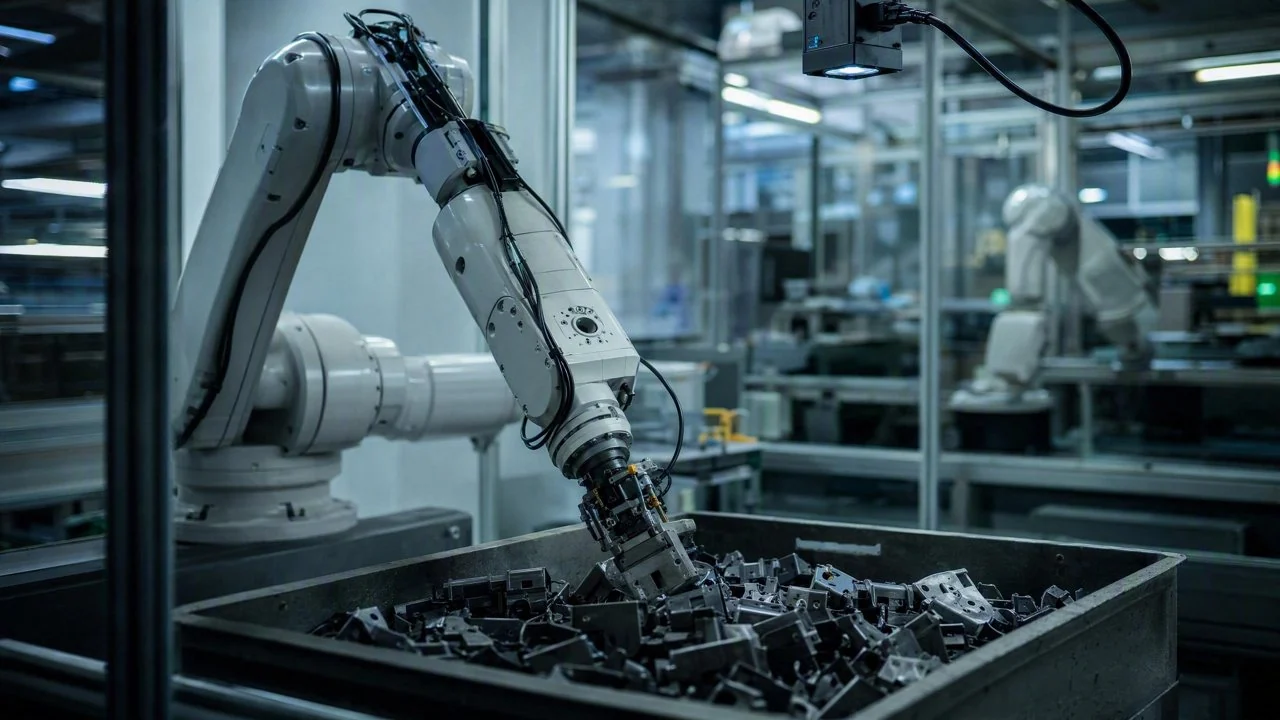
DaoAI 3D Robot Vision (proprietary 3D camera + 6D pose estimation, bin picking, glue dispensing/assembly/loading-unloading guidance, brain-eye-body closed loop, sub-millimeter hand-eye coordination), with its robust zero-code rapid retooling capability, reduces retooling time for automotive bin picking from hours to minutes, significantly boosting efficiency and flexibility for high-mix, low-volume production. In the automotive and parts manufacturing sector, the accelerating trends of electrification and intelligence have shortened product iteration cycles and diversified vehicle configurations, demanding greater production line flexibility and rapid retooling. Especially for core components like engines, transmissions, and chassis, manufacturing often involves unordered picking and assembly of numerous irregular and precision parts. These components are typically piled loosely in bins, and traditional automation struggles to adapt to their complexity and diversity, leading to production line bottlenecks.
In the automotive and parts manufacturing sector, the accelerating trends of electrification and intelligence have shortened product iteration cycles and diversified vehicle configurations, demanding greater production line flexibility and rapid retooling. Especially for core components like engines, transmissions, and chassis, manufacturing often involves unordered picking and assembly of numerous irregular and precision parts. These components are typically piled loosely in bins, and traditional automation struggles to adapt to their complexity and diversity, leading to production line bottlenecks. DaoAI 3D Robot Vision by WeLinkirt is designed to address this pain point. Its core capability lies in precise 6D pose estimation of randomly stacked parts and guiding robots for picking, especially in high-mix, low-volume production. Its zero-code rapid retooling capability brings significant efficiency improvements and cost optimization to automotive parts production.
Pain Points: Why This Hurdle Is Difficult to Overcome
Traditional automotive parts bin picking faces multiple challenges. Firstly, **low retooling efficiency** for high-mix, low-volume production. Each time a product model changes, traditional solutions require hours of manual teaching and parameter adjustment, leading to long production line downtime, low utilization, and high retooling costs. Secondly, **unstable picking success rates**. Due to random part poses and mutual occlusion in the bin, traditional 2D vision or simple 3D template matching struggles to accurately identify parts, resulting in missed picks, false picks, or even part damage, with picking success rates typically below 90%. Furthermore, **poor adaptability to complex irregular parts**. Automotive parts come in various complex shapes, and issues like surface reflection and similar colors further increase visual recognition difficulty, making it hard for traditional solutions to generalize to more varieties. These issues collectively lead to production efficiency bottlenecks, high labor costs, and quality risks.
The root cause is that traditional solutions lack a deep understanding of 3D spatial information and rapid learning capabilities. Manual teaching relies on experience and repetitive operations, which are inefficient and error-prone. Rule-based vision algorithms are fragile when facing changes in lighting, object occlusion, and diverse poses, making generalization difficult. The recent industry hot topic – general motion control systems ("cerebellum") for humanoid robots – emphasizes the value of generalization and task adaptability, which is precisely what current industrial robot vision systems urgently need. DaoAI 3D Robot Vision by WeLinkirt simulates the learning and adaptation mechanisms of a "cerebellum," enabling it to understand the 3D world like human eyes and operate precisely like human hands, thereby overcoming these inherent technical obstacles.
Technical Principles
DaoAI 3D Robot Vision system by WeLinkirt utilizes its **proprietary high-precision 3D camera** to acquire 3D point cloud data of parts. Combined with **advanced 6D pose estimation algorithms**, it can identify parts in any pose within the bin in real-time and with high accuracy. The system employs deep learning models, trained on extensive real or synthetic data, to extract target features from complex backgrounds and occlusions, and precisely calculate the object's 3D position and orientation (X, Y, Z, Rx, Ry, Rz). Unlike traditional CAD model-based matching methods, DaoAI's algorithms are more robust and generalizable, accurately identifying even slightly deformed or surface-worn parts. Furthermore, the system's built-in **brain-eye-body closed-loop control** mechanism enables tight coordination between visual perception and robot motion, adjusting picking strategies through real-time feedback to ensure **sub-millimeter hand-eye coordination accuracy**, achieving picking success rates of over 99.5%. The zero-code retooling capability of DaoAI 3D Robot Vision allows users to simply import new CAD models via an intuitive graphical interface, and the system automatically completes model recognition and grasp point planning, eliminating the need for complex programming or manual teaching, reducing retooling time from hours to minutes.
Compared to traditional methods, the advantages of DaoAI 3D Robot Vision by WeLinkirt are significant. Traditional 2D vision systems only acquire 2D planar information and cannot handle unordered stacking and pose variations; rule-based 3D vision systems require engineers to manually adjust numerous parameters, have poor generalization, and time-consuming retooling. In contrast, DaoAI 3D Vision, with its deep learning models and proprietary 3D camera, achieves intelligent perception and decision-making in complex 3D scenes. Its **zero-code rapid retooling** feature greatly lowers the technical barrier and deployment cost, making it particularly suitable for high-mix, low-volume production. For example, in automotive parts production, DaoAI 3D Robot Vision system can reduce retooling time by over 95%, from hours to minutes, significantly boosting production line efficiency.
Typical Application Scenarios
- **Unordered Picking of Engine Blocks/Cylinder Heads**: On engine assembly lines, cast engine blocks/cylinder heads are often randomly piled in bins. DaoAI 3D Robot Vision precisely identifies and guides robotic arms to pick them, ensuring the rhythm of subsequent machining and assembly.
- **Unordered Loading/Unloading of Transmission Gears/Shafts**: Transmission internal gears and shaft parts are diverse and complex in shape. Traditional manual loading/unloading is inefficient and prone to fatigue. DaoAI 3D Vision system by WeLinkirt can achieve automated unordered picking and precise placement of these parts, enhancing automation levels.
- **Assembly Guidance for Automotive Interior Parts**: For interior parts like dashboards and door panels, snap fasteners or screw holes require robots for precise glue dispensing or assembly. DaoAI 3D Vision provides high-precision pose guidance, ensuring assembly accuracy and consistency.
- **Unordered Sorting of Chassis Suspension Parts**: Chassis components, including connecting rods and ball joints, often enter the production line in bulk. DaoAI 3D Robot Vision by WeLinkirt can quickly identify, sort these parts, and guide robots to the next station, improving sorting efficiency.
- **Picking of Small-Batch Customized Components**: For high-end models or customized parts, production batches are small and varieties are numerous, requiring extremely fast retooling. The zero-code rapid retooling capability of DaoAI 3D Vision shows huge advantages in such scenarios, eliminating repetitive programming and allowing quick production switching by simply importing new models.
Case Study
A leading domestic automotive Tier-1 supplier, primarily producing core engine components, faced the challenge of low efficiency due to frequent retooling in its high-mix, low-volume production model. Its production line processed over a dozen different part models daily, and traditional bin picking solutions relied on manual teaching, with each retooling taking at least 2-3 hours, severely impacting production line utilization. To address this pain point, the supplier introduced DaoAI 3D Robot Vision system by WeLinkirt. Before deployment, downtime due to retooling accounted for over 15% of total production time, and the picking success rate was only around 88%. After integrating DaoAI 3D Vision, its **zero-code rapid retooling function** allowed engineers to simply import the CAD model of a new part, and the system completed configuration and became operational within 5 minutes, reducing retooling time by over 95%. Concurrently, thanks to DaoAI 3D Vision's precise 6D pose estimation and sub-millimeter hand-eye coordination, the picking success rate steadily increased to 99.6%, significantly reducing missed and false picks, and improving production efficiency and product quality. The client stated that the deployment of DaoAI 3D Robot Vision by WeLinkirt not only solved their retooling challenges for high-mix, low-volume production but also brought unprecedented flexibility to their production line.
DaoAI 3D Robot Vision by WeLinkirt, with its zero-code rapid retooling and sub-millimeter precision, redefines the automation standard for automotive parts bin picking.
The figures above are a typically achievable range in anonymized industry scenarios — a different line or a different batch of parts will move the result either way; on-site measurement governs.
WeLinkirt Solution and Products
DaoAI 3D Robot Vision system by WeLinkirt is an intelligent vision solution specifically designed for complex industrial scenarios. Its core advantage lies in its **proprietary high-precision 3D camera**, capable of acquiring high-quality 3D point cloud data, laying the foundation for subsequent precise recognition. Combined with **powerful 6D pose estimation algorithms**, the system can real-time analyze the exact position and orientation of objects in 3D space, thereby guiding robots for high-precision picking, glue dispensing, or assembly. To meet the demands of high-mix, low-volume production, DaoAI 3D Robot Vision by WeLinkirt offers **zero-code rapid retooling** functionality. Users can simply import CAD models via an intuitive graphical interface, and the system automatically completes learning and configuration, eliminating the need for complex code writing and greatly shortening retooling time. Furthermore, the system supports **brain-eye-body closed-loop control**, achieving integration of visual perception, decision-making, and robot motion, ensuring **sub-millimeter hand-eye coordination accuracy**. For deployment, WeLinkirt DaoAI provides various integration methods such as SDK/API/Docker, supporting 100% local private deployment to ensure data security and integration with existing MES/ERP systems. This solution can also be combined with WeLinkirt DaoAI World Model to further enhance cross-scenario generalization and continuous learning from production line feedback, achieving higher levels of intelligence and automation.
By deploying DaoAI 3D Robot Vision system by WeLinkirt, customers achieve significant business value. In the aforementioned automotive Tier-1 supplier case, **retooling time was reduced by over 95%**, from hours to less than 5min, greatly improving production line utilization. **Picking success rate increased to 99.6%**, effectively reducing material waste and rework. Overall, DaoAI 3D Vision solution by WeLinkirt helps customers achieve significant improvements in production efficiency, reduction in labor costs, and stability in product quality, providing strong technical support for enterprises to address the challenges of high-mix, low-volume production.
FAQ
How exactly does DaoAI 3D Robot Vision achieve zero-code rapid retooling?
DaoAI 3D Robot Vision's zero-code rapid retooling is primarily achieved through its intelligent recognition algorithms and graphical interface. Users simply import the CAD model of a new product into the system, and DaoAI's deep learning model automatically identifies target features, generates grasp points, and plans paths, without manual programming or complex parameter adjustments. This greatly simplifies the retooling process, reducing traditional teaching time from hours to minutes, significantly enhancing production line flexibility.
What are the core advantages of DaoAI 3D Robot Vision compared to traditional rule-based 3D vision systems?
The core advantages of DaoAI 3D Robot Vision lie in its deep learning-based 6D pose estimation algorithms and proprietary high-precision 3D camera. Traditional systems rely on manually set rules, are sensitive to lighting, occlusion, and pose changes, and have poor generalization. DaoAI, on the other hand, can autonomously learn complex 3D features, achieving more robust recognition and more precise sub-millimeter hand-eye coordination, while also offering zero-code rapid retooling, making it more suitable for high-mix, low-volume production.
What is the estimated budget for deploying WeLinkirt DaoAI 3D Robot Vision system, and what is the typical payback period?
The budget for DaoAI 3D Robot Vision system depends on the specific application scenario, the number of cameras required, the complexity of robot integration, and whether custom development is needed. We offer flexible hardware and software configuration options. The payback period is typically within 6-18 months, primarily achieved by reducing labor costs, increasing production line utilization, decreasing scrap rates, and improving product quality. We recommend contacting our sales team for a detailed solution and quotation assessment based on your specific requirements.
Full solution for this scenario: the full inspection solution for Automotive / parts
This article is an original publication by WeLinkirt (DaoAI).