
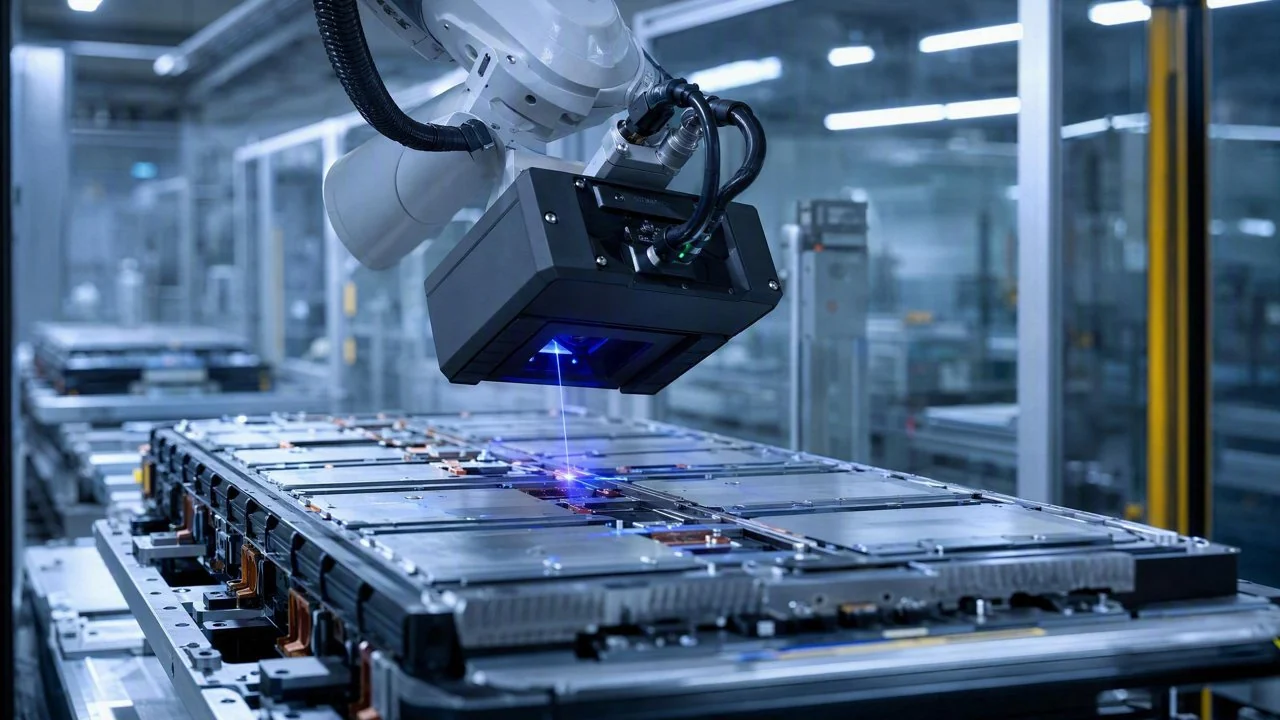
WeLinkirt's DaoAI 3D Robot Vision, utilizing proprietary 3D cameras and 6D pose estimation, reduces the miss detection rate in new energy battery module solder joint inspection from 1.5% with traditional solutions to <0.2%, while providing real-time traceability for critical quality data.
The new energy battery industry is experiencing unprecedented rapid development, imposing extremely high demands on the safety, reliability, and consistency of battery modules. Among these, the quality of solder joints between battery cells and busbars within the module is a critical factor determining battery performance and lifespan. These solder joints are numerous, densely arranged, and varied in shape; any cold solder, missing solder, short circuit, or abnormal solder joint size can lead to degraded battery module performance or even safety incidents. A leading new energy battery manufacturer faced challenges in achieving high-precision, comprehensive inspection of module solder joints on its automated production line, particularly in ensuring that quality data for every solder joint could be effectively traced and fed back for production process optimization. Traditional solutions struggled to meet these growing demands.
Pain Points: Why This Hurdle Is Difficult to Overcome
In new energy battery module solder joint inspection, traditional methods commonly suffer from numerous pain points. Firstly, manual visual inspection is inefficient and prone to missed detections, with rates often exceeding 1.5% due to fatigue, leading to substantial manual re-inspection hours. Secondly, traditional 2D vision solutions are limited by lighting, surface reflection, variations in solder joint height, and partial occlusion, resulting in persistently high false positive rates, often around 5%, which increases unnecessary downtime and rework costs. Thirdly, the lack of an effective data closed-loop mechanism means inspection data cannot be linked to specific production batches or process parameters, hindering deep quality traceability and root cause analysis. When batch issues arise, traditional solutions' insufficient quality traceability makes it difficult to quickly pinpoint problematic batches and causes, severely impacting recall and improvement efficiency. Furthermore, current industry trends, such as the full-stack open strategy for low-cost humanoid robot development platforms, are attracting more small and medium-sized manufacturers to automation. However, the high technical threshold and integration complexity of high-precision, robust 3D vision technology deter them from effectively converting inspection data into production optimization insights.
The root cause of these difficulties lies in the fact that module solder joints often have multi-angle distributions, height differences, and irregular shapes, making it impossible for traditional 2D vision to obtain accurate depth information. Concurrently, the complex optical properties of battery material surfaces (e.g., high reflectivity, light absorption) generate significant noise, interfering with image recognition. Moreover, new energy battery production lines operate at high speeds, demanding that inspection systems possess millisecond-level processing capabilities and extremely high stability. These factors collectively constitute a technological gap that traditional solutions struggle to bridge, making quality traceability and data closed-loop a distant goal.
Technical Principles
WeLinkirt's DaoAI 3D Robot Vision system, with its proprietary 3D camera and advanced 6D pose estimation technology, offers a new solution for new energy battery module solder joint inspection. This system uses high-precision structured light or laser scanning technology to rapidly acquire complete 3D topographical data of solder joints, achieving micron-level accuracy. Unlike traditional 2D vision, which relies solely on planar images, DaoAI 3D Vision can capture depth information such as solder joint height, volume, and coplanarity, enabling precise identification of cold solder, missing solder, solder penetration, and abnormal dimensions, even in reflective or shadowed areas. The integrated 6D pose estimation function of DaoAI 3D Robot Vision allows the robotic arm to precisely guide the 3D camera to any complex-angled solder joint for inspection, achieving sub-millimeter hand-eye coordination. Combined with WeLinkirt's proprietary AI visual foundation model, the system can automatically learn normal solder joint topographical features. Through the APDT few-shot learning function, it requires only 1–20 good samples for model training, significantly reducing deployment cycles and changeover times. Furthermore, the WeLinkirt DaoAI 3D Robot Vision system can upload real-time 3D data, defect types, and position information for each detected solder joint to a database, forming a complete quality archive. This provides a reliable basis for subsequent quality traceability and data closed-loop. Compared to traditional rule-based AOI, DaoAI 3D Vision not only improves the detection rate to over 99.8% but also reduces the false positive rate for manual re-inspection by 85%, greatly enhancing inspection accuracy and efficiency.
Compared to traditional manual visual inspection, the WeLinkirt DaoAI 3D Robot Vision system eliminates human error and fatigue-induced missed detections, achieving 100% comprehensive inspection. Compared to traditional 2D AOI, its 3D imaging capability completely resolves false positive issues caused by lighting, reflections, and height differences. Notably, DaoAI 3D Vision can effectively inspect hidden or partially obscured solder joints. This analysis, based on true 3D topography, is more robust and accurate than 2D detection based on grayscale or edge features, ensuring stable inspection performance even at high production line speeds.
Typical Application Scenarios
- **Laser Solder Joint Quality Inspection for Cell Connection Tabs:** Inspects laser solder joints between battery cells and connection tabs, identifying defects such as cold solder, missing solder, solder penetration, and spatter. The difficulty lies in the tiny, dense solder joints prone to reflection, making it hard for traditional 2D to accurately assess solder penetration depth and integrity. WeLinkirt's DaoAI 3D Robot Vision precisely measures solder joint height and volume through 3D topography reconstruction to determine welding quality.
- **Solder Joint Inspection for Busbar and Module Casing Connections:** Checks solder joints between busbars and module casings to ensure strength and conductivity. The challenge is that solder joints may be located deep within grooves or complex structures, making direct observation difficult. DaoAI 3D Robot Vision's 6D pose estimation guides the robotic arm, allowing the camera to flexibly enter confined spaces for inspection.
- **Solder Joint Coplanarity and Flatness Inspection:** Evaluates the overall coplanarity and surface flatness of solder joint arrays within the module, preventing poor contact due to warping or unevenness. The difficulty requires global high-precision 3D measurement. WeLinkirt's DaoAI 3D Robot Vision can quickly acquire point cloud data for the entire solder joint area, precisely calculating coplanarity errors.
- **Solder Joint Size and Shape Consistency Inspection:** Performs precise measurement and consistency analysis of solder joint diameter, height, and shape. The challenge lies in potential subtle variations between different batches and positions. DaoAI 3D Robot Vision conducts precise geometric measurements based on 3D data, combined with AI models for deviation analysis.
- **Quality Traceability and Data Linkage for Solder Joint Defects:** Links each solder joint's inspection results (defect type, position, 3D data) with production batch information, equipment parameters, and operators. The difficulty lies in building efficient data links and traceability systems. WeLinkirt's DaoAI 3D Robot Vision system can integrate with factory MES/ERP systems to achieve real-time upload and traceability of inspection data.
Case Study
On the module production line of a leading global new energy battery Tier-1 supplier, traditional solder joint inspection primarily relied on manual sampling and some 2D AOI equipment. However, with expanding capacity and higher safety requirements for products, their production line faced severe challenges: persistently high missed detection rates, significant monthly rework and scrap costs due to solder joint defects, and difficulty in quickly tracing problematic solder joints in specific batches. This client introduced WeLinkirt's DaoAI 3D Robot Vision system for fully automated module solder joint inspection. Before deployment, their production line's solder joint missed detection rate was approximately 1.2%, and the manual re-inspection false positive rate was as high as 7%, averaging 300 hours of manual re-inspection per line per month. With the assistance of the WeLinkirt team, by modifying existing robotic arms and integrating the DaoAI 3D Robot Vision system, system deployment and model training were completed in just 3 weeks. After deployment, WeLinkirt's DaoAI 3D Robot Vision system reduced the solder joint missed detection rate to <0.2% and the false positive rate by −85%, significantly reducing the need for manual re-inspection, with average manual re-inspection hours per line per month decreasing by 90%. More importantly, the system could record real-time 3D inspection data for all solder joints on each module and bind it with production batch information, achieving full lifecycle quality traceability from raw materials to finished products. When anomalies occurred, WeLinkirt's DaoAI 3D Robot Vision system could quickly pinpoint problematic solder joints, modules, and relevant production parameters, greatly improving problem-solving efficiency and product quality control.
WeLinkirt's DaoAI 3D Robot Vision system not only improved inspection accuracy but also established a crucial quality data closed-loop, elevating our product quality management to a new level.
The figures above are a typically achievable range in anonymized industry scenarios — a different line or a different batch of parts will move the result either way; on-site measurement governs.
WeLinkirt Solution and Products
WeLinkirt's DaoAI 3D Robot Vision system is at the core of this solution. It integrates WeLinkirt's proprietary high-speed, high-precision 3D camera, capable of rapidly acquiring 3D point cloud data of module solder joints. Through its built-in 6D pose estimation algorithm, the system can precisely identify the module's arbitrary pose on the production line and guide the robotic arm's end-effector (such as gripping, dispensing tools, or the 3D camera itself) for accurate operations. In solder joint inspection scenarios, this means that even if the module has slight positioning deviations, DaoAI 3D Robot Vision can dynamically adjust the inspection path in real-time to ensure comprehensive scanning of all solder joints without omission. Combined with WeLinkirt's ACI (AI-AOI) software system, we utilize APDT few-shot self-training technology to quickly establish solder joint defect models using a small number of good samples provided by the customer (typically 1–20 images), achieving 0-code automatic programming. The system's semantic false positive filtering function effectively reduces false positives caused by environmental noise and non-defect features. For deployment, DaoAI 3D Robot Vision supports multiple integration methods such as SDK/API/Docker and offers 100% local private deployment to ensure customer data security. By integrating with the customer's MES system, WeLinkirt's DaoAI 3D Robot Vision system achieves real-time upload, storage, and analysis of inspection data, building a complete data closed-loop from inspection to traceability to production optimization, providing a solid foundation for the customer's smart manufacturing.
This solution can also be linked with WeLinkirt's DaoAI World model, leveraging its unified foundation for semantic understanding and cross-scenario generalization capabilities to continuously learn from production line feedback and optimize defect identification models. WeLinkirt's DaoAI 3D Robot Vision system successfully reduced the module solder joint missed detection rate to <0.2% and the false positive rate by −85% on the customer's production line. It also helped the customer establish an efficient quality traceability system, significantly improving product quality and production efficiency. Furthermore, the WeLinkirt DaoAI 3D Robot Vision solution shortened product changeover time to 5min, significantly enhancing the flexibility and adaptability of the production line, saving the customer substantial operational and maintenance costs.
FAQ
How does DaoAI 3D Robot Vision achieve solder joint quality traceability?
WeLinkirt's DaoAI 3D Robot Vision system acquires topographical data for each solder joint through high-precision 3D scanning. This data, along with its positional information and defect type, is uploaded to a database in real-time. The system can integrate with factory MES/ERP systems to link inspection data with production batches, equipment parameters, and other information, forming a complete quality archive for full lifecycle traceability from production to delivery.
What are the advantages of DaoAI 3D Vision over traditional 2D AOI for solder joint inspection?
Traditional 2D AOI struggles with solder joint height differences, reflections, and occlusions, leading to false positives. WeLinkirt's DaoAI 3D Robot Vision, using its proprietary 3D camera, acquires true 3D topography, measuring solder joint height, volume, and coplanarity. It precisely identifies defects like cold solder and missing solder, maintaining high precision and robustness even under complex lighting and angles, resulting in higher detection rates and significantly reduced false positives.
What is the approximate cost budget for deploying WeLinkirt's DaoAI 3D Robot Vision solution?
The cost budget for WeLinkirt's DaoAI 3D Robot Vision solution varies depending on the specific application scenario, required inspection precision, integration complexity, and deployment scale. We offer flexible software and hardware configuration options and support local private deployment. We recommend scheduling an initial consultation with our expert team, who will provide a customized detailed quote and return on investment analysis based on your actual needs.
Full solution for this scenario: New-energy batteries industry solutions
This article was generated by AI. Customer cases are simulated scenarios based on real product capabilities and figures are illustrative; see product pages for official benchmarks.