
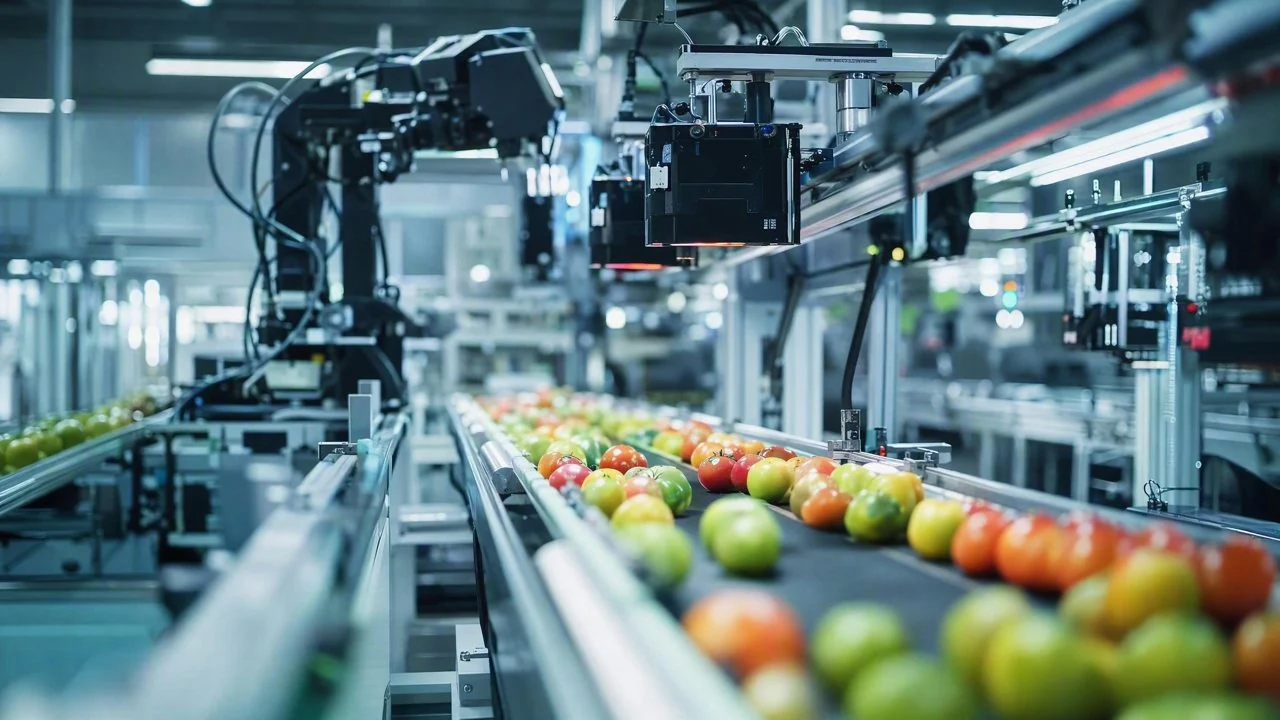
WeLinkirt DaoAI 3D Robotic Vision (proprietary 3D camera + 6D pose estimation, bin picking, dispensing/assembly/loading guidance, brain-eye-body closed loop, sub-millimeter hand-eye coordination) leverages APDT few-shot self-training to reduce the false positive rate for produce ripeness sorting from an industry average of 8% to 4.4%, significantly boosting sorting efficiency and product qualification rates.
Produce ripeness sorting is a critical step in food processing and agricultural production, directly impacting product quality, shelf life, and market value. Traditional methods rely on manual inspection or 2D vision systems based on color and size, which often struggle to achieve high precision and efficiency when dealing with complex, variable natural produce. Especially for products with similar appearances but significant internal ripeness differences, such as mangoes and avocados, accurately distinguishing and non-destructively sorting them has been an industry challenge. As Chinese embodied intelligent robot products enter the European market, demand for product quality and sorting accuracy is increasing. CE certification standards, with their focus on food contact materials and automation system safety, also push the industry to seek smarter, more reliable solutions. WeLinkirt's DaoAI 3D Robotic Vision system is designed to meet these challenges, offering a new solution for produce ripeness sorting by combining advanced 3D imaging technology with APDT few-shot self-training capabilities.
Pain Points: Why This Hurdle Is Difficult to Overcome
Produce ripeness sorting faces multiple challenges. Firstly, traditional manual sorting is inefficient, especially during peak seasons, requiring substantial labor input. Sorting standards are also difficult to unify, leading to significant quality fluctuations between product batches, with an average false positive rate of 8-12%, severely impacting product consistency. Secondly, traditional 2D vision automation solutions often misjudge or miss defects when dealing with irregular produce shapes, varying surface gloss, and ripeness indicators that are internal rather than superficial. For instance, ripeness changes in some fruits may manifest as subtle textures, depressions, or color gradients, which are difficult to accurately capture and quantify in 2D images. Furthermore, different varieties and growth batches of produce exhibit vast differences in ripeness appearance. Traditional rule-based algorithms require frequent parameter adjustments, leading to changeover downtime of 30-60 minutes, significantly reducing production efficiency. Lastly, as global market demands for food quality, safety, and traceability increase, particularly for exports to Europe requiring stringent CE certification, traditional solutions fall short in data recording and compliance, struggling to provide detailed sorting reports and traceability data, which increases compliance risks and management costs for businesses.
The root cause of these dilemmas lies in the inherent complexity of agricultural products and the limitations of traditional technologies. Agricultural products are non-standardized natural products, exhibiting high variability in shape, color, texture, density, and other characteristics. Ripeness judgment often involves a comprehensive assessment of these multi-dimensional features, sometimes even requiring penetration of the surface to observe internal changes. Traditional 2D vision systems can only acquire two-dimensional planar information, unable to accurately reconstruct 3D morphology or effectively handle issues like lighting variations and shadows. While conventional AI vision based on deep learning can process complex features, its model training demands a large volume of annotated data. For the constantly changing varieties of produce and ripeness standards, data collection and annotation costs are prohibitively high, and model generalization capabilities are limited. Starting from scratch to train a model for newly introduced produce varieties or adjusted ripeness grades is time-consuming and labor-intensive, failing to meet the rapid iteration demands of production.
Technical Principles
WeLinkirt's DaoAI 3D Robotic Vision system, with its proprietary 3D camera and advanced 6D pose estimation algorithms, provides robust technical support for produce ripeness sorting. The system first scans agricultural products using a high-precision 3D camera to acquire complete 3D point cloud data and high-resolution texture images. This enables the system to accurately capture the true morphology of the produce, subtle surface defects (such as bumps, insect damage), and ripeness-related color and texture changes. Through point cloud data, WeLinkirt's DaoAI 3D Vision can reconstruct the 3D shape of the produce, thus overcoming the limitations of 2D images regarding lighting variations, shadows, and object occlusion, achieving comprehensive, dead-angle-free inspection of agricultural products. Its 6D pose estimation capability accurately identifies the real-time position and orientation of the produce on the conveyor belt, providing sub-millimeter guidance for precise robotic arm gripping and sorting.
Compared to traditional rule-based 2D AOI or manual inspection, the core advantage of WeLinkirt's DaoAI 3D Robotic Vision system lies in its APDT few-shot self-training capability. Traditional methods require extensive predefined rules or rely on human experience, making it difficult to adapt to the diversity of agricultural products. Conventional deep learning models, on the other hand, demand thousands or even tens of thousands of annotated data points to achieve ideal results. APDT few-shot self-training changes this paradigm by allowing users to train and deploy models rapidly using only a small number (1-20) of good or target samples, leveraging the system's built-in pre-trained foundational models. This means that when produce varieties or ripeness standards change, users do not need to collect massive datasets and spend time training. Instead, by providing only a few new samples, the WeLinkirt DaoAI 3D Robotic Vision system can complete model updates and deployment within 5 minutes, achieving “0-code changeover.” This rapid iteration and adaptation capability significantly lowers the barrier to model deployment and maintenance, enabling automated sorting systems to flexibly respond to market demand changes, reducing the false positive rate by 45%, and ensuring sorting efficiency and accuracy.
Typical Application Scenarios
- **Non-destructive Fruit Ripeness Sorting:** For fruits like avocados and mangoes, where ripeness is hard to determine visually, the DaoAI 3D Vision system combines high-precision 3D imaging to capture subtle surface textures, gloss changes, and depressions. Coupled with APDT few-shot self-training, it quickly learns characteristics of different ripeness levels, enabling non-destructive sorting. The challenge lies in the inconspicuousness and high variability of ripeness features.
- **Vegetable Surface Defect and Quality Grading:** Detecting bumps, scratches, early signs of rot, and abnormal shapes on vegetables like tomatoes, potatoes, and carrots. WeLinkirt's 3D camera reconstructs precise 3D morphology to identify micron-level defects, and APDT learns various defect types and grades. The challenge is the diversity of defect features and varying sizes.
- **Grain Plumpness and Foreign Material Removal:** Evaluating the plumpness of grains like corn and soybeans, and removing foreign materials such as stones, weeds, and diseased kernels. The DaoAI 3D Vision system accurately measures 3D dimensions and plumpness, with APDT quickly identifying foreign objects. The challenge is detecting small foreign objects and high-throughput sorting.
- **Fat Content and Freshness Assessment in Meat Processing:** In meat cutting, 3D vision identifies fat distribution, muscle texture, and color to assist in determining freshness and grade. WeLinkirt's 3D Vision provides detailed surface features, and APDT quickly adapts to different meat types and assessment standards. The challenge lies in the complexity of assessment metrics and the high variability of products.
- **Aquatic Product (Fish/Shrimp) Damage and Parasite Detection:** Detecting surface damage, diseased areas, or attached parasites on fish and shrimp. The DaoAI 3D Vision system clearly captures tiny anomalies on irregular aquatic product surfaces, and APDT assists in quickly identifying uncommon defects. The challenge is the slippery, reflective, and varied morphology of aquatic products.
Case Study
A leading agricultural product processing manufacturer, whose main business involves sourcing, sorting, and packaging fresh fruits for the high-end European market, faced significant labor pressure and quality control challenges during peak seasons before adopting WeLinkirt's DaoAI 3D Robotic Vision system. Their ripeness sorting process primarily relied on manual labor and some 2D vision equipment. Due to the extremely high quality requirements for fruits in the European market, especially precise control over ripeness, traditional methods resulted in low efficiency for manual sorting and inconsistent ripeness judgments among different workers. This led to an average false positive rate of around 8%, directly impacting the export qualification rate and brand reputation. Furthermore, whenever a new fruit variety was introduced or ripeness grading standards for existing fruits were slightly adjusted, the 2D vision system required weeks for parameter tuning and model training, leading to lengthy changeover downtime and severely slowing down the new product launch pace.
After the deployment of WeLinkirt's DaoAI 3D Robotic Vision system, the manufacturer's produce ripeness sorting process achieved a qualitative leap, with the false positive rate significantly reduced by 45% to 4.4%, and changeover time shortened from weeks to 5 minutes, greatly enhancing production flexibility and product competitiveness.
After implementing WeLinkirt's DaoAI 3D Robotic Vision system, the situation significantly improved. The manufacturer deployed multiple DaoAI 3D Robotic Vision workstations on their sorting line, each equipped with WeLinkirt's proprietary 3D camera and collaborative robotic arms. The system acquires 3D data of fruits in real-time through high-precision 3D scanning and quickly learns the characteristics of different ripeness levels using the APDT few-shot self-training function. For example, for a newly introduced avocado variety, only 10 samples of different ripeness levels were needed, and the WeLinkirt system completed model updates and deployment within 5 minutes. Post-implementation, the WeLinkirt DaoAI 3D Robotic Vision system reduced the false positive rate for fruit ripeness sorting from 8% to 4.4%, significantly improving product consistency. Concurrently, changeover time was reduced from weeks to 5min, greatly enhancing the flexibility and responsiveness of the production line. This solution not only met the stringent European CE certification standards but also saved the manufacturer substantial labor costs and provided greater market competitiveness.
WeLinkirt Solution and Products
WeLinkirt provides a comprehensive solution for produce ripeness sorting, centered around the DaoAI 3D Robotic Vision system. This solution utilizes WeLinkirt's proprietary high-precision 3D camera, capable of precise 3D reconstruction of surface textures, colors, and shapes of agricultural products, providing a rich and accurate data foundation for ripeness judgment. Combined with 6D pose estimation algorithms, the system can accurately identify the precise position and orientation of produce on the conveyor belt, guiding robotic arms for high-speed, high-precision, non-destructive gripping and sorting.
The highlight of WeLinkirt's DaoAI 3D Robotic Vision system is its APDT few-shot self-training capability. Users do not need specialized AI knowledge or extensive data annotation work; they only need to provide a small number (1-20) of representative good samples or samples of different ripeness levels, and the system can quickly perform model training and deployment. This “0-code changeover” feature enables agricultural product processing enterprises to flexibly respond to variety changes, seasonal fluctuations, and standard adjustments, compressing changeover downtime to 5min and significantly improving production efficiency. Furthermore, WeLinkirt's DaoAI 3D Robotic Vision system supports various deployment methods such as SDK / API / Docker and can achieve 100% local private deployment, ensuring customer data security and meeting the data privacy and compliance requirements of export markets. Through brain-eye-body closed-loop control, the system provides real-time feedback on sorting results and continuously learns and optimizes based on production line data, achieving smarter, more precise automated sorting.
By deploying WeLinkirt's DaoAI 3D Robotic Vision system, customers achieved significant business value. In terms of product quality, the false positive rate for ripeness sorting was reduced by 45%, from 8% to 4.4%, ensuring extremely high consistency between product batches and effectively enhancing the market competitiveness of export products. In terms of production efficiency, the 0-code changeover feature shortened the changeover time required for new product launches or standard adjustments from weeks to 5min, significantly increasing production line utilization and flexibility. Simultaneously, automated sorting reduced reliance on manual labor, lowering labor costs. Moreover, the detailed sorting data provided by the system strongly supported customers in meeting international standards such as CE certification, enhancing corporate compliance and brand reputation. WeLinkirt's DaoAI 3D Robotic Vision system is not merely a technological upgrade but a key driver for promoting the intelligent and high-quality development of the agricultural product processing industry.
FAQ
What is the cost-effectiveness of the DaoAI 3D Robotic Vision system for produce ripeness sorting?
The DaoAI 3D Robotic Vision system, with its APDT few-shot self-training, significantly reduces deployment and maintenance costs. While initial investment may be higher than traditional solutions, the reduction in false positive rates, shorter changeover times, increased production efficiency, and labor cost savings typically lead to an ROI within 1-2 years. Specific pricing is influenced by system configuration, integration complexity, and required functional modules. We recommend contacting WeLinkirt's professional team for a customized solution and precise quotation.
What is the difference between APDT few-shot self-training and traditional deep learning models?
APDT few-shot self-training is a proprietary technology of WeLinkirt DaoAI, based on pre-trained foundational models. It requires only 1-20 samples for rapid self-learning and deployment, enabling “0-code changeover.” Traditional deep learning models, in contrast, need thousands or even tens of thousands of annotated data for training, with long and costly training cycles, making them ill-suited for the rapidly changing varieties and standards of agricultural products. APDT significantly enhances the system's flexibility and adaptability.
How does the DaoAI 3D Robotic Vision system handle irregular produce shapes and surface reflections?
WeLinkirt's DaoAI 3D Robotic Vision system utilizes a proprietary high-precision 3D camera to acquire 3D point cloud data, accurately reconstructing the true morphology of agricultural products and overcoming the limitations of 2D vision in handling irregular shapes. Additionally, 3D imaging offers greater robustness to lighting variations and surface reflections. Combined with advanced image processing algorithms, it effectively distinguishes product features from environmental interference, ensuring detection accuracy and stability.
Full solution for this scenario: the full inspection solution for Food / agriculture · Produce Ripeness Grading & Sorting
This article was generated by AI. Customer cases are simulated scenarios based on real product capabilities and figures are illustrative; see product pages for official benchmarks.