
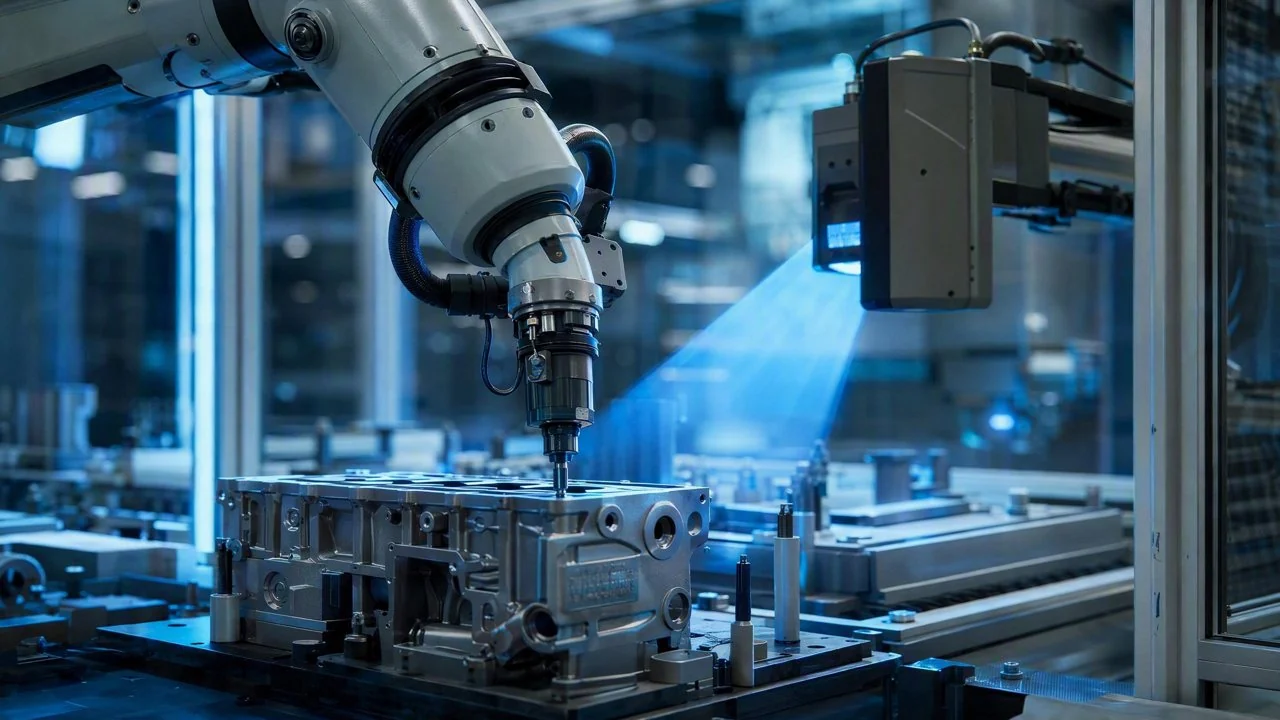
WeLinkirt's DaoAI 3D robot vision (self-developed 3D camera + 6D pose estimation, disordered bin picking, gluing/assembly/loading and unloading guidance, brain-eye-body closed-loop, sub-millimeter hand-eye coordination) shortens the changeover time of the automotive fastener tightening process from 30 minutes to 5 minutes through zero-code rapid changeover technology.
Industry background and user scenario: In the automotive/parts industry, fastener tightening is a crucial process, and its quality directly affects the safety and reliability of automobiles. Traditional tightening processes face difficulties in changeover and low efficiency when dealing with multi-variety small-batch production. WeLinkirt's DaoAI 3D robot vision solves this problem for automotive manufacturers with its zero-code rapid changeover advantage. A certain automotive parts manufacturing enterprise needs to produce a variety of automotive parts with different specifications on its production line, and the tightening requirements for fasteners of each part are different. Frequent changeovers have brought great troubles to production.
Pain points: Why is this hurdle so hard to cross?
Multi-dimensional quantitative pain points: In the traditional automotive fastener tightening process, enterprises face many difficulties. The changeover downtime is long, taking more than 30 minutes each time, which seriously affects production efficiency. The false alarm rate is high, reaching about 15%, resulting in a large waste of manual re-judgment man-hours. The single-piece cost is high. Due to low production efficiency and high false alarm rate, the production cost of each product has increased by 20%. In addition, with the application of 3D printing technology in the robot industry chain, new part design and manufacturing methods are constantly emerging, and traditional tightening processes are difficult to adapt to these changes, increasing compliance risks.
Root cause analysis: From the process level, the traditional tightening process requires manual adjustment of tightening parameters, which is inefficient and error-prone for multi-variety small-batch production. From the imaging level, traditional visual inspection systems have difficulty accurately identifying fasteners and tightening positions of different specifications, resulting in a high false alarm rate. From the material level, the material properties of parts manufactured by 3D printing technology are complex, and traditional tightening processes are difficult to ensure tightening quality. From the rhythm level, the rhythm of multi-variety small-batch production changes greatly, and traditional tightening processes are difficult to adapt to this change.
Technical principle
In-depth mechanism: WeLinkirt's DaoAI 3D robot vision uses a self-developed 3D camera to quickly and accurately obtain the three-dimensional information of parts. Through 6D pose estimation technology, it can accurately determine the position and posture of fasteners, providing accurate guidance for tightening operations. At the same time, the system also has a brain-eye-body closed-loop and sub-millimeter hand-eye coordination ability, which can adjust the tightening force and position in real-time to ensure tightening quality. When facing multi-variety small-batch production, the system supports zero-code rapid changeover. Through preset templates, the changeover operation can be completed quickly with simple selection and configuration.
Comparison with traditional methods: Compared with traditional rule-based AOI and manual visual inspection, WeLinkirt's DaoAI 3D robot vision has obvious advantages. Traditional methods require a large amount of manual intervention, with low efficiency and a high false alarm rate. While WeLinkirt's DaoAI 3D robot vision can achieve automatic detection and tightening, reducing the false alarm rate to less than 3% and greatly improving detection efficiency and accuracy. In addition, traditional methods require reprogramming and debugging during changeover, while the zero-code rapid changeover technology of WeLinkirt's DaoAI 3D robot vision shortens the changeover time from 30 minutes to 5 minutes, greatly improving production flexibility.
Typical application scenarios
- Process 1: Bolt tightening detection. Obtain the three-dimensional information of the bolt through a 3D camera to detect whether the tightening torque of the bolt meets the requirements. The difficulty lies in that different specifications of bolts require different detection parameters, and WeLinkirt's DaoAI 3D robot vision can adapt to different specifications of bolts through zero-code rapid changeover.
- Process 2: Nut assembly detection. Detect whether the nut is correctly assembled in the specified position and whether the tightness of the assembly is appropriate. The difficulty lies in that the position and posture of the nut are easily interfered with by other parts, and the 6D pose estimation technology of WeLinkirt's DaoAI 3D robot vision can accurately identify the position and posture of the nut.
- Process 3: Washer installation detection. Check whether the washer is installed in place and whether the flatness of the washer meets the requirements. The difficulty lies in that the thickness and shape of the washer are small, and traditional visual inspection systems have difficulty accurately identifying them. The self-developed 3D camera of WeLinkirt's DaoAI 3D robot vision can provide high-precision three-dimensional information.
- Process 4: Rivet connection detection. Detect whether the connection strength and position of the rivet meet the requirements. The difficulty lies in that the connection quality of the rivet is difficult to judge directly through the appearance, and WeLinkirt's DaoAI 3D robot vision can evaluate the connection quality by analyzing the three-dimensional morphology around the rivet.
Implementation case
Comparison before and after the implementation of an anonymous customer: A tier-1 automotive parts supplier needs to produce a variety of automotive engine parts with different specifications on its production line, and the tightening requirements for fasteners of each part are different. Before the implementation of WeLinkirt's DaoAI 3D robot vision system, the enterprise had a long changeover downtime, taking more than 30 minutes each time, a high false alarm rate of about 15%, and a high single-piece cost, with the production cost of each product 20% higher than expected. After the implementation of the system, the changeover time was shortened to 5 minutes, the false alarm rate was reduced to less than 3%, and the single-piece cost was reduced by 15%.
WeLinkirt's DaoAI 3D robot vision enables the automotive fastener tightening process to achieve high efficiency and precision in multi-variety small-batch production.
WeLinkirt's solution and products
Product capabilities and implementation methods: WeLinkirt's DaoAI 3D robot vision is centered around its self-developed 3D camera and advanced algorithms, and has functions such as 6D pose estimation, disordered bin picking, gluing/assembly/loading and unloading guidance. In terms of modeling, high-precision three-dimensional models are established by collecting a large amount of sample data of parts. In terms of changeover, it supports zero-code rapid changeover, and operators can complete the changeover operation with simple selection and configuration. In terms of deployment, the system supports multiple deployment methods such as SDK / API / Docker, and can achieve 100% local private deployment to ensure data security. In terms of integration, the system can be integrated with existing production line equipment to improve production efficiency. At the same time, WeLinkirt also provides a supporting DaoAI ACI (AI-AOI) software system and a SkyVision zero-code video monitoring AI platform to further improve detection efficiency and quality.
Quantitative results and business value: WeLinkirt's DaoAI 3D robot vision has brought significant quantitative results to the automotive/parts industry. The changeover time has been shortened from 30 minutes to 5 minutes, greatly improving production efficiency. The false alarm rate has been reduced from 15% to less than 3%, reducing manual re-judgment man-hours. The single-piece cost has been reduced by 15%, improving the economic benefits of the enterprise. In addition, the high-precision detection and zero-code rapid changeover capabilities of the system have also enhanced the enterprise's production flexibility and market competitiveness, laying a solid foundation for the sustainable development of the enterprise.
FAQ
What is DaoAI 3D robot vision?
DaoAI 3D robot vision is a product developed by WeLinkirt, which includes functions such as a self-developed 3D camera and 6D pose estimation. It can achieve a brain-eye-body closed-loop and sub-millimeter hand-eye coordination, and is especially suitable for processes such as fastener tightening of automotive parts. It enables zero-code rapid changeover.
How to choose between DaoAI 3D robot vision and traditional visual inspection systems?
Traditional visual inspection systems face difficulties in changeover and have a high false alarm rate in multi-variety small-batch production. DaoAI 3D robot vision enables zero-code rapid changeover and reduces the false alarm rate to less than 3%. If you have such production needs, DaoAI 3D robot vision is more recommended.
How much does it cost to use DaoAI 3D robot vision?
The quotation of DaoAI 3D robot vision is affected by many factors, such as function module selection, deployment method, and production line scale. You can make an appointment with our professional staff, and they will provide a detailed quotation according to your specific needs.
Full solution for this scenario: the full inspection solution for Automotive / parts
This article was generated by AI. Customer cases are simulated scenarios based on real product capabilities and figures are illustrative; see product pages for official benchmarks.