
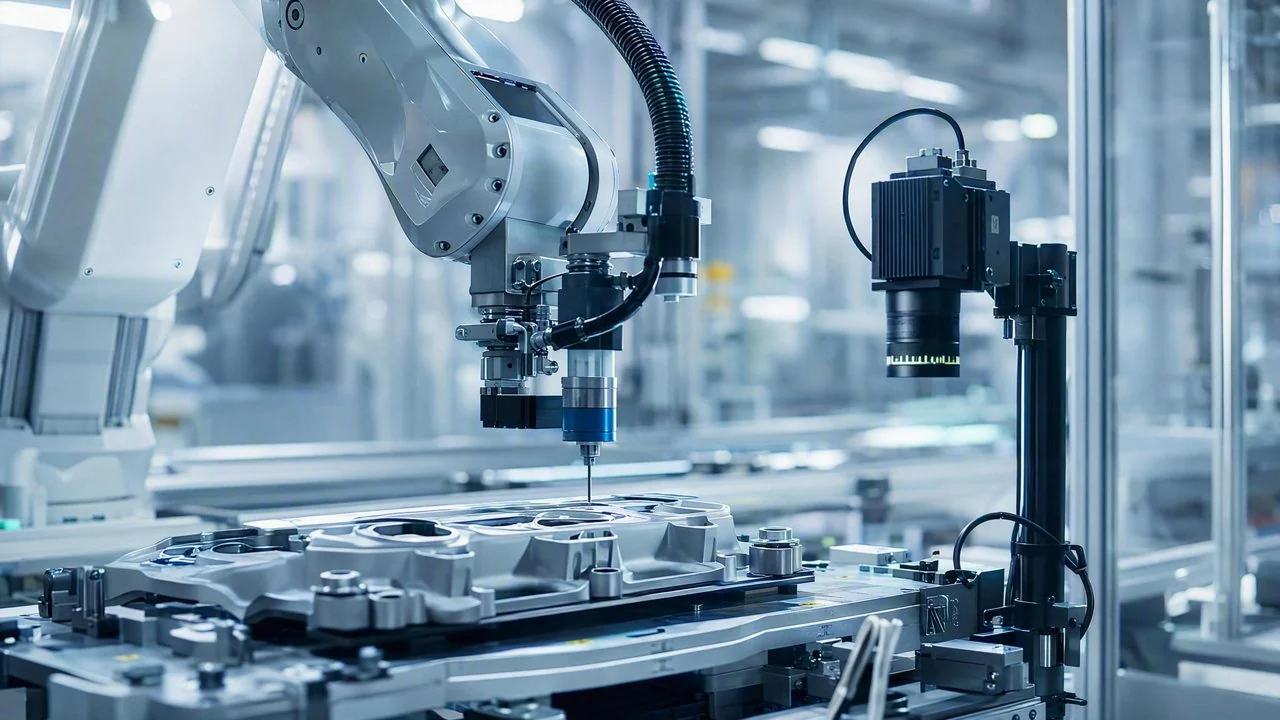
DaoAI 3D Robot Vision System, leveraging its proprietary 3D camera and 6D pose estimation, enables 100% online 3D inspection and path correction for automotive component adhesive application, reducing manual re-inspection rates from 4% in traditional solutions to <1%, significantly cutting labor and quality costs.
In automotive and component manufacturing, adhesive application and sealing are critical processes for ensuring product performance, safety, and durability. Particularly in new energy vehicle battery packs, body structural components, and interior trim bonding, the uniformity, continuity, and positional accuracy of adhesive application directly impact waterproofing, dustproofing, sound insulation, and structural strength. Traditionally, quality inspection for such high-precision adhesive application heavily relied on manual visual inspection. However, with accelerating production cycles and increasing product complexity, the limitations of manual inspection have become increasingly apparent, leading to inefficient detection, inconsistent results, significant labor costs, and potential quality risks. The DaoAI 3D Robot Vision System by WeLinkirt emerged in this context, offering a breakthrough solution for online inspection and correction of automotive adhesive application.
Pain Points: Why This Hurdle Is Difficult to Overcome
Quality control for automotive adhesive application faces multiple challenges that traditional inspection methods struggle to address. First, there are **high labor costs and inefficient manual inspection**: A typical medium-sized automotive component factory usually requires 5-8 experienced quality inspectors working shifts to ensure adhesive quality. The annual labor cost alone can amount to hundreds of thousands of yuan. However, human eye fatigue and subjective judgment discrepancies often result in a missed detection rate of 3-5%, with high false positive rates, directly impacting product quality and rework rates. Second, there's **detection precision and complexity**: Adhesive paths are often complex and varied. Micro-defects like adhesive width, height, continuity, and the presence of breaks, overflows, or air bubbles all require sub-millimeter detection precision. Traditional 2D vision is limited by viewing angles and lighting, making it difficult to accurately acquire 3D morphological information, leading to blind spots and false positives. Furthermore, there's **production rhythm and changeover pressure**: The automotive industry demands extremely high production rhythms, and any delay in the inspection process affects overall capacity. Simultaneously, in multi-variety, small-batch production, adhesive paths vary greatly between different components. Traditional rule-based AOI systems require lengthy programming for changeovers, making it difficult to quickly adapt to production line demands, resulting in downtime of 1-2 hours. These factors collectively form a 'high wall' for automotive adhesive quality control.
Why are these problems so difficult to solve? From a process perspective, physical properties of adhesive materials such as viscosity, curing speed, and surface tension, as well as factors like spray equipment wear and air pressure fluctuations, can all lead to minute deviations in adhesive morphology. These deviations might be imperceptible to the human eye but can cause serious consequences in long-term product use. From an imaging perspective, adhesives often exhibit reflective, translucent, or dark characteristics, which can lead to highlights, shadows, or insufficient contrast under conventional industrial cameras, affecting image quality. Traditional 2D vision systems struggle to penetrate the adhesive surface to capture its true 3D morphology. While current research in embodied AI for multi-robot collaborative systems shows progress in macroscopic task scheduling, at the microscopic level, such as sub-millimeter visual guidance and closed-loop control of individual robotic end-effectors, especially in delicate operations like complex curved surface adhesive application requiring high 'brain-eye-body' coordination, remains a key technical challenge. DaoAI 3D Robot Vision by WeLinkirt addresses these root causes by providing an embodied AI solution.
Technical Principles
The core of the WeLinkirt DaoAI 3D Robot Vision System for automotive adhesive inspection lies in its **proprietary high-precision 3D camera and intelligent 6D pose estimation technology**. Our 3D camera utilizes structured light or laser triangulation principles to acquire high-speed, high-precision 3D point cloud data of the object, reconstructing the true 3D morphology of the adhesive area. Unlike traditional 2D vision, which only captures planar images, DaoAI's 3D data includes all critical dimensional information such as adhesive width, height, cross-sectional shape, and volume, completely eliminating detection blind spots and false positives caused by lighting and reflections. Based on high-precision 3D point clouds, the system can perform **sub-millimeter 6D pose estimation**, accurately identifying the precise spatial position and orientation of the workpiece. Even with slight tilts or offsets, it achieves accurate positioning, providing a reliable baseline for subsequent adhesive path inspection and correction. WeLinkirt DaoAI's vision algorithms integrate deep learning with geometric modeling, enabling intelligent identification of various adhesive defect patterns, such as breaks, overflows, air bubbles, uneven width, and insufficient height.
Compared to traditional rule-based AOI or manual visual inspection, the advantages of WeLinkirt DaoAI 3D Robot Vision are multifaceted. **First, in terms of detection precision**, traditional rule-based AOI struggles with 3D morphology detection on complex curved surfaces and under varying lighting conditions, whereas DaoAI directly acquires depth information via its 3D camera, achieving sub-millimeter global morphological detection accuracy. **Second, in terms of robustness**, manual inspection is prone to fatigue and subjective judgment, and cannot achieve 100% full inspection; rule-based AOI is sensitive to environmental and workpiece variations, leading to high false positive rates. The DaoAI system, through its deep learning models, exhibits strong generalization capabilities and robustness to complex and varied adhesive defect patterns, capable of reducing missed detection rates to <0.5%. **Third, in terms of efficiency and cost**, manual inspection is slow and expensive; rule-based AOI requires complex changeover programming. The DaoAI system supports 0-code rapid changeover, and with its high-speed 3D data acquisition and processing capabilities, it can achieve 100% online inspection synchronized with production line rhythms, significantly reducing labor costs and downtime. **Finally, in multi-robot collaboration**, DaoAI's 'brain-eye-body' closed-loop capability allows robotic arms to perform real-time path correction based on visual feedback, and even guide multiple robots to collaboratively complete complex adhesive application tasks, laying the foundation for scalable embodied AI applications.
Typical Application Scenarios
- **Battery Pack Sealant Application Inspection**: Inspecting the sealant bead between battery pack housing and cover to ensure its width, height, and continuity meet design requirements, free from breaks, air bubbles, or overflows, guaranteeing the battery pack's waterproof and dustproof performance. The challenge lies in the adhesive typically being dark and somewhat reflective, with complex paths, making it difficult for traditional 2D to accurately measure height information.
- **Car Body Weld Seam Sealant Inspection**: Used to inspect weld seam sealants on car body panels and connectors, ensuring uniform, gap-free, and non-collapsed adhesive lines to enhance vehicle corrosion resistance and sound insulation. The challenge is that weld seam areas are often uneven, and the adhesive line might be close to the metal base color, requiring extremely high precision in 3D morphology reconstruction and defect identification.
- **Interior Trim Adhesive Bonding Inspection**: For adhesives used in interior trim components like door panels and dashboards, inspecting the position, size, and presence of adhesive dots or lines to ensure secure bonding. The challenge is that adhesive dots or lines can be tiny and located in confined or irregular areas, demanding high camera resolution and pose estimation capabilities.
- **Engine/Gearbox Gasket Adhesive Application Guidance and Inspection**: Guiding robots to precisely apply gasket adhesive on critical components like engine blocks and gearbox casings, and real-time inspection of application quality. The challenge is that these components have complex shapes, varied adhesive paths, and extremely high precision requirements, necessitating high-precision sub-millimeter hand-eye coordination between the vision system and the robot.
Case Study
A leading Tier-1 automotive component supplier, primarily manufacturing new energy vehicle battery module casings, historically relied on manual visual inspection for quality assurance of battery pack sealant application. Due to the long adhesive paths and extremely high consistency requirements for battery packs, the production line employed 6 quality inspectors working three shifts. However, they consistently faced issues of high missed detection rates (averaging 4%), high labor costs, and detection efficiency bottlenecks. Particularly during holidays or peak personnel turnover, labor shortages were common, severely impacting production continuity and quality stability. Facing increasing order volumes and stringent quality demands, the manufacturer decided to introduce the WeLinkirt DaoAI 3D Robot Vision System to automate and intellectualize their adhesive inspection process.
The WeLinkirt team deployed the DaoAI 3D Robot Vision System, including its proprietary high-precision 3D camera and integrated vision processing unit, on the manufacturer's production line. The system rapidly scanned and acquired 3D morphological data of the battery pack sealant, and combined with DaoAI's powerful deep learning algorithms, it real-time detected critical defects such as adhesive width, height, continuity, air bubbles, breaks, and overflows. Before the system's deployment, the production line's manual visual inspection yielded an average missed detection rate of 4% and a false positive rate of approximately 8%, leading to a significant number of non-conforming products flowing into the next stage or being incorrectly reworked, severely impacting production efficiency and quality costs. After the DaoAI 3D Robot Vision System went live and underwent several weeks of fine-tuning, it achieved 100% online full inspection, perfectly synchronized with the production line's rhythm. The most significant change was that the **manual re-inspection rate decreased from 4% pre-deployment to <1%**, meaning the vast majority of adhesive defects were precisely identified and corrected at the production line, greatly reducing the need for human intervention. Concurrently, the **false positive rate was reduced by 75%**, significantly easing the workload of subsequent manual re-evaluation. More importantly, the DaoAI system completely replaced the 6 quality inspectors' manual visual inspection positions, leading to a **significant reduction in labor costs** and eliminating the reliance on manual recruitment during peak production periods, ensuring stable capacity output.
DaoAI 3D Robot Vision eliminates the 'human-intensive' approach to automotive adhesive inspection, achieving ultimate precision and efficiency through embodied intelligence.
WeLinkirt Solution and Products
WeLinkirt's core solution for automotive component adhesive inspection is based on **DaoAI 3D Robot Vision**. This solution uses its proprietary high-precision 3D camera as the 'eye' to acquire accurate 3D morphological data; its powerful 6D pose estimation algorithm as the 'brain' to precisely locate workpieces and defects; and achieves a 'body' closed-loop with the robot control system for real-time adhesive path guidance and defect correction. WeLinkirt DaoAI 3D Robot Vision supports various deployment methods, capable of being integrated into the production line as an independent inspection station, or directly interfaced with existing robot systems via SDK / API for efficient collaboration. For modeling and changeover, DaoAI's APDT few-shot self-training technology allows for rapid training of high-precision models with just 1-20 good samples, significantly shortening the time for new product launches and changeovers, achieving **rapid changeover in 5 minutes**. Furthermore, the WeLinkirt DaoAI World Model, as a unified foundation, endows the system with stronger semantic understanding and cross-scenario generalization capabilities, enabling continuous learning from production line feedback to constantly improve detection accuracy and robustness. All data processing and model inference support 100% local private deployment, ensuring customer data security and preventing leakage.
Through the WeLinkirt DaoAI 3D Robot Vision solution, customers have achieved significant quantifiable results and business value. In terms of quality, the adhesive missed detection rate has been reduced to <0.5%, ensuring the consistent quality and reliability of outgoing products and effectively avoiding high costs associated with rework and recalls due to adhesive defects. In terms of efficiency, 100% online inspection and path correction ensure that the production line rhythm is unaffected, and changeover time is reduced from several hours to 5min, greatly enhancing production flexibility and capacity. In terms of cost, replacing manual visual inspection significantly reduces long-term labor costs and minimizes material waste and rework expenses caused by false positives. Overall, DaoAI 3D Robot Vision not only improves product quality and optimizes production efficiency but also enables customers to maintain a cost advantage and technological leadership in an increasingly competitive market.
FAQ
What is the approximate cost investment for the DaoAI 3D Robot Vision System in automotive adhesive inspection?
The cost investment for the DaoAI 3D Robot Vision System varies depending on the specific application scenario, required detection precision, integration complexity, and the number of cameras and processing units configured. It typically includes hardware (3D cameras, industrial PCs, etc.), software licenses, implementation, and service fees. Compared to the long-term labor costs of traditional manual visual inspection, automated solutions often have a shorter return on investment period. We recommend contacting our sales team with your specific requirements for a customized evaluation and quotation.
What is the fundamental difference between the DaoAI 3D Robot Vision System and traditional 2D vision systems for adhesive inspection?
The fundamental difference between the DaoAI 3D Robot Vision System and traditional 2D vision systems for adhesive inspection lies in the dimension of information. 2D vision only captures planar images, making it difficult to accurately measure 3D information such as adhesive width, height, and cross-sectional shape, and is susceptible to lighting and reflections. In contrast, DaoAI 3D Vision utilizes its proprietary 3D camera to acquire true 3D point cloud data, enabling precise reconstruction of adhesive morphology and sub-millimeter omnidirectional inspection. This completely resolves the blind spots and false positives of 2D vision, especially suitable for complex curved surfaces and high-precision adhesive application scenarios.
How does the DaoAI 3D Robot Vision System adapt to the fast changeover demands of multi-variety, small-batch production in the automotive industry?
The DaoAI 3D Robot Vision System greatly simplifies the changeover process through its APDT few-shot self-training technology. For new adhesive paths or component models, the system can complete model training and parameter adjustment within minutes (typically within 5 minutes) by providing just 1-20 good sample images. This significantly enhances the flexibility and adaptability of the production line compared to traditional rule-based AOI systems that require hours for programming and debugging, perfectly aligning with the multi-variety, small-batch production model of the automotive industry.
Full solution for this scenario: Automotive / parts industry solutions · 100% Inline 3D Inspection & Path Correction for Automotive Glue Dispensing
This article was generated by AI. Customer cases are simulated scenarios based on real product capabilities and figures are illustrative; see product pages for official benchmarks.