
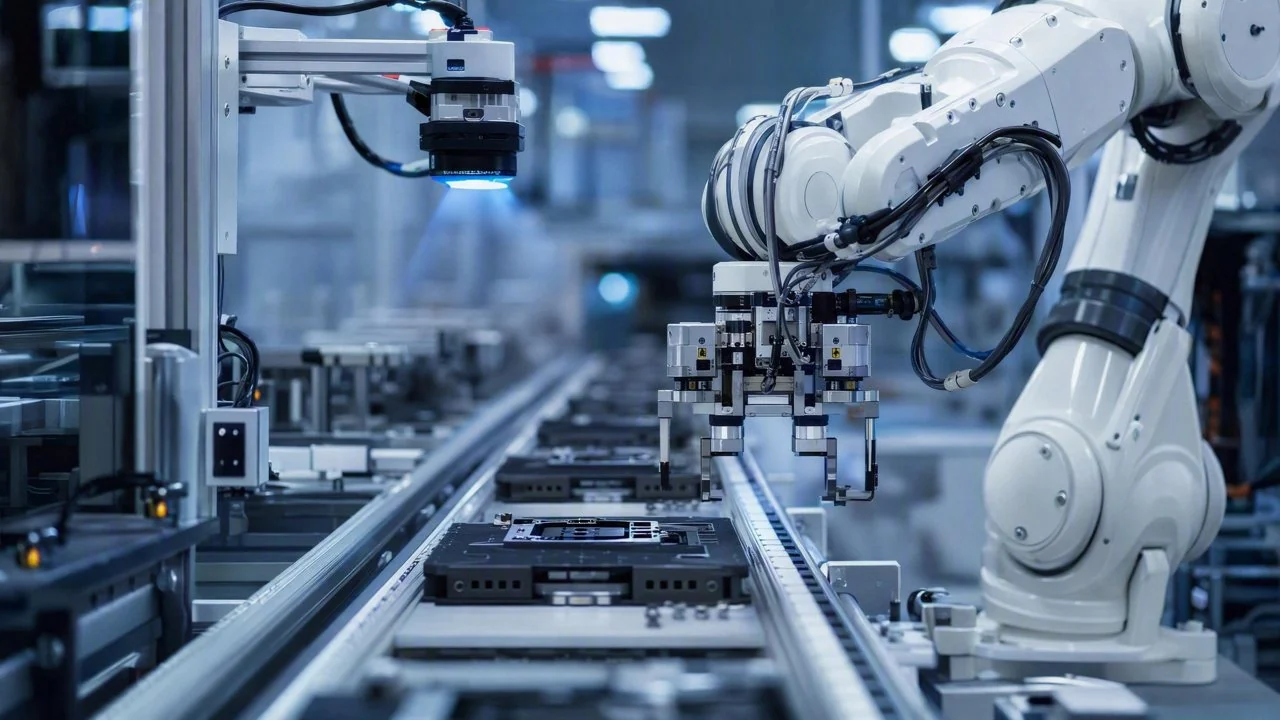
WeLinkirt's DaoAI 3D Robot Vision (proprietary 3D camera + 6D pose estimation, bin picking, glue dispensing/assembly/loading/unloading guidance, brain-eye-body closed loop, sub-millimeter hand-eye coordination) reduces the potential false negative rate of missing/incorrect parts in consumer product assembly lines from a common 0.5% to <0.05% through real-time high-precision detection and robot guidance. This effectively ensures production line takt time and 100% full inspection capacity, significantly improving product quality and customer satisfaction.
In consumer goods manufacturing, especially for highly integrated products like smart home devices and personal electronics, the precision of the assembly process directly determines the final product quality and user experience. These products often feature complex structures, numerous components, and confined assembly spaces. Any minor missing or incorrectly assembled part can lead to product malfunction or even safety hazards. Traditional sampling or manual visual inspection methods are overwhelmed by high-takt lines, struggling to balance speed and accuracy, particularly when dealing with continuous product iterations and personalized demands.
Pain Points: Why This Hurdle Is So Difficult to Overcome
Detecting missing and incorrectly assembled parts in consumer product assembly faces multiple challenges, making it difficult for traditional solutions to meet high standards. Firstly, **the risk of missed detections under high takt times** is a core pain point. Many consumer product lines operate at tens or even hundreds of pieces per minute. Traditional manual inspection is prone to fatigue under high intensity, leading to false negative rates typically fluctuating between 0.3% and 0.8%. Secondly, **persistently high false alarm rates** impact production efficiency. Rule-based AOI systems are sensitive to subtle variations in lighting, angles, and part surface reflections, often generating false alarms due to environmental interference or slight tolerances. This leads to significantly increased manual re-inspection hours, potentially several hours daily, severely slowing down overall production progress. Thirdly, **the challenge of changeovers for multi-variety, small-batch production** exacerbates cost pressures. The consumer goods market iterates rapidly, with numerous product models. Traditional vision systems require several hours or even days for reprogramming and debugging during each changeover, incurring high downtime costs. These factors collectively make comprehensive and efficient detection of missing/incorrect assembly a formidable obstacle.
Fundamentally, this difficulty stems from several aspects. At the process level, consumer product internal structures are becoming increasingly intricate, with many critical components hidden within the main structure. Traditional 2D vision cannot acquire complete 3D information. For instance, certain connectors or miniature screws might be assembled deep within a casing, making it hard for 2D images to determine if they are in place. At the imaging level, different materials (e.g., glossy plastics, metals, matte surfaces) reflect light differently, leading to insufficient image contrast or overexposure, making stable identification difficult. Furthermore, the critical role of humanoid robot joint sensing technology in the context of accelerating mass production is increasingly prominent, placing higher demands on robot vision systems. Traditional robot vision often relies on fixed template matching, lacking robustness to minor variations in part pose and position, making it difficult to achieve precise grasping and assembly guidance at high speeds, thereby increasing the probability of incorrect assembly. WeLinkirt recognizes that only through more advanced 3D vision technology and AI algorithms can these challenges be fundamentally addressed.
Technical Principles
The WeLinkirt DaoAI 3D Robot Vision system fundamentally resolves traditional inspection challenges by integrating proprietary high-precision 3D cameras and advanced 6D pose estimation algorithms. Our 3D cameras utilize structured light or laser triangulation principles to reconstruct the 3D morphology of the measured object with high precision, acquiring depth information. This allows the system to “see through” obstructions or identify tiny height differences or spatial misalignments that are difficult for traditional 2D vision to distinguish, thereby accurately determining if components are missing or incorrectly assembled. For example, whether a miniature spring is correctly installed in its slot, even if partially obscured by other components, DaoAI can precisely detect it through 3D morphology comparison.
Compared to traditional rule-based AOI or manual inspection, WeLinkirt's DaoAI's advantage lies in its deep learning-based 6D pose estimation capability and brain-eye-body closed-loop control. Traditional rule-based AOI relies on engineers manually writing complex rules, is sensitive to environmental and product changes, incurs high maintenance costs, and cannot handle unknown defects. Manual inspection is limited by human eye precision and fatigue, leading to high false negative rates at high takt times. In contrast, the DaoAI 3D Vision system, by training on large amounts of 3D point cloud data, can robustly estimate the 3D position and orientation (6D pose) of target objects in real-time. Combined with sub-millimeter hand-eye coordination, it directly guides robots for precise grasping, placement, or assembly. Furthermore, the APDT positive/few-shot learning mechanism (requiring only 1–20 good samples) significantly shortens model training and changeover times, reducing new product introduction preparation time from hours to minutes, greatly enhancing production line flexibility. The WeLinkirt DaoAI World Model, as a unified foundation, further enables the system with strong semantic understanding and cross-scenario generalization capabilities, enabling it to continuously learn from production line feedback and optimize detection accuracy and efficiency.
Typical Application Scenarios
- **Missing Parts Detection in Complex Multi-Component Assemblies**: In the assembly of consumer electronics like smartwatches or earphones, check if miniature connectors, screws, gaskets, etc., on internal circuit boards are complete and in place. The difficulty lies in the tiny size of components, tight spaces, and frequent obstructions. DaoAI 3D Vision can precisely identify height differences or omissions through 3D morphology comparison.
- **Incorrect Assembly Detection for Irregular Parts**: For plastic buckles, buttons, and other parts that are similar in shape but different in function, ensure their correct installation position and orientation. Traditional 2D vision might misjudge due to angles or lighting; WeLinkirt's DaoAI 3D Vision uses its unique geometric features for 6D pose recognition to rule out incorrect assembly.
- **Flexible Line Feeding Guidance**: Before consumer product packaging or assembly, robots need to pick irregularly shaped semi-finished products from unstructured bins. The Bin Picking function of DaoAI 3D Robot Vision, combined with 6D pose estimation, can accurately identify objects in any pose within the bin, guiding the robotic arm for efficient and collision-free grasping.
- **Precision Dispensing/Welding Guidance**: For consumer product components requiring precise dispensing or welding, such as the waterproof adhesive strip between a phone casing and screen, DaoAI 3D Vision provides sub-millimeter accurate trajectory guidance in real-time, ensuring precise dispensing paths and uniform adhesive volume, preventing overflow or missed application, and ensuring product sealing and aesthetics.
Case Study
A leading consumer electronics manufacturer faced severe challenges on its smart speaker assembly line. Due to the complex product structure and large number of components, traditional manual inspection and rule-based AOI struggled to guarantee 100% full inspection at high takt times. This resulted in hundreds of products being reworked each month due to missing or incorrectly assembled internal connectors, severely impacting production takt time and delivery cycles. Especially during periods of frequent product iteration, introducing new products often required weeks of vision system debugging, causing significant production halts. The client urgently needed a vision inspection solution that combined high precision, high speed, and rapid changeover capabilities.
WeLinkirt implemented the DaoAI 3D Robot Vision system for them. Before deployment, the assembly missing/incorrect part false negative rate on this line was approximately 0.4%, with a false alarm rate as high as 8%, leading to many good products being misidentified and requiring 4-6 hours of manual re-inspection daily. After deploying the DaoAI 3D Vision system, through 3D morphology inspection and 6D pose estimation of critical assembly points, the system could real-time determine the presence and correctness of each component. In the initial phase, we used only 10 good product images for APDT few-shot training, completing model deployment within hours. Once the system ran stably, the false negative rate for missing/incorrect assembly stabilized at <0.05%, and the false alarm rate was reduced by more than 90%, significantly reducing the burden of manual re-inspection. Concurrently, new product changeover time was reduced from the original 2 days to under 15 minutes, greatly enhancing production line flexibility and capacity utilization. Through the WeLinkirt DaoAI 3D Vision system, this client not only ensured production takt time but also achieved 100% full inspection, significantly improving product quality.
“The WeLinkirt DaoAI 3D Vision system helped us achieve 100% full inspection at high takt times. It not only significantly reduced false negative and false alarm rates, but more importantly, its rapid changeover capability enabled our production line to truly achieve flexible manufacturing, which is unmatched by traditional solutions.” — Production Director, a leading consumer electronics manufacturer.
WeLinkirt Solutions and Products
The WeLinkirt DaoAI 3D Robot Vision system serves as the core solution, providing comprehensive support for missing/incorrect assembly detection in the consumer goods industry. The system uses a proprietary high-precision 3D camera as its “eye,” acquiring high-precision 3D point cloud data through industrial-grade hardware. The core 6D pose estimation algorithm can identify the position and orientation of objects in 3D space in real-time with precision, maintaining high robustness even in complex unstructured or partially obscured scenarios. Combined with brain-eye-body closed-loop control, the DaoAI system can directly communicate with various industrial robots (e.g., robotic arms), providing sub-millimeter precision motion guidance for accurate grasping, placement, and assembly. For deployment and integration, DaoAI offers flexible SDK/API/Docker interfaces, supporting 100% local private deployment to ensure customer data security. Through APDT positive/few-shot learning, users only need to provide a small number of good samples to complete new model training and deployment in a short time, greatly reducing the technical barrier and changeover costs. The WeLinkirt DaoAI World Model, as the underlying unified AI engine, continuously optimizes algorithm performance, ensuring the system provides stable and reliable detection capabilities even when facing diverse products and working conditions.
Through the WeLinkirt DaoAI 3D Robot Vision solution, clients have achieved significant quantifiable results. Firstly, **the false negative rate was reduced to <0.05%**, greatly improving product quality and reducing brand damage and after-sales costs caused by defective product outflow. Secondly, **the false alarm rate was reduced by more than 90%**, effectively decreasing the workload of manual re-inspection and freeing up valuable human resources from repetitive tasks. Thirdly, **changeover time was shortened to 15min**, significantly enhancing production line flexibility, enabling clients to respond faster to market changes and achieve multi-variety, small-batch production. These improvements collectively ensured the stability of production takt time and the realization of 100% full inspection capacity, creating tangible business value for clients.
FAQ
How does the DaoAI 3D Robot Vision system ensure full inspection capacity on high-takt production lines?
WeLinkirt's DaoAI 3D Robot Vision system leverages high-speed proprietary 3D cameras combined with optimized deep learning algorithms to acquire and process 3D data in real-time. Its 6D pose estimation capability and sub-millimeter hand-eye coordination technology ensure robots can execute grasping and assembly tasks precisely and rapidly, with immediate feedback of inspection results for closed-loop control. This enables the system to perform 100% full inspection at speeds and accuracies far exceeding manual methods, without impacting existing production takt times, and can even improve overall efficiency by optimizing robot paths.
Compared to other 3D vision solutions, where do WeLinkirt's DaoAI's core advantages lie?
DaoAI's core advantages stem from its integrated hardware and software R&D capabilities and unique AI algorithms. We have independently developed high-precision 3D cameras, ensuring data acquisition quality and stability. Combined with advanced 6D pose estimation algorithms, the APDT few-shot learning mechanism, and the generalization capabilities provided by the DaoAI World Model, the system is not only highly accurate and robust but also offers rapid changeovers and ease of deployment. Especially when facing complex working conditions and multi-variety, small-batch production, our solution demonstrates superior adaptability and efficiency, significantly reducing customer TCO.
What is the budget required to deploy the DaoAI 3D Robot Vision system? What factors influence the quotation?
The deployment budget for the DaoAI 3D Robot Vision system depends on several factors, including the complexity of the required inspection, production line takt time requirements, compatibility with existing robotic systems, whether custom development is needed, and specific demands for local data privacy. We offer flexible modular products and deployment solutions to suit clients of different scales and budgets. Typically, we conduct detailed on-site evaluations and solution designs based on the client's specific needs to provide the most accurate quotation. We recommend contacting our sales team for a customized solution and detailed pricing.
Full solution for this scenario: the full inspection solution for Consumer / general
This article was generated by AI. Customer cases are simulated scenarios based on real product capabilities and figures are illustrative; see product pages for official benchmarks.