
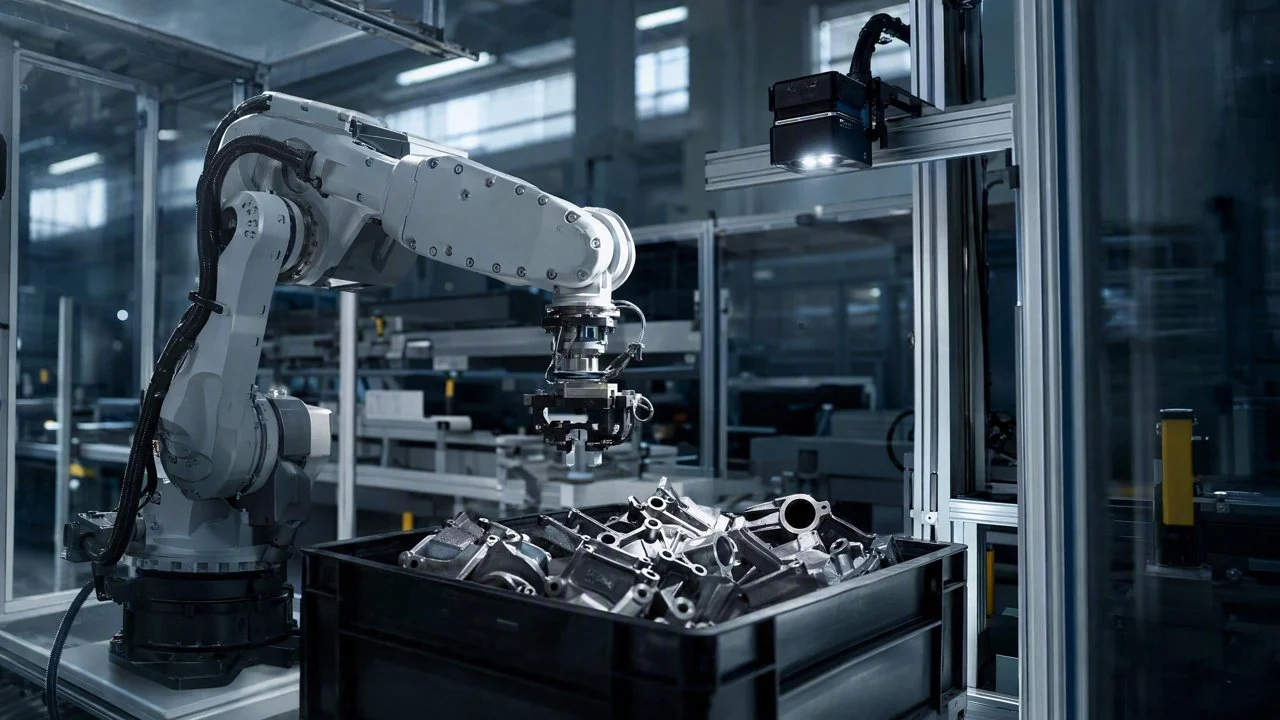
WeLinkirt's DaoAI 3D Robot Vision (proprietary 3D camera + 6D pose estimation, bin picking, glue dispensing/assembly/loading-unloading guidance, brain-eye-body closed-loop, sub-millimeter hand-eye coordination) reduces the missed detection rate in automotive parts bin picking from a traditional 2.5% to below 0.4% through its high-precision 3D perception and intelligent decision-making capabilities, greatly enhancing production line automation and efficiency. In automotive manufacturing and parts processing, efficiency and quality are core competencies. Especially when facing increasingly complex supply chains and personalized customization demands, flexible automation becomes imperative. Traditional manual operations or 2D vision-based fixed-path grasping solutions struggle with low recognition accuracy, slow speed, fatigue susceptibility, and poor flexibility when dealing with randomly stacked parts, failing to meet the stringent cycle time and quality requirements of modern automotive production.
Pain Points: Why This Hurdle Is So Difficult
In the automotive parts bin picking process, traditional solutions face multiple pain points. First, there's a **high missed detection rate**. Based on 2D vision or manual inspection, for parts with complex geometries, reflective materials, or mutual occlusion, the missed detection rate often reaches 2.5% or higher, leading to rework or scrap in subsequent processes and increased costs. Second, **significant rework and re-inspection volume** are common. Due to missed detections and mispicks, production lines require substantial additional human effort for manual re-inspection and handling of defective products, severely slowing down cycle times and increasing labor costs. Third, **low changeover efficiency** is a major issue. Automotive parts are diverse, with significant differences between models and batches. Traditional solutions require hours or even days of downtime for programming and debugging when changing products, resulting in extremely poor production flexibility. Finally, there are **data silos and traceability difficulties**. Traditional methods lack real-time data recording and analysis of the grasping process, making quality traceability and process optimization challenging, failing to meet modern automotive industry demands for digital and intelligent manufacturing.
The root causes of these challenges lie in: From a process perspective, automotive parts have complex and diverse shapes, with many highly reflective, dark, or irregularly shaped components. When stacked randomly in bins, severe mutual occlusion occurs, making it difficult for conventional 2D vision to obtain complete surface information. From an imaging perspective, traditional 2D cameras are extremely sensitive to lighting conditions; shadows, reflections, or ambient light changes can severely interfere with recognition results, leading to misidentification or missed identification. From a material perspective, different materials like metal and plastic have vastly different light reflection characteristics, increasing the difficulty of image processing. From a cycle time perspective, automotive production lines demand extremely high efficiency. Traditional solutions struggle to meet high-speed picking cycle time requirements while ensuring high accuracy. WeLinkirt deeply understands these challenges and is committed to providing breakthrough solutions through its advanced DaoAI 3D Robot Vision technology.
Technical Principles
The core of WeLinkirt's DaoAI 3D Robot Vision lies in its proprietary high-precision 3D camera and leading 6D pose estimation algorithm. This system uses structured light or laser triangulation principles to quickly acquire complete 3D point cloud data of parts within the bin, overcoming the limitations of 2D vision in depth information. The proprietary 3D camera boasts high resolution and precision, capable of stably reconstructing sub-millimeter 3D geometries even when facing complex reflective or dark surfaces, providing reliable data for subsequent pose estimation. WeLinkirt combines deep learning and geometric matching algorithms to process and analyze the acquired point cloud data in real-time, accurately identifying the 6D pose (X, Y, Z coordinates and rotation angles around three axes) of randomly stacked parts – a capability unattainable by traditional rule-based AOI or manual inspection. Compared to traditional methods, the advantage of WeLinkirt's DaoAI 3D Robot Vision is that it no longer relies on fixed templates or human experience, but rather uses powerful 3D perception and intelligent algorithms to achieve precise recognition and grasping of parts in any orientation, significantly enhancing flexibility and robustness.
At the algorithm level, WeLinkirt employs advanced deep learning models, trained with extensive real and synthetic data, enabling them to maintain high recognition accuracy even under challenging conditions such as complex backgrounds, partial occlusion, and varying lighting. This 'brain-eye-body closed-loop' control architecture allows the robot to adjust its grasping strategy in real-time based on visual feedback, achieving sub-millimeter hand-eye coordination. Traditional methods often require complex programming and iterative debugging, whereas DaoAI 3D Robot Vision automates this through intelligent algorithms, greatly simplifying deployment and maintenance. Furthermore, WeLinkirt supports APDT few-shot learning, requiring only a minimal number of good samples for model training, which significantly shortens changeover times and enhances the production line's ability to handle multi-variety, small-batch production.
Typical Application Scenarios
- **Unordered Picking of Engine/Gearbox Parts:** In assembly lines for heavy components like engine blocks and gearbox housings, WeLinkirt's DaoAI 3D Robot Vision can precisely pick randomly stacked castings or machined parts from deep bins, guiding robotic arms for loading/unloading or assembly. The challenge lies in the large size, heavy weight, complex surface textures, and reflective nature of the parts.
- **Sorting and Assembly Guidance for Small Precision Parts:** For small precision components like connectors, screws, and washers in automotive electronic modules, the system can identify them from bulk bins and guide robotic arms for high-precision sorting and insertion. The challenge here is the small size, severe mutual occlusion, and extremely high precision requirements.
- **Part Positioning for Car Body Welding Stations:** In welding stations before car body final assembly, WeLinkirt's DaoAI 3D Robot Vision can be used to identify and locate various brackets and reinforcement parts on the car body frame, guiding welding robots for precise welding. The challenges include diverse part shapes, high positioning accuracy requirements, and confined working environments.
- **Glue Dispensing/Sealing Guidance:** In automated glue dispensing or sealing operations for automotive interior/exterior parts, headlights, etc., the system can accurately identify the 3D geometry and position of the area to be glued, guiding the dispensing robot to follow predefined paths for high-quality application. The challenges involve complex path planning and strict requirements for glue line uniformity and consistency.
- **Loading/Unloading for Press-fitting/Riveting Processes:** WeLinkirt's DaoAI 3D Robot Vision can be used to pick stamped parts, riveted parts, etc., from bins and accurately place them onto fixtures for press-fitting or riveting equipment, enabling automated loading/unloading. The challenges include easily deformable part edges and the need for high-precision positioning.
Case Study
A renowned tier-1 automotive parts supplier faced long-standing challenges with unordered bin picking of engine cylinder head bolt hole covers on their production line. Traditionally, they relied on manual picking or 2D vision-guided fixed-path picking. However, due to the irregular surfaces of the bolt hole covers and varying stacking angles within the bins, missed picks and mispicks were frequent, leading to a missed detection rate as high as 2.5%. This severely impacted the efficiency of subsequent automated assembly and incurred significant rework costs. After implementing WeLinkirt's DaoAI 3D Robot Vision solution, by deploying WeLinkirt's proprietary 3D camera and its core 6D pose estimation algorithm, the system could quickly scan the bin and obtain the precise 3D position and orientation of each bolt hole cover in real-time. The robotic arm then performed accurate picks based on instructions from DaoAI 3D Robot Vision. Post-implementation, the customer successfully reduced the missed detection rate for bin picking to 0.38%. Concurrently, due to a significant increase in picking success rate, manual re-inspection volume decreased by 85%, line cycle time improved by 15%, and per-piece production costs were notably optimized. The entire system deployment and integration took only 2 weeks, and for subsequent changes to different models of bolt hole covers, DaoAI 3D Robot Vision's rapid changeover capability allowed line switching in just 5 minutes, greatly enhancing production flexibility.
"WeLinkirt's DaoAI 3D Robot Vision not only solved our bin picking challenges but also reduced the missed detection rate to an unprecedented level, truly realizing stable and efficient operation of our automated production line." — Production Manager at a Tier-1 Automotive Parts Supplier
WeLinkirt Solutions and Products
The core of WeLinkirt's DaoAI 3D Robot Vision solution is its proprietary 3D camera hardware and accompanying 6D pose estimation algorithm software. This solution provides full 'brain-eye-body closed-loop' capabilities, realizing intelligent control throughout the entire chain from perception to decision-making to execution. In the modeling phase, WeLinkirt supports various modeling methods, including CAD model import and point cloud reconstruction. Combined with APDT few-shot self-training technology, customers only need to provide a small number of good samples for the system to quickly learn and recognize new parts. For changeovers, WeLinkirt's DaoAI 3D Robot Vision offers 0-code rapid changeover capability, allowing production lines to switch between different products without complex programming or manual debugging. Simple configurations suffice, reducing changeover time from hours to minutes. For deployment and integration, WeLinkirt provides multiple deployment options such as SDK/API/Docker and supports 100% on-premise private deployment, ensuring customer data security. Furthermore, WeLinkirt can integrate with other product lines like SkyVision 0-code video surveillance AI platform and DaoAI World model to build more comprehensive intelligent factory solutions, enabling cross-scenario generalization and continuous learning capabilities. For instance, integrated with SkyVision, real-time monitoring and anomaly pre-warning of the picking process can be performed, further enhancing line stability. The sub-millimeter hand-eye coordination precision of WeLinkirt's DaoAI 3D Robot Vision ensures highly reliable picking and operation in complex industrial conditions.
Through the deployment of WeLinkirt's DaoAI 3D Robot Vision, customers not only achieve high-precision, high-efficiency automation in bin picking but also significantly enhance production line flexibility and adaptability. Quantifiable results include a missed detection rate reduced to <0.4%, a false alarm rate reduced by 90%, manual re-inspection volume reduced by 85%, changeover time shortened to 5min, and an overall line cycle time improvement of 15%. These directly translate into substantial business value, including reduced production costs, improved product quality, and enhanced market competitiveness. WeLinkirt is committed to providing cost-effective, easy-to-deploy, and high-performance vision solutions for the automotive and parts industry, accelerating the popularization of humanoid robot technology and the development of a developer ecosystem, assisting customers in achieving intelligent manufacturing transformation and upgrade.
FAQ
How does DaoAI 3D Robot Vision ensure high precision and stability in bin picking?
WeLinkirt's DaoAI 3D Robot Vision system achieves high precision and stability through its proprietary high-precision 3D cameras that capture millimeter-level 3D point cloud data, combined with advanced deep learning 6D pose estimation algorithms. This enables precise identification of the position and orientation of complexly stacked parts. Its 'brain-eye-body closed-loop' control architecture allows the robot to adjust its gripping strategy in real-time, achieving sub-millimeter hand-eye coordination, ensuring high precision and stability even under complex conditions like varying lighting and partial occlusion.
What is the approximate cost of deploying WeLinkirt's DaoAI 3D Robot Vision?
The deployment cost of WeLinkirt's DaoAI 3D Robot Vision is influenced by various factors, including the complexity of the specific application scenario, the number and model of 3D cameras required, robot brand compatibility, integration service needs, and whether customized development is necessary. We offer flexible solutions and support on-premise private deployment. We recommend contacting our sales team with your detailed requirements for a customized cost assessment and quotation.
How fast is DaoAI 3D Robot Vision's changeover, and does it support multi-variety, small-batch production?
Yes, WeLinkirt's DaoAI 3D Robot Vision is specifically optimized for multi-variety, small-batch production scenarios. With its 0-code rapid changeover capability and APDT few-shot self-training technology, customers only need 1-20 good sample images for the system to learn new parts and complete a production line changeover within 5 minutes. This significantly reduces downtime and enhances production flexibility, helping customers quickly respond to market changes.
Full solution for this scenario: Automotive / parts industry solutions · Automotive Assembly Error-Proofing: Robot Vision Reduces Misassembly Rate
This article was generated by AI. Customer cases are simulated scenarios based on real product capabilities and figures are illustrative; see product pages for official benchmarks.