
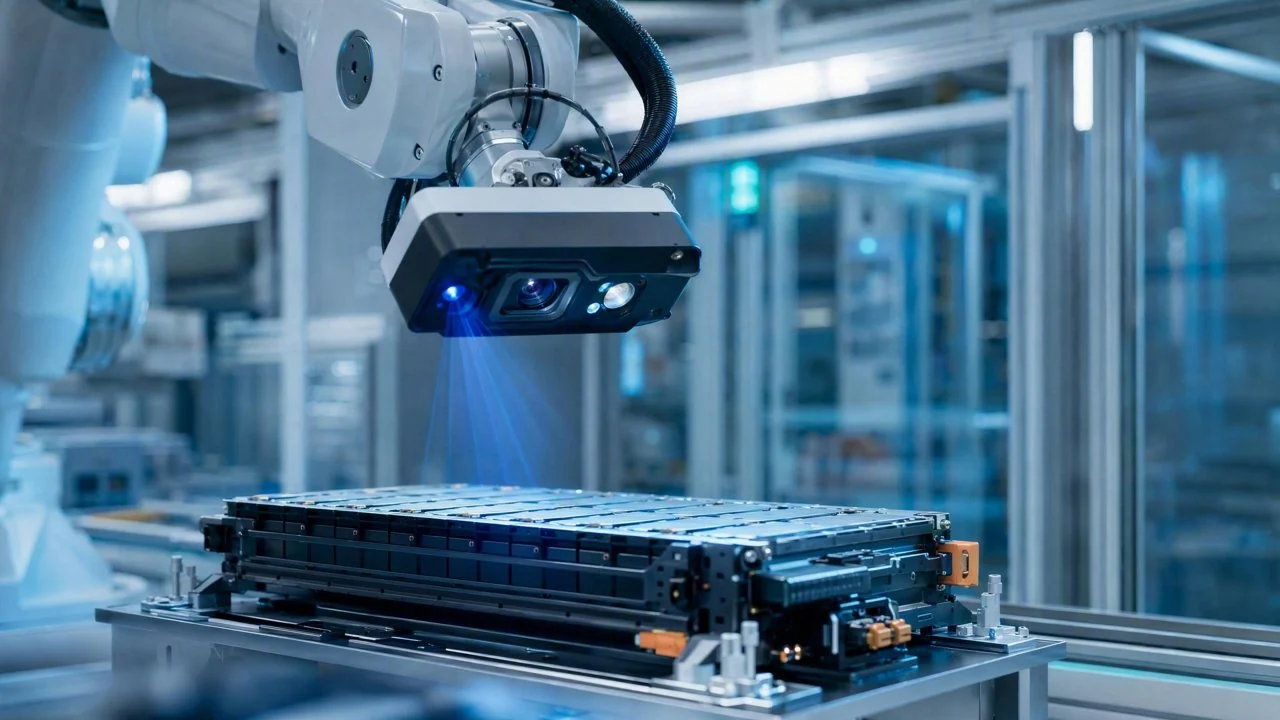
The WeLinkirt DaoAI 3D Robotic Vision system, with its proprietary 3D camera and advanced 6D pose estimation technology, has achieved precise traceability and data closure for new energy battery module solder joint quality, reducing traditional manual re-inspection rates by 75% and increasing critical defect detection rates to over 99.7%. Against the backdrop of the new energy vehicle industry expanding into embodied AI robotics, efficient, reliable, and data-manageable automated inspection solutions have become an industry imperative. WeLinkirt provided a customized solution to a leading new energy battery manufacturer to address challenges in laser solder joint consistency, defect identification, and data management on their module production line. This line is primarily responsible for integrating a large number of cells into modules, involving thousands of critical laser solder joints whose quality directly impacts the performance, safety, and lifespan of the battery module.
The WeLinkirt DaoAI 3D Robotic Vision system, leveraging its proprietary 3D camera and advanced 6D pose estimation technology, has achieved precise traceability and data closure for new energy battery module solder joint quality, reducing traditional manual re-inspection rates by 75% and increasing critical defect detection rates to over 99.7%. Against the backdrop of the new energy vehicle industry expanding into embodied AI robotics, efficient, reliable, and data-manageable automated inspection solutions have become an industry imperative. WeLinkirt provided a customized solution to a leading new energy battery manufacturer to address challenges in laser solder joint consistency, defect identification, and data management on their module production line. This line is primarily responsible for integrating a large number of cells into modules, involving thousands of critical laser solder joints whose quality directly impacts the performance, safety, and lifespan of the battery module. Due to the complex structure and high-density integration of battery modules, each solder joint can be a potential point of failure, thus imposing extremely high demands on solder joint quality control and traceability. Traditional inspection methods often struggle to meet these demands, especially in the face of large-scale production and stringent quality standards.
Pain Points: Why This Hurdle Is Difficult to Overcome
In the production of new energy battery modules, solder joint quality inspection faces multiple challenges. Firstly, traditional manual visual inspection or rule-based 2D AOI systems often suffer from missed detections and false positives when dealing with complex 3D solder joint morphologies. For instance, micron-level defects such as insufficient or excessive solder height, flatness, or penetration are difficult to accurately identify in 2D images. Secondly, due to the rapid iteration of battery module designs, each model changeover requires significant time and human resources for reconfiguring inspection programs, leading to increased production line downtime and reduced efficiency. For a leading battery manufacturer, inspecting tens of thousands of solder joints per hour means any minor efficiency bottleneck is amplified. Thirdly, and most critically, there is a lack of quality traceability and data closure. Traditional solutions only provide pass/fail judgments, failing to record detailed 3D morphological data, defect types, location information, and production batches for each solder joint. This makes it difficult to quickly pinpoint the root cause and initiate recalls or improvements when quality issues arise, increasing compliance risks and potential substantial losses. Furthermore, as new energy vehicle manufacturers actively explore embodied AI robotics, higher demands are placed on production line automation and data intelligence, and the 'information silo' effect of traditional inspection solutions severely hinders the intelligent upgrade of production processes.
Specifically, laser solder joints in module assembly are prone to various defects such as spatter, pores, cracks, collapse, cold solder joints, false solder joints, and short circuits. These defects are often tiny and may be hidden within complex 3D structures. Traditional 2D vision systems are limited by viewing angles and lighting, making it difficult to acquire complete depth information, resulting in a detection rate below 95% for such defects. Manual visual inspection, besides being inefficient, is highly subjective and lacks consistency, leading to high daily re-inspection hours. For a high-capacity production line, several hours of manual re-inspection daily not only increase operating costs but also slow down the overall production rhythm.
Technical Principles
The WeLinkirt DaoAI 3D Robotic Vision system effectively addresses these pain points through its core technologies. The system is equipped with WeLinkirt's proprietary high-precision 3D camera, which uses structured light or line laser scanning technology to acquire complete 3D morphological data of solder joints with sub-millimeter accuracy. Unlike traditional 2D imaging, the 3D camera directly obtains depth information, allowing for precise identification of 3D features such as solder joint height, volume, flatness, and coplanarity. Even minute collapses, pores, or insufficient penetration can be accurately quantified. After acquiring 3D point cloud data, the DaoAI vision system utilizes advanced 6D pose estimation algorithms to accurately perceive and compensate for the arbitrary posture of battery modules on the production line, ensuring stable and accurate inspection. This capability is unparalleled by traditional rule-based AOI systems, which often require extremely high precision in workpiece placement.
Furthermore, the DaoAI 3D Robotic Vision system integrates powerful AI algorithms, particularly its APDT (Automated Process Data Training) few-shot self-training capability. This means that with just 1–20 good samples, the system can quickly learn and establish a 'golden standard' model for solder joints. Through positive sample learning and semantic false positive filtering, it reduces the false positive rate by over 80%. Compared to traditional rule-based AOI, which relies on engineers manually writing complex rules, DaoAI's AI model can autonomously identify defect patterns and possesses cross-scenario generalization capabilities. When the production line undergoes a model changeover, the DaoAI ACI (AI-AOI) software system enables 0-code rapid changeover, completing the new product inspection program configuration within 5 minutes, significantly shortening downtime. This 'brain-eye-body closed-loop' intelligent inspection mode allows the WeLinkirt DaoAI 3D Vision system to achieve a complete closed loop from data acquisition, intelligent analysis, to feedback control, providing an unprecedented level of quality control for new energy battery production.
Typical Application Scenarios
- **Laser Solder Joint Penetration and Width Detection:** The DaoAI 3D Robotic Vision system can precisely measure the 3D morphology of laser solder joints, including penetration depth, width, and weld seam height. Traditional methods struggle to accurately assess penetration depth, while DaoAI, by reconstructing the solder joint profile, can detect micron-level insufficient or excessive penetration, ensuring welding strength and conductivity.
- **Solder Joint Pore and Crack Detection:** Utilizing 3D height maps and surface texture analysis, the system effectively identifies tiny pores, cracks, and spatter on the solder joint surface. These defects are often obscured by lighting or shadows in 2D images, whereas the DaoAI 3D Vision system can accurately distinguish them by capturing their 3D morphological anomalies.
- **Solder Joint Collapse and Protrusion Detection:** If battery module solder joints exhibit collapse or excessive protrusion, it can lead to short circuits or poor contact. The DaoAI 3D Robotic Vision can quantify localized height variations of solder joints, detecting sub-millimeter collapse or protrusion defects, ensuring solder joint consistency and safety.
- **Cold Solder Joint and False Solder Joint Detection:** Cold solder joints and false solder joints are common critical defects in battery modules that can lead to thermal runaway. The DaoAI 3D Vision system analyzes the 3D geometric features of the connection area between the solder joint and the base material, combined with an AI model to determine the presence of effective fusion, thereby effectively identifying these hidden defects.
- **Electrode Tab Coplanarity and Alignment Detection:** Before module assembly, the DaoAI 3D Robotic Vision can also guide robotic arms for precise alignment of electrode tabs and inspect their coplanarity. By acquiring 3D data of the electrode tabs, it ensures their ideal position before welding, thereby improving subsequent welding quality and providing pre-production data for quality traceability.
Case Study
The DaoAI 3D Robotic Vision system was successfully deployed on the module production line of a leading New Energy Battery Tier-1 supplier. This client's production line is characterized by high throughput and multi-variety small-batch production, where traditional inspection solutions struggled with frequent model changeovers and stringent quality traceability requirements. Before deployment, the client primarily relied on manual visual inspection and some 2D AOI equipment, resulting in a missed detection rate of around 0.8% and persistently high false positive rates. This necessitated significant human resources for re-inspection, averaging 2 skilled workers per shift dedicated to re-inspection for up to 4 hours daily. More critically, due to the lack of detailed solder joint data, tracing the root cause of quality issues was difficult, which had previously exposed them to potential recall risks.
After introducing the WeLinkirt DaoAI 3D Robotic Vision system, the situation changed dramatically. In the initial phase, the WeLinkirt team deployed their proprietary 3D cameras on-site, collected extensive 3D morphological data of solder joints, and trained models using the DaoAI ACI OS. With just 15 good samples, the system completed the preliminary establishment of the defect identification model within a week. After a period of production line integration and optimization, the system achieved a detection rate of over 99.7% for all critical solder joint defects and reduced the false positive rate by 85%. More importantly, the WeLinkirt DaoAI 3D Vision system records real-time 3D morphological data, inspection results, defect types, and location information for each inspected solder joint. This data is linked to production batches, module codes, and other information, creating a comprehensive quality traceability database. This enables the client to conduct full lifecycle quality traceability for every solder joint of every battery module. When quality issues arise, they can be pinpointed to specific solder joints, production times, shifts, and even equipment parameters within minutes, greatly enhancing the efficiency and reliability of quality management. The client reported that the DaoAI 3D Robotic Vision system reduced manual re-inspection hours by 75%, saving millions in operating costs annually, and significantly mitigating risks associated with quality issues.
"The DaoAI 3D Robotic Vision system not only improved our inspection accuracy and efficiency but, more importantly, built a true quality data closed-loop for us, allowing us to be accountable for every single solder joint."
WeLinkirt Solutions and Products
WeLinkirt's core solution is based on the DaoAI 3D Robotic Vision system, whose key components include: a proprietary high-precision 3D camera responsible for data acquisition, providing sub-millimeter point cloud data; the DaoAI ACI OS acts as the intelligent brain, with built-in visual foundation models, utilizing APDT few-shot learning and semantic false positive filtering technology to achieve intelligent identification and classification of solder joint defects. The system supports 0-code rapid changeover, allowing engineers to switch inspection tasks for new products within 5 minutes with minimal configuration on a graphical interface, significantly enhancing production line flexibility. For deployment, WeLinkirt supports various integration methods such as SDK/API/Docker and offers 100% on-premise private deployment options, ensuring customer data security stays within the factory, meeting the high standards for data privacy and security in the new energy industry. Furthermore, the DaoAI Robotic Vision system integrates with existing robotic arms and production line control systems, achieving a 'brain-eye-body closed loop'—visual system perception (eye), AI brain decision-making (brain), and robotic arm execution (body)—ensuring synchronous inspection and production. The WeLinkirt DaoAI World model, as a unified foundation, further enhances the system's semantic understanding and cross-scenario generalization capabilities, enabling continuous learning and optimization from production line feedback, constantly improving inspection performance.
Through the deployment of the WeLinkirt DaoAI 3D Robotic Vision system, the client not only solved current solder joint inspection accuracy and efficiency issues but also gained forward-looking data management capabilities. The detailed inspection reports and traceable data provided by the system not only meet industry regulatory requirements but also offer valuable data support for process optimization, preventative maintenance, and product design improvements. This data-centric quality management model enables the client to maintain a leading position in the fiercely competitive new energy battery market and provides a solid data foundation and technological reserve for their future exploration in embodied AI robotics.
FAQ
How does the DaoAI 3D Robotic Vision system enable quality traceability for new energy battery module solder joints?
The DaoAI 3D Robotic Vision system utilizes its proprietary high-precision 3D camera to accurately collect 3D morphological data for each solder joint, including height, volume, and defect types. This data is real-time linked with production batch and module codes, and stored in a traceable database. In case of a quality issue, historical inspection data for the corresponding solder joint can be quickly retrieved using the product code, enabling full lifecycle quality traceability.
What are the advantages of DaoAI 3D Robotic Vision for solder joint inspection compared to traditional 2D AOI or manual visual inspection?
The primary advantage of the DaoAI 3D Robotic Vision system is its ability to acquire complete 3D morphological data, overcoming the limitations of 2D vision in detecting hidden defects and depth information. It can identify minute pores, collapses, and insufficient penetration defects with sub-millimeter accuracy, resulting in higher detection rates and lower false positives. Coupled with AI algorithms, the system offers 0-code rapid changeover, significantly enhancing production line flexibility and efficiency, reducing reliance on human experience, and achieving more stable and consistent inspections.
What is the investment required for deploying the DaoAI 3D Robotic Vision system, and what is the typical ROI period?
The investment cost for the DaoAI 3D Robotic Vision system varies based on specific configurations, inspection complexity, and integration requirements, but the benefits are substantial. By reducing missed detections and false positives, cutting manual re-inspection costs, minimizing changeover downtime, and enhancing product quality and brand reputation, an ROI is typically achieved within 1–2 years. For specific pricing and ROI assessment, a customized analysis based on your actual production line conditions is recommended. Please contact the WeLinkirt sales team for a detailed proposal.
Full solution for this scenario: New-energy batteries industry solutions · New-Energy Battery Module Weld Misalignment Detection
This article was generated by AI. Customer cases are simulated scenarios based on real product capabilities and figures are illustrative; see product pages for official benchmarks.