
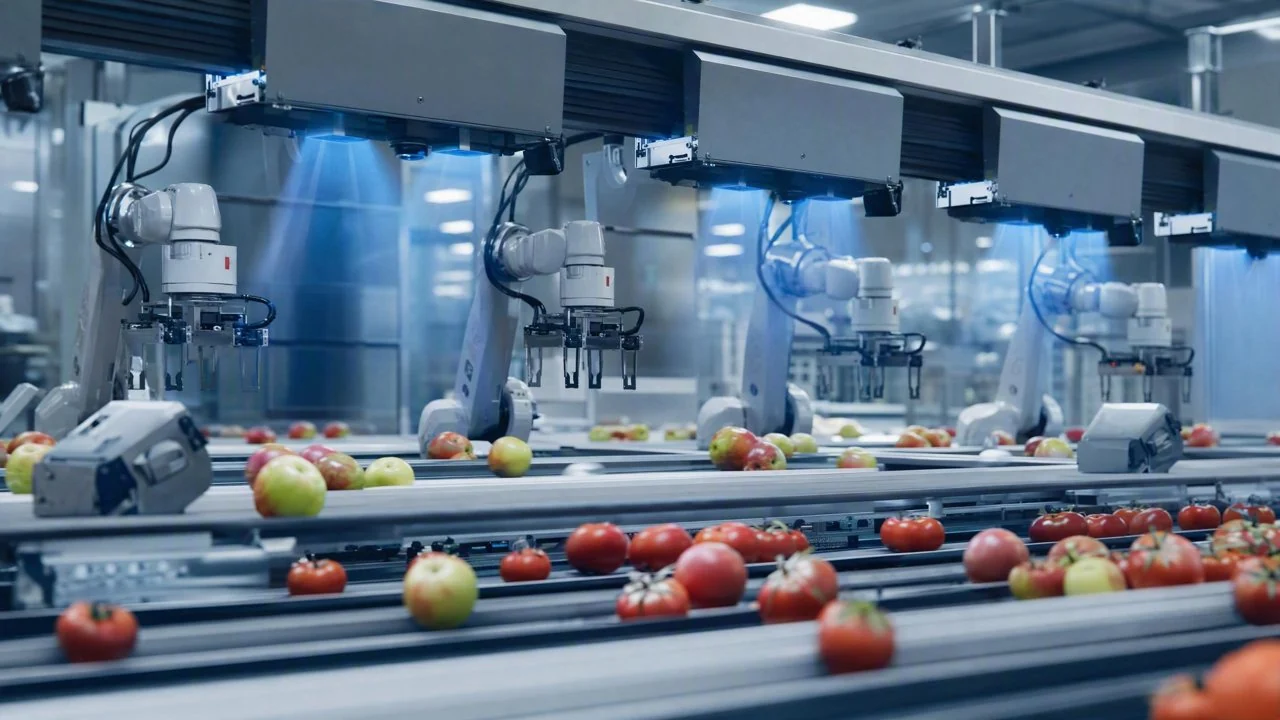
DaoAI 3D Robot Vision (proprietary 3D camera + 6D pose estimation, bin picking, dispensing/assembly/loading guidance, brain-eye-body closed-loop, sub-millimeter hand-eye coordination) precisely identifies the 3D morphology and subtle surface features of agricultural products, enabling 100% full inspection at high production speeds. This reduces the false negative rate for agri-product ripeness sorting from a typical 5-8% with traditional methods to <0.5%, significantly improving sorting efficiency and product consistency, delivering substantial economic benefits and competitive advantages to agri-product processing enterprises.
Achieving line throughput and 100% full inspection for agricultural product ripeness sorting is a critical industry demand. DaoAI 3D Robot Vision, leveraging its proprietary 3D camera and 6D pose estimation algorithms, precisely identifies the 3D morphology and subtle surface features of agricultural products, enabling 100% full inspection at high production speeds. This reduces the false negative rate for agri-product ripeness sorting from a typical 5-8% with traditional methods to <0.5%, significantly improving sorting efficiency and product consistency, delivering substantial economic benefits and competitive advantages to agri-product processing enterprises. In the food and agriculture sector, post-harvest sorting of agricultural products is crucial for ensuring quality, extending shelf life, and meeting market demands. Especially for perishable goods like fruits and vegetables, accurate ripeness assessment directly impacts their subsequent processing, storage, and sales value. Traditionally, this process heavily relies on manual experience, which is inefficient and subjective, struggling to meet the requirements of modern large-scale, standardized agricultural production. While automated sorting equipment is common, most still rely on 2D vision or simple weight/size screening. When precise judgment of complex ripeness indicators such as subtle surface defects, color gradients, and shape variations is required, their detection capabilities often fall short, leading to persistently high false negative rates that severely impact line throughput and overall production capacity.
Pain Points: Why This Hurdle Is So Challenging
The challenges in agricultural product ripeness sorting manifest in several dimensions: First, **high false negative rates**. Traditional manual visual inspection, when workers are fatigued or distracted, frequently errs in judging subtle color differences, localized softening, or early-stage pest damage, leading to a typical false negative rate of 5-8%. This directly results in substandard products entering the market or the next processing stage, impacting brand reputation and economic benefits. Second, **production line throughput bottlenecks**. Manual sorting is slow, with limited processing capacity per worker per minute, making it difficult to match the high-speed demands of processing lines. This often becomes the bottleneck for the entire production line. Increasing capacity typically requires a significant increase in manual labor, leading to high costs. Third, **high labor costs and recruitment difficulties**. The food processing industry involves intensive labor and often humid environments, resulting in high employee turnover and increasing difficulty in recruiting skilled sorters, further escalating operational costs. Fourth, **lack of objective and consistent standards**. Manual judgment is highly susceptible to subjective factors, leading to inconsistent ripeness assessment standards across different workers and shifts. This results in significant quality variations between product batches, making it difficult to establish uniform quality standards and increasing the risk of disputes with suppliers or customers.
The root cause of these pain points lies in the highly non-standardized nature of agricultural products themselves. Each fruit, each leaf is unique, with ripeness manifested in complex 3D morphology, irregular surface textures, gradient color distributions, and potential minute defects. Traditional 2D vision systems can only acquire planar image information, lacking the ability to perceive depth and stereo structures. Their identification capabilities for overlapping, occluded, or irregularly shaped fruits are limited, making it difficult to accurately judge their integrity and ripeness. For instance, a fruit with acceptable surface color but localized softening or internal rot is hard for 2D vision to detect. Furthermore, factors like image blur at high throughput, uneven lighting, and environmental humidity can also interfere with detection accuracy. This starkly contrasts with the emphasis of current embodied AI technologies like Figure robots on long-term stable operation and adaptability to complex environments, highlighting the limitations of traditional solutions in dealing with real, dynamic, and unstructured scenarios.
Technical Principles
WeLinkirt DaoAI 3D Robot Vision system effectively overcomes many challenges in agricultural product ripeness sorting through its core technologies. The key lies in its **proprietary high-precision 3D camera** and **advanced 6D pose estimation algorithms**. DaoAI's 3D camera utilizes structured light or laser triangulation principles to rapidly acquire sub-millimeter 3D point cloud data of agricultural product surfaces, precisely reconstructing their 3D morphology. Unlike traditional 2D vision which only provides planar pixel information, 3D data includes rich information such as depth, volume, and surface curvature, enabling the system to accurately identify the complete form, depressions, protrusions, and subtle texture changes of fruits. These are critical indicators for assessing ripeness, pest damage, or mechanical damage. For example, a slight surface collapse due to localized fruit softening might be difficult to discern in a 2D image, but 3D data can clearly capture the morphological anomaly.
Building on this, WeLinkirt DaoAI 3D Robot Vision's **6D pose estimation algorithm**, combined with deep learning models, can real-time and precisely calculate the 3D position (X, Y, Z) and 3D orientation (Rx, Ry, Rz) of each agricultural product in space – its 6D pose. This enables sorting robots to achieve **sub-millimeter hand-eye coordination**. Even if agricultural products are randomly placed, overlapped, or tilted on the conveyor belt, the robot can accurately grasp the target and sort it according to its ripeness level. Compared to traditional rule-based AOI systems' strong reliance on fixed poses and standard shapes, DaoAI's 3D vision technology demonstrates significant advantages in handling unstructured, randomly placed agricultural products. It not only improves detection accuracy but also, through **brain-eye-body closed-loop** control, achieves integration from visual perception to robot motion, significantly boosting sorting efficiency. This reduces the false negative rate from a typical 5-8% in traditional manual sorting to <0.5% and increases line throughput by over 30%, far exceeding the performance limits of traditional solutions.
Typical Application Scenarios
- **Fruit Ripeness Grading**: For fruits like apples, citrus, and tomatoes, WeLinkirt DaoAI 3D Robot Vision can identify surface color, glossiness, plumpness, and the presence of localized softening or blemishes, classifying them into unripe, ripe, and overripe grades to ensure consistent ripeness across batches entering the market. The challenge lies in the wide variation of ripeness indicators across different fruit varieties and the difficulty in quantifying color gradients.
- **Vegetable Quality Inspection**: Used for detecting leaf integrity, insect holes, yellowing, and rot in leafy greens (e.g., lettuce, spinach), as well as shape abnormalities, skin damage, and sprouting in root vegetables (e.g., potatoes, carrots). The difficulty lies in the diverse forms of vegetables, complex surface textures, and susceptibility to interference from dirt and other foreign matter.
- **Agricultural Product Foreign Object Removal**: In grains, legumes, or processed fruits and vegetables, identifying and removing foreign objects such as stones, metal scraps, plastic pieces, and insects. DaoAI 3D Robot Vision effectively distinguishes agricultural products from foreign objects through 3D morphology and material characteristic analysis, preventing misjudgment by traditional 2D vision due to similar colors. The challenge is that foreign objects vary in shape and size and may be hidden within the product or obstructed.
- **Post-Harvest Damage Detection**: Detecting mechanical damage such as compression, bruising, and abrasions incurred during harvesting and transportation. These damages may not be obvious initially but accelerate spoilage. DaoAI 3D Robot Vision can identify minute skin damage, depressions, or abnormal color areas. The difficulty lies in the very subtle nature of initial damage, which can be easily confused with ripeness changes.
- **Seedling Quality Screening**: In the breeding stage, evaluating seedling morphology, leaf count, and root development to select healthy, standard-compliant seedlings. The challenge is that seedlings are small, fragile, and exhibit significant variations in growth status.
Case Study
A leading agricultural product processing enterprise, specializing in the washing, grading, and packaging of fresh fruits and vegetables, heavily relied on manual labor for ripeness sorting before adopting WeLinkirt DaoAI 3D Robot Vision system. A production line processing 5 tons of fruits and vegetables per hour required 15-20 workers for visual inspection and sorting. Due to prolonged repetitive work, worker fatigue led to an average false negative rate of up to 7%, which could be even higher during night shifts or peak seasons. At the enterprise's site, this high false negative rate directly resulted in approximately 5% of substandard products entering the packaging stage, not only increasing customer complaints but also impacting brand image. Furthermore, the intensive manual sorting limited the potential for further increases in line throughput, often leading to insufficient capacity during peak seasons.
“The deployment of WeLinkirt DaoAI 3D Robot Vision completely transformed our production line. It not only freed up a significant amount of labor but, more importantly, enabled our product quality to reach unprecedented levels, and our line throughput significantly increased.”
To address these pain points, the enterprise implemented WeLinkirt DaoAI 3D Robot Vision solution. During implementation, the DaoAI team first assessed the production line environment and configured multiple proprietary 3D cameras based on the characteristics of different fruits and vegetables, integrating them with efficient 6D pose estimation algorithms. After system deployment, DaoAI 3D Robot Vision consistently kept the false negative rate for sorting below <0.5%, and the false positive rate also decreased by 85%. More significantly, sorting efficiency improved by 35%, reducing the previous 20 manual sorting positions to just 2-3 workers for monitoring and exception handling. This not only dramatically lowered labor costs but, more importantly, increased line throughput from the original 5 tons/hour to 7 tons/hour, achieving high production capacity with 100% full inspection. Through the enablement of WeLinkirt DaoAI 3D Robot Vision, the enterprise not only ensured product quality but also gained significant economic benefits and market competitiveness.
WeLinkirt Solution and Products
WeLinkirt DaoAI 3D Robot Vision provides an end-to-end solution for agricultural product ripeness sorting. Its core lies in our proprietary **high-precision 3D camera**, capable of capturing sub-millimeter morphological features of agricultural product surfaces, providing high-quality data for subsequent intelligent analysis. Combined with advanced **6D pose estimation algorithms**, the DaoAI system can precisely identify agricultural products at any orientation and position on the conveyor belt, accurately locating and grasping them even when overlapped or irregularly shaped. For modeling, WeLinkirt DaoAI 3D Robot Vision supports APDT positive/few-shot learning, requiring only 1-20 good samples to complete model training and changeover in 5 minutes, significantly shortening deployment cycles and new product introduction times. For the multi-variety, small-batch production typical of agricultural products, this rapid changeover capability is crucial. The system also integrates **brain-eye-body closed-loop** control, ensuring highly coordinated processes from visual perception and intelligent decision-making to robot execution, achieving sub-millimeter hand-eye coordination to guarantee sorting precision and efficiency. For deployment, WeLinkirt DaoAI 3D Robot Vision offers various integration methods such as SDK / API / Docker, supporting 100% local private deployment to ensure customer data security and integration with existing production line control systems.
Through the application of WeLinkirt DaoAI 3D Robot Vision, customers can gain multiple business values. Firstly, **significantly reduce false negative rates**, minimizing the risk of defective products escaping and improving product quality consistency. Secondly, **substantially increase line throughput and capacity**, achieving highly efficient 100% full inspection and alleviating labor shortages and high-cost pressures. For example, in this case, the false negative rate was reduced to <0.5%, while line throughput increased by 35%. Thirdly, **lower operational costs**, reducing reliance on extensive manual labor, leading to significant long-term return on investment. Fourthly, **enhance market competitiveness**, by consistently supplying high-quality products, earning consumer trust and market share. The deployment of WeLinkirt DaoAI 3D Robot Vision is not merely a technological upgrade but a critical step in the agricultural production model's transformation towards intelligence and precision.
FAQ
How does DaoAI 3D Robot Vision achieve full inspection at high throughput in agricultural product sorting?
WeLinkirt DaoAI 3D Robot Vision utilizes its proprietary high-precision 3D camera to rapidly acquire sub-millimeter 3D morphological data of agricultural products. Combined with advanced 6D pose estimation algorithms, it can real-time precisely locate and identify agricultural products in any orientation. This enables sorting robots to perform accurate grasping and classification at extremely high efficiency. Furthermore, through brain-eye-body closed-loop control, it ensures integration of detection and execution, thereby achieving 100% full inspection at high throughput, reducing the false negative rate of traditional solutions to <0.5%.
What is the upfront investment and payback period for deploying WeLinkirt DaoAI 3D Robot Vision solution?
The investment cost for WeLinkirt DaoAI 3D Robot Vision solution is influenced by various factors, including production line scale, number of robots required, inspection complexity, and integration needs. Typically, upfront investment covers hardware procurement (3D cameras, robots) and software licensing. However, as the system significantly reduces false negative rates, improves line throughput (e.g., a 35% increase in throughput in this case), and reduces labor costs (false positive rate reduced by 85%, labor needs decreased), the return on investment period is usually within 1-2 years. For specific quotes and detailed ROI analysis, we recommend contacting our sales team for a customized evaluation.
How does DaoAI 3D Robot Vision adapt to the multi-variety, small-batch production model of agricultural products?
WeLinkirt DaoAI 3D Robot Vision features rapid changeover capabilities, utilizing APDT positive/few-shot learning technology. It only requires 1-20 good samples to complete model training and production line changeover for new products within 5 minutes. This capability significantly reduces downtime for new product introduction and switching between different varieties, allowing it to flexibly adapt to the multi-variety, small-batch, and seasonal production demands of the agricultural industry, effectively enhancing production line flexibility and utilization.
Full solution for this scenario: Food / agriculture industry solutions
This article was generated by AI. Customer cases are simulated scenarios based on real product capabilities and figures are illustrative; see product pages for official benchmarks.