
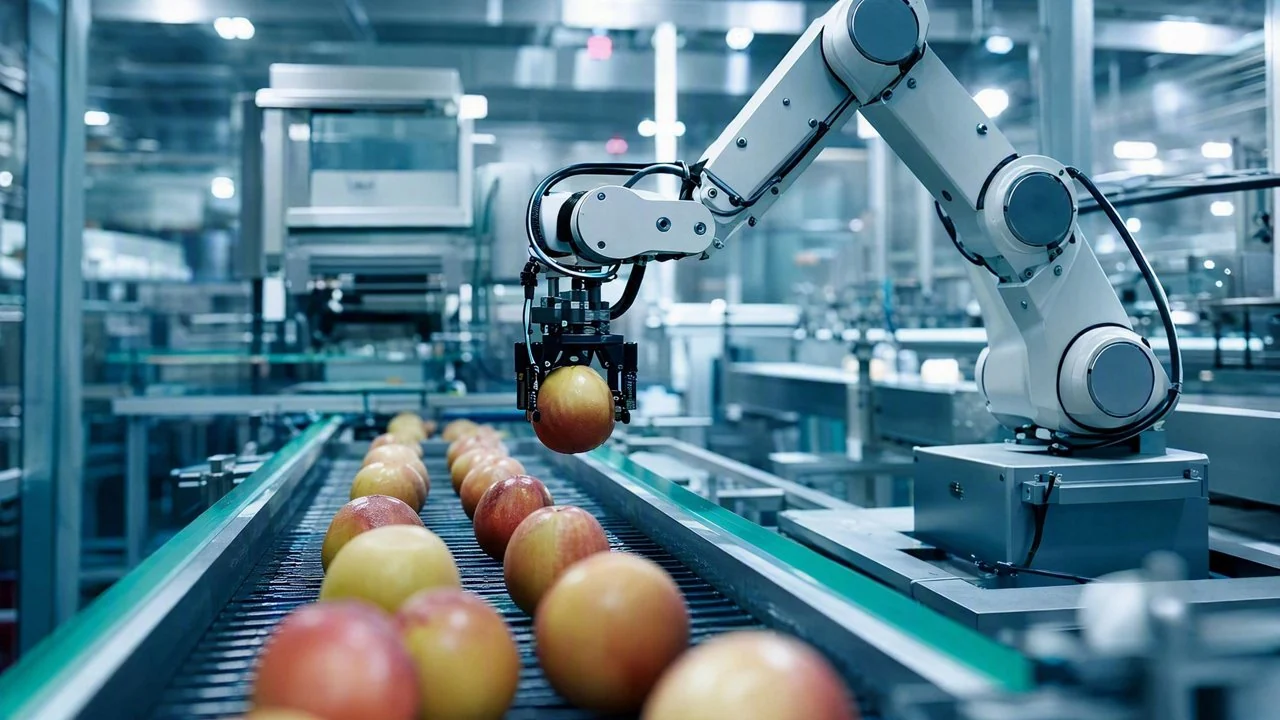
WeLinkirt's DaoAI 3D Robot Vision system (proprietary 3D camera + 6D pose estimation, bin picking, dispensing/assembly/loading/unloading guidance, brain-eye-body closed-loop, sub-millimeter hand-eye coordination) significantly enhances flexibility and efficiency in multi-variety, small-batch production by reducing changeover downtime for agri-food foreign object removal and quality grading lines from an average of 60 minutes to under 5 minutes, thanks to its unique zero-code rapid changeover capability. In the food/agriculture industry, particularly in primary and deep processing, foreign object removal and quality grading are critical processes for ensuring food safety and product value. However, the vast variety, diverse forms, and strong seasonality/batch characteristics of agricultural products often render traditional automation solutions ineffective when faced with frequent product changes, due to complex programming and time-consuming debugging. This leads to inefficient production lines, struggling to meet the growing market demand for personalized and diverse agricultural products.
In the food/agriculture industry, agricultural products undergo multiple processing steps from farm to table, with foreign object removal and quality grading being critical for consumer safety and product value. Whether it's the initial cleaning and sorting of fresh fruits and vegetables, or the deep processing of grains, nuts, and seafood, various foreign materials such as stones, soil, insects, plastic fragments, or even metal can be present. Simultaneously, differences in maturity, size, shape, and color among products necessitate precise grading. For a client providing diverse agricultural product processing services, their production line frequently needs to switch from processing apples to citrus, then to potatoes or corn. Each switch implies significant changes in product form, size, color, and defect characteristics. Traditional automated vision solutions often struggle with frequent product changes due to complex reprogramming and lengthy debugging, severely limiting production flexibility and efficiency. This directly leads to low production line efficiency, making it difficult to meet the growing market demand for personalized and diversified agricultural products.
Pain Points: Why This Hurdle Is Difficult to Overcome
The pain points in agricultural product foreign object removal and quality grading primarily manifest in several dimensions: Firstly, **high changeover costs and downtime**. Traditional vision systems require engineers to spend hours or even days on parameter adjustments, model retraining, and hand-eye calibration when facing different agricultural products. This results in an average changeover downtime of up to 60 minutes for production lines, representing a significant loss for food processing enterprises pursuing high turnover rates. Secondly, the **contradiction between detection accuracy and false alarm rate**. Agricultural product surfaces have complex textures, uneven colors, and diverse foreign object and defect characteristics. Traditional 2D vision or rule-based AOI systems struggle to distinguish subtle differences, leading to missed detections (e.g., foreign objects hidden in depressions) or false alarms (e.g., natural spots misidentified as defects). This results in high manual re-inspection workloads, with re-inspection labor accounting for up to 30% of total labor. Furthermore, **insufficient flexibility for multi-variety, small-batch production**. Market demand is increasingly diversified, with more customized and small-batch orders. Traditional solutions struggle to adapt quickly, making enterprises less competitive in responding to market changes. Finally, **labor costs and food safety risks**. Over-reliance on manual inspection is not only costly but also susceptible to fatigue and subjective judgment, making it difficult to guarantee 100% detection consistency and food safety compliance, especially for tiny foreign objects and early-stage diseases.
The root cause of these challenges lies in the unstructured nature, diversity, and complexity of agricultural products themselves, as well as the detection environment. Traditional solutions often rely on human experience or preset rules, lacking a deep understanding of the object's 3D morphology and complex textures. The current trend towards low-cost humanoid robot development platforms and embodied AI is precisely aimed at lowering industry barriers and accelerating the adoption of automation through more intelligent and user-friendly robotic systems. WeLinkirt's DaoAI 3D Robot Vision system is a product of this trend, designed to solve these core pain points through intelligent vision and robotic collaboration.
Technical Principles
The reason WeLinkirt's DaoAI 3D Robot Vision system can achieve zero-code rapid changeover and high-precision detection lies in its **proprietary high-precision 3D cameras and advanced 6D pose estimation algorithms**. The system first uses customized structured light or laser scanning to perform high-precision 3D point cloud reconstruction of agricultural products, obtaining complete geometric morphology data of the object, rather than just 2D image planar information. This enables the system to capture tiny foreign objects hidden in depressions and folds, and accurately distinguish between the product's natural texture and defects. Subsequently, using WeLinkirt's unique deep learning-based 6D pose estimation algorithm, the system can robustly identify the precise position and orientation (including X, Y, Z translation dimensions and Roll, Pitch, Yaw rotation dimensions) of agricultural products on the conveyor belt in real-time. Even irregularly stacked or randomly placed products can be accurately recognized. This capability is fundamental for precise gripping and removal, ensuring that the robotic arm can interact with target objects with sub-millimeter accuracy.
Compared to traditional rule-based 2D AOI or manual inspection, the advantages of WeLinkirt's DaoAI 3D Robot Vision include: **Dimensional upgrade**: From 2D planar information to 3D spatial information, addressing the limitations of traditional 2D vision in height, depth, and occlusion issues; **Intelligent generalization**: Leveraging the unified foundation of WeLinkirt's DaoAI World model, the system possesses strong semantic understanding and cross-scenario generalization capabilities, eliminating the need to reprogram for each new product. It can quickly adapt with only a small number of samples. Traditional rule-based AOI solutions require engineers to manually set numerous thresholds and geometric rules, making each changeover a time-consuming and specialized engineering task; manual inspection, on the other hand, is limited by human eye resolution, fatigue, and subjective judgment, unable to guarantee consistency. The DaoAI system works in a “brain-eye-body closed-loop” collaboration, with the vision system acting as the “eye” to perceive the world, the AI model as the “brain” to make decisions, and the robot as the “body” to execute operations. This achieves a fully automated, high-precision, and highly flexible process from perception to decision to execution. In practical applications, WeLinkirt's DaoAI 3D Robot Vision system can reduce the missed detection rate to <0.5% and the false alarm rate by over −85%, significantly improving detection reliability and efficiency.
Typical Application Scenarios
- **Foreign Object Removal for Fresh Fruits and Vegetables**: On the cleaning and sorting lines for fresh fruits and vegetables like apples, citrus, and tomatoes, DaoAI 3D Robot Vision can precisely identify and grip foreign objects such as twigs, leaves, small stones, insects, and even plastic fragments. The challenge lies in the diverse shapes of fruits and vegetables, uneven surface reflections, and the possibility of foreign objects being hidden in depressions, making it difficult for traditional 2D vision to effectively distinguish them. The high-precision 3D morphological data provided by the DaoAI 3D camera, combined with 6D pose estimation, ensures that the robotic arm can accurately identify and remove these foreign objects.
- **Impurity Sorting for Grains/Nuts**: For grains and nuts such as rice, wheat, peanuts, and walnuts, WeLinkirt's DaoAI 3D Robot Vision can identify and remove moldy particles, unripe kernels, shell fragments, and metal shavings. The difficulty lies in the small size and large quantity of particles, and the fact that impurities and products may have similar colors, leading to missed detections with traditional solutions. The DaoAI system, through high-resolution 3D scanning and deep learning models, can effectively distinguish these subtle differences.
- **Aquatic Product Quality Grading**: On processing lines for aquatic products like fish, shrimp, and shellfish, WeLinkirt's DaoAI 3D Robot Vision can automate grading based on size, shape, integrity, and freshness (e.g., clarity of eyes, body surface luster). The challenge lies in the slippery and reflective surfaces of aquatic products, and their irregular shapes, requiring robust visual recognition. DaoAI's 3D imaging technology effectively overcomes reflection interference to obtain stable 3D data for precise judgment.
- **Defect Detection for Baked Goods**: For baked goods such as bread and biscuits, DaoAI 3D Robot Vision can detect defects like burnt spots, cracks, and foreign objects (e.g., hair, packaging debris) on the surface. The difficulty lies in the complex surface textures of baked goods, large color variations, and potentially inconspicuous defects. DaoAI achieves high-precision defect identification through comprehensive analysis of 3D morphology and texture.
- **Meat Product Trimming and Portioning Guidance**: In meat processing, WeLinkirt's DaoAI 3D Robot Vision can guide robots to precisely trim fat, remove bone fragments, and perform automated portioning according to preset standards. The challenge lies in the irregular shapes of meat, soft texture, and the need for high-precision cutting. DaoAI's 6D pose estimation and sub-millimeter hand-eye coordination ensure that robots can perform delicate operations.
Case Study
A medium-sized agricultural product processing enterprise, specializing in the cleaning, sorting, and packaging of various organic vegetables and fruits, faced a major challenge: a wide variety of products and numerous small-batch, multi-batch orders, leading to 3-5 changeovers per day. Previously, their foreign object removal and quality grading relied mainly on manual visual inspection supplemented by traditional 2D vision systems. Each time a new product was introduced or a changeover occurred, vision engineers had to spend significant time adjusting light sources, configuring parameters, and modifying programs, with average changeover times reaching 60-90 minutes. This severely impacted production rhythm and order delivery. Manual inspection also suffered from fatigue-induced missed detections and false alarms, requiring 3-4 workers per shift for re-inspection, which increased operating costs. To improve production line flexibility and efficiency, the client introduced WeLinkirt's DaoAI 3D Robot Vision system.
WeLinkirt's DaoAI 3D Robot Vision system, with its zero-code rapid changeover capability, injects unprecedented flexibility and efficiency into multi-variety, small-batch agricultural product processing.
During the implementation, the WeLinkirt team first collected small sample data for several typical client products (e.g., cherry tomatoes, mini cucumbers, broccoli) and quickly built models capable of recognizing various foreign objects (e.g., soil, pests, packaging debris) and defects (e.g., bumps, early spoilage) using the generalization capabilities of the DaoAI World model. The key is that the system allows operators to configure and learn new products within 5 minutes using a simple graphical interface, without writing any code. After deployment, the client's production line showed significant improvements: **changeover downtime was reduced by 92%**, from an average of 60 minutes to under 5 minutes; **foreign object missed detection rate decreased by 80%**, from <2.5% to <0.5%; **false alarm rate decreased by 85%**, drastically reducing the workload of manual re-inspection, with only 1 worker per shift now needed for spot checks. The DaoAI 3D Robot Vision system achieved adaptive recognition and precise gripping of agricultural products of different shapes and sizes, ensuring product quality and food safety, while significantly improving overall line efficiency and flexibility.
WeLinkirt Solutions and Products
WeLinkirt's DaoAI 3D Robot Vision system provides a highly flexible and efficient solution for the agricultural product processing industry. Its core product, **DaoAI 3D Robot Vision**, integrates WeLinkirt's proprietary high-precision 3D cameras and advanced 6D pose estimation algorithms. In terms of modeling and changeover, the system supports **APDT positive/few-shot learning** (requiring only 1-20 good sample images), combined with **zero-code automatic programming**, enabling non-specialized personnel to complete new product vision model configuration in a short time. This means that when a client needs to switch processing varieties, no complex programming or intervention from professional vision engineers is required; operators can achieve rapid changeover within 5 minutes through an intuitive graphical interface and simple configuration. The “brain-eye-body closed-loop” capability of WeLinkirt's DaoAI 3D Robot Vision ensures that the robot can adjust its gripping strategy in real-time based on visual information, achieving precise gripping and placement of agricultural products in any posture from unstructured bins, with sub-millimeter accuracy.
Regarding deployment and integration, WeLinkirt offers various deployment options such as SDK/API/Docker, supporting 100% local private deployment to ensure client data remains on-premises, meeting the strict requirements of the food industry for data security and privacy. Furthermore, the system can be integrated with existing MES/ERP systems to achieve real-time production data upload and quality traceability. Through WeLinkirt's DaoAI 3D Robot Vision system, clients can not only significantly reduce changeover costs and manual re-inspection workloads but also dramatically improve product quality consistency and food safety levels. For example, in one application, WeLinkirt's DaoAI 3D Robot Vision system reduced production line changeover time from 60 minutes to less than 5 minutes, achieving an efficiency improvement of nearly 92%. Additionally, combined with the SkyVision zero-code video surveillance AI platform, clients can perform real-time monitoring and anomaly alerting across the entire production line, further enhancing the intelligence level of production management.
FAQ
How does the DaoAI 3D Robot Vision system achieve zero-code rapid changeover?
WeLinkirt's DaoAI 3D Robot Vision system achieves zero-code rapid changeover by integrating proprietary APDT few-shot learning technology and an intuitive graphical user interface. Users do not need to write code; they simply upload a small number (1-20) of good product samples, and the system automatically completes the visual model training and configuration for new products within minutes. This significantly reduces reliance on professional vision engineers and shortens changeover time to under 5 minutes.
How does the cost investment of DaoAI 3D Robot Vision system compare to traditional solutions?
The initial investment for the DaoAI 3D Robot Vision system may be slightly higher than traditional 2D vision or manual solutions, but its long-term operating costs are significantly lower. By reducing changeover downtime, decreasing manual re-inspection hours, and improving detection accuracy and line flexibility, it achieves a rapid return on investment. Specific costs depend on the application scenario, robot model, and system integration complexity. It is recommended to contact WeLinkirt for a customized quote and ROI analysis.
Beyond foreign object removal and quality grading, what other applications does DaoAI 3D Robot Vision have in the food/agriculture industry?
The 6D pose estimation and sub-millimeter hand-eye coordination capabilities of DaoAI 3D Robot Vision enable wide applications in the food/agriculture industry. For example, it can be used for precise harvesting of agricultural products, fine sorting (e.g., by shape, size, maturity), product arrangement guidance before packaging, automated cutting and trimming, and complex assembly (e.g., picking and placing components for pre-made dishes), effectively enhancing automation levels and production efficiency.
Full solution for this scenario: the full inspection solution for Food / agriculture · Food Foreign-Object Removal & Grading: Robot Vision Cuts False Positives
This article was generated by AI. Customer cases are simulated scenarios based on real product capabilities and figures are illustrative; see product pages for official benchmarks.