
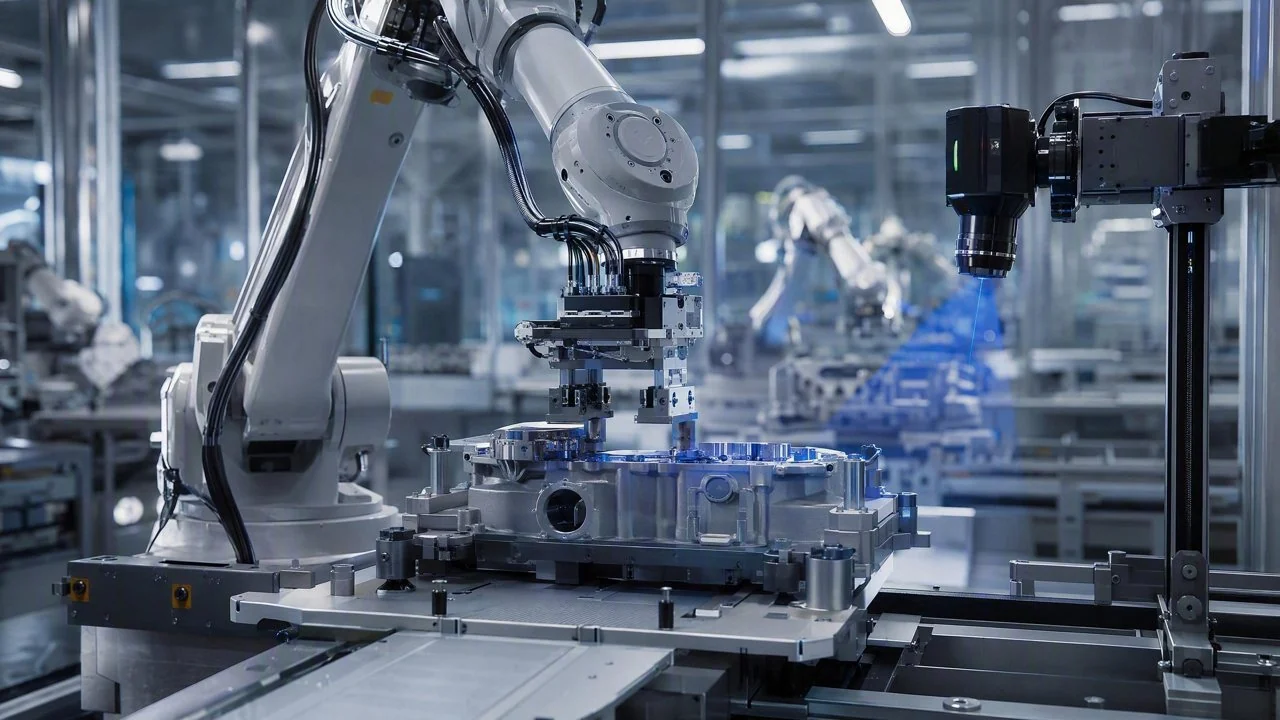
DaoAI 3D Robot Vision system (proprietary 3D camera + 6D pose estimation, bin picking, gluing/assembly/loading guidance, brain-eye-body closed loop, sub-millimeter hand-eye coordination) precisely guides and detects during final assembly, reducing automotive misassembly/missing part rates from an industry average of 0.8% to below 0.12%, significantly improving product quality and production line data security.
In the automotive and parts manufacturing industry, final assembly is a critical stage determining vehicle performance and reliability. Especially for mid-sized automotive manufacturers or Tier-1 suppliers, facing increasingly complex vehicle structures and diverse customization demands, the precision requirements for final assembly are extremely high. Traditional assembly processes often rely on manual inspection or simple 2D vision systems, which are prone to misassembly, missing parts, or incorrect orientation defects in multi-variety, small-batch production. These defects not only directly impact product quality but can also lead to recall risks and damage brand reputation. Concurrently, with the deepening of intelligent manufacturing, production data security and privacy protection have become focal points for enterprises. Particularly when collaborating with third-party suppliers, if core process data and quality data cannot be managed locally, it introduces potential compliance risks and data leakage vulnerabilities.
Pain Points: Why This Hurdle Is Difficult to Overcome
The problem of misassembly and missing parts in automotive final assembly remains challenging for several reasons. Firstly, **high complexity leads to persistent missed detection rates**. For example, an engine assembly might contain hundreds of components; even minor deviations in the position or orientation of small parts like bolts, gaskets, or wire harnesses can easily be missed by human inspectors due to fatigue. The industry average for misassembly/missing parts typically ranges from 0.5%–0.8%. Secondly, **diverse product models result in high false positive rates and low efficiency**. Component differences across various car models and configurations make it difficult for traditional rule-based vision systems to adapt to frequent product changeovers, requiring extensive reprogramming time, leading to increased false positive rates and an increase of over 30% in manual re-inspection hours. Thirdly, **production data security and compliance risks are increasingly prominent**. Many advanced vision inspection solutions rely on cloud-based algorithms or data processing, which is unacceptable for automotive manufacturers highly sensitive to data sovereignty. Any leakage of production data could involve core process secrets, product defect information, or even sensitive supplier chain details, posing significant commercial and legal risks. Finally, **flexible production demands higher 'brain-eye-body' coordination from robots**. In the context of accelerating commercialization of biomimetic humanoid robots, traditional robot vision systems often separate 'eye' and 'body', lacking deep understanding of complex 3D scenes and real-time feedback capabilities. This makes it challenging to handle unstructured bin picking and precise assembly in confined spaces, limiting production takt time.
Specifically, the difficulties in automotive final assembly at the process level include: 1. **Complex component geometries and uneven surface reflections**: Many metal parts have highly reflective or dark areas, making it difficult for traditional 2D vision to acquire stable images. 2. **Extremely high precision requirements for 3D spatial positioning**: For instance, precisely aligning a gearbox with an engine requires sub-millimeter 6D pose estimation. 3. **Unordered bin picking of components**: Components are randomly stacked in bins, requiring robots to accurately identify and pick targets, which is beyond the capability of traditional fixed-trajectory robots. 4. **Dynamic real-time nature of the assembly process**: During robot movement, real-time pose correction is needed to ensure precise insertion or tightening, posing stringent demands on the vision system's response speed and robustness.
Technical Principles
The DaoAI 3D Robot Vision system by WeLinkirt fundamentally solves complex challenges in automotive final assembly through its unique 'proprietary 3D camera + 6D pose estimation' core technology. The system is equipped with WeLinkirt's independently developed high-precision 3D camera, which utilizes structured light or laser triangulation principles to rapidly and accurately acquire 3D point cloud data of the object, reconstructing high-precision 3D morphology. Unlike traditional 2D vision, which only captures planar information, the DaoAI 3D camera can perceive an object's depth, attitude, and spatial position, providing the foundation for subsequent precise analysis. The 6D pose estimation algorithm of WeLinkirt's DaoAI 3D Robot Vision is another core advantage. It integrates deep learning with geometry to accurately identify target objects from complex 3D point cloud data and real-time calculate their XYZ position and rotation around XYZ axes (Roll, Pitch, Yaw) in 3D space—the complete 6 degrees of freedom information. This technology enables robots to 'see' and 'understand' an object's 3D state like human eyes, thereby achieving precise gripping and assembly.
Compared to traditional methods, WeLinkirt's DaoAI 3D Robot Vision offers significant advantages. While **manual inspection** offers some flexibility, it is prone to errors due to fatigue, lighting, and individual differences, leading to high missed detection rates and a lack of precise data recording. **Rule-based 2D vision systems**, though automated, are sensitive to ambient light, object deformation, and background interference, and cannot handle unordered stacking or 3D pose problems, making changeover programming complex and inefficient. **WeLinkirt's DaoAI 3D Robot Vision** overcomes these limitations: its proprietary 3D camera provides stable, high-precision 3D data, and the 6D pose estimation algorithm grants robots '3D vision' and 'spatial understanding'. Coupled with 'brain-eye-body' closed-loop control, it achieves sub-millimeter hand-eye coordination, elevating assembly precision to a new level. Crucially, WeLinkirt offers 100% on-premise private deployment options, with all algorithm models running on the client's local servers, ensuring production data never leaves the factory. This completely addresses automotive manufacturers' concerns about data security, a capability many cloud-dependent similar products cannot match.
Typical Application Scenarios
- **Bin Picking**: In front of automotive final assembly lines, a large number of small parts (e.g., bolts, gaskets, connectors) are often randomly stacked in bins. The WeLinkirt DaoAI 3D Robot Vision system uses its proprietary 3D camera to quickly scan the bin, combined with 6D pose estimation algorithms, to precisely identify and locate target components, guiding the robot for accurate gripping and placement in the specified orientation and location. This solves the challenge of traditional robots being unable to handle unordered materials.
- **Engine/Gearbox Assembly Alignment Guidance**: The alignment of engines and gearboxes requires extremely high precision; any minor deviation can lead to poor sealing or transmission failure. The DaoAI 3D Robot Vision system acquires real-time 3D morphology and relative pose of the engine and gearbox, guiding the robot to precisely adjust to the optimal alignment state, achieving sub-millimeter accurate insertion, ensuring assembly quality.
- **Vehicle Interior/Exterior Trim Assembly Guidance and Error Proofing**: The installation of car doors, dashboards, seats, and other interior/exterior trim involves numerous clips, screws, and wire connections. The WeLinkirt DaoAI 3D Robot Vision system can monitor the assembly process in real-time, checking if components are in place, oriented correctly, and if any fasteners are missing or misassembled, providing timely warnings and guiding the robot for correction, effectively preventing misassembly and missing parts.
- **Chassis Suspension System Component Loading/Unloading**: On the chassis production line, automated loading and unloading of components like suspension arms and steering knuckles require high alignment precision. The DaoAI 3D Robot Vision system can identify features of different component models, guiding the robot to accurately pick and place them into machining or assembly stations, ensuring production takt time and quality.
Case Study
A leading Tier-1 automotive component supplier, whose main business is providing core engine assembly components to several vehicle manufacturers, faced significant challenges. Under their traditional production model, the engine assembly line primarily relied on manual inspection and limited 2D vision assistance. With increasing order volumes and multi-model mixed-line production, the misassembly/missing part rate reached as high as 0.75%, severely impacting product quality and customer satisfaction. Furthermore, given that their products involve core technologies, they had strict requirements for localized storage and processing of production data, rejecting any cloud-based deployment solutions. After extensive evaluation, the manufacturer ultimately chose WeLinkirt's DaoAI 3D Robot Vision system. In the initial phase, the WeLinkirt team conducted a detailed assessment of the existing production line and performed customized model training for their specific complex engine assembly scenarios. Through the WeLinkirt DaoAI 3D Robot Vision system, the manufacturer successfully achieved automated assembly guidance and error-proofing for critical engine assembly components. Before implementation, an average of 15 misassembled or missing-part units per batch (approximately 2000 units) required rework, demanding an additional 2 human-shifts for manual re-inspection and repair. After system deployment, the WeLinkirt DaoAI 3D Robot Vision system consistently controlled the misassembly/missing part rate to below 0.1%, reducing the rework rate by 86.7%, significantly enhancing production efficiency and quality. More importantly, all visual inspection data and models were deployed on the manufacturer's local servers, ensuring absolute data security and fully complying with their stringent internal data management regulations.
"The WeLinkirt DaoAI 3D Vision system not only solved our long-standing misassembly problem but also provided the crucial on-premise private deployment we valued most, keeping our core production data securely in our hands. This is not just a technological upgrade, but a firm guarantee of our data sovereignty."
WeLinkirt Solution and Products
WeLinkirt's DaoAI 3D Robot Vision system is at the core of this solution. The system uses its proprietary high-precision 3D camera as its 'eye' to acquire accurate 3D spatial information; it employs advanced 6D pose estimation algorithms as its 'brain' to interpret object position and orientation in real-time; and through deep integration with industrial robots, it enables precise 'body' movements, forming a 'brain-eye-body' closed-loop control. In this automotive final assembly scenario, the WeLinkirt DaoAI 3D Robot Vision system was implemented as follows: Firstly, **rapid modeling and deployment**: For the client's various assembly models, leveraging few-shot learning (APDT) technology, only a small number of good samples (1-20 images) were needed for model training, achieving 5-minute 0-code quick changeover, significantly shortening the go-live cycle. Secondly, **high-precision real-time guidance**: The system acquires 3D data of the component to be assembled and the target assembly position in real-time, calculates precise 6D pose deviations, and sends commands via industrial Ethernet to guide the robot for sub-millimeter accurate alignment and assembly. Finally, **100% on-premise private deployment**: WeLinkirt's DaoAI 3D Robot Vision system supports various deployment methods such as SDK/API/Docker, ensuring all models, data, and computing power can run on the client's local servers, achieving data localization and fully meeting the client's stringent requirements for data security and compliance. Additionally, WeLinkirt's DaoAI ACI (AI-AOI) software system and DaoAI World world model serve as a unified foundation, providing the 3D vision system with powerful semantic understanding, cross-scenario generalization, and continuous learning capabilities, further enhancing the system's intelligence and robustness.
Through WeLinkirt's DaoAI 3D Robot Vision system, the client not only achieved significant technological improvements but also realized profound business value. In terms of data security, 100% on-premise private deployment completely eliminated data leakage risks, enhancing the enterprise's core competitiveness. For quality control, the system reduced misassembly/missing part rates by over 85%, significantly improving product quality and customer satisfaction. Regarding production efficiency, automated assembly guidance reduced reliance on manual re-inspection, decreased rework hours, and improved overall production takt time. Furthermore, the system's rapid changeover capability enabled the client to more flexibly respond to multi-variety, small-batch production models, enhancing market responsiveness and flexible manufacturing capabilities.
FAQ
What is 6D Pose Estimation and its role in robot vision?
6D pose estimation refers to determining an object's precise position (X, Y, Z coordinates) and orientation (rotation angles around X, Y, Z axes) in 3D space. In robot vision, it enables robots to accurately understand the spatial relationship of a target object relative to themselves, thereby achieving sub-millimeter precise guidance and operation for tasks like bin picking, complex assembly, and gluing. It is a key technology for achieving high-precision flexible automation in robotics.
How does WeLinkirt's DaoAI 3D Robot Vision system ensure data security?
WeLinkirt's DaoAI 3D Robot Vision system offers 100% on-premise private deployment options. This means all visual data acquisition, processing, algorithm model training, and inference are performed on the client's local servers or edge devices. Production data is never uploaded to the cloud or any third-party servers. This deployment model fully complies with stringent industry standards for data sovereignty and privacy protection, ensuring core process data remains within the factory and completely eliminating data leakage risks.
What are the costs and deployment time for WeLinkirt's DaoAI 3D Robot Vision system?
The investment for deploying WeLinkirt's DaoAI 3D Robot Vision system depends on the complexity of the specific application scenario, required hardware configuration (e.g., number of 3D cameras, robot model), and integration difficulty. Typically, the system's go-live cycle ranges from several weeks to several months, with few-shot learning significantly shortening model training time. To obtain an accurate quote and implementation timeline assessment, it is recommended to contact the WeLinkirt expert team directly for on-site survey and requirements analysis.
Full solution for this scenario: Automotive / parts industry solutions · Automotive Assembly Error-Proofing: Robot Vision Reduces Misassembly Rate
This article was generated by AI. Customer cases are simulated scenarios based on real product capabilities and figures are illustrative; see product pages for official benchmarks.