
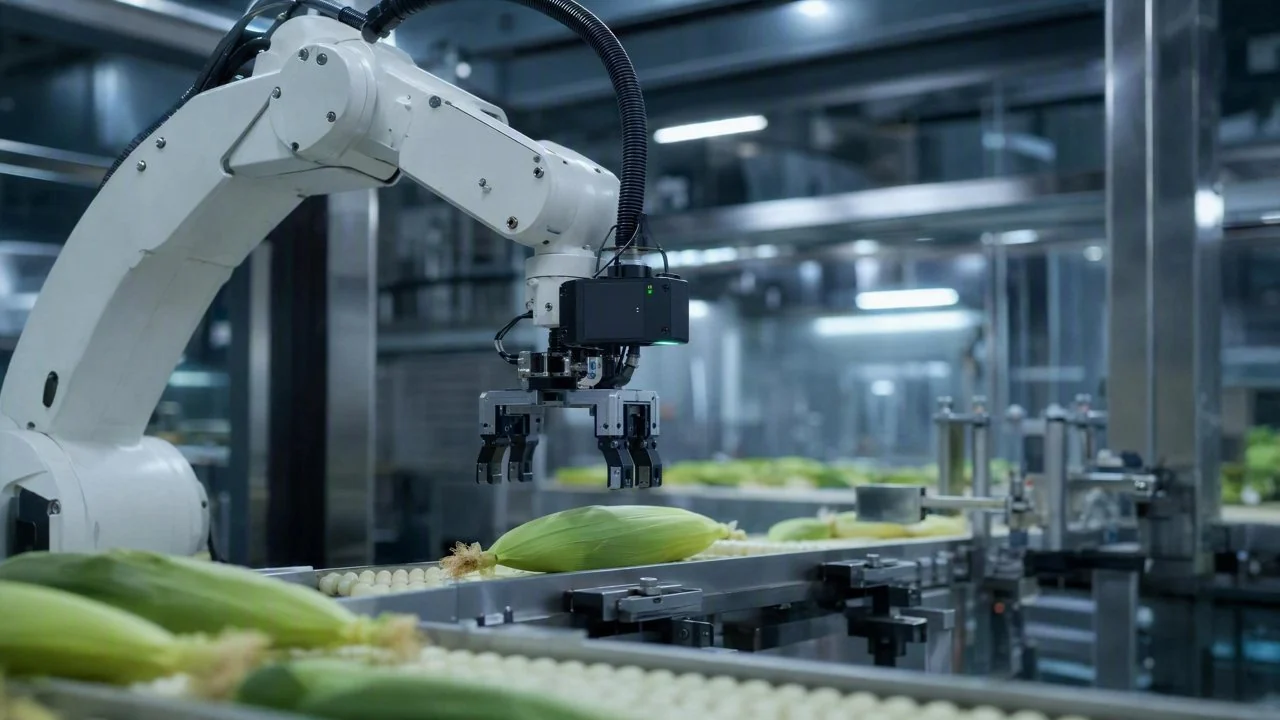
In the agri-food processing industry, WeLinkirt's DaoAI 3D Robot Vision system, powered by APDT few-shot self-training, has reduced foreign object escape rates from 2.5% (due to traditional manual sorting) to below 0.3%. Concurrently, it automates quality grading for various complex-shaped agricultural products, significantly boosting processing efficiency and food safety standards.
In the food and agriculture sectors, every step from farm to table demands stringent product quality and safety. Particularly, the sorting and processing of raw agricultural products often face challenges such as irregular shapes, varying colors, and complex textures. These characteristics make traditional rule-based machine vision difficult to apply, while manual inspection is inefficient and susceptible to subjective factors. Taking a large vegetable processing plant as an example, its primary business involves washing, cutting, packaging, and distributing fresh vegetables. One of the most critical stages is the removal of foreign objects (e.g., stones, soil, insect remnants) and quality grading based on size, shape, color, etc.
Pain Points: Why This Hurdle Was So Difficult
Before adopting an automated solution, this client primarily relied on manual labor for foreign object removal and quality grading, leading to multiple pain points. Firstly, the manual inspection resulted in a foreign object escape rate as high as 2.5%, especially for small foreign objects similar in color to the product. This directly impacted food safety compliance and increased consumer complaint risks. Secondly, manual grading was inefficient, with throughput per hour falling far short of production line demands. Inconsistent application of quality standards among different operators led to poor grading consistency, with product grade misclassification rates reaching 8%. Thirdly, enormous manual re-inspection hours were required, with over 10 workers per shift continuously inspecting, leading to high labor costs. Prolonged repetitive work also caused fatigue, further exacerbating missed detections and misclassifications. Moreover, due to the wide variety of agricultural products and significant appearance differences in the same type of produce across different batches and seasons, traditional rule-based machine vision systems required frequent parameter adjustments or even reprogramming, resulting in long changeover downtime, averaging over 2 hours per changeover, severely impacting production flexibility.
The root cause of these difficulties lies in the inherent complexity of agricultural products. For instance, fresh vegetables have varied surface textures, uneven gloss, and often carry soil or moisture, all of which pose significant challenges for 2D image analysis. Traditional cameras struggle to differentiate depth information, making it easy to confuse foreign objects similar in color and shape to vegetables (e.g., soil-covered roots, small stones). Quality grading, on the other hand, demands precise perception of 3D morphology, such as distinguishing the firmness of cabbage or the depth of potato indentations – capabilities beyond the reach of traditional 2D vision systems. In the current era where embodied AI is transitioning from concept to practical application, overcoming the technical bottleneck of high variability and few-shot scenarios in industrial applications, and achieving a 'brain-eye-body' closed-loop coordination, is a critical challenge. WeLinkirt's DaoAI 3D Robot Vision system is specifically designed to address such challenges.
Technical Principles
WeLinkirt's DaoAI 3D Robot Vision system employs a proprietary high-precision 3D camera capable of acquiring real-time, complete 3D point cloud data of agricultural products, enabling accurate 3D morphology reconstruction. This allows the system to overcome the limitations of traditional 2D vision under varying lighting, surface reflections, and complex shapes, precisely identifying the depth, volume, and true shape of foreign objects, rather than just their 2D projection. The core algorithm is 6D pose estimation, which accurately calculates the target object's position and orientation in space, providing data support for precise robotic arm grasping. Crucially, the DaoAI 3D Robot Vision system integrates APDT (Adaptive Pre-trained Deep-learning Transformer) few-shot self-training capability. Unlike traditional deep learning models that require extensive labeled data, APDT can rapidly learn and generalize recognition of defects or grade differences with only 1-20 good product samples. This is thanks to the semantic understanding and cross-scenario generalization capabilities of WeLinkirt's DaoAI World universal foundation model. It extracts high-level features from a small number of positive samples and continuously optimizes model performance through a feedback loop from the production line, achieving 'brain-eye-body' closed-loop control. This means that when a new product variety or defect type appears on the production line, users, without specialized programming knowledge, can simply provide a few good product samples through simple operations, and the system can complete model self-training and deployment in a short period, reducing changeover time from several hours to under 5 minutes.
Compared to traditional rule-based AOI (Automated Optical Inspection) systems, the advantage of DaoAI 3D Robot Vision lies in its powerful generalization and adaptability. Rule-based AOI requires engineers to spend significant time writing complex feature extraction rules, and it is sensitive to lighting and product pose variations. Once product types or defect types change, rules need to be re-adjusted, leading to extremely high maintenance costs. In contrast, DaoAI's AI model autonomously learns complex features and adapts to subtle changes in lighting, pose, and texture. Its sub-millimeter hand-eye coordination ensures that the robotic arm can precisely execute removal or sorting tasks. Compared to manual inspection, the DaoAI system not only significantly improves detection speed and consistency but also avoids errors caused by fatigue and subjective judgment, achieving 100% full inspection and elevating foreign object removal accuracy to an unprecedented level.
Typical Application Scenarios
- **Root Vegetable Foreign Object Removal:** For root vegetables like potatoes and carrots, foreign objects such as soil, stones, or residual roots are common contaminants. WeLinkirt's DaoAI 3D Vision system, through 3D morphology reconstruction, can precisely differentiate soil clumps and stones from the vegetables themselves, even if similar in color and shape, guiding robotic arms for accurate removal. The challenge lies in distinguishing surface-adhering soil from the product's natural indentations and textures.
- **Leafy Green Quality Grading:** For leafy greens such as cabbage and lettuce, grading is required based on leaf integrity, pest damage, size, and firmness. DaoAI 3D Vision analyzes point cloud data to detect leaf edge defects and calculate overall volume and density for fine-grained grading. The difficulty arises from complex leaf structures and susceptibility to compression deformation.
- **Fruit Defect Detection:** For fruits like apples and tomatoes, detecting surface abrasions, scars, mold spots, and insect bites. DaoAI 3D Vision captures micro-level surface morphological changes, distinguishing natural textures from defects. The challenges include diverse defect characteristics, varying sizes, and strong surface reflections.
- **Grain and Seed Purity Inspection and Sorting:** In grain processing, DaoAI 3D Vision can be used to detect and precisely sort out weed seeds, diseased grains, immature grains, and other impurities mixed in with the main crop. The difficulty lies in the small size, vast quantity, and subtle features of the target objects, making high efficiency and purity challenging for traditional methods.
- **Aquatic Product Shape and Size Grading:** For aquatic products like fish and shrimp, automated grading is performed based on shape, size, and integrity. DaoAI 3D Vision accurately measures the three-dimensional dimensions of irregularly shaped aquatic products and identifies breakages or deformities. Challenges include slippery, reflective surfaces and diverse forms of aquatic products.
Case Study
A leading agri-food processing enterprise, whose main business involves the pre-processing and packaging of various fresh vegetables, faced significant bottlenecks in foreign object escape rates and quality grading efficiency before integrating WeLinkirt's DaoAI 3D Robot Vision system. To address these issues, the client adopted the DaoAI 3D Robot Vision solution. In the initial deployment phase, the DaoAI engineering team leveraged the APDT few-shot self-training capability. By collecting only 15 good vegetable samples and combining them with annotations of a few anomalous samples, they rapidly completed model training and deployment. The system was integrated into a high-speed conveyor belt, working with multiple robotic arms for real-time grasping and sorting. Post-deployment, the DaoAI 3D Vision system significantly improved the detection accuracy of foreign objects like stones and insect remnants, reducing the foreign object escape rate from 2.5% before deployment to below 0.3%. Concurrently, for quality grading based on size, shape, and color, the system achieved a consistency of over 99%, far exceeding the 92% of manual grading.
WeLinkirt's DaoAI 3D Robot Vision system, with its APDT few-shot self-training capability, reduced agricultural product foreign object escape rates by 88% and boosted quality grading consistency to over 99%, achieving a leap in food safety.
WeLinkirt Solutions and Products
WeLinkirt's DaoAI 3D Robot Vision system is at the core of this solution. It utilizes a proprietary high-precision 3D camera to acquire high-density point cloud data, combined with advanced 6D pose estimation algorithms, to provide robotic arms with precise spatial positioning information. In terms of modeling and changeover, DaoAI's APDT few-shot self-training technology is a unique advantage. Users do not need specialized AI knowledge; they only need to provide a very small number (1-20) of good product samples, and the system can complete model training for new products or defect types within 5 minutes, significantly shortening changeover downtime and enhancing production line flexibility. For deployment, DaoAI supports various integration methods such as SDK/API/Docker and allows for 100% local private deployment, ensuring customer data security. In addition to core 3D robot vision capabilities, this solution can also be combined with WeLinkirt's DaoAI ACI (AI-AOI) software system to leverage its visual foundation model's feature recognition capabilities for further optimization of complex defect identification. It can also link with the SkyVision 0-code video surveillance AI platform to achieve intelligent monitoring of the entire production line environment, forming a multi-dimensional, comprehensive intelligent quality inspection system. WeLinkirt's DaoAI World universal foundation model ensures coordination between all modules and continuously improves system performance through production line feedback.
Through the described solution, the client not only significantly improved the accuracy of foreign object removal and the consistency of quality grading but also substantially reduced reliance on manual labor, decreasing manual re-inspection hours by 75% and directly saving significant labor costs. Concurrently, with changeover times drastically reduced to under 5 minutes, overall production line efficiency increased by over 20%. WeLinkirt's DaoAI 3D Robot Vision system not only resolved the client's immediate quality and efficiency challenges but also, through its APDT few-shot self-training capability, provided robust technical support for the agri-food processing industry to tackle high variability, multi-variety, small-batch production challenges. This has driven the deep implementation of embodied AI in the industrial sector, achieving a comprehensive upgrade from 'brain-eye-body' coordination to business model innovation.
FAQ
How does DaoAI 3D Robot Vision's APDT few-shot self-training technology specifically work?
APDT (Adaptive Pre-trained Deep-learning Transformer) is one of the core technologies of WeLinkirt's DaoAI 3D Robot Vision. It leverages pre-trained deep learning models and a Transformer architecture to learn the normal features of products from a small number (1-20) of good samples. When an object that deviates from these features is detected, the system flags it as a potential defect or foreign object. Through continuous learning and production line feedback, the model constantly optimizes, adapting to new products and defect types without requiring extensive labeled data, significantly lowering the barrier and time for AI model training.
What are the advantages of DaoAI 3D Robot Vision over traditional 2D machine vision solutions for foreign object removal and grading in agricultural products?
The biggest advantage of DaoAI 3D Robot Vision is its ability to acquire and process three-dimensional spatial information. Traditional 2D vision often leads to misjudgments or missed detections when dealing with irregularly shaped agricultural products, surface reflections, varying lighting, and foreign objects similar in color to the product. DaoAI's proprietary 3D camera precisely reconstructs the object's 3D morphology, differentiating depth and volume, thus more accurately identifying foreign objects and enabling fine-grained grading. Furthermore, combined with 6D pose estimation and sub-millimeter hand-eye coordination, robotic arms can grasp and handle targets with greater precision, an unparalleled capability for 2D vision solutions.
What is the cost of deploying WeLinkirt's DaoAI 3D Robot Vision system, and what is the typical payback period?
The deployment cost of the DaoAI 3D Robot Vision system is influenced by various factors, including production line scale, number of robotic arms required, detection precision demands, and whether customized integration is needed. We do not provide fixed quotes but offer detailed customized solutions and quotations based on specific client requirements. Typically, by significantly reducing escape rates, improving product quality, decreasing labor costs, and enhancing production line efficiency, clients usually achieve a return on investment within 12-24 months. We recommend contacting our sales team to schedule a free production line assessment for a more accurate cost estimate and ROI analysis.
Full solution for this scenario: Food / agriculture industry solutions · Fresh Food Foreign-Object Removal & Grading
This article was generated by AI. Customer cases are simulated scenarios based on real product capabilities and figures are illustrative; see product pages for official benchmarks.