
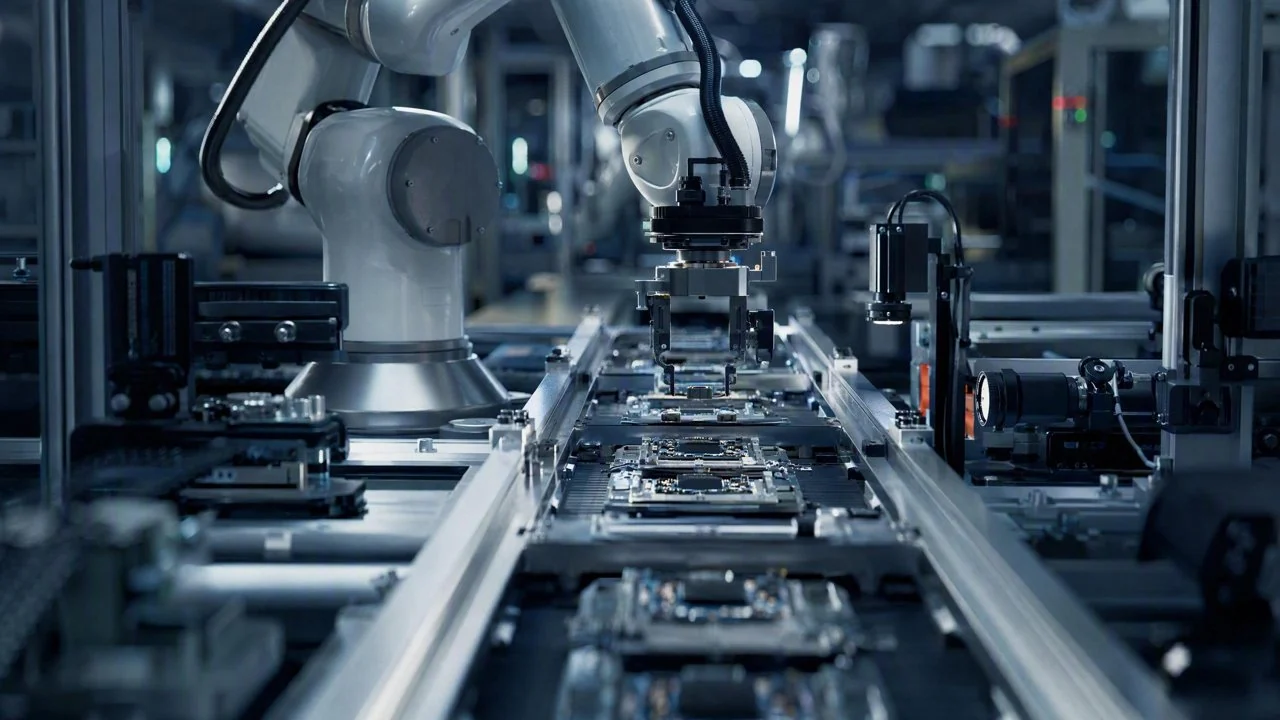
DaoAI 3D Robot Vision (proprietary 3D camera + 6D pose estimation, bin picking, guidance for gluing/assembly/loading/unloading, brain-eye-body closed loop, sub-millimeter hand-eye coordination) effectively addresses the frequent retooling and high labor costs associated with missing and incorrect assembly in high-mix, low-volume consumer goods production. Its unique "zero-code rapid retooling" capability successfully reduces production line changeover time from an average of 4 hours to less than 5 minutes.
The consumer goods industry, particularly in areas like small electronic products, home appliance accessories, and personal care items, is increasingly facing market demands for personalization, customization, and rapid iteration. This has led to a typical high-mix, low-volume production model. In this model, product types are numerous, and life cycles are short, placing extremely high demands on production line flexibility and changeover efficiency. In the assembly process, due to increasingly complex product structures and a wide variety of components, manual visual inspection is highly prone to defects such as missing, incorrect, or excessive assembly. For instance, a renowned consumer electronics manufacturer's assembly of internal components for earbud charging cases involves the precise placement of multiple miniature screws, sensor modules, and connectors. Traditional manual inspection is not only inefficient but also susceptible to misjudgment due to fatigue. DaoAI 3D Robot Vision from WeLinkirt, by combining its proprietary 3D camera with advanced 6D pose estimation technology, can achieve high-precision detection of these complex assemblies, ensuring every component is accurately in place as designed.
Pain Points: Why Is This Hurdle So Difficult to Overcome?
In the high-mix, low-volume production model of consumer goods, assembly defect detection faces multiple challenges: First, prolonged retooling downtime. Traditional rule-based 2D vision systems or manual inspection require several hours or even half a day of downtime for program adjustments, template switching, and manual training when frequently switching between different product models. This leads to low production efficiency, with annual losses due to retooling amounting to millions. Second, high rates of missed detections and false positives. The presence of complex 3D structures and similar components makes it difficult for 2D vision to distinguish between genuinely missing parts and normal parts that are merely obscured, resulting in a missed detection rate of 3-5%; meanwhile, factors such as ambient light changes and product surface reflections cause false positive rates to fluctuate between 8-15%, adding significant manual re-inspection workload. Third, high labor costs and skill dependency. Heavy reliance on experienced inspection workers incurs high recruitment and training costs, and the stability and consistency of manual inspection are difficult to guarantee. Against the backdrop of continuously rising labor costs, the pressure on this model is increasing. These pain points, especially with the accelerating market application of humanoid robots, highlight the urgency and necessity of automated, intelligent detection solutions, where leading enterprises need to build core competencies to seize market share.
The root causes of these difficulties are: at the process level, consumer product assembly often involves multi-layered, multi-angle component stacking, and 2D images cannot provide depth information, making it difficult to judge whether components are fully in place or obscured by underlying components. At the imaging level, diverse product surface materials, such as highly reflective plastics and matte metals, can cause glare or texture loss, affecting feature extraction by traditional vision algorithms. At the cycle time level, consumer goods production lines typically require high throughput, leaving very short time windows for detection. Traditional manual inspection or complex rule-based vision algorithms struggle to complete high-precision judgments within such short periods. For example, detecting whether a battery compartment cover inside a small remote control is properly installed – the tiny deformation of its latch is hard to discern in a 2D image but affects product functionality. WeLinkirt's DaoAI 3D Robot Vision precisely offers innovative solutions to these deep-seated technical challenges.
Technical Principles
WeLinkirt's DaoAI 3D Robot Vision system fundamentally solves the problems of missing 3D information and flexible adaptability in consumer product assembly detection through its core proprietary 3D camera and 6D pose estimation algorithm. The proprietary 3D camera utilizes high-precision structured light or laser triangulation principles to rapidly acquire complete 3D point cloud data of the measured object, reconstructing 3D morphology with sub-millimeter accuracy. This enables the system to accurately identify the shape, size, height, and relative position of components, clearly capturing even tiny protrusions, depressions, or deformations. For example, for a misassembled connector, its tilt angle in 3D space or the depth of incomplete insertion can be precisely quantified by the DaoAI 3D Vision system.
Compared to traditional rule-based 2D AOI or manual inspection, WeLinkirt's DaoAI 3D Vision offers several advantages: First, it provides true 3D depth information, eliminating misjudgments caused by lighting, shadows, and product surface reflections, reducing the false positive rate by over 85%. Second, through deep learning-driven 6D pose estimation, the system can learn and identify assembly features of different product models, achieving "zero-code rapid retooling." Users only need to provide a small amount of good sample data for training, and the system can automatically adapt to new product models, shortening changeover time from hours to less than 5 minutes. This significantly enhances production line flexibility. Furthermore, DaoAI 3D Robot Vision integrates a brain-eye-body closed-loop control, allowing it to instantly guide robotic arms for correction or rejection when defects are detected, achieving automated high-precision operations and reducing assembly missed detection rates to <0.5%.
Typical Application Scenarios
- **Internal Component Assembly Inspection for Electronic Products**: Such as miniature screws, FPC cables, sensor modules, battery covers inside smartphones, tablets, headphones, etc., checking for correct installation, absence of omissions, and precise positioning. The challenge lies in small component sizes, dense arrangement, susceptibility to occlusion, and diverse surface materials.
- **External Casing and Panel Assembly Integrity for Home Appliances**: Inspecting buttons, knobs, displays, decorative strips on washing machine, refrigerator, air conditioner panels for proper installation, misalignment, or damage. The challenge is numerous curved surfaces, strong reflections, and defects that may appear as tiny gaps or deformations.
- **Completeness of Internal Items in Daily Product Packaging Boxes**: For example, whether all individual items are present and arranged according to specifications in cosmetic kits or food gift boxes. The challenge is a wide variety of products, complex internal structures of packaging boxes, and the need for rapid judgment of the presence or absence of multiple items.
- **Assembly Consistency of Toys or Small Mechanical Parts**: Inspecting whether gears, bearings, connectors, etc., are correctly assembled according to drawings, without missing or misaligned parts. The challenge is small fit tolerances between components, where subtle assembly deviations can affect final functionality.
Case Study
A leading consumer electronics manufacturer, specializing in various smart wearable devices, faced significant challenges on its assembly line for the smart watch casing and mainboard connection components. Due to rapid product iteration and a high number of SKUs, traditional manual visual inspection and rule-based 2D vision systems could no longer meet production demands. Each time a new product was launched or an existing product underwent minor adjustments, retooling and adjustment time averaged 4-6 hours, severely slowing down the production rhythm. Furthermore, due to the miniaturization of connectors and diverse assembly angles, manual inspection had a missed detection rate as high as 2.5%, leading to high post-production rework costs, exceeding 200,000 RMB per month due to rework. This client urgently needed an automated solution capable of rapidly adapting to multi-variety production and high-precision detection of assembly defects. The introduction of WeLinkirt's DaoAI 3D Robot Vision solution completely transformed the situation. By deploying multiple DaoAI 3D Vision systems in conjunction with robotic arms for loading, unloading, and inspection, 100% online inspection of smart watch connection components was achieved.
The 'zero-code rapid retooling' capability of WeLinkirt's DaoAI 3D Vision has truly made our production line flexible, allowing us to calmly respond to market changes.
WeLinkirt Solution and Products
The DaoAI 3D Robot Vision solution provided by WeLinkirt to this client is centered on its proprietary 3D camera combined with powerful 6D pose estimation and transfer learning capabilities. We first deployed high-resolution DaoAI 3D cameras on the production line to acquire 3D point cloud data for each smart watch connection component. Through the DaoAI platform, engineers only needed to upload a small number of 3D point cloud models of good products, and the system could complete feature learning and model building for new products within minutes, truly achieving "zero-code" rapid retooling. When an assembly defect (such as an incompletely inserted connector or a missing screw) was detected, the DaoAI 3D Vision system would immediately output the defect type and precise 6D spatial coordinates, guiding the collaborating robotic arm for accurate corrective grasping or defective product sorting. Furthermore, WeLinkirt's DaoAI World model serves as a unified foundation, ensuring the system can continuously learn from production line feedback, constantly optimizing detection accuracy and generalization capabilities. The entire deployment process was integrated with existing production management systems via SDK/API/Docker interfaces and supports 100% local private deployment, ensuring customer data security and the independence of production line operations.
By introducing WeLinkirt's DaoAI 3D Robot Vision solution, the client's production line achieved significant improvements: product changeover time was reduced from an average of 4 hours to less than 3 minutes, an efficiency increase of over 98%. The missed detection rate for assembly defects decreased from 2.5% to <0.3%, and the false positive rate was reduced by over 90%, greatly reducing manual re-inspection workload and rework costs. After the solution went live, monthly losses due to rework decreased by nearly 95%, significantly enhancing product quality and customer satisfaction. This fully demonstrates the immense value of DaoAI 3D Robot Vision in improving production flexibility and reducing operating costs in high-mix, low-volume consumer goods production.
FAQ
How exactly does DaoAI 3D Robot Vision achieve “zero-code rapid retooling”?
WeLinkirt's DaoAI 3D Robot Vision achieves this through deep learning and transfer learning technologies, combined with 3D data collected by its proprietary 3D camera. Users only need to upload a small number of 3D point cloud models of good products via the system interface, or guide the robot to grasp good products a few times. The system then automatically learns and recognizes the assembly features of new products. This eliminates the need for manual writing of complex detection rules or parameter adjustments, greatly simplifying the retooling process and reducing traditional hours of changeover time to minutes.
What is the core difference between DaoAI 3D Vision system and traditional 2D AOI for detecting assembly defects?
The core advantage of DaoAI 3D Vision lies in acquiring and processing 3D depth information, enabling accurate identification of component height, shape, and spatial position, precisely determining even in the presence of occlusion or minor deformations. Traditional 2D AOI, however, relies solely on planar images, making it susceptible to light, shadow, reflection, and occlusion, struggling to distinguish between real defects and visual artifacts. Therefore, DaoAI 3D Vision significantly reduces missed detection and false positive rates, especially suitable for assembly inspection of complex 3D structures.
What is the typical cost structure and ROI period for deploying WeLinkirt's DaoAI 3D Robot Vision solution?
The cost of DaoAI 3D Robot Vision solutions primarily includes hardware (3D cameras, robots, industrial PCs, etc.), software licensing fees, and implementation service fees. Specific costs are customized based on factors such as production line scale, detection complexity, and required precision. The return on investment period is typically short, as the solution significantly reduces labor costs, rework rates, improves production efficiency, and product quality. By reducing downtime and defect losses, ROI is usually achieved within 6-18 months. We recommend contacting our expert team for a detailed evaluation and quotation.
Full solution for this scenario: the full inspection solution for Consumer / general · Assembly Missing-Part & Misassembly Detection
This article was generated by AI. Customer cases are simulated scenarios based on real product capabilities and figures are illustrative; see product pages for official benchmarks.