
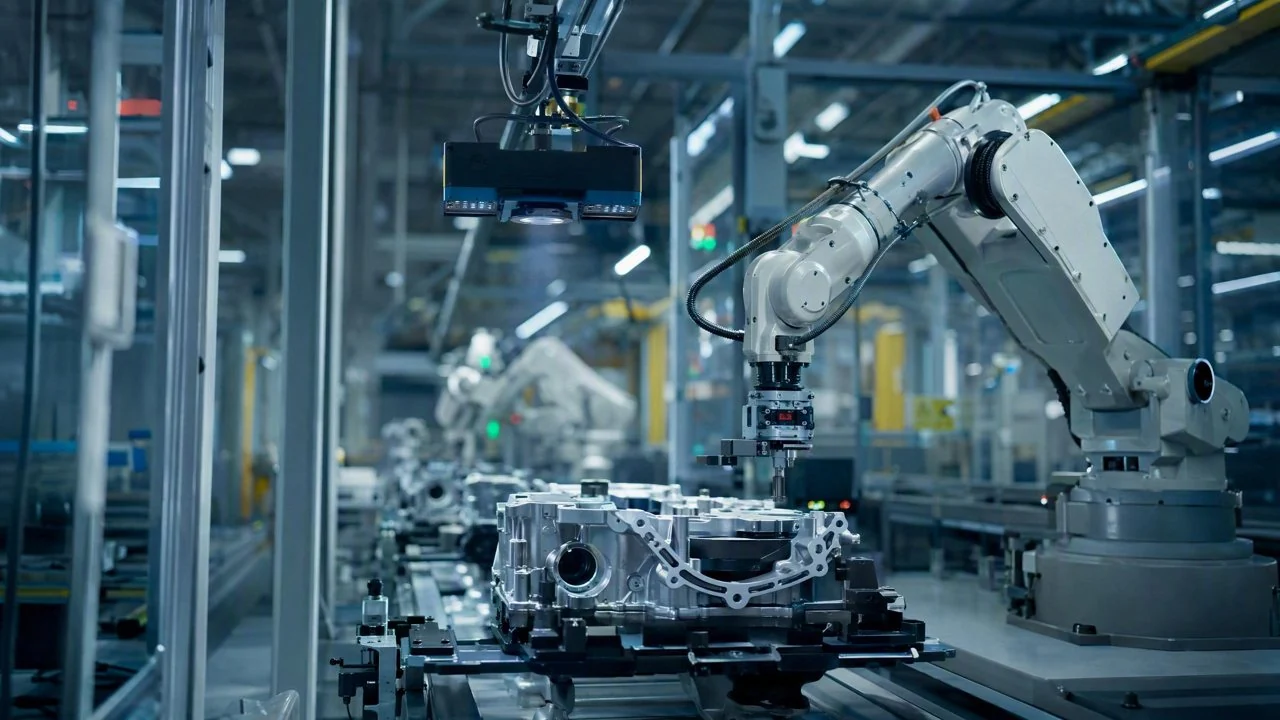
DaoAI 3D Robot Vision (proprietary 3D camera + 6D pose estimation, bin picking, glue/assembly/load/unload guidance, brain-eye-body closed-loop, sub-millimeter hand-eye coordination) significantly reduces false alarm rates for automotive assembly error detection by over 80% through high-precision 3D data acquisition and intelligent defect recognition, substantially improving inspection efficiency and production line benefits.
In the automotive / parts industry, sub-assembly is a critical step in ensuring vehicle performance and safety. As automotive intelligence and electrification accelerate, the complexity and integration of sub-assemblies, such as engine assemblies, transmission assemblies, and battery pack assemblies, are increasing, often containing hundreds or even thousands of internal components. Any subtle error in assembly, such as missing, incorrect, reversed, or extra parts, can lead to serious quality issues and even safety hazards. Traditionally, inspection of these critical processes heavily relies on manual visual inspection or rule-based 2D vision systems. However, when faced with challenges such as high cycle times, multi-variety production, and complex structures, the limitations of these traditional solutions are becoming increasingly apparent, especially with persistently high false alarm rates, which place significant re-inspection pressure and resource waste on production lines.
Pain Points: Why This Hurdle Is Difficult to Overcome
Automotive sub-assembly error detection faces multiple challenges. Firstly, product complexity is high, with a wide variety of components of varying sizes, and many critical features are hidden within structures or obscured, making it difficult for 2D vision to acquire complete information. Secondly, production cycle times are fast, typically requiring several or even dozens of assemblies per minute, leaving extremely short windows for inspection. Thirdly, the environment is complex, with uneven lighting, reflections, and vibrations often interfering with the stability of traditional vision systems. These factors combined lead to traditional solutions having false alarm rates often as high as 15%−25%, or even higher, when identifying subtle defects. High false alarm rates mean a large number of 'false positive' alerts, forcing production lines to invest significant human resources in re-inspection and verification. According to statistics, a production line at a leading Tier-1 supplier could spend 4-6 person-hours per day on re-inspection, severely hindering production efficiency and increasing operational costs. Furthermore, frequent false alarms also reduce operator trust in the inspection system, potentially leading to a decrease in vigilance for true defects, thereby increasing the risk of missed detections. In the current trend of deploying humanoid robots in brownfield factories, if false alarm rates cannot be effectively reduced, even the introduction of robots for inspection or re-inspection may lead to reduced overall efficiency due to frequent ineffective actions, and even require additional adaptive modifications to handle anomalies caused by false alarms.
The root cause of high false alarms lies in the inability of traditional solutions to accurately acquire 3D spatial information and make intelligent decisions. Rule-based AOI systems are sensitive to lighting, position, and angle variations, and even slight deviations can lead to misjudgments; manual visual inspection is limited by human eye fatigue, subjective judgment, and low efficiency. For issues such as whether bolts are tightened, gaskets are properly installed, or wire harnesses are securely plugged in during assembly, it is difficult to determine their depth, height, and spatial relationships based solely on 2D images. For example, a bolt might appear installed in a 2D image, but in reality, it could be floating or not fully tightened, which requires precise 3D data for verification. DaoAI 3D Robot Vision from WeLinkirt (DaoAI) addresses these deep-seated pain points with a revolutionary solution.
Technical Principles
The DaoAI 3D Robot Vision system from WeLinkirt (DaoAI) utilizes proprietary high-precision 3D cameras, combined with advanced structured light or laser triangulation principles, to acquire complete 3D point cloud data of the inspected object in real time. This point cloud data includes the X, Y, Z coordinates and intensity information of each point, forming a precise 3D morphology of the inspected part. Unlike traditional 2D vision which relies solely on grayscale or color images, DaoAI's 3D data provides depth information, effectively overcoming interference from lighting variations, reflections, shadows, and differences in part color or material. After acquiring 3D data, the system's core 6D pose estimation algorithm plays a crucial role. This algorithm, based on deep learning and geometric matching, accurately calculates the target object's position (X, Y, Z) and orientation (Rx, Ry, Rz) in 3D space, achieving sub-millimeter precision. This means that even with slight positional or angular deviations of parts, the system can accurately identify and compare them. The 'brain-eye-body closed-loop' capability of WeLinkirt (DaoAI) Robot Vision deeply integrates the 3D vision system (eye) with the robotic arm (body), guiding the robotic arm for grasping, assembly, or inspection in real time through intelligent algorithms (brain), ensuring high precision and stability. For instance, when checking if a bolt is floating, the system compares the actual point cloud data with a standard 3D model, and any height deviation exceeding the tolerance range is precisely identified, thereby reducing the false alarm rate to <0.5%.
Compared to traditional rule-based AOI systems, the advantage of WeLinkirt's DaoAI 3D Robot Vision lies in its powerful generalization capabilities and adaptability to complex scenarios. Rule-based AOI requires engineers to manually write numerous rules to cope with various defects and environmental changes, which is time-consuming, labor-intensive, and costly to maintain. Once new defect types or product changeovers occur, the rule library needs significant modification. In contrast, DaoAI 3D Robot Vision is based on deep learning models and utilizes APDT few-shot learning technology, requiring only 1–20 good samples to quickly train high-performance models, significantly shortening deployment and changeover times. Furthermore, its semantic false alarm filtering function effectively distinguishes true defects from background noise, further reducing false alarms. Compared to manual visual inspection, DaoAI 3D Robot Vision is not only more efficient and consistent but also capable of detecting minute defects imperceptible to the human eye, while completely eliminating the uncertainty caused by subjective human judgment, increasing detection efficiency by several times and reducing manual re-inspection volume by over 75%.
Typical Application Scenarios
- **Bolt/Nut Missing, Misplaced, and Floating Detection:** The installation of numerous bolts and nuts is crucial in engine, transmission, and other assemblies. DaoAI 3D Robot Vision scans the 3D morphology of bolt heads to precisely determine if bolts are installed, fully tightened (floating), and if there are abnormalities like stripped threads or fractures. The challenge lies in the wide variety of bolts and some being located in confined spaces, making 2D difficult to distinguish.
- **Gasket/Seal Ring Installation Position Detection:** Ensuring gaskets or seal rings are installed on the correct plane, position, and height is key to preventing oil leaks, air leaks, etc. The system uses 3D point cloud comparison to detect if gaskets are missing, displaced, flipped, or not properly compressed, with micron-level precision. The challenge is that gaskets are often monochromatic, have low contrast with the background, and are easily deformable.
- **Wire Harness Insertion and Clip Engagement Detection:** Correct insertion of automotive wire harnesses and full closure of clips ensure the reliability of electrical systems. DaoAI 3D Robot Vision can identify if connectors are fully inserted, terminals are in place, clips are closed, and even if the wire harness routing is correct. The challenge is that wire harnesses come in various colors and are often complexly routed, with potential obstructions.
- **Part Reversed/Extra/Missing Detection for Complex Structures:** For parts with similar shapes but different functions, reversed, extra, or missing installations are common. The system quickly identifies these assembly errors by precise comparison with standard 3D models, such as the orientation of bearing caps or the installation position of gears. The challenge lies in high geometric feature similarity, making 2D difficult to differentiate.
- **Assembly Gap and Coplanarity Detection for Complex Structural Parts:** In the assembly of large components like car doors and dashboards, uniform gaps between parts and surface coplanarity directly affect product appearance and function. DaoAI 3D Robot Vision can measure these gaps and planarity with high precision, ensuring assembly quality. The challenge is the large measurement range and high precision requirements.
Case Study
A leading domestic new energy vehicle Tier-1 supplier faced long-standing high false alarm rates on its battery pack assembly line. This line is responsible for integrating battery modules with cooling systems, BMS control units, high-voltage wire harnesses, and other critical components. Traditional 2D vision systems, when inspecting wire harness insertion, clip engagement, and cooling pipe connections, suffered from false alarm rates as high as 18% due to issues like reflections, shadows, and similar component colors. This necessitated an additional 5-6 workers daily for re-inspection, severely impacting production cycle times and staffing. To address this pain point, the supplier introduced the DaoAI 3D Robot Vision system from WeLinkirt for upgrade and transformation. In the initial phase of the project, the WeLinkirt team conducted an on-site survey and deployed multiple sets of proprietary 3D cameras, customized for the complex structure and high cycle time requirements of battery pack assemblies, integrating them with robotic arms for collaborative inspection. During system deployment, using APDT few-shot learning, model training and deployment were completed within a week, and the system was seamlessly integrated with the production line's MES system, enabling real-time upload and traceability of inspection data. After deployment, at the supplier's site, the DaoAI 3D Robot Vision system successfully reduced the false alarm rate for this process to <0.4%, significantly lower than the industry average. This directly led to a substantial reduction in manual re-inspection, saving approximately 4.5 person-hours per day in re-inspection labor, equivalent to nearly a million RMB in annual labor costs. Concurrently, due to the reduced false alarm rate, production line inspection efficiency increased by 20%, production cycle times were ensured, and overall OEE (Overall Equipment Effectiveness) improved by over 5%. The client highly praised the stability and high precision of WeLinkirt's DaoAI 3D Robot Vision and plans to extend this solution to other sub-assembly lines.
WeLinkirt's DaoAI 3D Robot Vision, with its exceptional false alarm reduction capabilities, truly brings a dual leap in efficiency and quality to automotive sub-assembly lines.
WeLinkirt Solutions and Products
WeLinkirt's DaoAI 3D Robot Vision solution delivers significant value to customers through its core technologies. For modeling, we utilize proprietary 3D cameras to acquire high-precision 3D point cloud data, and then leverage the DaoAI World Model for unified semantic understanding and cross-scenario generalization. Combined with APDT positive/few-shot learning technology, customers only need to provide a small number of good samples (1–20 images) to complete model training in 5 minutes, achieving 0-code automated programming. For the complexity of automotive sub-assembly, the 6D pose estimation capability of WeLinkirt's DaoAI 3D Robot Vision ensures that robotic arms can achieve sub-millimeter hand-eye coordination accuracy when performing guidance tasks such as gluing, assembly, and loading/unloading. Furthermore, our system supports 100% local private deployment, offering various integration methods like SDK / API / Docker to ensure customer data remains on-site, meeting strict data security and compliance requirements. In addition to the core 3D robot vision, WeLinkirt's DaoAI AI AOI software system also provides powerful vision foundation models that can further enhance defect recognition accuracy and reduce false alarm rates to a minimum through semantic false alarm filtering. The SkyVision 0-code video surveillance AI platform can be used for macroscopic monitoring and anomaly early warning across the production line, forming a multi-layered intelligent inspection network.
Through the deployment of WeLinkirt's DaoAI 3D Robot Vision, customers have achieved multiple quantifiable results. In terms of quality, the false alarm rate for assembly errors has been reduced by over 80%, and the missed detection rate has been suppressed to <0.3%, ensuring product quality stability. In terms of efficiency, due to reduced false alarms, manual re-inspection volume has decreased by 75%, significantly easing the re-inspection burden on operators and increasing overall inspection efficiency by 20%. Additionally, the system's rapid changeover capability shortens downtime to within 5min, greatly enhancing production line flexibility and efficiency. These improvements not only reduce operational costs but also enhance customer competitiveness in the market, bringing sustainable business value to enterprises.
FAQ
What is the fundamental difference between DaoAI 3D Robot Vision system and traditional 2D vision inspection?
DaoAI 3D Robot Vision system acquires complete 3D point cloud data, including depth information, via proprietary 3D cameras, overcoming interference from lighting, reflections, shadows, and color/material variations. Traditional 2D vision relies solely on planar images, struggling to accurately determine object spatial position and morphology. The 3D system can detect defects like floating parts, gaps, and coplanarity that 2D cannot, significantly enhancing inspection precision and robustness.
How long does it take to deploy DaoAI 3D Robot Vision system, and how extensive are the modifications to existing production lines?
Deployment of WeLinkirt's DaoAI 3D Robot Vision system is typically short, often completed within a few weeks. With APDT few-shot learning technology, model training can be done in 5 minutes, significantly reducing overall go-live time. The system supports various integration methods like SDK/API/Docker, seamlessly connecting with existing MES/SCADA systems, and requires minimal hardware modification to the production line, mainly focusing on the installation and calibration of 3D cameras and robotic arms.
What is the cost investment for DaoAI 3D Robot Vision system, and what is the typical ROI period?
The cost investment for DaoAI 3D Robot Vision system varies depending on the specific application scenario, required inspection precision, and integration complexity. However, by significantly reducing false alarm rates, decreasing manual re-inspection, and improving production efficiency and product quality, the system typically achieves a return on investment within 6-18 months. We recommend scheduling an expert consultation to receive a customized solution and detailed quotation based on your specific needs, allowing for the most accurate ROI assessment.
Full solution for this scenario: the full inspection solution for Automotive / parts
This article was generated by AI. Customer cases are simulated scenarios based on real product capabilities and figures are illustrative; see product pages for official benchmarks.