
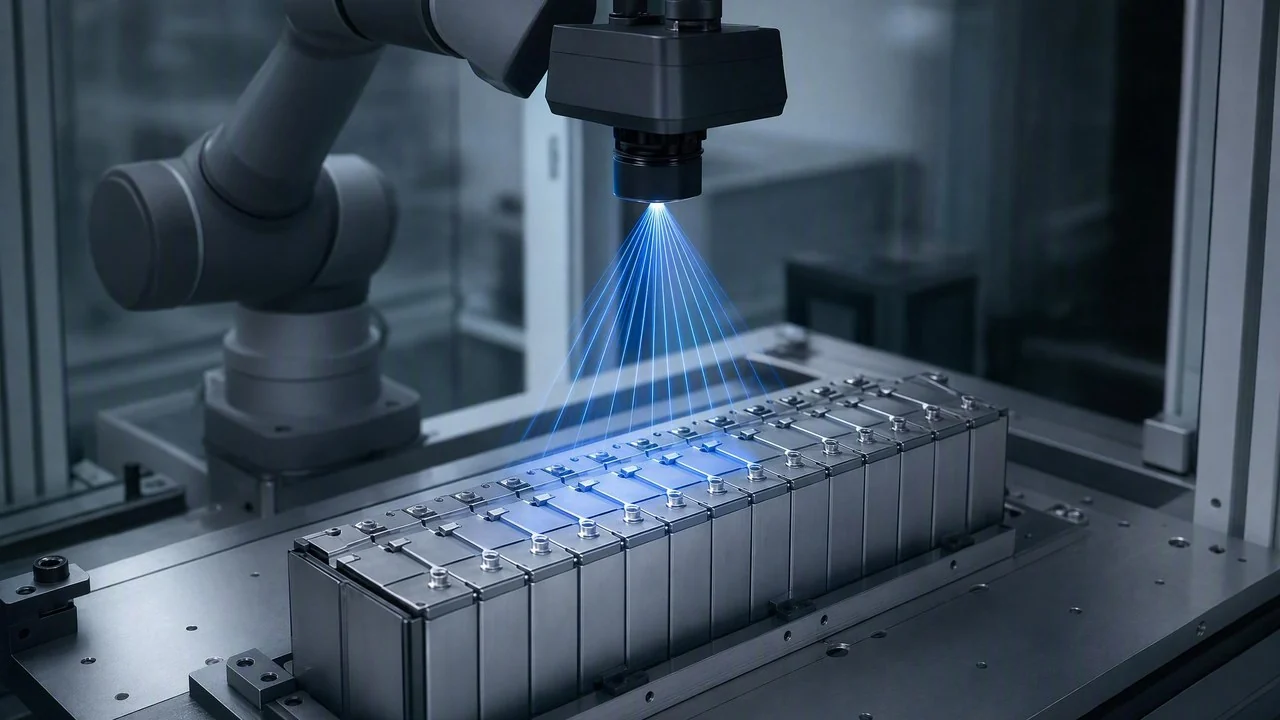
Wemio DaoAI 3D Robot Vision (proprietary 3D camera + 6D pose estimation, bin picking, dispensing/assembly guidance, brain-eye-body closed-loop, sub-millimeter hand-eye coordination) precisely perceives and intelligently discriminates complex 3D geometries, reducing missed defect rates for EV battery module solder joints from a common 1.5% to <0.4%, significantly enhancing production line quality control. The EV battery industry is experiencing explosive growth, demanding unprecedented levels of production efficiency and product quality. As a core component of battery packs, the quality of solder joints connecting internal cells within modules directly impacts battery safety, cycle life, and energy density. On high-speed production lines, automated inspection of these critical solder joints is key to ensuring overall performance. However, due to factors such as tiny solder joint sizes, dense distribution, uneven surface reflectivity, and complex 3D geometries, traditional inspection methods often struggle to achieve ideal detection rates and extremely low missed defect rates, posing significant challenges for the industry.
The pursuit of product consistency and reliability in the new energy battery industry is relentless, especially in module manufacturing, where zero tolerance for various solder joint defects is a universal consensus. A leading Tier-1 supplier of new energy batteries, whose production line processes tens of thousands of battery modules daily, each containing hundreds of critical solder joints. These solder joints may exhibit various defects such as cold solder joints, short circuits, insufficient solder, offset welding, solder dross, and oxidation, among which cold solder joints and micro-short circuits are extremely difficult to detect hidden defects with the most severe consequences. Traditional 2D vision or manual inspection often falls short when dealing with solder joints with complex 3D geometries and varying reflective properties, leading to persistently high missed defect rates. This not only increases downstream rework costs but also poses potential battery safety hazards, severely impacting brand reputation.
Pain Points: Why This Hurdle Is So Difficult to Overcome
The pain points faced by this top-tier supplier are multi-dimensional: Firstly, **high missed defect rates**, with traditional inspection methods having missed defect rates of 1.5% or even higher for hidden defects like cold solder joints and micro-short circuits, severely threatening product reliability. Secondly, **ineffective false alarm reduction**, leading to a large number of good products being misidentified, requiring additional manual re-inspection hours, costing approximately ¥694 per hour in labor. Thirdly, **slow inspection cycle times**, where existing solutions cannot meet the demands of high-speed production lines, and the average inspection time per module is too long, becoming a production bottleneck. These issues stem from the inherent complexity of solder joints and the limitations of existing technologies in 3D perception and intelligent discrimination.
The root causes of these dilemmas are: new energy battery module solder joints are typically laser-welded, exhibiting varied surface morphologies, a mix of specular and diffuse reflections, and small, dense spacing between joints. Traditional 2D vision systems struggle with highly reflective, low-contrast areas, often leading to misjudgments or missed defects. Manual inspection, on the other hand, is limited by human eye fatigue and subjective judgment variability, making it difficult to ensure consistency and high detection rates in long-duration, high-intensity inspection tasks. Furthermore, the current “domain gap” problem between simulated data generation and real-world data in embodied AI robot training also reflects the insufficient generalization capability of machine vision systems in diverse, uncertain scenarios within complex physical environments. Wemio DaoAI deeply understands this challenge and is committed to bridging this gap through its advanced 3D robot vision technology, enhancing robots' perception and decision-making abilities on real production lines.
Technical Principles
The core of Wemio DaoAI 3D Robot Vision solution lies in its **proprietary high-precision 3D camera and leading 6D pose estimation technology**. This 3D camera utilizes structured light projection combined with multi-view stereo matching algorithms to reconstruct the 3D morphology of solder joints with high precision, acquiring sub-millimeter depth information. This effectively overcomes the limitations of traditional 2D vision regarding reflections, shadows, and height variations. By obtaining complete point cloud data, the system can accurately capture the geometric features of solder joints, such as height, volume, and tilt, which are crucial for identifying defects like cold solder joints and insufficient solder. Coupled with deep learning algorithms, Wemio DaoAI's 6D pose estimation technology can accurately identify and locate battery modules and internal solder joints in any posture in real-time, providing a stable and reliable benchmark for subsequent defect analysis.
Compared to traditional rule-based AOI systems, Wemio DaoAI 3D Robot Vision offers advantages in several aspects: Rule-based AOI relies on predefined geometric thresholds and brightness judgments, which are poorly adaptable to solder joints with complex morphologies or uneven reflections, often leading to numerous false alarms and missed defects. In contrast, DaoAI 3D Robot Vision, through deep learning models, can autonomously learn complex patterns of solder joint defects from vast amounts of 3D data, possessing stronger generalization capabilities and robustness. For example, for defects like cold solder joints that may not be obvious in 2D images, the DaoAI system can achieve high-precision identification through detailed analysis of 3D contours and height collapse features of solder joints. Furthermore, its “brain-eye-body closed-loop” mechanism enables the robot to adjust its inspection strategy in real-time based on visual feedback, achieving sub-millimeter hand-eye coordination to ensure the precision and stability of each inspection. Wemio DaoAI utilizes APDT positive/few-shot learning technology, requiring only 1–20 good samples to quickly train models, significantly shortening deployment cycles.
Typical Application Scenarios
- **Cell Connector Solder Joint Defect Detection:** Inspects laser solder joints on cell connectors, including cold solder joints, short circuits, offset welding, solder balls, and insufficient solder. The challenge lies in the small size, dense arrangement, and high reflectivity of the connector material. DaoAI 3D Robot Vision overcomes reflection interference using 3D morphology reconstruction, accurately quantifying solder joint volume and height.
- **Module Busbar Welding Quality Inspection:** Inspects the welding quality between the Busbar and cells or casing to ensure the reliability of the current transmission path. The challenge is that Busbars are larger, but welds may be hidden inside the structure or have tiny cracks. The DaoAI system can identify microscopic morphological abnormalities in weld areas through deep learning.
- **Pack Casing Internal Component Assembly Guidance and Defect Detection:** Guides robots to precisely assemble battery modules into the Pack casing and inspects whether assembled connectors (e.g., bolts, clips) are in place, loose, or deformed. The challenge is confined spaces and obstructed views. DaoAI 6D pose estimation can guide the robot to avoid obstacles and accurately identify targets.
- **Adhesive Bead Path and Width Inspection:** In the module or Pack sealing adhesive application, inspects the continuity, width, and height of the adhesive bead to prevent liquid penetration. The challenge is that the bead may collapse, break, or overflow. DaoAI 3D Vision can real-time scan the 3D contour of the bead to ensure adhesive quality.
- **Cell Surface Scratch and Foreign Object Detection:** Detects scratches, dents, or foreign objects on the cell surface, which may affect battery performance or even safety. The challenge is that defects are microscopic and may occur on curved surfaces. DaoAI system's high-resolution 3D imaging can capture these micron-level surface defects.
Case Study
A leading new energy battery module manufacturer in East China had long been plagued by the dual challenges of inefficient manual inspection and high missed defect rates from traditional 2D AOI. Particularly in module solder joint inspection, significant human resources were still required for sampling and re-inspection each shift, limiting production cycle times. The monthly average missed defect rate was around 1.5%, directly resulting in millions of dollars in annual rework and warranty costs. After implementing Wemio DaoAI 3D Robot Vision solution, through two months of system integration and production line calibration, the production line achieved a qualitative leap. The DaoAI team deployed a robot vision system equipped with a proprietary 3D camera and utilized its few-shot learning capability to quickly train precise models for various solder joint defects. Before implementation, the customer's module solder joint missed defect rate was as high as 1.5%, and manual re-inspection was time-consuming. After implementation, the DaoAI 3D Robot Vision system increased the detection rate of module solder joint defects to over 99.6% and stably reduced the missed defect rate to <0.4%. Concurrently, the false alarm rate decreased by 80%, significantly reducing the workload of manual re-inspection and improving the inspection cycle time by 35%.
"Wemio DaoAI 3D Robot Vision not only solved our long-standing solder joint missed defect problem but also elevated our production line efficiency to a new level, truly achieving a win-win in both quality and speed."
Wemio Solutions and Products
The core solution provided by Wemio is based on DaoAI 3D Robot Vision, which integrates a proprietary high-precision 3D camera, powerful 6D pose estimation algorithms, and a “brain-eye-body closed-loop” control logic. In the context of new energy battery module solder joint inspection, this system performs micron-level morphology reconstruction and analysis of solder joints using high-resolution 3D point cloud data, accurately identifying various defects such as cold solder joints, short circuits, and insufficient solder. For deployment, Wemio DaoAI platform supports various integration methods such as SDK/API/Docker, enabling 100% local private deployment to ensure customer data security. Through the APDT positive/few-shot learning mechanism, model training can be completed with only a minimal number of good samples (1-20 images), significantly shortening the cycle from production line debugging to official launch. Furthermore, Wemio DaoAI World Model, as a unified foundation, endows the system with strong semantic understanding and cross-scenario generalization capabilities, allowing it to continuously learn and optimize from production line feedback, constantly improving detection accuracy and robustness.
Through the application of Wemio DaoAI 3D Robot Vision, customers achieve significant business value. First is **significant quality improvement**: solder joint defect detection rate reaches over 99.6%, and missed defect rate is reduced to <0.4%, greatly lowering product quality risks and recall costs. Second is **substantial efficiency optimization**: false alarm rate is reduced by 80%, eliminating unnecessary re-inspection steps and improving overall production cycle time by 35%. Finally, **effective cost control**: reduced reliance on manual inspection lowers labor costs and avoids huge expenses from downstream rework and warranty by detecting defects early. Wemio DaoAI 3D Robot Vision's sub-millimeter hand-eye coordination capability ensures high-precision operation in complex industrial environments, providing solid support for the intelligent upgrade of new energy battery manufacturing.
FAQ
How does DaoAI 3D Robot Vision handle complex reflection issues on new energy battery module solder joints?
Wemio DaoAI 3D Robot Vision utilizes a proprietary high-precision 3D camera, combining structured light projection and multi-view stereo matching algorithms, to effectively overcome specular and diffuse reflections on solder joint surfaces. By acquiring complete 3D morphological data, the system identifies defects from depth information rather than single brightness information, thus avoiding the failure of traditional 2D vision under strong reflections and ensuring high-precision detection.
What are the core advantages of DaoAI 3D Robot Vision for solder joint inspection compared to traditional AOI systems?
The core advantage of DaoAI 3D Robot Vision lies in its 3D perception capabilities and deep learning-based intelligent discrimination. Traditional AOI relies on fixed rules and 2D images, struggling with complex 3D morphologies and hidden defects. In contrast, Wemio DaoAI system accurately identifies subtle defects like cold solder joints and insufficient solder through high-precision 3D reconstruction, combined with 6D pose estimation for precise localization. Its few-shot learning capability also significantly shortens model training and deployment time.
How does DaoAI 3D Robot Vision ensure inspection cycle times on high-speed production lines?
Wemio DaoAI 3D Robot Vision ensures stable operation on high-speed production lines by optimizing image acquisition speed and utilizing an efficient parallel computing architecture. Its “brain-eye-body closed-loop” mechanism allows the robot vision system to collaborate with the robotic arm in real-time, rapidly completing image acquisition, data processing, and defect judgment. Sub-millimeter hand-eye coordination minimizes inspection time, thereby meeting the high-capacity and high-efficiency demands of the new energy battery industry.
Full solution for this scenario: the full inspection solution for New-energy batteries
This article was generated by AI. Customer cases are simulated scenarios based on real product capabilities and figures are illustrative; see product pages for official benchmarks.