
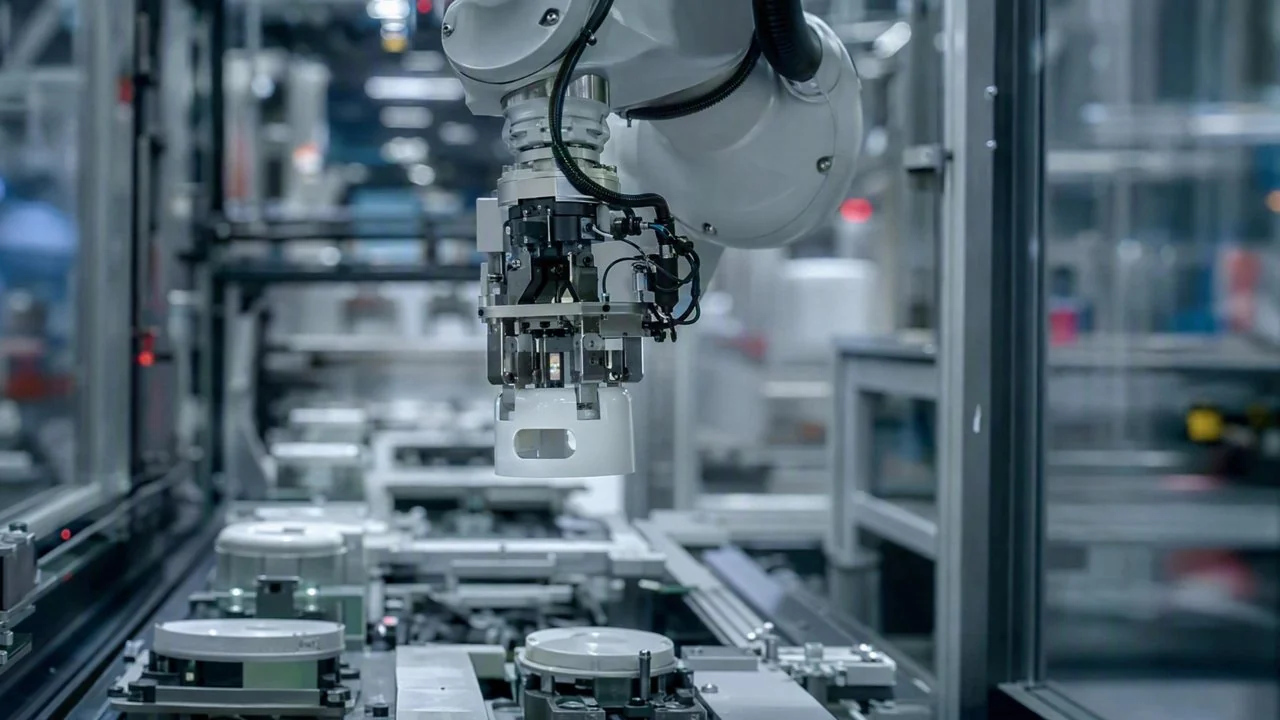
WeLinkirt's DaoAI 3D Robot Vision, utilizing 6D pose estimation and a proprietary 3D camera, has reduced changeover time for missing/incorrect assembly detection in consumer goods production from an average of 2 hours to under 5 minutes, ensuring product quality while significantly enhancing flexibility and efficiency for multi-variety, small-batch production lines.
The consumer goods industry, particularly in small household appliances and electronic accessories, is transitioning from large-scale standardized production to multi-variety, small-batch, and personalized customization. This shift places extremely high demands on production line flexibility. In the assembly process, common issues like missing or incorrect parts, if not detected promptly, can lead to product scrap, rework, and even damage to brand reputation. Traditional manual inspection is inefficient and prone to fatigue, while rule-based conventional machine vision systems face challenges with complex programming, long changeover times, and difficulty adapting to product diversity. WeLinkirt's DaoAI 3D Robot Vision (proprietary 3D camera + 6D pose estimation, bin picking, gluing/assembly/loading/unloading guidance, brain-eye-body closed-loop, sub-millimeter hand-eye coordination) emerges in this context, with its core advantage lying in 0-code rapid changeover and high-precision detection. It provides critical support for flexible manufacturing in the consumer goods industry, compressing changeover preparation time from hours to minutes, thereby greatly enhancing production line adaptability.
Pain Points: Why This Hurdle Is Difficult to Overcome
In the face of multi-variety, small-batch production in consumer goods, detecting missing/incorrect assembly parts presents multiple pain points: Firstly, **long changeover downtime**: each time the production line switches product models, engineers using traditional vision systems spend hours or even half a day reprogramming and calibrating, leading to production stagnation, with average changeover downtime exceeding 120 minutes. Secondly, **low efficiency and high missed detection rate for manual inspection**: complex and diverse product structures and subtle assembly differences make manual visual inspection highly susceptible to missed detections due to fatigue or blind spots, especially on high-speed production lines, where the missed detection rate can reach 0.5% – 1%, directly impacting product quality. Thirdly, **high false positive rates leading to significant re-inspection costs**: traditional rule-based machine vision systems are sensitive to ambient lighting, surface reflections, and subtle color differences, often generating false positives that result in numerous good products being misidentified. This necessitates additional manual re-inspection, adding at least 15% to re-inspection labor hours and dragging down overall production efficiency. Finally, **data silos and slow iteration**: traditional vision systems lack continuous learning capabilities, unable to translate production line feedback into model optimization, leading to slow updates of defect libraries and difficulty keeping pace with new product launches. These issues collectively constitute a major obstacle to the flexible upgrade of consumer goods assembly lines and limit the widespread adoption and innovation of embodied intelligence technologies like low-cost humanoid robots, due to the lack of a 'perceptive brain' that can quickly adapt to diverse scenarios.
The root cause of these difficulties lies in several factors: From a process perspective, consumer product assembly often involves small parts of various materials and complex structures, such as snaps, screws, gaskets, and labels. The absence or misalignment of these components is challenging to accurately identify their 3D state using simple 2D vision. From an imaging perspective, part surfaces may exhibit high reflectivity, transparency, or color variations, interfering with traditional 2D imaging, while 3D imaging technology has a high entry barrier. From a cycle time perspective, consumer product manufacturing typically demands high cycle rates, leaving extremely short time windows for inspection, which traditional manual or complex programmed vision systems struggle to meet in real-time. These factors collectively contribute to the persistent difficulty in quality control for assembly in multi-variety, small-batch production.
Technical Principles
The core advantage of WeLinkirt's DaoAI 3D Robot Vision lies in its combination of a proprietary high-precision 3D camera and advanced 6D pose estimation technology, providing a revolutionary solution for assembly inspection in the consumer goods industry. WeLinkirt's self-developed 3D camera, utilizing structured light or laser triangulation principles, can reconstruct the 3D morphology of the object with high precision, obtaining depth information. This allows the system to overcome the limitations of traditional 2D vision regarding lighting, reflection, and color, accurately identifying the 3D structure, height, and coplanarity of components, thereby precisely determining the presence of missing or incorrect parts. For instance, a component that appears to be 'present' in a 2D image might just be a shadow, but under 3D view, abnormalities in its height or shape become immediately apparent.
Building on this, WeLinkirt's DaoAI 3D Robot Vision integrates industry-leading 6D pose estimation algorithms. These algorithms can real-time calculate the 3D spatial position (X, Y, Z) and 3D orientation (Rx, Ry, Rz) of an object, known as 6D pose. This is crucial for robot-guided assembly and bin picking. By precisely perceiving the 6D pose of target components, robots can achieve sub-millimeter hand-eye coordination, accurately locating, grasping, and placing components during high-speed movements, ensuring assembly accuracy. Compared to traditional rule-based machine vision systems, WeLinkirt's DaoAI solution requires no complex script programming. Instead, it uses an intuitive graphical interface and a small number of good samples (APDT positive/few-shot learning, 1–20 images of good parts) for model training and changeover configuration, greatly simplifying deployment and maintenance processes. WeLinkirt's DaoAI 'brain-eye-body closed-loop' system enables the robot vision system not only to 'see' but also to 'understand' and 'act,' continuously optimizing performance through real-time feedback to achieve higher levels of intelligence.
Typical Application Scenarios
- **Missing Parts Detection for Internal Structures of Small Household Appliances**: In the internal assembly of small appliances like rice cookers and coffee makers, detecting whether key components such as heating modules, circuit boards, and sensors are missing or improperly installed. WeLinkirt's DaoAI 3D Robot Vision can accurately identify their presence and correct installation position through 3D morphology comparison, even if components are hidden within complex structures. The difficulty lies in confined internal spaces and severe component occlusion.
- **Incorrect Assembly and Deformation Detection for Electronic Product Interfaces/Buttons**: In the assembly of electronic products like mobile phones and tablets, USB ports, SIM card slots, and physical buttons are prone to incorrect assembly, misalignment, or deformation. DaoAI 3D Vision can reconstruct the 3D morphology of these tiny components with high precision, determining deviations from standard models to ensure correct assembly. The difficulty lies in minute component sizes and strict tolerances.
- **Missing Accessory Detection Inside Packaging Boxes**: In the packaging of consumer goods, accessories such as manuals, charging cables, and gifts are often required. WeLinkirt's DaoAI 3D Robot Vision can perform 3D scans of packaged products to detect if all pre-set accessories are complete, preventing omissions. The difficulty lies in the variety of accessories, varying sizes, and random positions.
- **Assembly Sequence and Component Integrity Detection for Multi-Layer Stacked Products**: Some consumer products, such as cosmetic sets or multi-layer snack gift boxes, require specific stacking or assembly sequences. DaoAI 3D Vision can identify the stacking order of components in each layer, whether they are missing or misplaced, ensuring product integrity and consistency. The difficulty lies in inter-layer occlusion and high component similarity.
- **Label or Sticker Positioning and Flatness Detection**: On consumer product packaging, the positioning accuracy and flatness of labels or stickers directly affect product appearance. WeLinkirt's DaoAI 3D Robot Vision can not only detect if labels are applied but also use 3D data to determine if there are defects such as curling or wrinkles, and guide robots for precise application. The difficulty lies in diverse label materials and complex reflective properties.
Case Study
A leading manufacturer specializing in small household appliances faced frequent switches across dozens of product models. Traditional missing part detection relied on manual visual inspection and rule-based 2D vision. Due to frequent product model changes, engineers spent significant time readjusting 2D vision parameters and rewriting detection scripts for each changeover, resulting in an average downtime of over 2 hours per changeover. This severely limited the manufacturer's ability to respond to market demands and engage in multi-variety, small-batch production. Concurrently, manual inspection exhibited a high missed detection rate at high cycle times, leading to customer complaints and increased rework costs.
The manufacturer adopted WeLinkirt's DaoAI 3D Robot Vision solution. During deployment, the WeLinkirt team first collected 3D data and trained models for several typical products. Using DaoAI's 0-code programming interface, engineers only needed to import a small number of good 3D data samples, and the system automatically learned and built defect detection models. After deployment, WeLinkirt's DaoAI 3D Robot Vision system was integrated into critical inspection stations on the assembly line, real-time scanning each product coming off the line, accurately identifying missing or incorrectly assembled components such as screws, snaps, and gaskets. Comparing before and after deployment, the most significant change was changeover efficiency. What used to be a 120-minute changeover process now, with DaoAI's rapid changeover capability, takes only 5 minutes to load new product models and adjust parameters. This enabled the production line to switch production tasks more flexibly, increasing daily product model changes from 2 to 5. Concurrently, detection accuracy significantly improved, with the missed detection rate dropping from 0.8% to <0.1%, and the false positive rate reduced by 85%, substantially decreasing manual re-inspection workload. The deployment of WeLinkirt's DaoAI 3D Robot Vision allowed this manufacturer to achieve a significant leap in production flexibility while maintaining high quality.
“WeLinkirt's DaoAI 3D Robot Vision's 0-code rapid changeover has completely transformed our efficiency bottleneck in multi-variety, small-batch production. We can now respond to market changes much faster.” — Production Director, a leading consumer goods manufacturer
WeLinkirt Solutions and Products
WeLinkirt's DaoAI 3D Robot Vision is the core of this solution. It comprises the following key technologies: **proprietary high-precision 3D camera**, providing stable, high-resolution 3D point cloud data to ensure precise perception of tiny components and complex structures; **advanced 6D pose estimation algorithms**, combined with deep learning technology, capable of real-time accurate acquisition of the 3D spatial position and orientation of measured components, providing sub-millimeter accuracy for robot guidance; and a **'brain-eye-body closed-loop' system**, ensuring highly coordinated perception, decision-making, and execution throughout the robot's process, with continuous learning for performance optimization. In practical application, WeLinkirt's DaoAI offers an intuitive 0-code programming interface, allowing production line engineers to quickly train and deploy new detection models with a small number of good samples (APDT positive/few-shot learning, 1–20 good images), fulfilling the promise of '5-minute changeover.' The entire system supports various deployment methods including SDK/API/Docker and offers 100% on-premise private deployment to ensure data security and production stability. In addition to the core 3D Robot Vision, WeLinkirt can also provide the accompanying DaoAI AI AOI software system according to customer needs, leveraging the feature recognition capabilities of visual foundation models to further enhance detection robustness and generalization, for instance, in detecting 2D features like surface scratches and stains.
Through WeLinkirt's DaoAI 3D Robot Vision, customers can achieve: **ultra-fast changeover**, reducing changeover time for multi-variety, small-batch production from hours to under 5 minutes, significantly improving production line utilization and order response speed; **high-precision detection**, with missed detection rates reliably controlled at <0.1%, ensuring product quality and brand reputation; **reduced operating costs**, by minimizing manual re-inspection hours and increasing automation levels; and **flexible manufacturing**, enabling production lines to quickly adapt to market changes and new product introductions. These quantified achievements collectively constitute the unique business value of WeLinkirt's DaoAI 3D Robot Vision in the field of missing/incorrect assembly detection for consumer goods.
FAQ
How does DaoAI 3D Robot Vision achieve 0-code rapid changeover?
WeLinkirt's DaoAI 3D Robot Vision achieves 0-code rapid changeover through its advanced APDT few-shot learning technology and intuitive graphical programming interface. Engineers only need to import 1-20 3D samples of good products, and the system automatically learns and builds new detection models without complex coding. This reduces changeover time from hours to under 5 minutes, significantly enhancing production line flexibility.
What are the advantages of DaoAI 3D Robot Vision over traditional 2D vision for detecting missing/incorrect assembly parts?
WeLinkirt's DaoAI 3D Robot Vision utilizes a proprietary high-precision 3D camera to acquire 3D morphological information of objects, overcoming the limitations of traditional 2D vision regarding lighting, reflection, and color. It precisely identifies 3D features such as the stereo structure, height, and coplanarity of components, thus more accurately determining if parts are missing, misplaced, or deformed, especially suitable for complex structures and tiny components, maintaining a missed detection rate of <0.1%.
What is the typical deployment and integration period for DaoAI 3D Robot Vision?
The deployment cycle for WeLinkirt's DaoAI 3D Robot Vision is typically rapid. Thanks to its modular design and 0-code configuration capabilities, from system integration to production line testing and operational use, it can usually be completed within a few weeks. The specific duration depends on the complexity of the client's production line and integration requirements, but it is significantly shorter compared to traditional customized vision systems. It also supports 100% on-premise private deployment, ensuring data security and quick response.
Full solution for this scenario: the full inspection solution for Consumer / general · Assembly Missing-Part & Misassembly Detection
This article was generated by AI. Customer cases are simulated scenarios based on real product capabilities and figures are illustrative; see product pages for official benchmarks.