
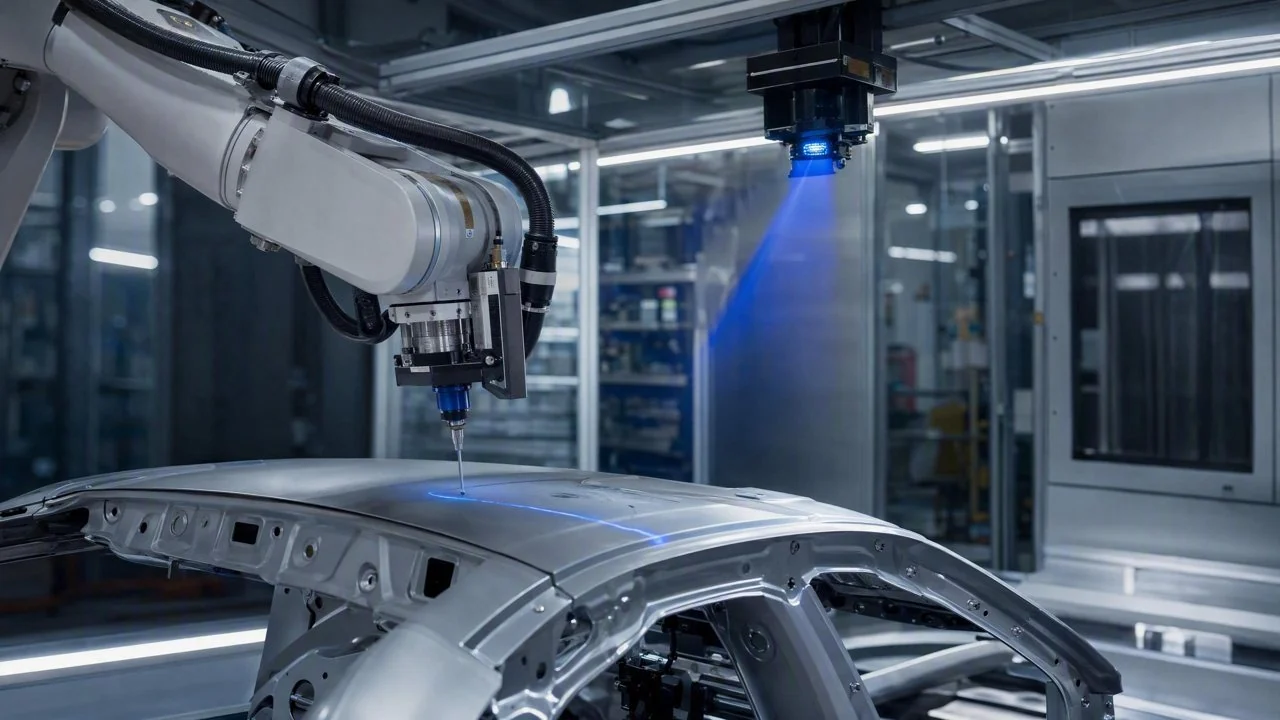
DaoAI 3D Robot Vision by WeLinkirt (proprietary 3D camera + 6D pose estimation, bin picking, guiding for dispensing/assembly/loading, brain-eye-body closed-loop, sub-millimeter hand-eye coordination) reduces missed detection risks in automotive component adhesive application to <0.01% by replacing traditional manual sampling with high-precision 3D morphology reconstruction and AI defect recognition. It generates traceable adhesive quality reports for each product, establishing quality traceability and a data closed-loop for continuous process optimization.
In the lean manufacturing system of automotive components, the quality of the adhesive application/sealing process directly determines the product's durability, sealing performance, and safety. Even minor defects in this critical step can lead to vehicle noise, water leakage, corrosion, or even structural failure, resulting in substantial recall costs and brand reputation damage. Traditional sampling inspection methods struggle to cope with increasingly complex structural parts and high production speeds, leading to unacceptable risks of missed detections. Especially for sealing strips on critical load-bearing components, 100% full inspection has become an industry consensus. The challenge for automotive component manufacturers is how to achieve this goal efficiently, accurately, and traceably. The introduction of WeLinkirt's DaoAI 3D Robot Vision aims to address this core pain point by employing advanced 3D imaging and AI analysis technology to ensure every adhesive application process meets the highest standards, while providing robust data support for subsequent quality traceability and process optimization.
Pain Points: Why This Challenge Is Difficult to Overcome
Quality control in automotive component adhesive application faces multiple challenges: First, **high missed detection rates**: Traditional manual visual inspection or 2D vision systems struggle to identify defects such as adhesive width, height, continuity, overflow, or breaks, often being susceptible to lighting, reflections, product color, and surface texture. This leads to persistently high missed detection rates, especially for internal defects or micro-bubbles. Second, **poor traceability**: In the event of a batch quality issue, it's difficult to quickly pinpoint specific production batches, workstations, or even individual products, leading to expanded recall scopes and high traceability costs. A deeper challenge lies in the **lack of a data closed-loop**: Without real-time, high-precision 3D morphological data of the adhesive, process parameter adjustments often rely on experience, preventing the formation of a data-driven optimization cycle, thereby limiting improvements in production efficiency and yield. For instance, a leading Tier-1 supplier once incurred millions in recall costs due to adhesive defects causing vehicle noise after assembly, but lacked precise data to trace the specific responsible batch or accurately guide the optimization of the adhesive robot parameters.
The root causes of these difficulties are: **Complex 3D morphology**: Adhesive beads often have complex curved surfaces and varying heights, making it difficult for 2D vision to acquire complete depth information. **Material properties**: The translucency, reflectivity, and color similarity of materials like rubber and silicone to the substrate make it challenging for traditional vision imaging and thresholding to distinguish defects. **High-speed production**: Automotive production lines typically demand extremely high throughput, requiring inspection systems to complete data acquisition and analysis within very short cycle times, which traditional high-precision scanning or manual inspection cannot meet. Furthermore, while open-source models have made significant strides in enhancing the perception, decision-making, and execution capabilities of embodied AI robots, translating these general capabilities into industrial-grade, sub-millimeter precision defect detection and path correction still requires highly specialized domain knowledge and customized algorithms, as well as dedicated hardware and software systems like WeLinkirt's DaoAI 3D Robot Vision, designed specifically for industrial scenarios.
Technical Principles
WeLinkirt's DaoAI 3D Robot Vision system, through its **proprietary high-precision 3D camera**, combined with **multi-point laser triangulation** or **structured light projection technology**, can acquire complete point cloud data of the measured object's surface within microseconds, achieving sub-millimeter level 3D morphology reconstruction. This system overcomes the limitations of traditional 2D vision regarding lighting, reflections, and color, precisely capturing key parameters of the adhesive bead contour such as width, height, volume, and continuity. For example, for a sealing bead with a width of 2.5mm ± 0.2mm, the WeLinkirt DaoAI 3D Vision system can achieve a measurement accuracy of <0.05mm, ensuring strict adherence to adhesive quality standards.
At the data processing level, WeLinkirt's DaoAI 3D Robot Vision integrates advanced **6D pose estimation** and **AI defect recognition algorithms**. By training deep learning models on vast amounts of adhesive application data, the system can autonomously learn and identify various complex defect patterns, such as breaks, overflows, air bubbles, uneven width, and height collapse. Compared to traditional rule-based AOI systems, DaoAI's AI algorithms offer stronger generalization capabilities and robustness, adapting to product batch variations and environmental changes, significantly reducing false positive rates. Concurrently, the system supports **brain-eye-body closed-loop** collaboration with robot controllers, providing real-time feedback of inspection results to guide the robot in micro-adjustments and corrections of the adhesive application path, ensuring each product meets process requirements. This sub-millimeter hand-eye coordination capability makes WeLinkirt's DaoAI 3D Vision excel in precision adhesive application.
Typical Application Scenarios
- **Body Weld Sealant Inspection**: Applying sealant to body welds to prevent moisture ingress and noise. The challenge lies in complex weld geometries, requiring strict control over bead width, height, and continuity. DaoAI 3D Vision accurately measures the 3D morphology of the bead, identifying defects like breaks, air bubbles, and overflows.
- **Engine Cylinder Head Gasket Dispensing Guidance and Inspection**: The precision of adhesive application for engine cylinder head gaskets directly impacts engine sealing performance. DaoAI 3D Robot Vision provides sub-millimeter accurate dispensing path guidance and conducts 100% inline inspection of the bead's width, height, and positional deviation after application.
- **Automotive Interior Sound/Vibration Damping Adhesive Quality Inspection**: Inspecting the application of sound/vibration damping adhesives on interior components like door panels and dashboards to ensure uniformity and coverage. Challenges include similar colors between adhesive and substrate, and often irregular shapes. WeLinkirt's DaoAI 3D Vision accurately identifies adhesive contours and thickness using depth information.
- **New Energy Battery Pack Sealing Strip Integrity Inspection**: Water and dust protection for new energy battery packs is crucial, with sealing strip integrity directly affecting battery safety. DaoAI 3D Vision performs full-path scanning of battery pack housing sealing strips, detecting breaks, collapses, foreign matter inclusion, and other defects to ensure IP rating.
Case Study
A leading domestic Tier-1 supplier of new energy vehicles faced long-standing challenges in the power battery module housing sealant application process: low efficiency of manual sampling, high risk of missed detections (approximately 0.5%), and inability to achieve single-piece traceability. Especially during production ramp-up, the immense pressure of manual re-inspection significantly impacted production rhythm. The client introduced WeLinkirt's DaoAI 3D Robot Vision system, deployed beneath the adhesive application robot, to perform 100% inline inspection of the sealing strip on each battery module housing. Before implementation, adhesive defects caused potential water leakage risks in about 50 out of every 10,000 products, requiring substantial human resources for re-inspection. After the DaoAI 3D Vision system went online, through high-precision 3D measurement and AI defect recognition, the missed detection rate was reduced to <0.01% (i.e., fewer than 1 missed detection per 10,000 products). It also enabled real-time acquisition and storage of adhesive quality data. Each product now generates a unique QR code linked to its complete 3D adhesive morphology data, defect type, location, and dimensions, achieving full-link quality traceability from raw materials to final vehicle assembly. Furthermore, WeLinkirt's DaoAI system supports APDT few-shot learning, allowing the customer to train a model in just 5 minutes with only 10 good samples, significantly reducing changeover time.
WeLinkirt's DaoAI 3D Robot Vision transforms automotive component adhesive quality from 'sampling by experience' to 'full inspection with traceability,' providing a solid data foundation for intelligent manufacturing.
WeLinkirt Solution and Products
WeLinkirt provides a complete solution for automotive component adhesive inspection, centered around **DaoAI 3D Robot Vision**. This solution includes proprietary high-precision 3D camera hardware, high-performance image processing units, and a deep learning-based DaoAI AI algorithm engine. We offer multiple deployment options: SDK / API / Docker, supporting 100% local private deployment to ensure core customer data remains on-site, meeting the stringent data security and privacy requirements of the automotive industry. During implementation, WeLinkirt engineers integrate and fine-tune the system according to the client's specific products and process characteristics, including: 3D camera installation and calibration (ensuring sub-millimeter hand-eye coordination), robot motion path planning (in conjunction with 6D pose estimation), and DaoAI AI model training and deployment. Through the semantic understanding and cross-scenario generalization capabilities of the DaoAI World global model unified platform, the system continuously learns from production line feedback, constantly improving detection accuracy and efficiency. Additionally, WeLinkirt's DaoAI AI AOI software system provides a user-friendly interface, supporting 0-code automatic programming, allowing new product inspection plans to be configured in just 5 minutes, significantly lowering customer usage barriers and changeover costs.
By deploying WeLinkirt's DaoAI 3D Robot Vision system, the customer achieved **100% inline inspection** of adhesive quality, reducing the missed detection rate by over 98%, from approximately 0.5% to <0.01%. Simultaneously, each product now possesses traceable quality data, providing strong evidence for subsequent product recalls and quality analysis. This not only significantly enhanced product quality reliability but also substantially reduced manual re-inspection costs, freeing up valuable production capacity. Customers can leverage the data closed-loop to continuously optimize adhesive application process parameters, achieving leaner and smarter manufacturing, with an estimated annual quality cost saving of over one million RMB.
FAQ
What types of defects can DaoAI 3D Robot Vision identify in automotive adhesive application inspection?
WeLinkirt's DaoAI 3D Robot Vision system can precisely identify various defects during the adhesive application process, including but not limited to breaks, overflows, air bubbles, uneven bead width, height collapse, positional deviation, and foreign material inclusion. Through high-precision 3D morphology reconstruction and deep learning algorithms, the system can handle complex curved surfaces and reflective materials, ensuring comprehensive coverage of all potential quality issues.
What are the advantages of DaoAI 3D Robot Vision compared to traditional 2D vision or rule-based AOI?
Compared to traditional 2D vision or rule-based AOI, the core advantage of WeLinkirt's DaoAI 3D Robot Vision lies in its 3D perception capabilities and AI intelligence. It can acquire complete depth information, overcome interference from lighting, reflections, and color differences, and accurately quantify defects with complex morphologies. Concurrently, its deep learning-based AI algorithms offer stronger generalization and adaptability, capable of handling diverse defect patterns, significantly reducing false positives and missed detections, and supporting few-shot learning for rapid changeovers.
How does DaoAI 3D Robot Vision ensure quality traceability and a data closed-loop?
WeLinkirt's DaoAI 3D Robot Vision achieves this by collecting real-time 3D morphological data and defect information for each product, associating and storing it with the product's unique identifier (e.g., QR code). This data is traceable to specific production times, workstations, and inspection results. The system supports data export and integration with MES/QMS systems, forming a complete data closed-loop from inspection to process optimization, providing comprehensive support for quality analysis, problem localization, and continuous improvement.
Full solution for this scenario: Automotive / parts industry solutions · 100% Inline 3D Inspection & Path Correction for Automotive Glue Dispensing
This article was generated by AI. Customer cases are simulated scenarios based on real product capabilities and figures are illustrative; see product pages for official benchmarks.