
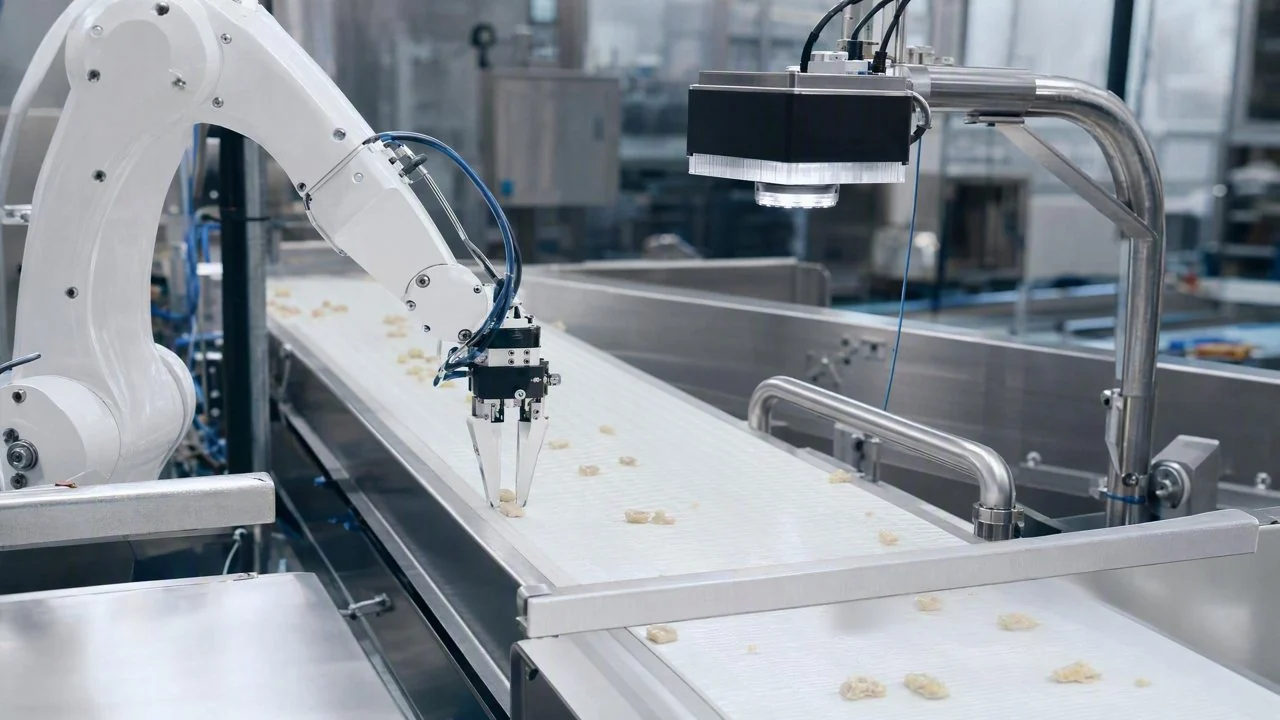
WeLinkirt DaoAI 3D Robotic Vision (proprietary 3D camera + 6D pose estimation, bin picking, guidance for dispensing/assembly/loading/unloading, brain-eye-body closed loop, sub-millimeter hand-eye coordination), leveraging APDT few-shot self-training, reduces new defect recognition model training time in food processing from weeks to hours, significantly cutting downtime for line changeovers and new product introductions.
In the deep processing of food and agriculture, quality control and foreign object removal are critical for ensuring food safety and brand reputation. As consumer demands for food safety and quality escalate, traditional manual inspection or rule-based 2D vision systems struggle to meet the requirements of high efficiency, high precision, and multi-variety production. Especially when dealing with irregularly shaped, color-varying, and complex-textured agricultural products, minute defects or foreign objects can easily be missed, leading to batch-level quality issues. The large-scale deployment of embodied AI robots in manufacturing offers transformative opportunities for the food processing industry, but a core challenge lies in how to rapidly and accurately adapt to constantly changing inspection objects and defect types, achieving true flexible production.
Pain Points: Why This Hurdle Is So Difficult
At a major nut processing enterprise, their sorting line processes tons of different nut varieties daily, including walnuts, almonds, and cashews. During peak seasons, a manual inspection team of over 50 workers operates in shifts, yet still faces numerous challenges. Firstly, high false negative rates: Due to the similarity between natural nut textures and defects like mold, insect damage, or discoloration, manual inspection's false negative rate often exceeds 2.5%, further degrading accuracy during night shifts or extended work. Secondly, high false positive rates: Misclassifying good nuts as defective leads to the rejection of high-quality products, resulting in up to 8% material loss. Thirdly, long changeover downtime: Each time a nut variety is switched or a new product is introduced, several hours to days of downtime are required to readjust vision parameters or train workers for new defects, reducing production efficiency by 15%. Finally, compliance risks and labor costs: Food safety regulations are increasingly stringent, with any batch-level quality issue potentially leading to hefty fines and brand reputation damage. Simultaneously, high-intensity repetitive labor leads to high worker turnover, continuously increasing human resource costs.
The root cause of these difficulties is that nuts and other agricultural products are typical non-standardized objects, varying greatly in shape, size, color, and texture. Defects are often subtle and hidden; for example, mold spots may resemble the color of normal shells, or insect holes may be concealed in crevices. Traditional 2D vision systems are limited by lighting, shadows, and surface reflections, making it difficult to obtain accurate 3D morphological information, leading to misjudgments. Deep learning models that rely on extensive annotated data require significant time and human effort for data collection and annotation when new defect types emerge. This clashes with the multi-variety, seasonal, and rapidly changing characteristics of the food industry, hindering the widespread deployment of embodied AI robots in this sector.
Technical Principles
The WeLinkirt DaoAI 3D Robotic Vision system, through its self-developed high-precision 3D camera, can acquire complete 3D point cloud data of the objects in real-time, accurately reconstructing their 3D morphology. This enables the system to overcome the limitations of traditional 2D vision—which is susceptible to lighting, shadows, and surface texture interference—by truly reflecting information such as object height, depth, and volume. Based on this high-precision 3D data, the DaoAI robotic vision system utilizes its core APDT (Anomaly Pattern Detection & Training) few-shot self-training technology to achieve rapid and robust identification of food foreign objects and defects.
APDT few-shot self-training is a groundbreaking technology from WeLinkirt DaoAI. It overturns the traditional deep learning model's reliance on massive defect samples, requiring only 1-20 good samples to quickly complete model training. Its core mechanism is: first, by learning from a large amount of good product data, it establishes a precise cognitive model of 'normal' patterns; second, when any region with a significant deviation from the 'normal' pattern is detected, it is identified as an anomaly or defect. This process requires no defect samples, greatly shortening the model development cycle. When new defect types appear, APDT can quickly adapt based on a small number of new good samples, without the need to collect and annotate large amounts of defect data, reducing new defect recognition model training time from weeks to hours. Compared to traditional rule-based AOI, DaoAI 3D Robotic Vision can handle more complex defect types and irregular objects, while avoiding tedious parameter tuning. Compared to traditional deep learning that relies on extensive annotation, APDT significantly reduces the cost and time of data acquisition and model iteration, enabling embodied AI robots to adapt more flexibly to the rapid changes in food production lines.
Typical Application Scenarios
- **Foreign Object Removal in Nuts and Grains**: DaoAI 3D Robotic Vision uses 3D morphological data to precisely identify foreign objects like stones, metal fragments, or plastic pieces mixed into nuts and grains. Even if foreign objects are similar in color to the product or partially obscured, their unique shape and height information allow for differentiation. The challenge lies in the diverse shapes of foreign objects and their close mixing with the product.
- **Surface Defect Detection and Grading for Fruits and Vegetables**: For fruits and vegetables such as apples, citrus, and potatoes, DaoAI 3D Robotic Vision can detect surface defects like mold spots, insect holes, bruises, and cracks, and grade them based on defect area, depth, and location, guiding robotic arms for sorting. The difficulty arises from diverse and irregular defect characteristics, and often reflective fruit and vegetable surfaces.
- **Bone and Cartilage Removal in Meat Products**: In meat processing, WeLinkirt DaoAI 3D Robotic Vision can identify and guide robotic arms to remove small bone fragments or cartilage hidden within meat cuts, enhancing product safety and texture. The challenge is that bone fragments and meat are similar in color and texture, and bone is often embedded within tissue.
- **Scorching and Discoloration Detection in Baked Goods**: For baked goods like bread and biscuits, DaoAI 3D Robotic Vision precisely identifies localized scorching, discoloration, or undercooked areas, ensuring uniform color and consistent product quality. The difficulty lies in the complex surface textures of products and the challenge of quantifying scorching levels.
- **Shape and Quality Grading for Aquatic Products**: For aquatic products like fish and shrimp, WeLinkirt DaoAI 3D Robotic Vision can accurately grade them based on completeness, size, and shape, discarding incomplete or non-conforming products. The challenge is that aquatic product surfaces are often wet and highly reflective, with varied shapes.
Case Study
A renowned food processing enterprise in East China, specializing in various snack foods including nuts and puffed snacks, had long faced issues of high labor costs, persistent false negative and false positive rates, and lengthy new product introduction cycles on its nut sorting line. To improve production efficiency and product quality, the enterprise introduced the WeLinkirt DaoAI 3D Robotic Vision system, deploying multiple embodied AI sorting workstations equipped with proprietary 3D cameras and robotic arms. Before deployment, the production line required 40 human operators working three shifts, with an average false negative rate of 2.8% and a false positive rate as high as 7.5%. Moreover, each time a nut variety was changed, it required at least 2 days of downtime for setup and manual training.
By deploying the WeLinkirt DaoAI 3D Robotic Vision solution, combined with APDT few-shot self-training technology, the enterprise achieved significant improvements. Firstly, the system consistently reduced the false negative rate to <0.4% and the false positive rate by -85% to <1.2% when processing various nuts like walnuts and almonds. This not only significantly improved product quality but also substantially reduced the loss of good products. Secondly, thanks to APDT's few-shot learning capability, models for new nut varieties or defect types could be trained and deployed within 30 minutes using only 1-5 good samples, reducing changeover downtime from 2 days to less than 1 hour, boosting production efficiency by 20%. Furthermore, the original 40-person sorting team has been optimized to 8 workers responsible for monitoring and maintenance, drastically cutting labor costs. The DaoAI 3D Robotic Vision system, with its high precision, efficiency, and flexibility, delivered tangible business value to the enterprise.
DaoAI 3D Robotic Vision's APDT few-shot self-training reduces new defect model training time from weeks to hours, bringing unprecedented flexible production capabilities to the food processing industry.
WeLinkirt Solutions and Products
The WeLinkirt DaoAI 3D Robotic Vision system is at the core of this solution. It integrates WeLinkirt's proprietary high-precision 3D camera, capable of acquiring sub-millimeter depth information, providing high-quality data for subsequent defect recognition and pose estimation. Its built-in 6D pose estimation algorithm can accurately identify the 3D position and orientation of objects in any posture, guiding robotic arms for bin picking and precise defect removal. Through brain-eye-body closed-loop control, robotic arms receive real-time visual feedback, enabling sub-millimeter hand-eye coordination to ensure the precision of every grasp and placement. For model deployment, DaoAI 3D Robotic Vision supports SDK/API/Docker deployment, allowing 100% on-premise private deployment to ensure data never leaves the factory, meeting the strict compliance requirements of the food industry. Additionally, the WeLinkirt DaoAI World model, as a unified foundation, with its semantic understanding and cross-scenario generalization capabilities, enables the system to continuously learn from production line feedback, constantly optimizing recognition accuracy and adaptability, laying the groundwork for broader future applications of embodied AI robots.
Combined with the APDT few-shot self-training capability of WeLinkirt DaoAI 3D Robotic Vision, customers can rapidly respond to the dynamic market demands of the food industry. For instance, in nut sorting scenarios, when a new type of foreign object (e.g., a new packaging material fragment) appears, only a few good product images need to be collected to update the model within tens of minutes, without interrupting production. This rapid changeover and self-adaptive capability significantly enhance the flexibility and efficiency of the production line. WeLinkirt also offers the DaoAI AI AOI software system, whose feature recognition capabilities, based on visual foundation models, enable 0-code automatic programming for a single good product in 5 minutes, further simplifying operation and maintenance. Through these comprehensive capabilities, DaoAI 3D Robotic Vision provides efficient, precise, and flexible intelligent solutions for food processing enterprises.
This deployment of the WeLinkirt DaoAI 3D Robotic Vision system achieved rapid training and deployment of new defect recognition models, reducing changeover downtime by over 95%, from days to less than 1 hour. Concurrently, the system reduced the false negative rate for nut sorting to <0.4% and the false positive rate by -85%, significantly improving product quality and yield. By reducing reliance on manual labor, substantial annual labor costs were saved, and food safety risks were effectively mitigated, bringing significant economic benefits and brand value to the client.
FAQ
What is DaoAI 3D Robotic Vision's APDT Few-Shot Self-Training technology?
APDT (Anomaly Pattern Detection & Training) is a core technology of WeLinkirt DaoAI 3D Robotic Vision, allowing the system to identify anomalies or defects by learning from only a few good samples (1-20 images). This means models can be trained quickly without a large number of defect samples, significantly shortening the development cycle for new product or defect type recognition models, enhancing production line flexibility and adaptability.
How does DaoAI 3D Robotic Vision address the challenges of irregular shapes and complex textures in the food industry?
WeLinkirt DaoAI 3D Robotic Vision utilizes its proprietary high-precision 3D camera to acquire complete 3D point cloud data of objects, accurately reconstructing their 3D morphology. This enables the system to overcome the limitations of traditional 2D vision, which is susceptible to lighting, shadows, and surface reflections, by truly reflecting object shape, depth, and volume. This allows for precise identification of subtle defects on irregular objects, even if they are similar in color or texture to the product.
How long does it take to deploy the DaoAI 3D Robotic Vision system, and how is data security ensured?
The deployment cycle for the DaoAI 3D Robotic Vision system is relatively short, with specific timelines depending on line complexity and integration needs. However, thanks to APDT few-shot self-training, model training and debugging times are significantly reduced. The system supports SDK/API/Docker deployment, enabling 100% on-premise private deployment. This ensures all production data is stored entirely within the client's facility, meeting the strict data security and privacy requirements of the food industry, with data never leaving the factory.
Full solution for this scenario: the full inspection solution for Food / agriculture
This article was generated by AI. Customer cases are simulated scenarios based on real product capabilities and figures are illustrative; see product pages for official benchmarks.