
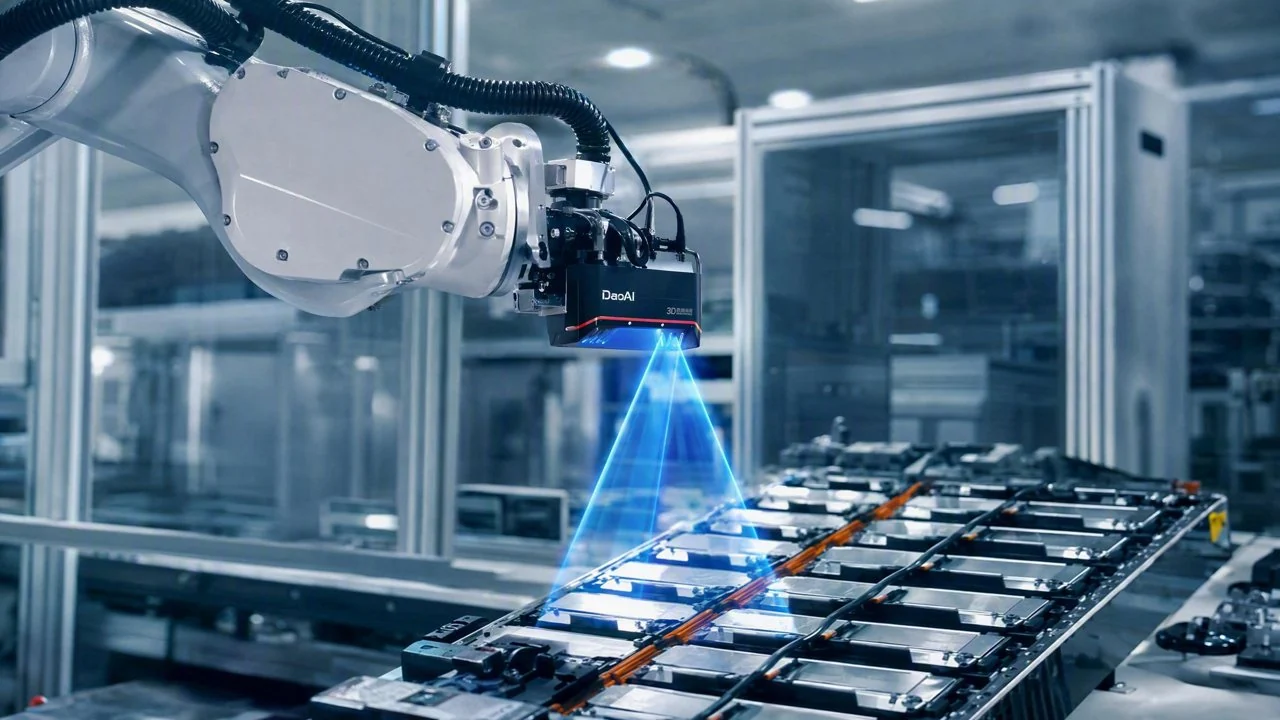
WeLinkirt's DaoAI 3D Robot Vision system, with its proprietary 3D camera, 6D pose estimation, bin picking, guidance for dispensing/assembly/loading & unloading, brain-eye-body closed-loop, and sub-millimeter hand-eye coordination capabilities, has elevated the average detection rate for new energy battery module weld spot inspection from approximately 95% with traditional solutions to over 99.7%, significantly reducing the missed defect rate to below 0.3%. This provides robust quality assurance for battery manufacturers. The new energy battery industry is experiencing unprecedented rapid growth, and the quality of its core component—the battery module—directly impacts vehicle performance, range, and safety. During module manufacturing, the welding quality between cells and busbars is crucial, especially concerning the completeness, consistency, and absence of cold solder joints, missing welds, or short circuits. A leading new energy battery manufacturer's production line faces increasingly stringent quality requirements and production rhythm pressures. Their module weld spot inspection process is a critical link in ensuring product reliability. Traditional inspection solutions struggle to meet their extreme demands for high detection rates and low missed defect rates, particularly under the challenges posed by complex 3D structures and reflective materials.
Pain Points: Why This Hurdle Is Difficult to Overcome
In new energy battery module weld spot inspection, traditional methods face multiple challenges. Firstly, battery modules have a compact internal structure with densely arranged weld spots in 3D, making it difficult for conventional 2D vision solutions to acquire complete spatial information. This leads to weld spot occlusion and inaccurate morphological measurements, ultimately affecting the missed defect rate. Secondly, weld spot surfaces often exhibit reflections, high-brightness areas, as well as tiny defects like welding spatter and oxidation layers. These factors frequently cause false positives or missed defects in traditional image processing. Thirdly, the industry demands extremely high quality for module weld spots, requiring the detection of sub-millimeter defects such as cold solder joints, insufficient welds, pores, and cracks, posing a severe test for inspection accuracy. Traditional rule-based AOI systems require extensive manual parameter adjustments when facing new defect types or minor process parameter changes, resulting in long changeover downtime and an inability to adapt to rapidly changing production needs. Furthermore, manual visual inspection is not only inefficient and costly but also limited by human eye fatigue and subjective judgment, with an average missed defect rate typically above 5%, and lacks data traceability. Similar to how Honor Robot Phone aims to redefine user experience through embodied interaction technology, industrial inspection urgently needs to shift from passive identification to active perception and closed-loop control to eliminate human intervention bottlenecks.
Specifically, the client's pain points primarily include: 1. **Persistent High Missed Defect Rate**: Traditional solutions struggle to effectively identify tiny defects in complex backgrounds, leading to an average missed defect rate of 3-5% for critical weld spot defects. If these defects flow to downstream processes or end-users, they can cause serious quality incidents and recall risks. 2. **High False Positive Rate**: Due to factors like weld spot surface reflections and ambient light interference, traditional solutions often have a false positive rate of around 10%, resulting in numerous good products being misidentified. This necessitates significant manual re-inspection hours (approximately 200 hours per month), severely slowing down the production rhythm. 3. **Insufficient Flexibility**: New energy battery products iterate quickly, with frequent minor adjustments in module design and weld spot layout. Traditional vision systems require several hours or even days for changeover, failing to meet the demands of multi-variety, small-batch production. 4. **Lack of Data Closed Loop**: There is no effective feedback mechanism between inspection data and upstream welding processes, preventing the formation of a closed-loop optimization for quality management.
Technical Principles
The micro-chain love DaoAI 3D robot vision system effectively addresses these pain points primarily due to its unique software and hardware collaborative technology. At the hardware level, the system is equipped with WeLinkirt's self-developed high-precision 3D camera, capable of achieving micron-level 3D morphology reconstruction of battery module weld spots. This solves the problem of traditional 2D vision's inability to acquire depth information, allowing the system to accurately identify 3D features of weld spots such as height, volume, and coplanarity, thereby effectively distinguishing morphological defects like cold solder joints and insufficient welds. At the software level, the core of WeLinkirt's DaoAI robot vision is its advanced 6D pose estimation algorithm and brain-eye-body closed-loop control system. Through deep learning and computer vision technology, the system can precisely identify the 3D spatial position and attitude of weld spots, guiding the robotic arm to perform inspection with sub-millimeter accuracy. Similar to Honor Robot Phone's pursuit of embodied interaction, DaoAI's 'brain-eye-body closed loop' allows the robot not only to 'see' clearly but also to 'understand' and 'execute' inspection tasks, achieving real-time coordination of vision, decision-making, and motion, ensuring that each inspection is performed at the optimal angle and distance. This realization of embodied intelligence enables the WeLinkirt DaoAI system to reduce the missed defect rate to levels far below traditional solutions, for example, reducing the missed defect rate by over 80% in actual production lines.
Compared to traditional methods, WeLinkirt's DaoAI 3D Robot Vision offers advantages in: **1. Precise 3D Perception**: The proprietary 3D camera overcomes inherent imaging challenges of 2D vision such as reflections and shadows. By constructing real 3D models from point cloud data, its accuracy in identifying weld spot defects far surpasses rule-based AOI. **2. Deep Learning Intelligence**: Based on the WeLinkirt DaoAI ACI (AI-AOI) software system, it utilizes APDT positive/few-shot learning technology, requiring only 1-20 good sample images for rapid model training. This avoids the tedious rule writing and parameter adjustment of traditional AOI, significantly shortening changeover time. **3. Flexible Robotic Deployment**: Combined with 6D pose estimation, the robot can flexibly adjust inspection paths and angles, covering complex areas inaccessible to traditional fixed AOI, achieving comprehensive inspection of weld spots from any angle. **4. Closed-Loop Quality Management**: WeLinkirt's DaoAI World model, serving as a unified foundation, can provide real-time feedback of inspection data to upstream welding equipment, enabling adaptive adjustment and optimization of process parameters, forming a true quality closed loop.
Typical Application Scenarios
- **Module Cell and Busbar Connection Weld Spot Inspection**: Detects defects such as cold solder joints, missed welds, pores, and cracks in laser weld spots between cells and busbars. The challenge lies in the tiny, densely arranged weld spots, with spatter and reflections often occurring at the weld seams. WeLinkirt's DaoAI 3D Robot Vision accurately identifies weld spot geometric features through 3D morphology reconstruction, effectively preventing misjudgments.
- **Module Side Plate and End Plate Connection Weld Seam Inspection**: Inspects the integrity, continuity, and presence of structural defects like incomplete penetration or burn-through in module housing welds. The difficulty lies in typically long weld seams that may have curvature, requiring both speed and precision in inspection. DaoAI 3D Vision's robotic guidance ensures precise coverage of the inspection path.
- **Battery Pack Cooling Plate Weld Spot Inspection**: Inspects the sealing and integrity of weld spots in the cooling plate waterways within the battery pack, ensuring no leakage risk. The challenge involves complex cooling plate structures, weld spots potentially located in confined spaces, and extremely high inspection precision requirements to prevent tiny cracks. WeLinkirt's DaoAI 3D Robot Vision's sub-millimeter hand-eye coordination plays a crucial role here.
- **PACK Casing Seal Weld Seam Inspection**: Inspects the quality of sealing weld seams on the exterior casing of the battery pack to prevent moisture and dust ingress. The difficulty lies in the large length of the weld seams, requiring consistency and efficiency for full-segment inspection. DaoAI's efficient data acquisition and processing capabilities enable full coverage inspection at high takt times.
- **BMS Terminal Weld Spot Inspection**: Inspects the welding quality of various terminals on the Battery Management System (BMS) circuit board, including pin coplanarity, solder joint fullness, and the presence of short circuits or cold solder joints. The challenge involves dense electronic components, extremely small weld spots, and strict requirements for 3D parameters like coplanarity. DaoAI's 3D camera can precisely measure micron-level morphology.
Case Study
A leading domestic new energy battery manufacturer faced numerous challenges with traditional AOI systems in the module weld spot inspection stage when establishing a new module production line. Their original production line used a rule-based 2D AOI combined with manual re-inspection, resulting in an average missed defect rate of about 4.5% for module weld spot defects. This led to approximately 500 defective products flowing downstream each month, causing significant rework costs and potential quality risks. Simultaneously, due to a false positive rate as high as 12%, 2-3 employees were required daily for re-inspection, consuming substantial human resources. To address this predicament, the manufacturer introduced WeLinkirt's DaoAI 3D Robot Vision system. After a month-long trial run and optimization, the WeLinkirt DaoAI team significantly improved inspection performance by rapidly collecting data from actual weld spot defect samples on the production line, conducting APDT few-shot training, and leveraging the high-precision 3D morphology reconstruction capabilities of the 3D camera. After deployment, the system's average detection rate stabilized at over 99.7%, successfully reducing the missed defect rate to <0.3%, cutting the number of defective products flowing downstream by over 93%. Concurrently, the false positive rate was dramatically reduced to 1.5%, decreasing manual re-inspection hours by 85% and greatly optimizing human resource allocation and production efficiency. The rapid changeover capability of the WeLinkirt DaoAI system also received high praise from the client; importing new module models now only takes 5min to complete model updates and parameter adjustments, far less than the several hours required by traditional solutions.
WeLinkirt's DaoAI 3D Robot Vision system not only enhanced the precision of module weld spot inspection but also brought new advancements to new energy battery production quality management through data closed-loop.
WeLinkirt Solutions and Products
The core solution WeLinkirt provided to this client is its DaoAI 3D Robot Vision system. This system integrates WeLinkirt's proprietary high-precision 3D camera, capable of performing high-resolution 3D scans of battery module weld spots to obtain precise point cloud data. Through the WeLinkirt DaoAI ACI OS, leveraging its powerful feature recognition capabilities and APDT few-shot learning technology, automatic programming and training of the inspection model can be completed in just 5 minutes with only a small number of good samples (1-20 images). In actual deployment, the WeLinkirt DaoAI robot vision system uses 6D pose estimation technology to guide collaborative robots to precisely reach each weld spot. Even when facing complex 3D structures and randomly placed modules, it achieves accurate positioning and inspection. The system supports 100% on-premises private deployment, ensuring customer data security. Furthermore, the WeLinkirt DaoAI World model, as the underlying unified platform, further enhances the system's semantic understanding and cross-scenario generalization capabilities, continuously learning from production line feedback for iterative optimization of inspection strategies. Its open SDK/API interfaces also facilitate integration with existing MES/SCADA systems, enabling data interoperability.
The quantifiable results delivered by WeLinkirt's DaoAI 3D Robot Vision system are significant: **1. Substantial Increase in Detection Rate**: Weld spot defect detection rate consistently >99.7%, far exceeding traditional solutions, effectively preventing defective products from flowing downstream. **2. Significant Reduction in Missed Defect Rate**: Missed defect rate reduced to <0.3%, greatly enhancing product quality and safety assurance. **3. Lower False Positive Rate**: False positive rate reduced by over 85%, saving substantial manual re-inspection hours and improving overall production line efficiency. **4. Improved Changeover Efficiency**: New product changeover time shortened from several hours to 5min, significantly increasing production line flexibility. **5. Data Closed Loop and Traceability**: All inspection data is traceable and provides real-time feedback to upstream processes, driving quality management from passive detection to proactive prevention and optimization, delivering tangible business value to the client.
FAQ
How does the DaoAI 3D Robot Vision system ensure sub-millimeter hand-eye coordination accuracy?
WeLinkirt's DaoAI 3D Robot Vision system achieves sub-millimeter hand-eye coordination accuracy by utilizing its proprietary high-precision 3D camera to acquire accurate 3D point cloud data. This data is combined with advanced 6D pose estimation algorithms to precisely calculate the spatial position and attitude of target objects. Furthermore, we employ a brain-eye-body closed-loop control strategy to continuously correct robot arm movements in real-time, ensuring precise synchronization between visual perception and robotic execution, thereby meeting the high-precision inspection demands for new energy battery module weld spots and similar applications.
What are the core advantages of DaoAI 3D Robot Vision compared to traditional 2D AOI for new energy battery inspection?
The core advantages of DaoAI 3D Robot Vision lie in its 3D perception capabilities and robotic flexibility. Traditional 2D AOI cannot acquire depth information, struggling with reflections, shadows, and defects in complex 3D structures. In contrast, DaoAI's 3D camera reconstructs the true morphology of weld spots, identifying micron-level 3D defects like cold solder joints and pores. Combined with a robot, it enables multi-angle, comprehensive inspection and supports rapid changeover, adapting to multi-variety, small-batch production—capabilities difficult for 2D AOI to achieve.
What is the approximate deployment cost and timeline for the DaoAI 3D Robot Vision system?
The deployment cost of the DaoAI 3D Robot Vision system is influenced by various factors, including the complexity of the required inspection, the difficulty of integrating with existing production lines, and whether customized functionalities are needed. We offer flexible hardware and software configuration options to provide customers with the most cost-effective solutions. Deployment timelines typically range from several weeks to a few months, depending on project complexity and client cooperation. For a precise quote and detailed deployment plan, we recommend contacting our sales engineers for a free consultation and on-site assessment.
Full solution for this scenario: the full inspection solution for New-energy batteries · New-Energy Battery Module Weld Misalignment Detection
This article was generated by AI. Customer cases are simulated scenarios based on real product capabilities and figures are illustrative; see product pages for official benchmarks.