
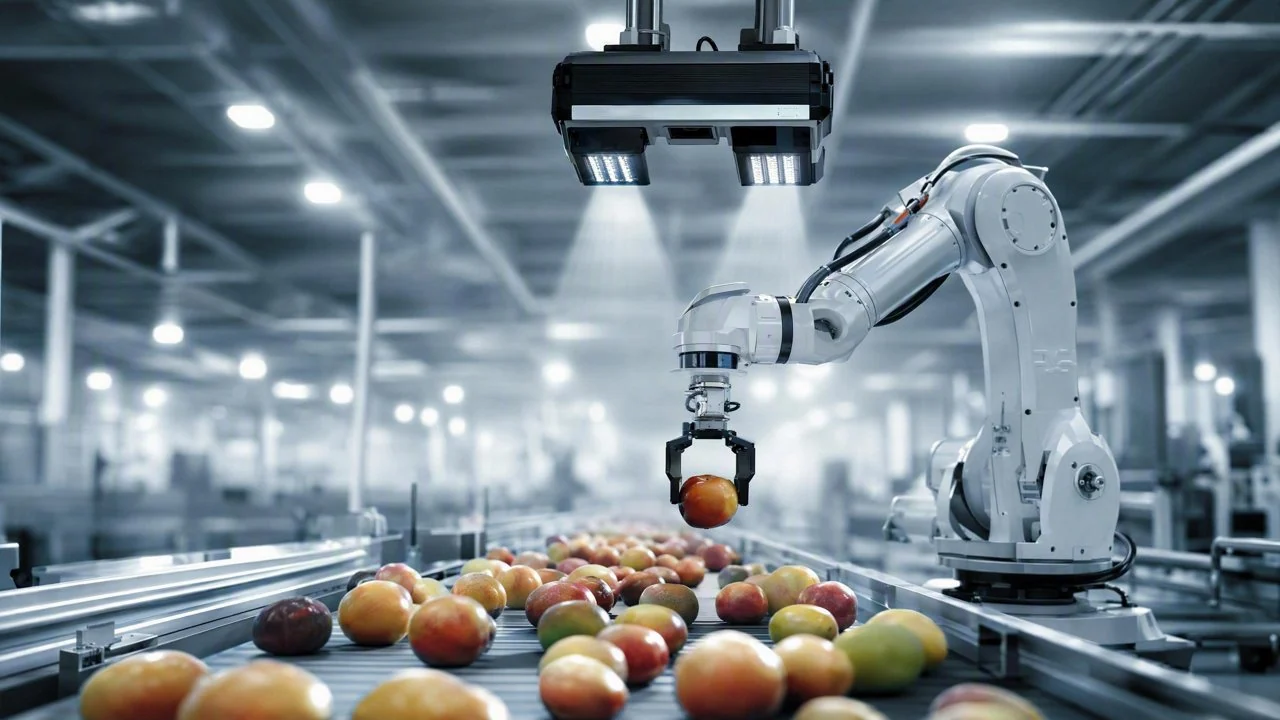
Post-harvest processing, particularly maturity sorting of agricultural products, is critical for determining shelf life, market value, and consumer satisfaction. DaoAI 3D Robot Vision, with its proprietary 3D camera and advanced 6D pose estimation, precisely identifies produce ripeness and guides robots for bin picking and sorting. This system successfully establishes a full-chain quality traceability and data closed-loop from harvest to final storage, reducing the misjudgment rate caused by human experience from an average of 8% to <2%. It significantly enhances sorting efficiency and product uniformity, ensuring the reliability of high-end agricultural product batch quality.
In the food/agriculture industry, agricultural product maturity sorting has traditionally been a labor-intensive process heavily reliant on human expertise. Taking a large fruit processing enterprise as an example, it processes tens of thousands of kilograms of various fruits daily, requiring precise sorting based on ripeness and appearance defects. On traditional production lines, workers visually inspect fruits for color, spots, and shape for grading. This method is inefficient when dealing with high volumes of rapidly moving produce and is highly susceptible to subjective judgment, fatigue, and lighting conditions, leading to inconsistent sorting results that impact product quality stability and market reputation. Furthermore, the lack of standardized data and records makes product quality traceability difficult; in cases of consumer complaints or market feedback, it's challenging to quickly identify problematic batches and causes.
Pain Points: Why This Hurdle Is So Difficult to Overcome
Agricultural product maturity sorting faces multiple challenges, making it a persistent bottleneck in production lines. Firstly, **high misjudgment rates and low consistency**: Under traditional manual sorting, due to variations in worker experience and physiological fatigue, maturity misjudgment rates typically range from 8% to 12%. For instance, subtle differences between early ripe, normally ripe, overripe, and diseased produce are often difficult to distinguish accurately by eye, leading to substandard products mixing with premium ones, or premium products being misclassified as substandard, directly affecting commercial value. Secondly, **high labor costs and recruitment difficulties**: This process is highly labor-dependent, requiring a large number of skilled workers, especially during peak harvest seasons, leading to soaring labor costs. Younger workers are generally unwilling to undertake such repetitive and intensive tasks, causing severe labor shortages for enterprises. Thirdly, **lack of data support and difficult quality traceability**: Manual sorting processes lack standardized data records, making it impossible to quantitatively track the maturity and sorting path of each agricultural product. This renders the quality traceability system ineffective. In the event of a quality issue, it is difficult to trace it back to specific sorting stages and batches, posing potential risks to brand reputation. Additionally, **high changeover costs and low flexibility** present another significant challenge. The maturity judgment criteria differ for various types and batches of agricultural products. Traditional automated equipment often requires complex parameter adjustments or even hardware changes, resulting in long downtime for changeovers and poor production flexibility, making it difficult to adapt to multi-variety, small-batch production demands.
Delving into the root causes, the complexity of agricultural product maturity judgment lies in the non-linear correlation of its multi-dimensional features. A single color indicator is insufficient to reflect maturity; it requires combining various visual information such as shape, texture, and gloss, and even assessing internal structure or hardness. Traditional 2D vision technology struggles to capture the true 3D morphology and deep texture information of fruits, while manual inspection is subject to subjective factors. Furthermore, agricultural products on conveyor belts are often randomly stacked and oriented differently, posing severe challenges for machine vision systems in recognition and grasping. Current industry hot topics in humanoid robots and embodied intelligence are also focusing on how to enable robots to achieve stronger “brain-eye-body” coordination in complex, unstructured environments, and agricultural product sorting is a typical scenario for the application of such technologies, requiring overcoming the closed-loop bottlenecks of perception, decision-making, and execution.
Technical Principles
The DaoAI 3D Robot Vision system by WeLinkirt fundamentally solves the challenges of agricultural product maturity sorting by integrating proprietary high-precision 3D cameras and advanced 6D pose estimation algorithms. Its core technology lies in acquiring centimeter-level or even sub-millimeter-level 3D morphological data of agricultural products, combined with deep learning models for feature extraction and judgment. DaoAI’s self-developed 3D cameras use structured-light projection; the system can also ingest depth data from third-party Time-of-Flight (ToF) cameras, generating high-density point cloud data in real-time, accurately reconstructing the true 3D geometry and surface details of agricultural products, including subtle depressions, protrusions, and intricate texture variations. These are critical pieces of information that traditional 2D images cannot provide. For example, by analyzing changes in fruit curvature and volume, its growth status and maturity can be judged more accurately.
At the algorithm level, WeLinkirt's DaoAI 6D pose estimation algorithm can calculate the precise position and orientation (X, Y, Z, Rx, Ry, Rz) of agricultural products in space in real-time. This means that no matter the angle or stacking method of the produce, the system can accurately “see” and locate it. Combined with advanced deep learning models, the system can perform multi-modal fusion analysis on this 3D data, identifying subtle differences in color gradients, texture features, and spot distribution at various maturity stages. For instance, for a specific fruit, the model can learn the spectrum of color changes, the decay of surface gloss, and slight deformations due to softening as it transitions from unripe to ripe and then overripe. Compared to traditional rule-based 2D AOI or manual inspection, the DaoAI 3D Robot Vision system by WeLinkirt offers higher precision, faster speed, and possesses powerful generalization and self-learning capabilities. Traditional methods often rely on predefined thresholds or human experience, making it difficult to adapt to the high variability of agricultural products and changing environments. In contrast, the WeLinkirt system, leveraging APDT few-shot self-training technology, can quickly train models with just a few good samples, achieving 0-code rapid changeover, reducing new product changeover time from hours to 5min, greatly enhancing production line flexibility and efficiency. Concurrently, the system records each sorting result, building a full-chain quality traceability system from harvest to sorting and packaging, providing data support for subsequent quality management and optimization.
Typical Application Scenarios
- **Precise Fruit Maturity Grading**: The DaoAI 3D Vision system can perform multi-dimensional maturity assessment for fruits like apples, pears, and citrus. By analyzing fruit color, surface texture, plumpness, and subtle deformations, it sorts them into categories such as unripe, normally ripe, and overripe. The challenge lies in the significant visual feature differences in maturity across various varieties and batches, often with natural spots or damage, requiring precise differentiation between maturity features and defect features.
- **Smart Vegetable Quality Sorting**: For leafy and root vegetables, the DaoAI system can detect freshness, pest damage, and signs of decay. For example, it can inspect lettuce for leaf integrity, yellowing, and disease spots, and potatoes for sprouting, greening, and damage. The difficulty arises from irregular vegetable shapes, complex surfaces, and susceptibility to environmental factors like soil and moisture, demanding robust 3D perception capabilities.
- **Grain and Seed Defect Removal**: In seed processing, the DaoAI 3D Vision can identify and remove impurities, diseased seeds, underfilled seeds, or damaged seeds. Through 3D morphological analysis, it can accurately determine seed size, shape, plumpness, and even tiny surface cracks. The challenge is that seeds are small, numerous, and defect features are often inconspicuous, requiring high-resolution, high-speed detection capabilities.
- **Meat Product Appearance Quality Assessment**: For fresh meat products, the DaoAI system can evaluate color uniformity, fat distribution, presence of foreign objects, damage, or spoilage signs on the surface. Through 3D reconstruction, it can determine if meat cuts are intact and evenly sliced. The difficulty lies in the complex reflections on meat surfaces, subtle color variations, and biological heterogeneity, demanding high generalization capabilities from the vision model.
- **Aquatic Product Grading and Foreign Object Detection**: In the processing of aquatic products like fish, shrimp, and crabs, DaoAI 3D Vision can grade based on size, shape, and integrity, and detect parasites, foreign objects, or damage. The challenge is that aquatic products have slippery, reflective surfaces and diverse forms, requiring fast and accurate recognition and localization under high-speed conveyance.
Implementation Case Study
A leading domestic agricultural product deep processing enterprise, whose core business is supplying pre-packaged fruits to high-end supermarkets, faced severe maturity sorting efficiency bottlenecks and quality consistency challenges before adopting the WeLinkirt DaoAI 3D Robot Vision system. Their traditional production line relied on manual sorting, requiring nearly a hundred workers in three shifts daily. This method was slow, and due to the subjectivity of human judgment, the misjudgment rate for maturity sorting was as high as about 10%, directly impacting product shelf life and customer satisfaction. Furthermore, the lack of digital records made quality traceability costly and difficult to comply with increasingly stringent food safety regulations.
To address these pain points, the enterprise deployed the WeLinkirt DaoAI 3D Robot Vision system. This system comprises multiple sets of DaoAI's proprietary 3D cameras, high-precision industrial robots, and an intelligent decision-making unit powered by the DaoAI World Model. During the implementation, the WeLinkirt engineering team utilized APDT few-shot self-training technology, completing model training and deployment within 30 minutes using only 15 good samples of different maturity levels. After deployment, the system achieved precise 6D pose recognition and maturity judgment for randomly oriented fruits on the conveyor belt, guiding robotic arms for bin picking and classification. Before deployment, the production line processed approximately 3000 fruits per hour with a 10% misjudgment rate. After deployment, the DaoAI 3D Robot Vision system increased processing speed to 4500 fruits per hour while drastically reducing the maturity misjudgment rate to <2.5%. More importantly, the system generates a unique ID for each sorted fruit, recording its maturity level, sorting time, and batch information, which is uploaded to the enterprise's MES system, building a traceable digital archive. This enables the enterprise to achieve full-chain quality traceability from the orchard to the consumer's table. In case of issues, the specific batch and sorting stage can be identified within 10min, significantly improving food safety management. Additionally, this solution reduced labor costs by 80%, with an estimated return on investment within 1.5 years.
The WeLinkirt DaoAI 3D Robot Vision system not only improved the efficiency and accuracy of agricultural product sorting but, more crucially, established a full-chain digital traceability system, giving agricultural product quality management an intelligent boost.
WeLinkirt Solutions and Products
The WeLinkirt DaoAI 3D Robot Vision system is the core of this agricultural product maturity sorting solution. It integrates WeLinkirt's independently developed high-precision 3D cameras, capable of real-time acquisition of centimeter-level 3D point cloud data of agricultural products, laying the foundation for subsequent precise recognition. Combined with advanced 6D pose estimation technology, the system can accurately identify agricultural products in any posture and stacking on the conveyor belt, calculating their precise position and orientation in space, providing accurate guidance for robot grasping. For the complex task of agricultural product maturity judgment, the WeLinkirt DaoAI World Model serves as a unified foundation, playing a crucial role. It possesses powerful semantic understanding and cross-scenario generalization capabilities, precisely identifying maturity features of different varieties and batches of agricultural products through continuous learning from massive agricultural product images and 3D data, and can even perform fine-grained grading according to customized customer standards. APDT few-shot self-training technology further simplifies the new product introduction and model iteration process; enterprises do not need professional vision engineers, only a small number of good samples are required to complete model training and deployment in a short time, achieving 0-code rapid changeover, greatly enhancing the flexibility of the production line.
In terms of deployment, the WeLinkirt DaoAI solution supports 100% local private deployment, with all data processed within the customer's factory, ensuring data security and privacy. The system is provided in various forms such as SDK/API/Docker, allowing integration with existing MES/ERP systems to upload sorting data in real-time to the enterprise database, building a complete quality traceability chain. Furthermore, the system possesses brain-eye-body closed-loop capabilities, where robots adjust their grasping strategies in real-time based on visual feedback, achieving sub-millimeter hand-eye coordination to ensure every grasp is precise and non-damaging. Ultimately, the WeLinkirt DaoAI 3D Robot Vision system reduced the misjudgment rate of agricultural product maturity sorting by 75%, increased sorting efficiency by +50%, and effectively reduced labor costs by 80%, bringing significant economic and social benefits to enterprises, while providing consumers with safer and higher-quality agricultural products.
FAQ
How does the DaoAI 3D Robot Vision system achieve precise judgment of agricultural product maturity?
The WeLinkirt DaoAI 3D Robot Vision system utilizes proprietary high-precision 3D cameras to acquire 3D morphological data of agricultural products. Combined with 6D pose estimation algorithms, it precisely locates and analyzes multi-dimensional features such as fruit color, texture, and shape. Its core lies in the DaoAI World Model, which performs fused analysis of this 3D data through deep learning models, capable of recognizing subtle maturity differences far exceeding the precision of traditional 2D vision and manual inspection.
What is the approximate deployment cost and ROI period for the DaoAI 3D Vision solution?
The deployment cost of the DaoAI 3D Vision solution is influenced by various factors, including production line scale, number of robots, integration complexity, and customization requirements. Typically, initial investment will be higher than traditional manual solutions, but due to its significantly improved efficiency, reduced misjudgment rates, and saved labor costs, the return on investment is estimated to be within 1.5 to 3 years. We provide detailed cost-benefit analyses; please contact our experts for a customized quote.
How does DaoAI Robotics Vision ensure quality traceability after agricultural product sorting?
After each sorting operation, the WeLinkirt DaoAI 3D Robot Vision system generates a unique digital ID for each agricultural product, recording its maturity level, sorting time, batch, and other detailed data. This data is uploaded in real-time to the customer's MES/ERP system, forming a complete digital archive. This enables enterprises to achieve full-chain quality traceability from source harvesting to final consumption, allowing for rapid identification and analysis of issues should quality problems arise.
Full solution for this scenario: the full inspection solution for Food / agriculture · Produce Ripeness Grading & Sorting
This article was generated by AI. Customer cases are simulated scenarios based on real product capabilities and figures are illustrative; see product pages for official benchmarks.