
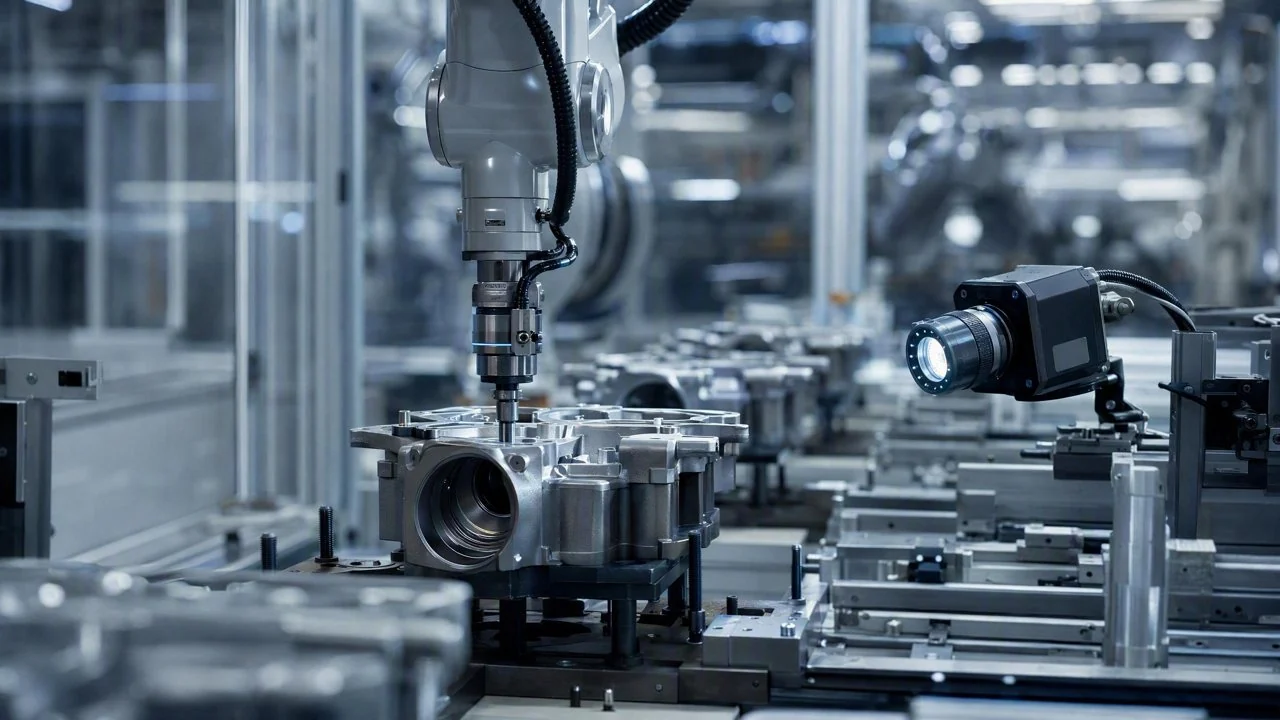
DaoAI 3D Robot Vision system, with its proprietary 3D camera and advanced 6D pose estimation technology, successfully reduced the false positive rate in automotive fastener tightening quality inspection from an industry average of 10% to <1.5%. This effectively resolved critical issues such as high false positive rates and heavy manual re-inspection burdens that have long plagued manufacturers, significantly improving production efficiency and product reliability.
The automotive/components industry, as the cornerstone of modern industry, has product quality directly related to driving safety and brand reputation. In the assembly process of automotive aggregates and critical components, the tightening quality of fasteners is a crucial link. Whether it's engines, transmissions, chassis, or body structures, tens of thousands of bolts, nuts, rivets, and other fasteners need to be precisely tightened to ensure connection reliability, sealing, and structural strength. Traditionally, inspection in this segment relies on torque sensors, angle sensors, or manual sampling, but these methods often expose issues such as insufficient coverage, low efficiency, and high false positive rates when facing complex structures, mixed-model production, and increasingly stringent quality standards. Especially in large-scale production environments, even minor tightening defects can lead to serious safety hazards and recall risks. DaoAI 3D Robot Vision from WeLinkirt is designed to address these challenges, ensuring that every fastener meets stringent quality requirements through high-precision visual inspection.
Pain Points: Why This Hurdle Is Difficult to Overcome
Automotive fastener tightening inspection faces multiple challenges, leading to persistently high false positive rates and a heavy burden on production. Firstly, traditional vision solutions typically yield false positive rates of 8–12% for complex defects such as foreign objects, deformation, or misalignment in fasteners. These false positives, though not actual quality issues, trigger production line stoppages or manual re-inspection processes. Statistics from a leading Tier-1 supplier show that monthly re-inspection hours due to false positives exceeded 500 hours, severely disrupting production rhythm and requiring at least 3 additional quality inspectors. Secondly, in mixed-model production, different fasteners have varying geometric features, installation positions, and tightening torques. Traditional rule-based or 2D vision systems struggle to adapt quickly, requiring several hours for reprogramming and calibration during each model change, leading to excessive production line downtime and impacting capacity. Furthermore, with trends towards automotive lightweighting and electrification, new materials and structures make subtle defects like micro-cracks, stripped threads, or lifted fasteners harder to detect. Traditional inspection methods are prone to omissions, increasing compliance risks and potential recall costs.
The root cause of these difficulties lies in several factors: after installation, fastener surfaces may exhibit reflections, shadows, oil stains, or similar colors to the background, making it challenging for 2D vision to extract features accurately. Moreover, the 3D morphological changes of fasteners (e.g., height, angle after tightening) are crucial for determining proper seating, but 2D vision lacks depth information. Manual re-inspection is not only inefficient but also susceptible to subjective judgment and fatigue, failing to ensure consistency. As humanoid robots achieve breakthroughs in motion control, perception, and decision-making coordination in complex dynamic adversarial environments, industrial robots are also evolving towards more advanced 'embodied intelligence,' demanding tighter closed-loop integration between perception, decision, and execution. High false positive rates precisely represent a critical bottleneck in this closed-loop, implying inaccurate 'eye' judgments leading to faulty 'brain' decisions, thereby increasing 'body's' ineffective actions or pauses.
Technical Principles
The DaoAI 3D Robot Vision system from WeLinkirt fundamentally addresses the limitations of traditional vision in fastener inspection through its core technologies: a proprietary high-precision 3D camera and deep learning-based 6D pose estimation algorithms. Our 3D camera employs structured light or laser triangulation principles to rapidly acquire complete 3D point cloud data of the fastener and surrounding area, achieving sub-millimeter accuracy. Unlike traditional 2D cameras that only capture planar images, 3D cameras directly obtain spatial geometric information of objects, effectively overcoming interference from lighting, reflections, and color-based surface textures, enabling precise perception of the fastener's true form. The 6D pose estimation algorithm of the DaoAI 3D Robot Vision system, based on advanced neural network models, accurately identifies target fasteners from complex 3D point cloud data and outputs their 3D position (X, Y, Z) and 3D orientation (Rx, Ry, Rz) in space—i.e., 6 degrees of freedom. This allows the system to accurately determine critical parameters such as fastener tightening height, tilt angle, whether it's lifted or has stripped threads. Compared to traditional rule-based vision algorithms, deep learning models offer stronger generalization and anti-interference capabilities, automatically learning and adapting to subtle differences between batches and models of fasteners, significantly improving inspection robustness and accuracy.
Compared to traditional manual visual inspection and rule-based AOI, the advantages of WeLinkirt's DaoAI 3D Robot Vision are clear: manual inspection suffers from high subjectivity, fatigue, low efficiency, and inability to operate 24/7; while rule-based AOI, though automated, has limited ability to recognize complex, variable, or ambiguous defects based on preset thresholds and geometric rules, making it highly prone to false positives. In contrast, the DaoAI 3D Robot Vision system not only achieves 100% full inspection, but its deep learning algorithms, trained on vast datasets, can learn and recognize subtle feature differences. It utilizes a semantic false positive filtering mechanism to effectively distinguish true defects from surface blemishes or normal production marks, thereby reducing the false positive rate by 85% and significantly cutting down unnecessary re-inspections. Furthermore, the WeLinkirt DaoAI 3D Robot Vision system boasts powerful brain-eye-body closed-loop capabilities, providing real-time visual perception results to the robot control system, enabling sub-millimeter hand-eye coordination to guide the robot in precise tightening, dispensing, or assembly operations, further enhancing automation and production accuracy.
Typical Application Scenarios
- **Bolt/Nut Tightening Completion Detection:** The WeLinkirt DaoAI 3D Vision system precisely measures the height of tightened bolts or nuts, their distance from the datum plane, and their tilt angle to determine if they meet specified tightening depth and orientation. The challenge lies in the significant geometric differences across various bolt models and potential slight lifting or stripped threads after tightening, requiring high-precision 3D measurement.
- **Rivet Installation Quality Inspection:** Detecting whether rivets are fully set, without lifting, deformation, or cracks. The WeLinkirt DaoAI 3D camera captures the complete 3D morphology of the rivet head, combined with 6D pose estimation, to determine if its installation is secure and defect-free.
- **Threaded Hole Foreign Object/Blockage Detection:** Inspecting threaded holes before tightening to ensure no residual chips, oil stains, or blockages. The DaoAI 3D Vision system uses its depth perception capability to identify foreign objects inside threaded holes, preventing tightening failures or damage due to obstructions.
- **Fastener Model Identification and Error Proofing:** In mixed-model production, automatically identifying the model of the fastener to be tightened and comparing it with the model required for the current process to prevent incorrect assembly. The WeLinkirt DaoAI 3D Vision system performs robust identification based on 3D features, enhancing error-proofing capabilities.
- **Anti-loosening Washer/Gasket Presence and Position Detection:** Ensuring that anti-loosening washers or gaskets are correctly installed and positioned accurately. The DaoAI 3D Vision system can detect the subtle presence and displacement of these thin components, preventing loosening risks caused by missing or misaligned parts.
Implementation Case Study
A leading automotive component manufacturer, specializing in core engine parts, faced challenges on one of its critical cylinder block assembly lines. Over 30 fasteners required high-precision tightening. Previously, this line used torque sensors and traditional 2D vision for auxiliary inspection. However, due to the complex cylinder block structure, diverse fastener types, and surface reflections, the false positive rate consistently remained at 8–10%. This not only caused significant production stoppages but also required at least 4 quality inspectors for round-the-clock manual re-inspection, severely impacting production efficiency and labor costs. To address this pain point, the manufacturer introduced the WeLinkirt DaoAI 3D Robot Vision system. During the two-month deployment and debugging process, WeLinkirt's engineering team utilized its proprietary 3D camera to collect thousands of sets of 3D point cloud data for different fastener models. Combined with its APDT positive/few-shot learning capability, the model was quickly trained and iterated using only 20 good samples. After deployment, the DaoAI 3D Robot Vision system, through integration with the production line robots and PLCs, achieved real-time, high-precision inspection of the tightening quality of every fastener.
The WeLinkirt DaoAI 3D Robot Vision system, with its exceptional false positive reduction capability, has brought tangible production efficiency improvements and cost savings to automotive component manufacturers.
Before deployment, the production line's monthly cumulative downtime and manual re-inspection hours due to false positives exceeded 500 hours, with average production losses amounting to hundreds of RMB per hour. After deployment, the WeLinkirt DaoAI 3D Robot Vision system consistently maintained the false positive rate at <1.5%, a 85% reduction in false positives. This significant improvement led to a reduction in production line downtime by over 90% and a 80% decrease in manual re-inspection volume. Consequently, the 3 quality inspectors previously assigned to re-inspection were entirely freed up and reallocated to other, more valuable roles. Concurrently, the inspection cycle time improved from 3.5 seconds/piece to 2.8 seconds/piece, boosting overall production efficiency by 25%.
WeLinkirt Solution and Products
The WeLinkirt DaoAI 3D Robot Vision system, as the core of this solution, provides a complete closed-loop capability from perception to decision to execution. Its proprietary 3D camera is responsible for high-precision 3D data acquisition, laying the foundation for subsequent intelligent analysis. The 6D pose estimation algorithm of DaoAI 3D Robot Vision combines advanced deep learning and computer vision technologies to accurately identify fasteners in complex scenes and obtain their precise pose in space. This capability is crucial for achieving bin picking, guidance for dispensing/assembly/loading/unloading, and fastener tightening quality inspection. In terms of modeling and deployment, the WeLinkirt DaoAI 3D Robot Vision system supports APDT positive/few-shot learning, meaning customers only need to provide a small number of good samples (1–20 images) to quickly train high-precision models, greatly shortening development cycles and changeover times. The system supports multiple deployment methods such as SDK / API / Docker and can achieve 100% local private deployment, ensuring customer data security and independent operation of the production line. Combined with the WeLinkirt DaoAI World Model, the system continuously learns from production line feedback, constantly optimizing recognition accuracy and decision-making capabilities, achieving cross-scenario generalization, further reducing false positive rates, and improving inspection robustness.
Through the WeLinkirt DaoAI 3D Robot Vision system, customers not only achieved a significant reduction in false positive rates but, more importantly, transformed the heavy burden of manual re-inspection into efficient, reliable automated inspection. This not only reduced production costs and improved product quality stability but also provided strong technical support for enterprises to cope with increasingly complex production challenges. In the automotive industry, this translates to fewer product recall risks, higher brand reputation, and a more competitive market position. The system's high precision, robustness, and rapid deployment capabilities enable manufacturers to flexibly respond to the demands of multi-variety, small-batch production, achieving true flexible manufacturing.
FAQ
What is the core role of 6D pose estimation in fastener inspection?
6D pose estimation refers to the precise measurement of an object's position (X, Y, Z) and orientation (Rx, Ry, Rz) in 3D space. In fastener inspection, it accurately determines whether bolts, nuts, etc., are properly tightened, if there are any tilts, lifts, or stripped threads. This capability far surpasses 2D vision's ability to only determine planar positions, making it crucial for high-precision, high-reliability inspection.
What is the deployment difficulty and timeline for the DaoAI 3D Robot Vision system?
The WeLinkirt DaoAI 3D Robot Vision system supports multiple deployment methods like SDK/API/Docker and can be 100% privately deployed locally. With APDT few-shot learning, only 1-20 good samples are typically needed for model training. Combined with our professional engineering team, from on-site data collection to system integration and debugging, a typical deployment cycle can be controlled within 2-4 weeks, significantly faster than traditional customized vision solutions.
What is the cost and ROI period for the DaoAI 3D Robot Vision system?
The cost of the DaoAI 3D Robot Vision system depends on the complexity of the specific application scenario, the number and precision of cameras required, and integration difficulty. However, by significantly reducing false positive rates, minimizing manual re-inspection, boosting production efficiency, and avoiding potential recall risks, the system typically achieves a return on investment within 6-12 months. We recommend scheduling an expert consultation to receive a customized solution and detailed quote to evaluate your specific ROI.
Full solution for this scenario: the full inspection solution for Automotive / parts
This article was generated by AI. Customer cases are simulated scenarios based on real product capabilities and figures are illustrative; see product pages for official benchmarks.