
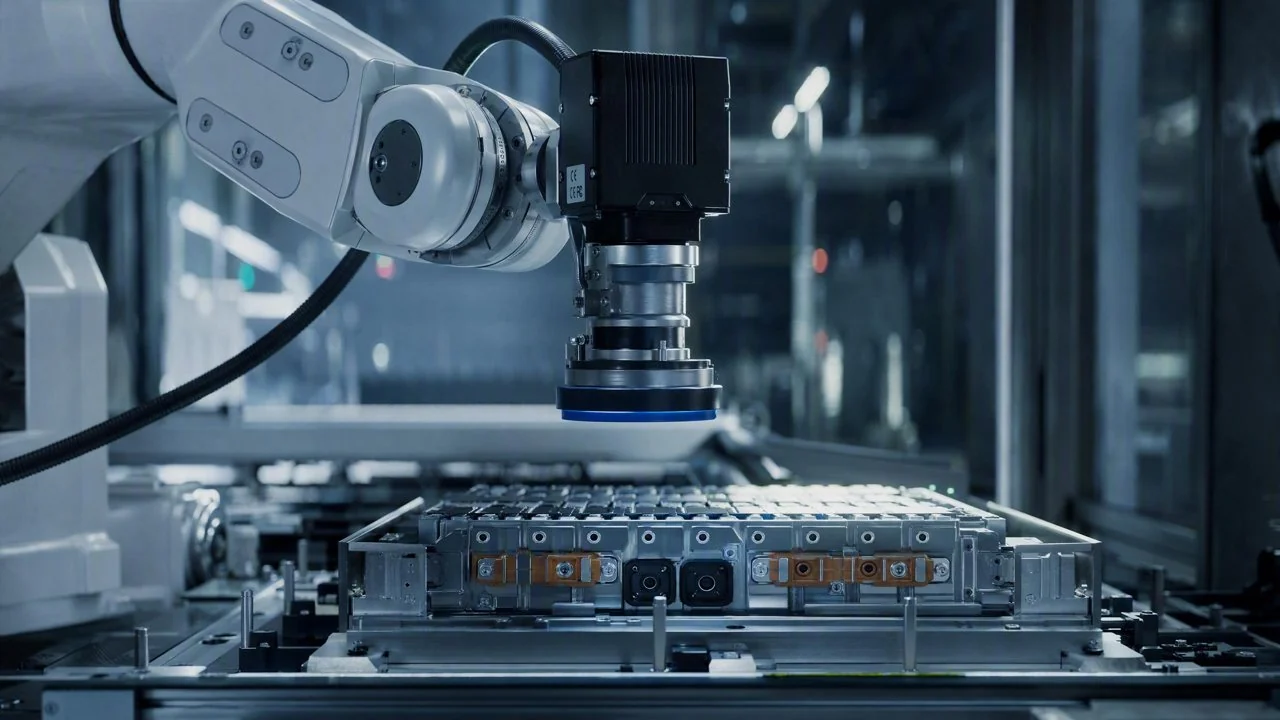
DaoAI 3D Robot Vision (self-developed 3D camera + 6D pose estimation, bin picking, glue dispensing/assembly/loading guidance, brain-eye-body closed loop, sub-millimeter hand-eye coordination) reduces the false negative rate for EV battery module solder joint inspection from a typical 1.5% to <0.3% by reconstructing 3D morphology and intelligently identifying defects, significantly enhancing overall production line inspection efficiency and product quality reliability.
Solder joint inspection for new energy vehicle (NEV) battery modules is a critical quality control step in battery production, directly impacting the safety, consistency, and cycle life of battery packs. As electric vehicle market demands for range and charging speed increase, battery energy density continues to rise, and the internal connection structures of battery modules become increasingly complex, featuring numerous, densely distributed, and diverse types of solder joints (e.g., laser welding, ultrasonic welding). On the production line of a leading NEV battery Tier-1 supplier, the quality of solder joints between cell connecting tabs and busbars is paramount. These joints must not only be mechanically robust but also ensure perfect electrical conductivity and heat dissipation efficiency. Any minute cold solder, missing solder, short circuit, or abnormal solder joint morphology could lead to localized overheating within the battery module, potentially escalating to thermal runaway. Therefore, high-precision, sub-millimeter, and highly reliable inspection of these critical solder joints is of utmost importance for ensuring the quality of NEV battery products.
Pain Points: Why This Hurdle Is Difficult to Overcome
NEV battery module solder joint inspection faces multiple challenges, leading to suboptimal detection rates and persistent false negatives with traditional solutions. Firstly, the complexity of solder joint morphology is a primary difficulty. Laser-welded joints may exhibit subtle collapses, spatter, pores, or cracks, while ultrasonic-welded joints might show uneven indentations or poor bonding. These defects are often minuscule and can be hidden within joint edges or internally, making them difficult for traditional 2D vision systems to capture their 3D characteristics effectively. Secondly, production cycle times impose stringent demands on inspection speed; inspecting several to dozens of modules per minute makes comprehensive manual inspection virtually impossible and highly susceptible to human fatigue, resulting in high false negative rates. Statistics show that traditional rule-based AOI systems for module solder joint inspection typically have false negative rates around 1.5%, which is unacceptable for high-value, high-safety NEV battery products. Furthermore, surface reflections, material variations, and ambient light changes can interfere with 2D image acquisition, increasing false positives and consuming significant manual re-inspection time. Finally, with the trend towards low-cost humanoid robot foundations and embodied intelligence, there is a growing demand for intelligent and flexible production lines, which traditional fixed inspection solutions struggle to meet for multi-model, small-batch production changeovers.
Specifically, traditional 2D AOI solutions in solder joint inspection suffer from the following root causes for high false negatives: first, the inability to acquire accurate 3D height information, rendering them ineffective for defects involving Z-axis changes like cold solder, collapses, or protrusions; second, facing reflective or shadowed areas, 2D image information is often incomplete or distorted, leading to misjudgments; third, rule-based algorithms lack generalization capabilities for new defect types or process fluctuations, requiring frequent parameter adjustments and incurring high maintenance costs. These factors collectively create bottlenecks for traditional solutions in ensuring high detection rates and effectively reducing false negatives for NEV battery module solder joints.
Technical Principles
The core of the DaoAI 3D Robot Vision solution by WeLinkirt lies in its self-developed high-precision 3D cameras and advanced 6D pose estimation technology. Utilizing structured light or laser triangulation principles, the system rapidly acquires complete 3D point cloud data of solder joint areas with sub-millimeter precision, reconstructing high-resolution surface morphology. Unlike traditional 2D cameras that only capture planar grayscale information, DaoAI's 3D cameras can precisely measure 3D features such as solder joint height, volume, and coplanarity, enabling accurate identification of cold solder, collapses, pores, spatter, short circuits, and all other defects involving Z-axis variations. Furthermore, combined with the semantic understanding capabilities of WeLinkirt's DaoAI World model and APDT few-shot learning technology, the system can quickly learn normal solder joint morphology characteristics from a small number of good samples and perform high-precision classification and localization of abnormal morphologies, effectively reducing the false negative rate.
Compared to traditional rule-based AOI or manual inspection, WeLinkirt's DaoAI 3D Robot Vision offers superior advantages due to richer data dimensions and stronger intelligent analysis capabilities. Traditional AOI relies on engineers manually setting numerous thresholds and geometric rules, which are sensitive to lighting and product tolerances, and struggle to cope with complex and diverse defect types. Manual inspection, on the other hand, is inefficient, inconsistent, and prone to fatigue, unable to meet high-cycle production demands. In contrast, DaoAI 3D Robot Vision, through deep learning algorithms, autonomously extracts defect features from vast amounts of 3D data, accurately identifying even micron-level morphological anomalies. Its 6D pose estimation capability allows robots to flexibly adjust inspection postures, adapting to different module types and complex structures, ensuring every solder joint is covered from the optimal angle, further boosting the detection rate and effectively mitigating the risk of false negatives.
Typical Application Scenarios
- **Laser Solder Joint Quality Inspection for Cell Connecting Tabs:** Inspecting laser solder joints between cell connecting tabs and busbars, identifying defects such as cold solder, missing solder, burn-through, pores, spatter, solder balls, and collapses. The challenge lies in the small size and high density of solder joints, with some defects being highly concealed. DaoAI 3D Vision accurately captures these minute anomalies through 3D morphology reconstruction.
- **Ultrasonic Solder Joint Indentation and Bonding Inspection for Busbars:** Evaluating the depth and width consistency of indentations on ultrasonic solder joints between busbars and cell tabs, as well as detecting poor bonding or cracking. The difficulty arises from the complex surface texture of ultrasonic solder joints, which 2D vision struggles to differentiate between normal texture and defects. WeLinkirt's DaoAI 3D Vision precisely measures deformation to assess bonding quality.
- **Module Busbar Dispensing Guidance and Defect Inspection:** Performing precision dispensing on module busbars, with DaoAI 3D Robot Vision providing sub-millimeter dispensing guidance to ensure uniform and accurately positioned glue lines. Simultaneously, inspecting post-dispensing defects such as glue width, height, breaks, and overflows, ensuring insulation and sealing performance.
- **Thermal Management Component Assembly Guidance and Misassembly/Missing Part Detection:** Guiding robots to precisely pick and place thermal management components like cooling plates and sensors within the module. Detecting misassembly, missing components, misalignment, or damage to ensure effective operation of the thermal management system. DaoAI 3D Robot Vision's 6D pose estimation capability plays a crucial role in such complex assembly tasks.
- **Overall Coplanarity and Gap Inspection After Module Assembly:** Performing overall coplanarity and flatness inspection of assembled battery modules, as well as measuring gaps between components. WeLinkirt's DaoAI 3D Vision can quickly scan the entire module surface, generating high-precision 3D models to evaluate overall deformation and assembly accuracy, ensuring module structural stability.
Implementation Case Study
A leading NEV battery Tier-1 supplier faced significant challenges in the solder joint inspection phase of their power battery module production line. Due to the complex module structure, dense solder joints, and various defect types, their traditional 2D AOI system, operating at high cycle times, consistently showed a false negative rate of around 1.5%. This led to a substantial number of defective products flowing into downstream processes, increasing rework costs and potential quality risks. Simultaneously, the false positive rate was as high as 8%, requiring multiple quality inspectors to perform manual re-inspection daily, severely impacting production efficiency. To enhance product quality and the level of production line intelligence, the customer adopted the WeLinkirt DaoAI 3D Robot Vision solution. After three months of system integration and debugging, and with the assistance of WeLinkirt engineers, the detection models for different module types were rapidly deployed using APDT few-shot self-training technology.
WeLinkirt's DaoAI 3D Robot Vision reduced the false negative rate for NEV battery module solder joint inspection by 80%, boosting the overall detection rate to over 99.7%, significantly alleviating the pressure of manual re-inspection.
After deployment, the DaoAI 3D Robot Vision system demonstrated exceptional performance. At the customer's site, its false negative rate successfully dropped to <0.3%, representing an 80% reduction compared to traditional solutions, raising the overall detection rate to over 99.7%. Concurrently, the false positive rate also significantly decreased by 75%, from 8% to below 2%, greatly reducing the burden of manual re-inspection and freeing up approximately 70% of quality inspection personnel. This not only effectively prevented defective products from entering the market, ensuring the ultimate quality and safety of battery modules, but also saved the customer substantial rework costs. Furthermore, the rapid changeover capability of the WeLinkirt DaoAI 3D Robot Vision solution reduced changeover time for different module types from the original 30 minutes to 5min, significantly enhancing production line flexibility and efficiency.
WeLinkirt Solutions and Products
The WeLinkirt DaoAI 3D Robot Vision solution, with its self-developed 3D cameras and powerful AI algorithms at its core, provides an end-to-end intelligent upgrade for NEV battery module solder joint inspection. Our 3D cameras deliver high-precision 3D point cloud data, combined with 6D pose estimation, enabling robots to accurately locate and inspect every solder joint. For deployment and integration, DaoAI offers flexible SDK/API interfaces, supporting integration with existing production line MES/SCADA systems to achieve closed-loop data management. For rapid changeover of different module types, we leverage the APDT few-shot learning technology within the DaoAI ACI (AI-AOI) software system, requiring only 1–20 good samples to automatically program new product inspection models within 5 minutes, greatly reducing changeover time and enhancing production line flexibility. Moreover, the WeLinkirt DaoAI World model, serving as a unified foundation, ensures semantic understanding and cross-scenario generalization capabilities, allowing the system to continuously learn from production line feedback and optimize detection performance. We support 100% local private deployment, ensuring customer data security and preventing leakage.
Through WeLinkirt's DaoAI 3D Robot Vision, customers have not only achieved a significant reduction in module solder joint false negatives, boosting the detection rate to over 99.7%, but also made substantial breakthroughs in overall production efficiency, quality management, and cost control. High-precision 3D inspection capabilities ensure the core safety and performance of battery products, reducing potential recall risks. Simultaneously, automated inspection reduces reliance on manual labor, optimizes human resource allocation, and effectively controls production costs. The successful implementation of this solution also validates WeLinkirt's leading practice in promoting the popularization of embodied intelligence and lowering the entry barrier for industrial robot vision applications.
FAQ
What are the main advantages of DaoAI 3D Robot Vision over traditional 2D AOI for NEV battery solder joint inspection?
DaoAI 3D Robot Vision's core advantage lies in its self-developed 3D camera, which acquires precise 3D morphological data for sub-millimeter accuracy inspection. Unlike traditional 2D AOI, which relies solely on planar grayscale information, 3D vision accurately identifies height-varying defects like cold solder, collapses, and pores, and effectively handles reflective interference. Combined with AI algorithms, it offers stronger generalization capabilities, significantly improving detection rates and reducing false negatives.
What is the typical cost and deployment timeline for the WeLinkirt DaoAI 3D Robot Vision solution?
Deployment costs primarily depend on production line scale, inspection precision requirements, robot integration level, and customization needs. WeLinkirt offers flexible SDK/API deployment options, supporting local private deployment to ensure data security. Typically, the timeline from requirements analysis to system go-live is about 3-6 months, with specific costs evaluated based on the detailed solution. We encourage customers to schedule an expert consultation for a customized quote and ROI analysis.
How does DaoAI 3D Robot Vision adapt to the diverse module types and rapid changeover demands in the NEV battery industry?
WeLinkirt's DaoAI 3D Robot Vision utilizes APDT few-shot self-learning technology, requiring only 1-20 good samples to automatically program new product inspection models within 5 minutes, significantly reducing changeover time. Concurrently, its 6D pose estimation capability provides robots with flexibility, allowing rapid adaptation to different module sizes and structures without extensive hardware adjustments, meeting the flexible demands of multi-model, small-batch production.
Full solution for this scenario: New-energy batteries industry solutions · New-Energy Battery Module Weld Misalignment Detection
This article was generated by AI. Customer cases are simulated scenarios based on real product capabilities and figures are illustrative; see product pages for official benchmarks.