
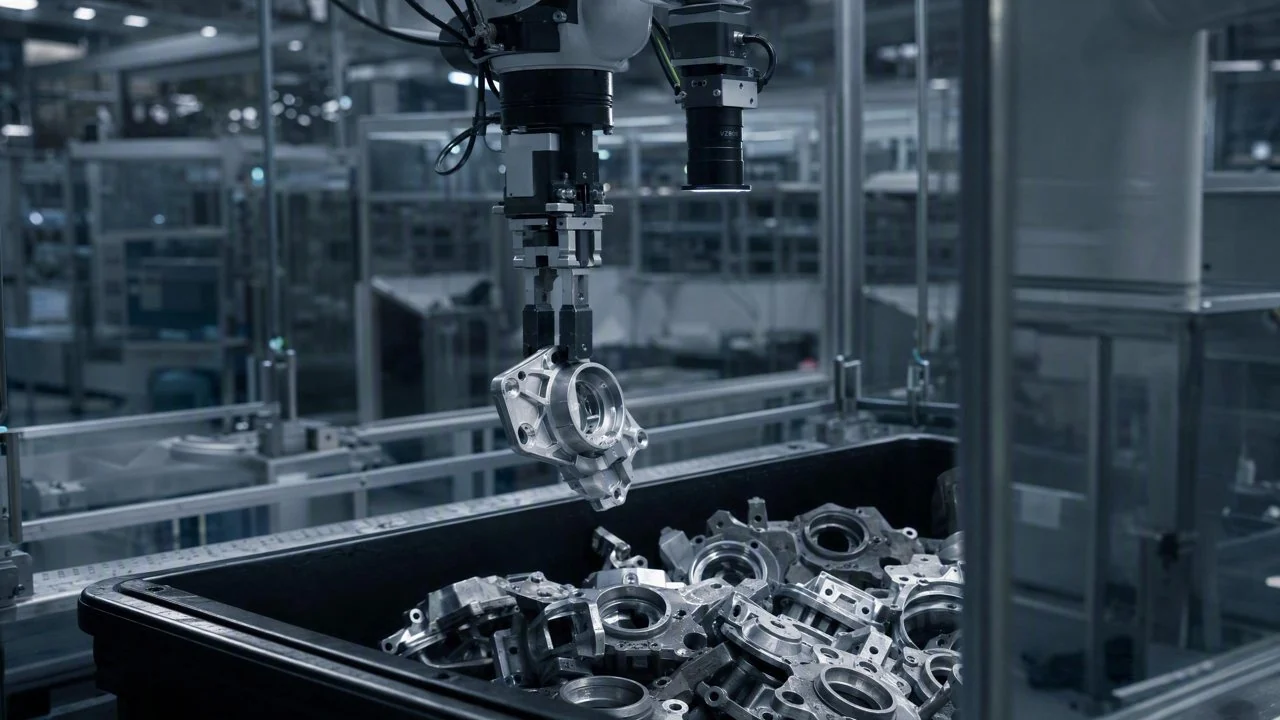
WeLinkirt's DaoAI 3D Robot Vision (proprietary 3D camera + 6D pose estimation, bin picking, glue dispensing/assembly/loading/unloading guidance, brain-eye-body closed-loop, sub-millimeter hand-eye coordination), powered by APDT few-shot self-training, has reduced the mis-detection rate of traditional solutions in automotive parts bin picking scenarios from 15% to <2.5%, achieving high-precision, high-efficiency automated picking. In the automotive and parts manufacturing sector, facing increasing demands for flexible production and diverse component geometries, achieving efficient and accurate disordered picking has consistently been a bottleneck in automation upgrades. Especially for a wide variety of automotive components that are stacked haphazardly, have reflective surfaces, or irregular shapes, traditional robot vision solutions often fall short, leading to low picking success rates and high mis-detection rates, severely impacting production rhythm and overall manufacturing efficiency.
In the pre-assembly stage of automotive and parts manufacturing, accurately picking randomly stacked components from bins and delivering them to the next workstation is a critical step towards fully automated production. A leading automotive Tier-1 supplier, for instance, needed to pick various types of stamped parts, castings, and injection-molded parts from standard Euro containers for subsequent assembly processes. These components range in size from tens to hundreds of millimeters, with diverse surface treatments including electroplating, painting, and bare metal, leading to vastly different reflective properties. Traditional automation solutions often rely on manual sorting or customized fixtures, which are inefficient and costly, struggling to adapt to the flexible production demands of multi-variety, small-batch manufacturing. WeLinkirt's DaoAI 3D Robot Vision is specifically designed to address these challenges, leveraging its innovative APDT few-shot self-training mechanism to quickly adapt to the recognition and picking of different components, significantly enhancing the level of production line automation.
Pain Points: Why This Hurdle Is Difficult to Overcome
In the context of automotive parts bin picking, challenges manifest in several dimensions: Firstly, **high mis-detection rates**. Traditional rule-based or simple 2D vision solutions often achieve less than 85% recognition success when faced with complex stacking and mutual occlusion of parts, leading to mis-detection and missed pick rates as high as 15%, requiring extensive manual intervention. Secondly, **inefficient changeover**. Each time the production line switches component models, traditional solutions demand hours or even days of expert engineer time for parameter adjustment and recalibration, resulting in prolonged line downtime, averaging 4-8 hours per changeover. Thirdly, **poor robustness to complex surfaces and lighting**. Automotive components often have metal or polymer surfaces, exhibiting complex optical phenomena such as specular reflection, diffuse reflection, and local shadows, which severely interfere with 2D vision imaging, making feature extraction difficult. Traditional solutions struggle to effectively address these challenges, fundamentally due to a lack of precise perceptual capabilities for 3D spatial information and object pose. Today's industry hot topic—how the human-brain-inspired embodied intelligence engine EngineAI Awaken enables robots to achieve higher levels of environmental perception and decision-making—precisely highlights this core pain point: robots need to build a complete 3D understanding of their environment through multi-modal perception (vision, touch, etc.), similar to the human brain, and make intelligent decisions based on this, rather than relying solely on planar information or predefined rules.
Traditional solutions for disordered bin picking primarily rely on 2D vision sensors for feature matching. However, due to the random stacking of components in bins, severe occlusion and pose variations occur, making feature points in 2D images unstable and prone to misidentification. For example, two parts with similar shapes but different poses might appear drastically different in 2D images, or entirely different parts might look highly similar from a specific viewpoint. Furthermore, common gloss and reflections on automotive component surfaces create highlights or shadows in 2D images, further blurring object boundaries and texture features, rendering algorithms based on edge detection or grayscale matching ineffective. These fundamental issues prevent traditional solutions from meeting the precision and robustness requirements of modern automotive manufacturing for efficiency and flexibility.
Technical Principles
The core advantage of WeLinkirt's DaoAI 3D Robot Vision lies in its proprietary 3D camera and advanced 6D pose estimation algorithms, combined with the innovative APDT (Auto-Programmed Deep Training) few-shot self-training mechanism. The DaoAI 3D camera utilizes structured light or laser triangulation principles to reconstruct high-precision 3D point cloud data of components within the bin, thereby acquiring true 3D morphological information of objects. This completely overcomes the limitations of 2D vision, which is susceptible to lighting and surface reflections. After obtaining high-precision 3D data, DaoAI employs a deep learning-based 6D pose estimation algorithm. This algorithm analyzes geometric features and spatial relationships in the point cloud data to accurately identify the target object's position (X, Y, Z) and orientation (Rx, Ry, Rz) in 3D space in real-time, achieving sub-millimeter precision. This capability enables the robot to precisely plan picking paths, avoid obstacles, and grasp targets with optimal posture.
Compared to traditional methods, WeLinkirt's DaoAI 3D Robot Vision's APDT few-shot self-training mechanism is key to achieving rapid adaptation and high robustness. Traditional rule-based vision systems require engineers to manually write a large number of complex feature extraction rules and are sensitive to lighting and pose changes; while traditional deep learning-based solutions require vast amounts of labeled data for training, which is time-consuming and labor-intensive. DaoAI's APDT mechanism, however, allows users to complete model self-training and deployment within minutes by providing only 1-20 good sample images (e.g., a few instances of components photographed from different angles). This mechanism learns the target's 3D features from a small number of positive samples and, combined with adversarial generative networks and self-supervised learning techniques, automatically generates diverse training data without extensive manual labeling, thereby building robust recognition models in a short time. This “brain-eye-body closed-loop” learning mode enables the system to quickly learn and generalize from limited experience, much like the human brain, significantly reducing deployment complexity and changeover costs, and effectively reducing the mis-detection rate from 15% in traditional solutions to <2.5%.
Typical Application Scenarios
- **Disordered Picking and Loading/Unloading Guidance for Automotive Stamped Parts:** For stamped parts of car bodies or chassis, which are often irregularly shaped and tightly stacked. DaoAI 3D Robot Vision precisely identifies the 6D pose of each stamped part, guiding the robot to pick it from the bin and accurately place it onto a stamping machine or conveyor belt. The challenge lies in the deformation and reflection of thin sheet metal parts when stacked.
- **Disordered Sorting of Engine/Gearbox Castings:** Large, heavy castings like engine blocks and gearbox housings often have rough surfaces and are frequently oily. WeLinkirt's DaoAI system can penetrate some surface oil, recognizing the rough surface features of castings, and guiding heavy-duty robots for precise picking. The challenge lies in the complex textures and batch variations of casting surfaces.
- **Pre-processing for Automotive Interior/Injection-Molded Parts Assembly:** Plastic parts such as door panels and center console components have smooth, varied surfaces, prone to specular reflection. DaoAI 3D Robot Vision, through high-precision 3D reconstruction, effectively avoids the sensitivity of 2D vision to reflections, ensuring accurate recognition and picking of smooth injection-molded parts. The challenge lies in highlights and low contrast on smooth surfaces.
- **Disordered Feeding of Small Fasteners/Connectors:** For small automotive fasteners like bolts, nuts, and clips, which are usually numerous and extremely disordered in bins. DaoAI 3D Robot Vision can recognize tiny features of these small parts, enabling precise picking from high-density stacks and feeding them into vibratory bowls or assembly stations. The challenge lies in the small size, large quantity, and high stacking density of parts.
- **Disordered Picking of New Energy Battery Module Structural Components:** Various structural components in new energy vehicle battery modules, such as end plates and connecting pieces, are made of diverse materials and require extremely high picking precision. WeLinkirt's DaoAI 3D Robot Vision provides stable and reliable 6D pose information for these critical structural components, guiding robots for efficient picking. The challenge lies in material diversity and high precision requirements.
Case Study
A medium-sized Tier-2 automotive component supplier, primarily producing stamped parts for car seat frames, previously relied on manual labor to pick parts from bins and place them onto welding fixtures. During peak periods, this required 4 workers on rotating shifts, leading to high labor intensity and issues like missed or incorrect placements due to fatigue. To enhance automation and reduce labor costs, the supplier adopted WeLinkirt's DaoAI 3D Robot Vision solution. Before deployment, due to the complex shapes and disordered stacking of parts, traditional 2D vision solutions performed poorly in tests, achieving only 80-85% picking success rates and mis-detection rates as high as approximately 15%. Each model changeover required expert engineers to spend several hours. After the WeLinkirt DaoAI 3D Robot Vision system went live, leveraging APDT few-shot self-training, it completed model training and deployment for new part models in just 15 minutes using only 15 good sample images from different angles. Upon stable operation, the picking success rate increased to 99.4%, the mis-detection rate dropped to <0.6%, and the production cycle time improved from a manual 12 seconds/piece to 8 seconds/piece. This not only completely freed up 4 laborers but also significantly enhanced overall production efficiency and product consistency. The client stated that WeLinkirt's DaoAI 3D Robot Vision's rapid changeover capability allows them to respond more flexibly to small-batch, multi-variety production orders, greatly boosting their market competitiveness.
"The APDT few-shot self-training capability of DaoAI 3D Robot Vision allows us to complete changeovers in minutes when handling multi-variety, small-batch orders, which was unimaginable with traditional solutions."
WeLinkirt Solutions and Products
WeLinkirt's DaoAI 3D Robot Vision solution, centered around its proprietary 3D camera and powerful algorithm platform, provides end-to-end automation capabilities for automotive parts bin picking. At the hardware level, we offer high-resolution, high-precision 3D cameras capable of stably outputting high-quality 3D point cloud data, maintaining excellent performance even in complex lighting and reflective environments. At the software level, DaoAI's core 6D pose estimation algorithm combines deep learning with geometric constraints to ensure accurate object recognition and pose estimation. Most critically, WeLinkirt's DaoAI APDT few-shot self-training mechanism allows users to train and deploy new models within minutes by providing only a minimal number (1-20) of good samples, greatly simplifying the process of new product introduction and production line changeover. This "0-code" or "low-code" programming approach makes it easy for non-specialized personnel to operate, significantly lowering the barrier to automation implementation. Furthermore, the entire system supports SDK/API/Docker deployment and can achieve 100% local private deployment, ensuring customer data security and autonomous control of production line operations.
In addition to core 3D robot vision capabilities, WeLinkirt also provides the DaoAI World Model as a unified foundation for cross-scenario generalization and continuous learning from production line feedback, further enhancing the system's intelligence. The DaoAI ACI (AI-AOI) software system can be used for feature recognition of visual base models and semantic false positive filtering, ensuring the reliability of inspection results. These products collectively form WeLinkirt's powerful industrial AI ecosystem, offering comprehensive and efficient intelligent manufacturing solutions to customers. Through DaoAI 3D Robot Vision, customers not only achieve a significant increase in picking success rates, reducing mis-detection rates from 15% to <2.5%, but also shorten changeover times from several hours to 15min, effectively lowering operating costs and enhancing market competitiveness.
FAQ
What is DaoAI 3D Robot Vision's APDT Few-Shot Self-Training mechanism?
APDT (Auto-Programmed Deep Training) is WeLinkirt's proprietary few-shot self-training technology. It allows users to automatically complete the training and deployment of deep learning models within minutes by providing only 1-20 good sample images, without the need for extensive manual data labeling or specialized AI algorithm engineers. This mechanism intelligently learns 3D object features from a small number of samples and generalizes them, significantly lowering the barrier to model development and deployment, especially suitable for rapid changeovers in multi-variety, small-batch production scenarios.
What are the differences between DaoAI 3D Robot Vision and traditional 2D vision in bin picking scenarios?
DaoAI 3D Robot Vision utilizes a proprietary 3D camera to acquire 3D point cloud data of objects, enabling precise perception of an object's true position and orientation (6D pose) in 3D space. This completely overcomes the limitations of 2D vision when facing complex stacking, occlusion, and reflection issues. Traditional 2D vision only captures planar information, is susceptible to lighting and surface characteristics, and cannot accurately determine object depth or tilt angles, leading to low picking success rates and precision. DaoAI 3D Vision, however, achieves sub-millimeter high-precision picking guidance, greatly enhancing robustness and efficiency in complex scenarios.
What is the budget required to deploy WeLinkirt's DaoAI 3D Robot Vision solution, and what is the typical payback period?
The deployment budget for DaoAI 3D Robot Vision is influenced by various factors, including the required camera model, complexity of robot integration, software licensing scope, and custom development needs. Specific pricing requires evaluation based on the client's actual application scenarios and requirements. However, considering the significant improvements in picking success rates, reduced mis-detection rates, dramatically shortened changeover times, and saved labor costs, the return on investment can typically be achieved within several months to a year. We recommend scheduling an expert consultation so we can provide you with a detailed cost analysis and customized solution.
Full solution for this scenario: Automotive / parts industry solutions · Automotive Assembly Error-Proofing: Robot Vision Reduces Misassembly Rate
This article was generated by AI. Customer cases are simulated scenarios based on real product capabilities and figures are illustrative; see product pages for official benchmarks.