
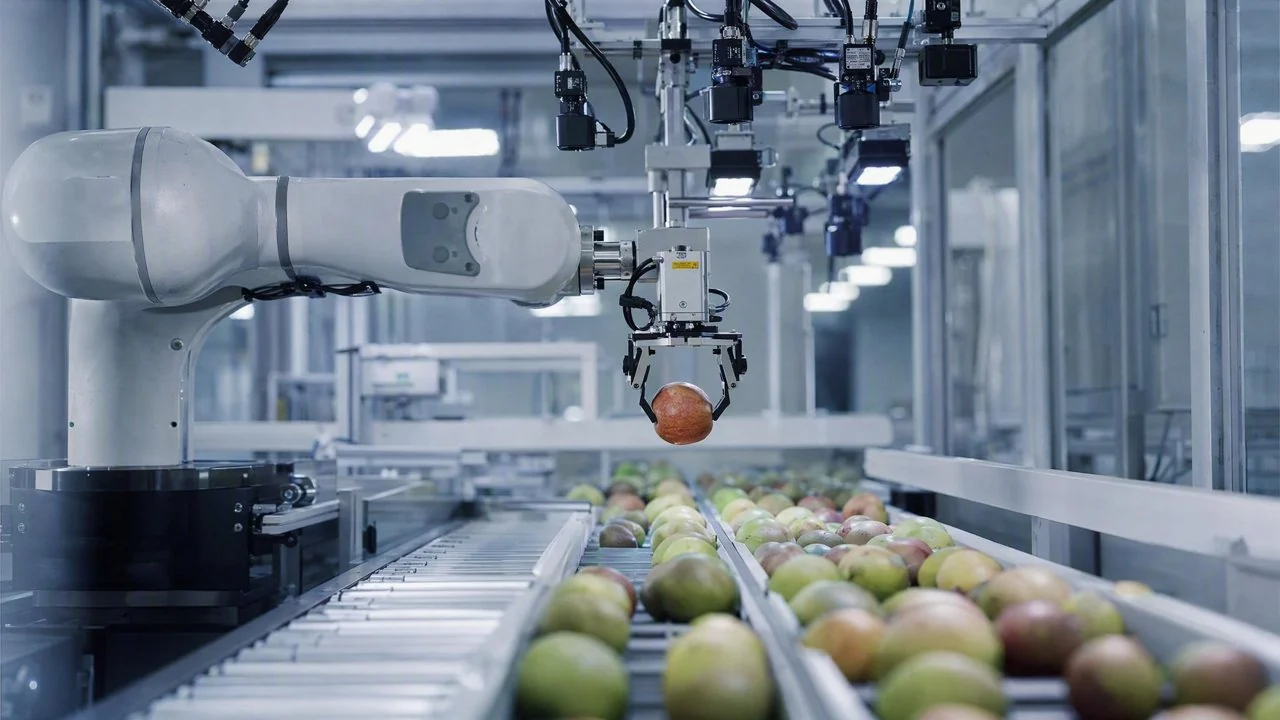
WeLinkirt's DaoAI 3D Robot Vision (featuring proprietary 3D cameras + 6D pose estimation, bin picking, glue dispensing/assembly guidance, brain-eye-body closed-loop control, and sub-millimeter hand-eye coordination) leverages its unique zero-code rapid changeover capability to dramatically reduce changeover times for produce ripeness sorting lines from a traditional 2-4 hours to under 5 minutes. This effectively resolves flexibility and efficiency bottlenecks faced by agricultural processing enterprises operating in multi-variety, small-batch production models.
The agricultural and food processing industries are undergoing a profound transformation. Growing consumer demand for quality, freshness, and variety in agricultural products is driving production lines towards greater refinement and flexibility. Particularly in the ripeness sorting of agricultural products, traditional methods relying on human experience or simple photoelectric sensors can no longer meet increasingly complex market demands. For instance, a major agricultural processing enterprise, whose business encompasses the processing and packaging of various seasonal fruits and vegetables, needs to rapidly and accurately sort products based on ripeness, size, and color according to different market demands and product batches. Previously, each time a different variety or ripeness standard was required, significant time was spent on equipment parameter adjustments and manual calibration, severely impacting production efficiency and order delivery capabilities. This multi-variety, small-batch, high-frequency changeover production model imposes extremely high demands on the flexibility of automated sorting systems.
Pain Points: Why This Hurdle is Difficult to Overcome
Traditional solutions for produce ripeness sorting face multiple challenges. First, **long changeover downtime**: Each time a different agricultural product is processed or sorting standards are adjusted, traditional rule-based vision systems or manual sorting lines require 2-4 hours of downtime for program modification, parameter calibration, and manual sample comparison, leading to a 20% to 30% reduction in overall line efficiency. Second, **high labor cost and subjectivity**: Heavy reliance on manual visual inspection for ripeness judgment results in high labor costs and significant judgment discrepancies among operators, leading to inconsistent sorting, with both false negative and false positive rates exceeding 5%. Third, **difficulty adapting to multi-variety small-batch production**: The complexity of changeovers and long debugging cycles in traditional solutions make automation investments less cost-effective when dealing with highly seasonal, diverse, and small-batch agricultural products, failing to effectively meet market demands. Finally, **complex and difficult-to-quantify defect types**: Produce ripeness is a continuously changing indicator involving variations in color, texture, shape, and even microstructures. Traditional 2D vision struggles to capture these 3D features and cannot effectively evaluate internal ripeness, leading to detection blind spots and misjudgments.
The root cause of these pain points lies in the biological characteristics of agricultural products and the limitations of traditional technology. Agricultural products are non-standardized, vary greatly in appearance, and their ripeness changes subtly and is affected by environmental factors. Traditional 2D vision systems only capture planar information, making it difficult to accurately perceive the true three-dimensional shape, contours, and color of fruits under different lighting conditions, which are crucial for ripeness determination. Manual inspection is not only inefficient but also suffers from rapidly declining accuracy due to fatigue. In the current commercialization path of embodied AI, intelligent devices like wheeled humanoid robots are gradually entering factories. However, to achieve truly efficient automation, their 'eyes' and 'brains' must be intelligent enough to quickly adapt to environmental changes. This is precisely the core problem WeLinkirt's DaoAI 3D Robot Vision aims to solve.
Technical Principles
WeLinkirt's DaoAI 3D Robot Vision system offers a new solution for agricultural product ripeness sorting through its self-developed 3D cameras and advanced 6D pose estimation technology. The system employs high-precision structured light or laser triangulation principles to acquire real-time, complete three-dimensional morphological data of agricultural products with sub-millimeter accuracy (e.g., height measurement accuracy up to 0.1mm). Combined with DaoAI's powerful visual foundation models, the system can perform in-depth analysis of this 3D data to identify subtle features at different ripeness stages. For example, for fruits, it can precisely measure volume, surface curvature, degree of indentation, and integrate color information to comprehensively determine ripeness. WeLinkirt's DaoAI's 'brain-eye-body closed-loop' mechanism ensures tight collaboration between the vision system and the robotic arm, achieving sub-millimeter hand-eye coordination, enabling the robotic arm to accurately grasp and place target agricultural products.
Compared to traditional methods, the advantages of WeLinkirt's DaoAI 3D Robot Vision are evident in several aspects. Traditional rule-based AOI systems require engineers to manually write complex rules to identify defects. Each time product types or inspection standards change, significant time is spent modifying code. In contrast, DaoAI introduces APDT few-shot learning capabilities, requiring only 1-20 good samples to complete model training within 5 minutes, enabling zero-code changeover. This greatly simplifies the operation process, allowing even non-professionals to quickly configure and deploy the system. Furthermore, DaoAI World, as a unified foundation model, possesses powerful semantic understanding and cross-scenario generalization capabilities. It continuously learns from production line feedback, constantly optimizing sorting strategies to maintain high accuracy and efficiency even when facing new agricultural product varieties or new sorting requirements, reducing false positive rates by over 80% while keeping false negative rates below <0.5%.
Typical Application Scenarios
- **Fruit Ripeness Sorting (e.g., apples, citrus, tomatoes)**: DaoAI 3D Robot Vision precisely identifies surface color changes, spots, shape deformities, and slight indentations of fruits. Combined with 3D morphological data, it comprehensively determines ripeness levels, achieving standardized sorting and avoiding subjective human judgment. Challenges include fruit surface reflections, color gradients, and variations across different varieties.
- **Vegetable Quality Grading (e.g., potatoes, onions, leafy greens)**: The system can detect damage, rot, pest traces, as well as size and shape metrics of vegetables. For potatoes, it can identify sprout eye depth and surface pits, ensuring grading consistency. Challenges include diverse vegetable forms, complex surface textures, and potential hidden damage in recessed areas.
- **Grain Seed Defect Detection and Sorting**: For large quantities of grain seeds, DaoAI 3D Vision can detect moldy, insect-damaged, broken, or immature seeds, improving seed purity and ensuring subsequent planting quality. Challenges involve tiny seed size, vast quantities, and subtle defect features.
- **Fine Sorting of Special Agricultural Products (e.g., mushrooms, medicinal herbs)**: For irregularly shaped mushrooms or traditional Chinese medicinal herbs with unique surface textures, the system achieves precise grasping and sorting, grading them based on growth status and completeness, reducing losses from manual handling. Challenges lie in the varied forms of these products and the extremely high demands for grasping and recognition accuracy.
- **Live Aquatic Product Grading (e.g., shrimp, crab)**: Even for live organisms, DaoAI 3D Vision can be used in specific scenarios to perform preliminary grading by rapidly capturing their size and body characteristics, for example, during brief moments out of water. Challenges include live movement and extremely high requirements for visual capture speed and accuracy.
Case Study
A leading domestic agricultural product processing enterprise faced significant challenges with surging multi-variety, small-batch orders. Their existing manual sorting lines and rule-based 2D vision systems proved inadequate. Each time the fruit variety changed (e.g., from apples to pears), engineers spent 3-4 hours on vision system parameter adjustments and robotic arm path programming, leading to frequent line shutdowns and annual capacity losses amounting to millions of RMB due to changeovers. The introduction of WeLinkirt's DaoAI 3D Robot Vision system fundamentally changed this situation. The DaoAI team first collected a small amount of data for the client's various agricultural product samples, utilizing the APDT few-shot self-training function to quickly establish ripeness sorting models for different products. During deployment, WeLinkirt engineers integrated the DaoAI system into the client's existing production line control system via SDK / API interfaces. After deployment, the enterprise achieved zero-code rapid changeover. When switching sorting varieties, operators simply select the preset model in the DaoAI interface, and the entire changeover process takes only 3-5 minutes, greatly enhancing line flexibility. Concurrently, due to the precise judgment of DaoAI 3D Vision, manual re-inspection volume decreased by 75%, and sorting efficiency increased by over 40%.
WeLinkirt's DaoAI 3D Vision's zero-code rapid changeover capability transformed our production line from 'rigid' to 'flexible.' Multi-variety, small-batch orders are no longer a challenge, but a new growth opportunity.
WeLinkirt Solutions and Products
The core solution provided by WeLinkirt revolves around the DaoAI 3D Robot Vision system. This system is centered on a self-developed high-precision 3D camera, combined with advanced 6D pose estimation algorithms, enabling precise positioning and 3D morphological reconstruction of agricultural products placed in any orientation. Its greatest highlight is the 'zero-code rapid changeover' capability, which stems from the APDT few-shot learning technology of the DaoAI ACI (AI-AOI) software system. Users do not need to program; they only need to provide 1-20 good samples, and the system can automatically complete model training and deployment within minutes. Addressing the complexity of agricultural product ripeness sorting, WeLinkirt also utilizes the DaoAI World foundation model to build a unified semantic understanding platform, allowing the system to better comprehend the definitions of different agricultural product types and ripeness levels, and possess cross-scenario generalization capabilities. Furthermore, the system supports 100% local private deployment, integrated via SDK / API / Docker, ensuring data security remains on-site and meeting clients' strict requirements for data privacy. WeLinkirt can also provide DaoAI 2D / 3D ACI equipment to further enhance inspection accuracy and coverage, enabling auxiliary judgment of internal defects in agricultural products.
By integrating WeLinkirt's DaoAI 3D Robot Vision system, clients can not only significantly reduce operating costs but also substantially improve production efficiency and product quality. For instance, in the aforementioned agricultural product processing enterprise case, the DaoAI 3D Vision system helped them **reduce changeover time for produce ripeness sorting by 98%**, from several hours to under 5 minutes. Simultaneously, due to improved sorting accuracy, **manual re-inspection volume decreased by 75%**, leading to an overall production line efficiency increase of over 40%. These quantified achievements directly translate into significant business value: faster market response, enhanced enterprise competitiveness in a volatile market, and effective control over product quality, avoiding economic losses and brand reputation damage due to improper sorting. DaoAI 3D Robot Vision, with its exceptional flexibility and precision, injects new impetus into the high-quality development of the agricultural processing industry.
FAQ
How does DaoAI 3D Robot Vision achieve zero-code rapid changeover in agricultural product sorting?
WeLinkirt's DaoAI 3D Robot Vision system leverages its unique APDT few-shot learning technology, eliminating the need for engineers to write code. Users only need to provide 1-20 good samples, and the system can automatically complete the training and deployment of new product models within minutes. When switching sorting varieties, operators simply select the corresponding preset model in the user interface, without complex programming or parameter adjustments, achieving rapid changeover and significantly shortening downtime, enhancing production line flexibility.
How does the DaoAI 3D Vision system compare in cost-effectiveness to traditional 2D vision or manual sorting?
While the initial investment for the DaoAI 3D Vision system is higher than traditional 2D vision or purely manual sorting, its long-term cost-effectiveness is far more significant. It effectively reduces operating costs by dramatically cutting changeover downtime, decreasing manual re-inspection volume, and improving sorting accuracy and efficiency. Simultaneously, it enhances product quality through standardized sorting, reduces scrap rates, and increases product premium potential. The specific return on investment period requires a customized evaluation based on the client's production scale, product types, and existing pain points. Please contact WeLinkirt for a detailed quotation.
How does the DaoAI 3D Robot Vision system ensure accuracy and consistency in agricultural product ripeness sorting?
WeLinkirt's DaoAI 3D Robot Vision system utilizes proprietary high-precision 3D cameras to acquire complete three-dimensional morphology and color information of agricultural products. Combined with 6D pose estimation and advanced AI algorithms, it precisely identifies subtle ripeness features on the product surface, such as color gradients, texture changes, and shape contours. Its 'brain-eye-body closed-loop' mechanism ensures high coordination between visual judgment and robotic arm grasping actions, achieving sub-millimeter accuracy, thereby delivering significantly higher precision and consistency than manual inspection and substantially reducing false negative and false positive rates.
Full solution for this scenario: the full inspection solution for Food / agriculture · Produce Ripeness Grading & Sorting
This article was generated by AI. Customer cases are simulated scenarios based on real product capabilities and figures are illustrative; see product pages for official benchmarks.