
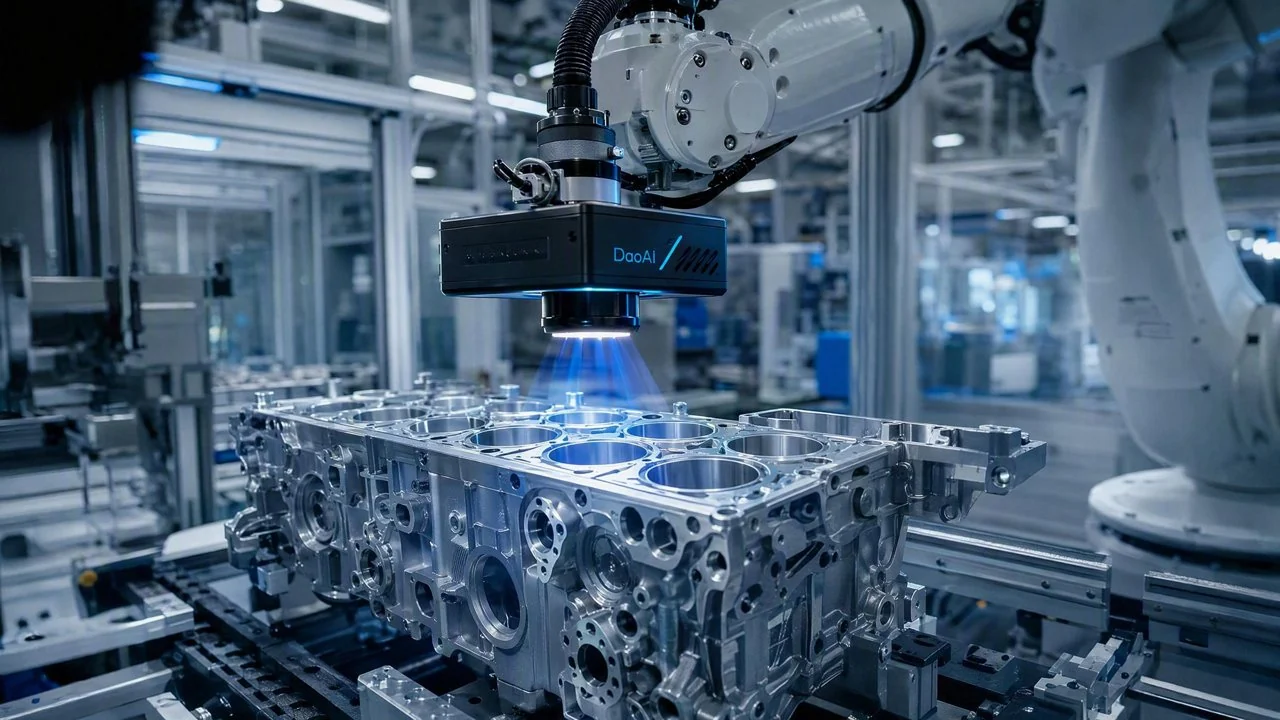
WeLinkirt's DaoAI 3D Robotic Vision (featuring self-developed 3D camera + 6D pose estimation, bin picking, guidance for dispensing/assembly/loading/unloading, brain-eye-body closed-loop, sub-millimeter hand-eye coordination) utilizes the APDT few-shot self-training model to reduce false positives in automotive fastener tightening defects from an industry-typical 5% to <0.8%, while shortening new product changeover time from hours to under 15 minutes. In automotive and component manufacturing, the quality of fastener tightening directly impacts vehicle safety and reliability. From engine compartments to body structures, the correct installation and tightening of thousands of fasteners are critical steps on the assembly line. With the electrification and intelligence trends in automobiles, precision assembly requirements are increasing. Traditional manual or rule-based vision inspection solutions struggle to meet the growing complexity and stringent demands for inspection efficiency and accuracy.
In automotive and component manufacturing, fastener tightening is a core process to ensure product structural integrity and functional reliability. Whether in engine blocks, transmission housings, vehicle chassis, or interior components, the correct torque, angle, and seating of every bolt, nut, or rivet are critical. Any tightening defect, such as missing, floating, stripped threads, cross-threading, or insufficient torque, can lead to serious quality issues and even safety hazards. Traditionally, these inspections largely relied on operator visual checks, torque wrench spot checks, or simple 2D vision systems. However, facing increasingly complex component structures, variable surface reflections, and high-beat production lines, these traditional methods face significant challenges in terms of efficiency and accuracy, proving insufficient, especially when identifying subtle defects and handling diverse product models.
Pain Points: Why This Hurdle Is Difficult to Overcome
The challenges in detecting automotive fastener tightening defects are evident in several dimensions: Firstly, **high false positive rates**. Traditional rule-based 2D vision systems are extremely sensitive to ambient light, product surface reflections, and minute fastener deformations. They often misinterpret normal reflections or background noise as defects, leading to false positive rates of 5% or even higher. This necessitates a significant amount of human re-inspection for otherwise compliant products. Secondly, **massive manual re-inspection hours**. Every percentage point reduction in false positives can save thousands of hours of manual re-inspection time, which is particularly crucial given the current shortage of core technical talent in embodied AI robotics. Redirecting limited human resources to high-value tasks instead of repetitive re-inspection is paramount. Thirdly, **low efficiency in new product changeovers**. For the automotive industry's multi-variety, small-batch production model, each new model or component launch requires hours or even days to adjust parameters and write rules for traditional vision systems, severely impacting production rhythm. Finally, **insufficient defect detection rate**. For subtle defects like slight floating, stripped threads, or tightening angle deviations, traditional methods often struggle to detect them effectively, posing potential missed detection risks.
The root cause of these pain points lies in the complexity and variability of tightening defects. Different fastener surface materials (galvanized, phosphated, etc.) lead to significant differences in reflection characteristics. Their installation positions are often accompanied by surrounding structural obstructions, making imaging difficult. More importantly, there may be only sub-millimeter visual differences between a qualified fastener and a defective one. For example, a slightly floating nut might have a height difference of only 0.3mm, making it difficult to distinguish in a 2D image; stripped threads or cross-threading might require judgment from thread details or installation angles. Traditional methods struggle to capture these high-dimensional subtle features and cannot effectively learn and generalize from vast amounts of data, thus making false positives and missed detections commonplace.
Technical Principles
WeLinkirt's DaoAI 3D Robotic Vision system fundamentally solves the challenges of automotive fastener tightening inspection through its self-developed 3D camera and advanced 6D pose estimation algorithms. The system employs high-precision structured light or laser triangulation technology to acquire sub-millimeter 3D morphological data of fasteners and their surroundings. Unlike traditional 2D vision, which only captures planar brightness information, DaoAI's 3D camera reconstructs the true 3D geometry of objects, allowing for precise identification of the actual height, depth, tilt angle, and integrity of components such as bolts, nuts, and washers. For example, for floating defects, the system can directly measure the distance between the nut's top surface and the reference plane with an accuracy of up to 0.05mm, rather than inferring from brightness changes. Simultaneously, the 6D pose estimation capability of WeLinkirt's DaoAI 3D Robotic Vision accurately calculates the fastener's 3D position and orientation (X, Y, Z, Rx, Ry, Rz) in space, providing a precise spatial reference for subsequent defect judgment.
Crucially, WeLinkirt's DaoAI 3D Robotic Vision system incorporates **APDT few-shot self-training** technology. This technology enables the system to learn and generalize rapidly without needing a large number of defect samples. Traditional AI models require tens of thousands of defective images for effective training, but in actual production, defect samples are often rare and difficult to obtain. APDT technology builds a robust baseline model by self-training with only 1-20 good samples, then fine-tunes with a small number of defect or anomaly samples. Even without defect samples, it can identify anomalies through a deep understanding of good product features. This approach significantly shortens the model training cycle, reducing new product changeover time from hours to under 15 minutes. Compared to rule-based AOI, the APDT few-shot self-training enabled DaoAI 3D Robotic Vision system offers higher robustness and generalization capabilities, adapting to complex and variable environments and product differences, thereby greatly reducing false positives and effectively improving the detection rate of minute defects.
Typical Application Scenarios
- **Bolt/Nut Floating Detection**: The DaoAI 3D camera measures the actual distance between the top surface of the bolt or nut and the assembly datum plane to precisely determine if floating is present. The challenge lies in sub-millimeter height differences and obstructions from surrounding structures.
- **Stripped/Cross-threaded Detection**: Utilizing 3D morphology reconstruction, WeLinkirt's DaoAI 3D Robotic Vision system can capture the integrity and engagement state of threads, identifying stripped threads or cross-threading. The difficulty lies in the minute and variable details of threads.
- **Washer Missing/Misalignment Detection**: The DaoAI 3D vision system can identify the presence, type, and correct position of washers relative to bolts or nuts. Challenges include small washer size, similar color to background, and potential obstruction.
- **Anti-loosening Coating/Gasket Ring Detection**: For fasteners with anti-loosening coatings or gasket rings, the system can detect if the coating is intact and if the gasket ring is in place and undamaged. The challenge is the high precision required for coating thickness and gasket ring deformation detection.
- **Fastener Model Identification and Mixed Assembly Detection**: By comparing 3D contour features, the DaoAI 3D Robotic Vision system can differentiate between various fastener models, preventing assembly errors due to model confusion. The difficulty lies in distinguishing subtle differences between similar models.
Implementation Case Study
A leading Tier-1 automotive component supplier in China faced significant challenges in inspecting fastener tightening quality on its engine block assembly line. Due to the wide variety of product models, each engine block contained dozens of fasteners of different specifications. Traditional 2D vision systems, when dealing with complex reflections and minute defects, exhibited a false positive rate as high as 5.5%, requiring an additional 2-3 quality inspectors daily for manual re-inspection. This severely hampered production line efficiency and increased labor costs. Furthermore, each new product launch required engineers to spend at least 4 hours to rewrite and debug vision inspection rules, impacting the speed of new product introduction.
“After integrating WeLinkirt's DaoAI 3D Robotic Vision system, our production line's false positive rate plummeted from 5.5% to <0.8%, saving significant manual re-inspection time. Even more impressively, new product changeover time was reduced from hours to less than 15 minutes, greatly enhancing production flexibility.”
The supplier implemented WeLinkirt's DaoAI 3D Robotic Vision system. During the onboarding process, we leveraged its APDT few-shot self-training capability, completing model training and deployment within 30 minutes using only 10 good samples and a small number of historical defect samples. After deployment, the system performed 3D scanning and analysis of each fastener's tightening status, real-time determining the presence of floating, stripped threads, or missing fasteners. The false positive rate before deployment was 5.5%, which the DaoAI 3D Robotic Vision system successfully reduced to <0.8%, decreasing manual re-inspection volume by 85%. Concurrently, new product changeover time was shortened from an average of 4 hours to 12 minutes, greatly improving the flexibility and efficiency of the production line. The stable operation of WeLinkirt's DaoAI 3D Robotic Vision also led to a 0.2% improvement in the overall qualification rate of this production line, effectively reducing rework costs and quality risks.
WeLinkirt Solution and Products
WeLinkirt's DaoAI 3D Robotic Vision system offers an end-to-end solution for automotive fastener tightening inspection. Its core lies in its self-developed high-precision 3D camera, capable of stably acquiring 3D point cloud data in complex industrial environments. Combined with advanced 6D pose estimation algorithms, the system accurately identifies the spatial position and orientation of fasteners, providing reliable geometric information for subsequent defect judgment. Through the unified foundation of the DaoAI World global model, the system possesses semantic understanding and cross-scenario generalization capabilities, continuously learning from production line feedback to optimize detection performance. For deployment, WeLinkirt provides various integration methods such as SDK/API/Docker, supporting 100% local private deployment to ensure customer data security. For scenarios requiring high-precision guidance like fastener tightening, the "brain-eye-body closed-loop" capability of DaoAI 3D Robotic Vision enables sub-millimeter hand-eye coordination between vision and robotic arms, precisely guiding robots for subsequent operations or re-inspection, forming an efficient automated workflow.
Through APDT few-shot self-training, WeLinkirt's DaoAI 3D Robotic Vision system not only addresses the pain points of traditional vision solutions in terms of false positive rates and changeover efficiency but also achieves precise detection of minute defects. Its business value is reflected in: **significantly reduced operating costs**, saving substantial manual re-inspection hours and improving personnel utilization efficiency; **greatly enhanced production flexibility**, with shortened new product changeover times for faster market response; **strengthened product quality assurance**, reducing missed detection risks and improving product reliability and customer satisfaction. These advantages collectively bring tangible economic benefits and market competitiveness to automotive component manufacturers.
FAQ
How does the DaoAI 3D Robotic Vision system achieve sub-millimeter hand-eye coordination?
WeLinkirt's DaoAI 3D Robotic Vision system acquires precise 3D data via its self-developed high-precision 3D camera. Coupled with advanced 6D pose estimation algorithms, it can calculate the exact position and orientation of objects in space in real-time. Subsequently, through precise calibration algorithms and motion control interfaces, visual information is converted into robot executable motion commands, achieving a "brain-eye-body closed-loop" between vision and the robotic arm, ensuring sub-millimeter operational accuracy for precision assembly and grasping tasks.
What is the difference between APDT few-shot self-training and traditional machine learning models?
Traditional machine learning models typically require a large number of labeled defect samples for effective training, which is often difficult to achieve in real industrial scenarios. APDT few-shot self-training is a core technology of WeLinkirt's DaoAI. It builds a robust baseline model by self-learning with only a few (1-20) good samples and can learn to identify anomalies with a small number of anomalous samples or even without defect samples. This method significantly shortens model training and deployment time, improving changeover efficiency and generalization capabilities for new defects.
How is the cost of deploying WeLinkirt's DaoAI 3D Robotic Vision system evaluated?
The deployment cost of WeLinkirt's DaoAI 3D Robotic Vision system is influenced by various factors, including the number and model of 3D cameras required, the complexity of robotic arm integration, customized software feature demands, and the deployment environment. We offer flexible deployment options like SDK/API/Docker and support 100% local private deployment. We recommend contacting our sales team with your specific application scenario and requirements. We will provide a customized solution and detailed quotation, along with an assessment of the return on investment period.
Full solution for this scenario: the full inspection solution for Automotive / parts
This article was generated by AI. Customer cases are simulated scenarios based on real product capabilities and figures are illustrative; see product pages for official benchmarks.