
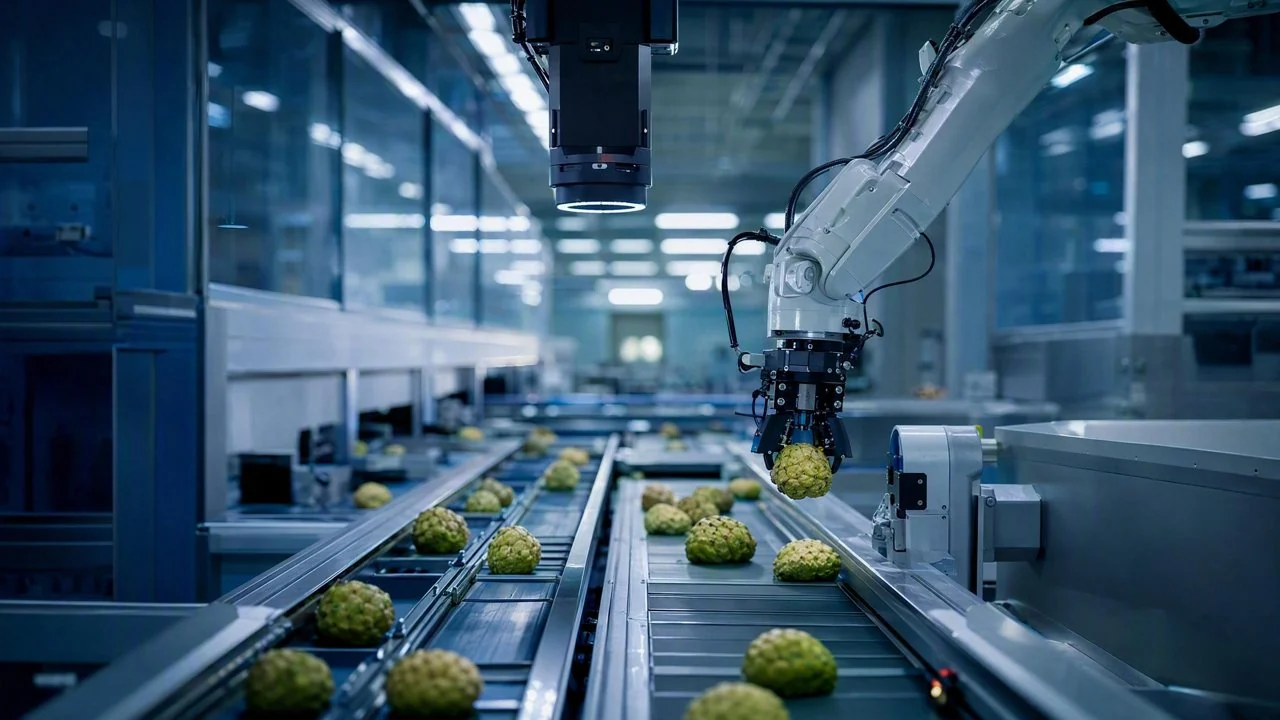
The WeLinkirt DaoAI 3D Robot Vision system (self-developed 3D camera + 6D pose estimation, bin picking, glue/assembly/load/unload guidance, brain-eye-body closed-loop, sub-millimeter hand-eye coordination), leveraging high-precision 3D perception and intelligent decision-making, reduces the manual foreign object detection false negative rate in food processing from a common 2% to <0.4%, significantly enhancing food safety and quality grading consistency. Its on-premises private deployment capability effectively mitigates data leakage risks.
In the food and agriculture industry, consumer expectations for product safety and quality are constantly rising. Any tiny foreign object or quality defect can lead to severe brand reputation damage and even legal risks. Especially for processed fruits, vegetables, grains, or pre-made meals, their diverse shapes and complex surface textures often render traditional manual inspection or 2D vision-based rejection solutions inefficient. These methods are prone to missed detections due to fatigue, lighting variations, or product occlusion. A major agricultural product processing enterprise, when handling large volumes of agricultural product sorting and foreign object removal, faced severe challenges. They required an automated system capable of precisely identifying various foreign objects (such as stones, plastic pieces, insect residues) and performing refined quality grading (such as ripeness, damage level). Furthermore, due to the involvement of core food production data, they had extremely stringent requirements for on-premises deployment and data security. The WeLinkirt DaoAI 3D Robot Vision system was developed precisely to address such pain points. Its powerful 3D perception and processing capabilities, combined with the characteristics of on-premises private deployment, provided the enterprise with an ideal solution that balances efficiency, accuracy, and data security.
Pain Points: Why This Hurdle Is So Difficult to Overcome
Foreign object removal and quality grading in agricultural product processing are far more challenging than typical industrial product inspection. Firstly, the complexity and diversity of product forms are major challenges. For instance, different batches of vegetable leaves vary greatly in curl, and fruits differ in size and color, making traditional vision algorithms based on fixed rules difficult to generalize. Secondly, foreign objects can be highly similar to the product itself in material and color, such as soil and root stems, or dark stones and roasted grains, which are hard to distinguish in 2D images, leading to manual false negative rates of 2% or even higher. Concurrently, manual inspection also suffers from high false positive rates, increasing rework hours, with an average of 15-20 minutes of extra time per hour dedicated to re-inspection. Thirdly, high-tempo production lines demand extremely fast processing speeds from inspection systems. Manual inspection reaches its limit at 60-80 items per minute, and prolonged high-intensity work easily causes visual fatigue, leading to increased false negative rates over time.
Delving deeper, the challenges primarily manifest in several aspects: **Imaging Difficulties**: Traditional 2D vision, when confronted with flat, reflective, translucent, or complex-textured foreign objects, lacks depth information and cannot effectively distinguish foreign objects from shadows, indentations, or color differences on the product surface. For example, a thin piece of plastic or glass shard might blend with the product surface in a 2D image. **Algorithm Bottlenecks**: Traditional rule-based vision algorithms require manual coding of complex rule sets for each foreign object and product form, leading to high changeover costs and difficulty adapting to the immense natural variations in agricultural products. The current industry hot topic of embodied AI robot application technology standards highlights the robot's perception, decision-making, and execution capabilities, with 'perception' heavily relying on high-precision, robust 3D vision technology. If the perception layer cannot effectively identify foreign objects, subsequent decisions and executions are impossible. **Data Security and Privacy**: For food production enterprises, defect data, product batch information, supplier data, etc., generated during the production process are all core sensitive information. Uploading this data to the cloud for processing or training poses potential data leakage risks, making many enterprises hesitant about cloud-based AI solutions and urgently needing on-premises private deployment solutions like those offered by WeLinkirt.
Technical Principles
The WeLinkirt DaoAI 3D Robot Vision system fundamentally addresses the limitations of traditional 2D vision by integrating a self-developed high-precision 3D camera and advanced 6D pose estimation algorithms. Our 3D camera can rapidly acquire complete 3D point cloud data of the object under inspection, accurately reconstructing its surface morphology. Even minute bumps, depressions, or material differences are clearly rendered. Through point cloud data, the system can precisely identify the true geometric shape and spatial position of foreign objects, rather than just relying on their 2D projected features. For example, a stone similar in color to the product might be difficult to distinguish in a 2D image, but in a 3D point cloud, its unique geometric shape and surface reflection characteristics due to hardness will make it clearly distinct from soft agricultural products, thus being accurately identified by the WeLinkirt system.
At the algorithm level, the DaoAI 3D Robot Vision system employs a combination of deep learning and generative AI models. Trained on vast amounts of real and synthetic data, it possesses powerful feature learning and generalization capabilities. We can not only perform high-precision 6D pose estimation to guide robotic arms for bin picking or precise gluing/assembly but, more importantly, in foreign object detection and quality grading, the system can learn and understand the '3D semantic features' of products and foreign objects. For instance, for a certain fruit, the system can learn its normal mature surface curvature, texture density, and color gradient distribution. When rot, insect damage, or external scratches appear, these 3D features change significantly. The WeLinkirt algorithm can capture these micron-level or even sub-millimeter differences. Compared to traditional rule-based AOI, the DaoAI 3D Robot Vision system eliminates the need for engineers to manually write complex thresholds or edge detection rules. It can quickly learn new products or defect types with a small number of samples, reducing changeover time from hours to <5min, greatly enhancing production flexibility. Compared to manual inspection, the system offers faster detection speed, higher accuracy, better stability, and is immune to fatigue, consistently keeping the foreign object removal false negative rate below <0.4%.
Typical Application Scenarios
- **Surface Foreign Object Detection and Removal for Fruits and Vegetables**: For foreign objects such as soil, stones, grass clippings, or plastic pieces attached to the surface of fresh fruits and vegetables (e.g., apples, potatoes, tomatoes), the WeLinkirt DaoAI 3D Vision system performs high-precision 3D reconstruction to identify the true geometric shape and spatial position of the foreign objects, guiding robotic arms for precise gripping and removal. The challenge lies in the similarity of color and texture between foreign objects and fruit/vegetable surfaces, as well as the irregular shapes of the produce.
- **Grain and Nut Defect Detection**: Detecting defects such as burnt grains, moldy grains, insect-damaged grains, unhulled grains, and mixed-in stones or metal shavings in roasted grains (e.g., coffee beans, peanuts). The DaoAI 3D Vision utilizes comprehensive features of 3D morphology, color, and texture for judgment, capable of identifying even subtle color differences and deformations. The challenge is that defects may not have obvious color differences from normal products, and the sheer volume of products requires high detection speeds.
- **Foreign Object Detection in Meat Processing**: Detecting potential contaminants like bone fragments, metal shards, or plastic pieces that may be mixed in during meat cutting and processing. The WeLinkirt system can penetrate certain meat surface textures, using depth information to identify deeply hidden foreign objects, ensuring the safety of meat products. The challenge lies in the high flexibility, complex surface texture, and certain reflectivity of meat products.
- **Aquatic Product Grading and Impurity Removal**: Grading aquatic products like shrimp and fish by size and appearance, and removing impurities such as shells, aquatic plants, and small stones. The DaoAI 3D Vision system accurately measures the 3D dimensions and contours of aquatic products and identifies surface damage or foreign objects, enabling efficient automated sorting. The challenge lies in the wet and reflective surfaces of aquatic products, large individual variations, and the need for industrial cameras resistant to humid environments.
Implementation Case Study
A large-scale pre-made meal processing enterprise, whose main business is to provide standardized cleaned vegetables and semi-finished products for chain restaurants. In the vegetable sorting process after washing and cutting, the traditional solution mainly relied on manual inspection, requiring dozens of workers daily to remove foreign objects and perform preliminary grading on vegetables on the conveyor belt. However, due to the complex morphology of vegetables, the wide variety of foreign objects (such as mud, small stones, plastic film scraps), and the relatively fast production line tempo, the false negative rate of manual inspection remained high, averaging around 2%. This led to frequent customer complaints and returns, severely impacting brand reputation. Furthermore, this enterprise had extremely strict requirements for production data security; all data from every production step had to be stored and processed locally, with no upload to any external servers allowed.
The on-premises private deployment of WeLinkirt's DaoAI 3D Robot Vision system provided us with robust data security for production, while also reducing the false negative rate by 80%. This is the path to intelligent manufacturing upgrade we envisioned.
After thoroughly understanding the client's needs, the WeLinkirt DaoAI team deployed the DaoAI 3D Robot Vision system for them. This system integrated multiple self-developed high-precision 3D cameras, covering the entire conveyor belt area, acquiring real-time 3D morphological data of the vegetables. Through the locally deployed DaoAI World model, the system performed real-time inference on the production line, identifying foreign objects such as mud clumps, small stones, and plastic fragments in the vegetables, and assessing the quality of the vegetables (e.g., whether they were rotten, insect-damaged, or damaged). The system transmitted the detection results in real-time to downstream robotic arms, guiding them to precisely pick and remove foreign objects or sort unqualified products to the reject area. After deployment, the enterprise's manual foreign object removal false negative rate significantly decreased from 2% to <0.4%, and the false positive rate was reduced by 70%, greatly reducing the workload of manual re-inspection. More importantly, all visual inspection data and model training processes were completed on the client's local servers, ensuring absolute security of core production data and fully complying with their internal data compliance requirements. Through the deployment of the DaoAI 3D Robot Vision system, the client not only improved product quality and food safety standards but also achieved transparency and traceability in the production process, laying a solid foundation for subsequent smart factory upgrades.
WeLinkirt Solutions and Products
The WeLinkirt DaoAI 3D Robot Vision system, as the core solution, derives its power from the deep integration of the excellent performance of self-developed 3D camera hardware with advanced software algorithms. In this case, we adopted a multi-view 3D imaging solution to ensure complete coverage of complex curved surfaces and occluded areas. Through data modeling with the DaoAI World model, the system can perform rapid learning and model training with a small number of good samples (e.g., 1-20 images), achieving 0-code automatic programming and greatly lowering deployment and maintenance thresholds. Targeting the characteristics of small batch and multi-variety agricultural products, we provided APDT few-shot self-training capability, enabling the system to quickly adapt to new varieties or seasonal changes, with changeover times controlled within <5min, avoiding prolonged downtime. The WeLinkirt system supports various deployment methods such as Docker, SDK, and API, and its 100% on-premises private deployment capability was crucial in this case, ensuring all data circulates, processes, and stores within the client's internal network, meeting the most stringent data security and privacy protection requirements, effectively mitigating potential data leakage risks from cloud deployment. Furthermore, the system, through its brain-eye-body closed-loop mechanism, tightly integrates visual perception, intelligent decision-making, and robot motion control, achieving sub-millimeter hand-eye coordination accuracy, ensuring robotic arms can precisely execute gripping, placement, and other operations.
Through the implementation of the WeLinkirt DaoAI 3D Robot Vision system, the client achieved significant business value. Firstly, product quality and food safety standards were substantially improved, reducing the risk of recalls and brand losses due to foreign objects or quality defects. Secondly, production efficiency and automation levels were significantly enhanced, reducing reliance on high-intensity manual inspection and optimizing human resource allocation. Thirdly, data security and compliance were fully guaranteed, eliminating the client's concerns about the leakage of core production data. Overall, the WeLinkirt solution not only addressed current production line pain points but also helped the enterprise build future-oriented intelligent manufacturing capabilities, enhancing market competitiveness.
FAQ
How does the DaoAI 3D Robot Vision system ensure data security in food processing?
The WeLinkirt DaoAI 3D Robot Vision system supports 100% on-premises private deployment. This means all visual data acquisition, image processing, AI model training, and inference operations are completed within the client's own servers and network environment. Data is never uploaded to any external cloud platform, fundamentally eliminating the risk of data leakage and fully complying with the stringent data compliance and privacy protection requirements of the food industry.
Beyond foreign object removal, what other applications does DaoAI 3D Vision have in the food industry?
In addition to high-precision foreign object removal, the WeLinkirt DaoAI 3D Robot Vision system can be widely applied to quality grading in the food industry. For example, it performs precise detection and grading of fruits and vegetables based on ripeness, size, shape, and surface damage (e.g., scratches, rot); evaluates fat content and texture of meat; and inspects baking degree and integrity of baked goods. Its 3D perception capability allows it to handle complex food forms and diverse defect types.
What is the initial investment and implementation timeline for deploying the DaoAI 3D Robot Vision system?
The investment for deploying the DaoAI 3D Robot Vision system depends on the complexity of the specific application scenario, production line scale, and required functional modules. Our solution is modular and highly customizable. Initial investment primarily includes hardware (3D cameras, robots, etc.) and software licensing fees. The implementation period typically ranges from several weeks to several months. A detailed proposal and quotation can be provided after on-site survey and requirements assessment. Please contact the WeLinkirt professional team for customized consultation and an accurate budget.
Full solution for this scenario: the full inspection solution for Food / agriculture · Food Foreign-Object Removal & Grading: Robot Vision Cuts False Positives
This article was generated by AI. Customer cases are simulated scenarios based on real product capabilities and figures are illustrative; see product pages for official benchmarks.