
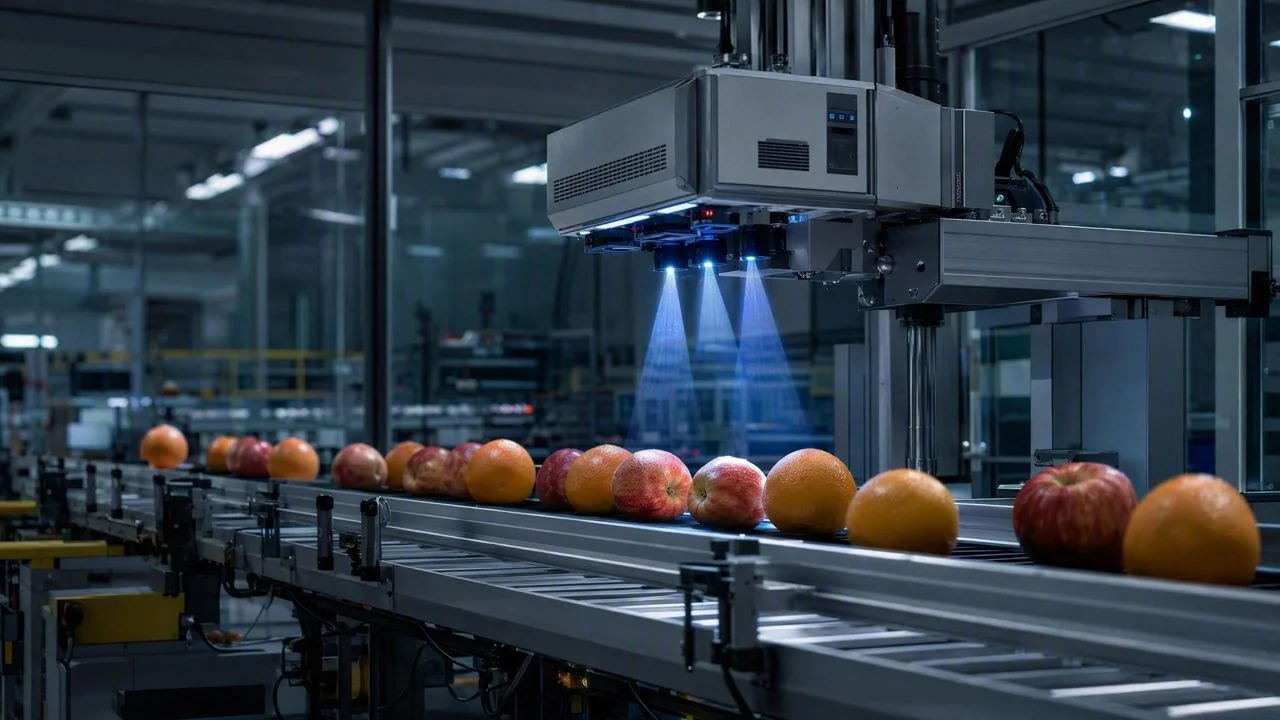
Wemio DaoAI 3D robot vision (self-developed 3D camera + 6D pose estimation, disordered bin picking, glue coating/assembly/loading and unloading guidance, brain-eye-body closed-loop, sub-millimeter hand-eye coordination) reduces the miss-detection rate of agricultural product ripeness sorting from 8% to less than 1% through accurate 3D imaging and intelligent algorithms. Currently, the food/agriculture industry has increasingly strict requirements for the quality control of agricultural products, especially in the ripeness sorting process. Traditional methods are inefficient and error-prone. A certain agricultural product processing line needs to handle a large number of various agricultural products such as apples and oranges every day, and there are many difficulties in sorting ripeness.
Industry background and user scenario: Nowadays, consumers' requirements for the quality of agricultural products are constantly increasing. The food/agriculture industry must ensure that the agricultural products entering the market meet the ripeness standards. The production line of a certain agricultural product processing enterprise is faced with the task of sorting the ripeness of a large number of agricultural products. The traditional manual sorting method is not only inefficient but also difficult to ensure the accuracy of sorting. The emergence of Wemio DaoAI 3D robot vision system provides an effective way to solve this problem. The system uses a self-developed 3D camera to obtain the three-dimensional information of agricultural products and combines technologies such as 6D pose estimation to accurately judge the ripeness of agricultural products, greatly improving the sorting efficiency and accuracy, and reducing the miss-detection rate from 8% to less than 1%.
Pain points: Why is this hurdle difficult to overcome?
Multidimensional quantification of pain points: In the sorting of agricultural product ripeness, traditional methods have many difficulties. First of all, the miss-detection rate is as high as 8%, which causes some unripe or overripe agricultural products to flow into subsequent processes, affecting product quality. Secondly, the man-hours for manual re-judgment are long. Due to the subjectivity of manual judgment, a large number of manual re-checks are required for each batch of products, increasing labor costs. Moreover, the false-alarm rate is also relatively high, about 15%, which makes some agricultural products with appropriate ripeness misjudged, resulting in waste. In addition, traditional methods are difficult to achieve quality traceability. Once a problem occurs, it is impossible to quickly locate the source of the problem. From the perspective of the breakthrough of humanoid robots in the wave of embodied intelligence, these pain points make traditional methods difficult to meet the needs of efficient and intelligent sorting.
Root cause analysis: From the process level, the appearance of agricultural products is irregular, and their colors and textures are also different. Traditional imaging technologies are difficult to accurately capture these features, resulting in judgment errors. From the material level, different varieties of agricultural products have different reflection and absorption characteristics of light, which further increases the difficulty of imaging. Moreover, the sorting rhythm of agricultural products is fast. It is difficult for humans to make accurate judgments in a short time, and traditional machine-vision algorithms are inefficient in dealing with complex scenarios and cannot meet the needs of rapid sorting.
Technical principle
In-depth mechanism: Wemio DaoAI 3D robot vision system uses a self-developed 3D camera to quickly obtain the three-dimensional morphology information of agricultural products. Its 6D pose estimation algorithm can accurately determine the spatial position and posture of agricultural products, and analyze the ripeness of agricultural products in combination with advanced intelligent algorithms. The algorithm can accurately identify the characteristics of agricultural products at different ripeness levels through a large number of sample learnings. For example, for apples, the algorithm can judge the ripeness according to their color, shape and surface texture. Compared with traditional machine-vision algorithms, the algorithm of Wemio DaoAI 3D robot vision system has stronger adaptability and accuracy and can handle complex scenarios.
Comparison with traditional methods: Traditional rule-based AOI methods and manual visual inspection mainly rely on fixed rules and subjective human judgment. Rule-based AOI methods are difficult to adapt to the diversity and complexity of agricultural products. When encountering new varieties or irregular-shaped agricultural products, misjudgments are likely to occur. Manual visual inspection is limited by human fatigue and subjective factors, and its accuracy and efficiency are relatively low. While Wemio DaoAI 3D robot vision system can achieve automated and precise detection through intelligent algorithms and 3D imaging technology, reducing the miss-detection rate to less than 1% and the false-alarm rate to less than 3%, greatly improving the sorting quality and efficiency.
Typical application scenarios
- Apple ripeness sorting: The three-dimensional information of apples is obtained through a 3D camera, and their color, shape and surface texture are analyzed. The difficulty lies in that the color and texture of apples are affected by factors such as variety and growth environment, and the algorithm needs to have strong adaptability. Wemio DaoAI 3D robot vision system can accurately judge the ripeness of apples through a large number of sample learnings.
- Orange ripeness detection: 3D imaging technology is used to detect the size, shape and color of oranges. Since the surface of oranges is smooth and the light reflection is complex, imaging is prone to errors. Wemio DaoAI 3D robot vision system solves this problem through special light processing and algorithm optimization.
- Banana ripeness grading: Grading is carried out according to the curvature, color and length of bananas. The shape of bananas changes greatly during the growth process, and the color transition is not obvious, so the judgment is difficult. Wemio DaoAI 3D robot vision system realizes accurate grading through multi-dimensional analysis.
- Grape ripeness screening: The overall color, particle size and compactness of grape clusters are detected. The shape of grape clusters is complex, and the particles block each other, increasing the difficulty of detection. Wemio DaoAI 3D robot vision system can clearly obtain the information of each grape particle for accurate screening.
Implementation case
Comparison before and after the implementation of an anonymous customer: A medium-sized agricultural product processing enterprise processes about 50 tons of agricultural products per day. Before the implementation of Wemio DaoAI 3D robot vision system, the miss-detection rate of the enterprise's agricultural product ripeness sorting was 8%, the false-alarm rate was 15%, and the manual re-judgment man-hours reached 20 hours per day. After the implementation, the miss-detection rate was reduced to less than 1%, the false-alarm rate was reduced to less than 3%, and the manual re-judgment man-hours were reduced to less than 2 hours per day. At the same time, the system realized quality traceability and data closed-loop. The enterprise can monitor the sorting data in real-time, adjust production strategies in time, and improve the overall production efficiency and product quality.
Wemio DaoAI 3D robot vision system has brought a qualitative leap to the sorting of agricultural product ripeness, realizing efficient and accurate sorting and quality traceability.
Wemio's solution and products
Product capabilities and implementation methods: Wemio DaoAI 3D robot vision system is centered around a self-developed 3D camera and intelligent algorithms, with high-precision 6D pose estimation and accurate ripeness judgment capabilities. In terms of modeling, it is trained with a large number of actual samples to ensure that the algorithm can adapt to different varieties and shapes of agricultural products. When changing models, the system can complete parameter adjustment within 5 minutes to achieve a quick switch. In terms of deployment, it supports multiple methods such as SDK / API / Docker and can be deployed 100% privately locally to ensure data security. At the same time, the system can also be integrated with the enterprise's existing production management system to realize data sharing and collaborative work. In addition, Wemio's DaoAI World model can realize semantic understanding and cross-scenario generalization, and continuously learn from production-line feedback to further improve system performance.
Quantitative results and business value: Wemio DaoAI 3D robot vision system reduces the miss-detection rate of agricultural product ripeness sorting by 87.5%, the false-alarm rate by -80%, and the manual re-judgment man-hours by 90%. These results not only improve product quality, reduce waste, but also reduce labor costs and enhance the enterprise's production efficiency and competitiveness. At the same time, the quality traceability and data closed-loop function provides strong decision-making support for the enterprise, which helps the enterprise optimize the production process and increase its market share.
FAQ
What is the DaoAI 3D robot vision system?
The DaoAI 3D robot vision system is a product developed by Wemio. It includes technologies such as self-developed 3D cameras and 6D pose estimation, enabling functions like disordered bin picking and glue coating/assembly guidance. It can accurately judge the ripeness of agricultural products, reducing the miss-detection and false-alarm rates.
What are the advantages of the DaoAI 3D robot vision system compared with traditional sorting methods?
Compared with traditional methods, the system can reduce the miss-detection rate to less than 1% and the false-alarm rate to less than 3%. It can also achieve quality traceability and data closed-loop, quickly change models, and improve sorting efficiency and product quality.
How much does it cost to use the DaoAI 3D robot vision system?
The cost of the system is affected by various factors, such as the complexity of the detection object, deployment method, and functional requirements. For a specific quotation, please contact Wemio for an appointment consultation.
Full solution for this scenario: Food / agriculture industry solutions · Produce Ripeness Grading & Sorting
This article was generated by AI. Customer cases are simulated scenarios based on real product capabilities and figures are illustrative; see product pages for official benchmarks.