
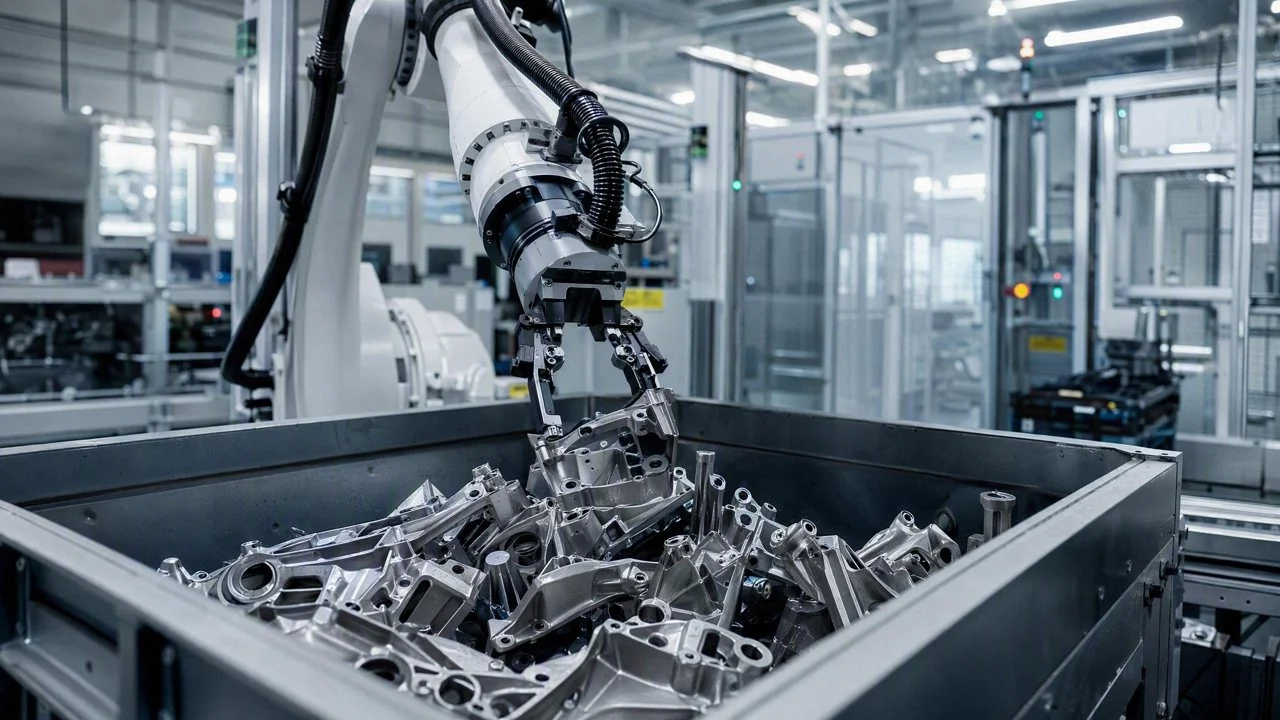
WeLinkirt's DaoAI 3D Robot Vision (proprietary 3D camera + 6D pose estimation, bin picking, gluing/assembly/loading/unloading guidance, brain-eye-body closed-loop, sub-millimeter hand-eye coordination) reduces the leakage rate for automotive parts chaotic bin picking from a conventional 5% to <0.5% through high-precision 6D pose estimation and deep learning fusion, significantly enhancing production line automation and efficiency.
In the automotive and parts manufacturing industry, automated production lines have become mainstream, yet many critical links remain constrained by traditional technological bottlenecks. Automating the chaotic bin picking of complex, randomly stacked parts has always been a challenge in the industry. Taking a leading tier-1 automotive parts supplier as an example, core components such as engine cylinder heads and gearbox housings need to be picked chaotically from deep bins before entering the next processing step. These parts are often large, have reflective surfaces or hollow structures, and are randomly stacked in bins with varied poses, posing severe challenges to traditional vision systems for recognition and localization. Traditional solutions often rely on manual operations or customized fixtures, which are inefficient and costly, failing to meet the demands for flexibility and high throughput in modern production.
Pain Points: Why This Hurdle Is Difficult to Overcome
In the chaotic bin picking scenario for automotive parts, traditional solutions face multiple dilemmas. First, persistently high leakage rates are a core pain point; traditional methods struggle to identify deep, edge, or occluded workpieces in complex stacking environments, leading to approximately 5% of workpieces being missed and requiring manual intervention. Second, manual review and intervention consume vast amounts of labor. At least 2-3 workers per shift are dedicated to handling downtime and anomalies caused by misidentification or missed detections by vision systems, which not only increases labor costs but also limits the improvement of production line cycle times. Furthermore, traditional vision systems lack sufficient accuracy in estimating workpiece poses, making it difficult to maintain a stable picking success rate above 95%. Frequent picking failures not only wear out grippers but also cause production line stoppages, affecting overall OEE (Overall Equipment Effectiveness).
The root causes of these challenges are multifaceted: firstly, the geometric complexity of workpieces, such as the irregular curved surfaces, holes, and bosses of engine cylinder heads, which, when randomly stacked in bins, create extensive self-occlusion and mutual occlusion, making it difficult for 2D vision to acquire complete information; secondly, surface optical properties, where some treated parts exhibit high reflectivity or mirror effects, interfering with the structured light or laser projection of 3D vision, resulting in poor quality point cloud data; thirdly, deep bin and size limitations, where deep bins restrict the camera's field of view and illumination angle, and when there are many workpieces, identifying those at the bottom becomes extremely difficult; fourthly, the industry's extremely high demands for picking accuracy and stability, where sub-millimeter pose errors can lead to picking failures or damage to workpieces. Coupled with the current trend of low-cost full-stack open platforms promoting the popularization and ecosystem development of humanoid robots, the automotive industry has an even more urgent need for high-precision, highly flexible, and cost-effective robotic vision solutions to achieve deeper levels of automation and intelligence, as traditional rule-based vision algorithms struggle in such unstructured environments.
Technical Principles
WeLinkirt's DaoAI 3D Robot Vision system effectively addresses these challenges through a series of innovative technologies. Its core lies in the independently developed high-precision 3D camera and deep learning-based 6D pose estimation algorithm. The proprietary 3D camera employs multi-spectral structured light technology combined with High Dynamic Range (HDR) imaging, which effectively suppresses high reflections and dark area noise, acquiring high-quality, high-density point cloud data. Even complex curved surfaces or dark workpieces can be clearly imaged. Compared to commercially available 3D cameras, WeLinkirt's self-developed camera offers superior point cloud density and reconstruction accuracy, providing a solid foundation for subsequent pose estimation.
For 6D pose estimation, DaoAI innovatively integrates point cloud feature learning with geometric constraint optimization. The system first uses deep neural networks pre-trained on large-scale point cloud datasets to perform semantic segmentation on the input bin point cloud, accurately identifying the area of each workpiece to be picked. Subsequently, through multi-view fusion and a variant of the Iterative Closest Point (ICP) algorithm, combined with WeLinkirt's unique “shape-pose decoupling” model, it can robustly estimate the 6D pose (X, Y, Z, Rx, Ry, Rz) of workpieces even in complex occlusion scenarios. This algorithm exhibits strong generalization capabilities for partially occluded workpieces; even if only 20% of the workpiece surface is exposed, sub-millimeter pose estimation accuracy can be achieved. Compared to traditional algorithms based on CAD template matching or feature point extraction, WeLinkirt's DaoAI deep learning model has stronger noise resistance and adaptability to complex scenarios, maintaining a detection rate of over 99.5% and consistently controlling the leakage rate below <0.5% when facing diverse workpiece poses, varying lighting, and partial occlusions. Furthermore, the system's “brain-eye-body closed-loop” mechanism allows real-time data interaction between the robotic vision system and the robotic arm, continuously learning and optimizing picking strategies to achieve sub-millimeter hand-eye coordination, further enhancing picking success rate and stability.
Typical Application Scenarios
- **Chaotic Bin Picking of Engine Cylinder Heads/Gearbox Housings**: For large, irregularly shaped, and potentially reflective castings like automotive engine cylinder heads and gearbox housings, DaoAI 3D Robot Vision can accurately identify and estimate their 6D poses from deep bins. The challenge lies in the complex shapes, severe self-occlusion, and varying stacking heights within the bins, which traditional vision struggles to penetrate. WeLinkirt's system, with its high-density point cloud and deep learning algorithms, can reconstruct complete 3D models and precisely locate them.
- **Chaotic Sorting of Small Stamped Parts/Fasteners**: Small stamped parts, bolts, and nuts used in automotive door panels and body structures often exist as chaotic bulk materials on production lines. DaoAI 3D Vision can quickly scan and distinguish closely stacked parts with similar shapes, guiding robots for precise sorting. The difficulty lies in small parts being easily confused and densely stacked; WeLinkirt's high-resolution 3D imaging and refined feature extraction effectively address this issue.
- **Loading/Unloading of New Energy Battery Modules**: In the production of new energy vehicle battery modules, cells or modules are picked from trays and placed onto assembly lines, requiring extremely high positioning accuracy to prevent damage. DaoAI 3D Robot Vision identifies specific features on cells or modules to achieve high-precision 6D pose estimation, guiding robotic arms for stable gripping and placement. The challenge is the high consistency of battery surface materials, indistinct features, and stringent requirements for gripping force and pose control; the WeLinkirt system provides sufficient precision and robustness.
- **Assembly Guidance for Automotive Interior Parts**: For interior parts like dashboards and door panels, robots need to precisely pick and install them based on their real-time position and pose on the conveyor belt. DaoAI 3D Robot Vision can track moving workpieces in real-time, providing dynamic 6D pose information to ensure assembly accuracy and cycle time. The difficulty lies in the fast movement and varied poses of workpieces; the WeLinkirt system can achieve high-speed, real-time pose updates and predictions.
Implementation Case Study
A medium-sized automotive parts manufacturing enterprise, specializing in precision castings for powertrains, historically relied on manual operations for chaotic bin picking of castings before processing. This method was inefficient and labor-intensive. Traditional 2D vision solutions, when attempted, resulted in high missed pick rates of 5-8% due to the complex shape, rough and reflective surfaces of the castings, coupled with the deep bins. This necessitated extensive manual intervention to resolve anomalies, severely hindering the production line's cycle time. The company decided to deploy WeLinkirt's DaoAI 3D Robot Vision system. In the initial phase, the WeLinkirt team conducted detailed on-site surveys and model training. Utilizing APDT (Advanced Parameter-free Deep Training) few-shot self-training technology, a 6D pose recognition model for the castings was quickly built using only 15 good samples. Before implementation, the average leakage rate for this process was approximately 6.2%, with a picking success rate of only 93.8%, leading to at least 15 hours of unplanned downtime and review labor per week. After implementing WeLinkirt's DaoAI 3D Robot Vision system, at the enterprise's site, and following two weeks of integration and optimization, the leakage rate consistently dropped to <0.4%, and the picking success rate increased to over 99.6%. This significantly reduced the need for manual intervention on the production line, drastically cutting downtime, and substantially improving production efficiency.
WeLinkirt's DaoAI 3D Robot Vision reduced the chaotic bin picking leakage rate from 6.2% to <0.4%, achieving near-zero manual intervention in automated production.
WeLinkirt Solution and Products
WeLinkirt's DaoAI 3D Robot Vision solution offers end-to-end automation capabilities for automotive parts chaotic bin picking, leveraging its full-stack self-developed hardware and software advantages. The core product, the DaoAI 3D Robot Vision system, integrates a proprietary high-precision 3D camera, high-performance edge computing units, and deep learning algorithms based on the DaoAI World model. For deployment, the system supports various integration methods such as SDK/API/Docker and can achieve 100% on-premise private deployment, ensuring customer data remains in-house and meeting stringent industry data security requirements. For new workpieces or changeovers, WeLinkirt provides 0-code rapid changeover capabilities; simply importing a new CAD model or providing a small number of workpiece samples allows the system to automatically complete model training and parameter adjustments within minutes, greatly reducing changeover downtime. Furthermore, WeLinkirt's DaoAI 3D Robot Vision system can collaborate with the DaoAI ACI (AI-AOI) software system to achieve full-chain quality control from picking and assembly to final inspection, further enhancing detection accuracy and efficiency through features like semantic false positive filtering.
By deploying WeLinkirt's DaoAI 3D Robot Vision system, the client achieved significant business value. Firstly, the leakage rate for chaotic bin picking decreased by 93.5%, from 6.2% to <0.4%, directly reducing production line downtime and manual intervention caused by missed picks. Secondly, the picking cycle time improved by 20%, allowing more workpieces to be processed per hour and boosting overall production efficiency. Concurrently, manual review and intervention time decreased by 85%, freeing up labor and reducing operating costs. WeLinkirt's DaoAI 3D Robot Vision system, while ensuring sub-millimeter hand-eye coordination accuracy, also saved the client significant costs in custom gripper design and manufacturing, achieving a rapid return on investment. Its open platform architecture also lays the foundation for future integration of more humanoid robots and automation equipment, driving automotive parts manufacturing towards higher levels of intelligence.
FAQ
What is 6D Pose Estimation in Robotic Vision?
6D pose estimation refers to determining an object's six degrees of freedom in 3D space: three translations (X, Y, Z) and three rotations (Rx, Ry, Rz). In robotic vision, it allows a robotic arm to precisely know the spatial position and orientation of the object to be grasped, enabling accurate picking, placing, or assembly. WeLinkirt's DaoAI 6D pose estimation technology combines proprietary 3D cameras and deep learning algorithms to achieve sub-millimeter accuracy even with complex workpieces and chaotic stacking.
How long does it take to deploy WeLinkirt's DaoAI 3D Robot Vision system?
The deployment cycle for WeLinkirt's DaoAI 3D Robot Vision system is typically short. For standardized chaotic bin picking scenarios, from on-site survey to system integration, it can usually be completed within 2-4 weeks. This is due to its 0-code rapid changeover capability and APDT few-shot self-training technology, which significantly reduces model training and debugging time. Actual deployment time may vary based on customer production line complexity and integration requirements. We recommend contacting our experts for a detailed assessment.
What is the approximate cost budget for the DaoAI 3D Robot Vision system?
The cost budget for the DaoAI 3D Robot Vision system depends on several factors, including the number and model of 3D cameras required, edge computing hardware configuration, choice of software functional modules (e.g., whether it includes closed-loop control, multi-robot collaboration), and the complexity of integration services. WeLinkirt offers flexible modular solutions that customers can customize based on their actual needs. We recommend scheduling an expert consultation, where we will provide a detailed proposal and quotation based on your specific application scenario and performance requirements, ensuring maximum return on investment.
Full solution for this scenario: the full inspection solution for Automotive / parts
This article was generated by AI. Customer cases are simulated scenarios based on real product capabilities and figures are illustrative; see product pages for official benchmarks.